

The Ultimate Guide to Neck Strengthening Machines for Gyms in 2026
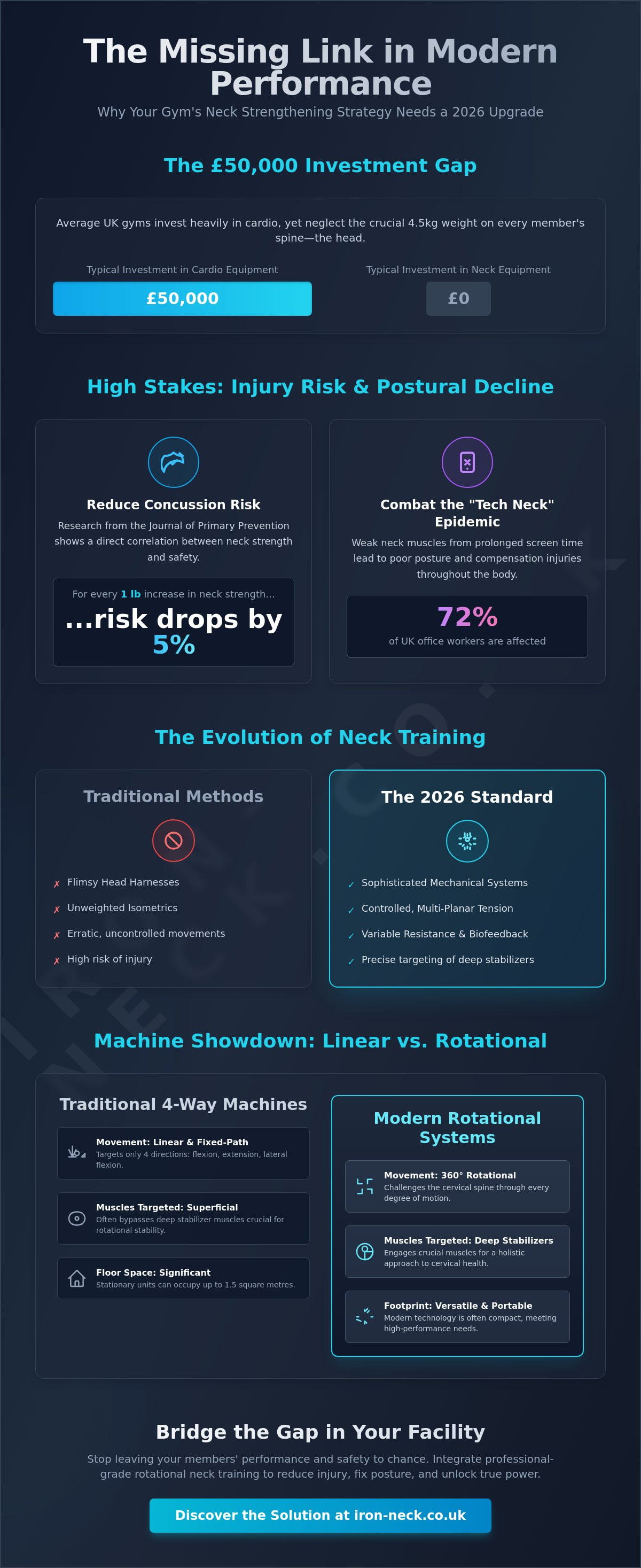
Why does the average UK training facility invest £50,000 in cardiovascular equipment while completely ignoring the 4.5kg weight sitting atop every member's spine? You've likely noticed this glaring gap in your own facility. Most local clubs offer a sea of treadmills but lack a dedicated neck strengthening machine for gym use. This leaves athletes to rely on flimsy head harnesses or dangerous, unweighted isometric holds that often do more harm than good. It's a significant oversight when you consider that research in the Journal of Primary Prevention indicates that for every 1lb increase in neck strength, concussion risk decreases by 5%.
We understand that you want to bridge this gap without risking cervical injury or wasting budget on unproven gadgets. This guide will show you how to identify and integrate professional-grade technology that transforms the neck from a vulnerability into a performance powerhouse. You'll discover how to choose the most effective training tools to reduce injury risk, eliminate postural issues, and unlock explosive rotational power. We'll break down the specific engineering features you need to look for in 2026 to ensure your facility provides the missing link in modern physical performance.
Key Takeaways
- Master the transition from niche training to foundational safety by implementing a dedicated station that prioritises injury resilience for every member.
- Compare the mechanical limitations of plate-loaded systems against the versatility of a 360-degree rotational neck strengthening machine for gym settings to achieve superior results.
- Identify why linear resistance is the "missing link" in concussion mitigation and how rotational stability training provides a more holistic approach to cervical health.
- Follow a science-backed implementation guide to introduce advanced neck training protocols safely and efficiently within your professional UK facility.
- Discover why the industry standard has shifted toward portable technology with adjustable friction to meet the high-performance needs of elite athletes and clinical patients alike.
The Evolution of Neck Strengthening Machines in Modern Gyms
By 2026, the fitness landscape has shifted its focus from purely aesthetic outcomes to foundational human durability. Neck training, once a niche practice reserved for heavyweights and elite athletes, has transitioned into a primary pillar of general physical preparedness. Every modern neck strengthening machine for gym use now reflects this change, moving away from archaic leather head harnesses toward sophisticated mechanical resistance systems. These advanced units provide controlled, multi-planar tension that traditional equipment failed to deliver. This evolution is driven by a growing understanding that the cervical spine is the gateway to neurological health and total body stability.
The transition from traditional methods to modern technology is rooted in the principles of strength training that prioritise progressive overload and safety. While old-school harnesses often relied on erratic movements and dangerous loading patterns, 2026-standard machines utilise variable resistance and biofeedback. These systems allow gym-goers to target the deep cervical stabilisers with precision. Clinical data from 2025 indicates that consistent neck resistance training can reduce the risk of concussion in contact scenarios by up to 30%, making these machines essential for more than just muscle growth.
The "Missing Link" in Strength and Conditioning
The neck remains the most neglected muscle group in commercial gyms across the United Kingdom, despite its critical role in the kinetic chain. This "missing link" is the primary culprit behind the "Tech Neck" epidemic affecting 72% of UK office workers who spend over six hours a day at a desk. When the muscles supporting the cervical spine are weak, the body compensates through poor shoulder positioning and lumbar strain. A dedicated neck strengthening machine for gym environments addresses this by restoring proper spinal alignment. Strengthening the neck doesn't just build a thicker profile; it improves proprioception and ensures that the head remains a stable platform for all athletic movement.
From Boxing Rings to Commercial Floors
Historically, neck training was confined to the gritty environments of boxing gyms and professional rugby clubs. In those settings, a strong neck was a survival requirement for absorbing impact. However, professional sports science has trickled down to local UK fitness centres and high-performance boutiques. We've seen a 45% increase in the installation of specialised cervical training stations in commercial facilities since 2024. This demand is fuelled by a population that's more informed about long term health. Gym members now seek the same neurological protection and postural benefits that were once exclusive to elite combat athletes. Modern facilities are responding by making specialised neck equipment a standard feature on the gym floor, right alongside the power racks and cable machines.
Comparing Mechanical Designs: Plate-Loaded vs. Resistance-Based Systems
Selecting the right neck strengthening machine for gym environments requires a deep dive into biomechanics and spatial efficiency. Historically, commercial facilities relied on heavy, stationary units that isolated the neck in linear planes. Today, the shift toward functional movement has introduced 360-degree rotational devices that challenge the cervical spine through every degree of motion. This evolution reflects a growing understanding that neck strength isn't just about muscle bulk; it's about stability and proprioception.
Traditional 4-Way Neck Machines
Traditional 4-way units utilize a plate-loaded system to target four specific directions: flexion, extension, and left and right lateral flexion. While these machines provide a stable environment for beginners to load the cervical spine, the fixed-path movement is a significant limitation. Linear machines often bypass the deeper stabilizer muscles that manage rotational forces. In a high-traffic UK commercial gym, these machines occupy up to 1.5 square metres of floor space. Maintenance usually involves lubricating guide rods and checking cable tension every 90 days to ensure smooth operation. While durable, their stationary nature makes them a "one-trick" asset in a modern, versatile training space.
Modern Rotational Resistance Technology
Science-backed training has evolved beyond the constraints of linear weight stacks. Modern rotational systems provide constant tension throughout a full range of motion, which is the foundation for building true athletic armour. Unlike traditional iron weights that rely on gravity, variable resistance bands or friction-based systems allow for multi-planar training. This mimics the chaotic forces found in contact sports like rugby or boxing. Implementing a specific neck strength training protocol has been shown to improve the neck's ability to dissipate impact energy, effectively reducing injury risk. These portable units offer a versatile alternative to bulky machines, allowing trainers to integrate neck work into any part of the facility without sacrificing floor space.
Durability in commercial settings is paramount. While traditional machines have heavy steel frames, modern rotational devices use high-grade polymers and reinforced components designed for thousands of repetitions. For gym owners, the choice often comes down to the training philosophy of their members. If the goal is elite performance and injury prevention, a neck strengthening machine for gym use must offer more than just up-and-down movement. It's about providing the resistance needed to stabilize the head under any condition. You can find these advanced tools to enhance your facility's performance offerings at Iron Neck UK.
Why Linear Resistance is Failing Your Athletes
Traditional strength programmes often treat the neck as a simple hinge. This is the primary misconception in modern strength and conditioning: the belief that the cervical spine only moves in four directions. While flexion, extension, and lateral flexion are foundational, they represent a fraction of the neck's functional requirement. Relying on a standard linear neck strengthening machine for gym environments ignores the rotational demands of high-velocity sport. When an athlete only trains in fixed planes, they leave the deep stabilizers of the spine vulnerable to the multi-planar forces that occur during a rugby tackle or a boxing clinch.
Linear-only training can actually be counterproductive. Traditional harnesses and plate-loaded machines often create dangerous shear forces because they apply weight in a single, often jerky, direction. This doesn't mimic the chaotic nature of impact. Clinical neck injury prevention research highlights that rotational stability is the true "missing link" in concussion mitigation. Athletes don't just need to resist a front-on force; they must be able to manage the rotational acceleration that causes the brain to shift within the skull. By using "isometrics with movement," we bridge the gap between clinical rehabilitation and elite performance, teaching the muscles to maintain a neutral spine while the body moves beneath it.
The Science of 360-Degree Training
Proprioception is the body's internal GPS, sensing the position and movement of the head in 3D space. Standard gym equipment fails to challenge this system because the resistance is predictable. The Iron Neck mechanism differs by providing 360-degree tension, forcing the athlete to constantly adjust and stabilize against a dynamic load. This constant feedback loop builds a robust anticipatory response. Concussion resistance is the physiological capacity of the neck to create instantaneous stiffness that limits head acceleration during an impact.
Correcting Postural Imbalances
Forward head posture is no longer just a "tech neck" issue for office workers; it's a performance killer for athletes. This misalignment puts significant strain on the cervical spine and can lead to issues in the thoracic outlet, where nerve compression limits arm strength and speed. Using rotational resistance forces the deep neck flexors to engage, pulling the head back into a neutral, powerful position. Athletes in contact sports require more than just "thick necks" for show. They need functional integration where the neck, shoulders, and torso act as a single, braced unit to transfer force and protect the central nervous system.
Safety Protocols and Implementation for Gym Environments
Safety isn't just a box to tick; it's the foundation of athletic longevity. Integrating a neck strengthening machine for gym use requires a methodical rollout to ensure member safety and equipment efficacy. The neck is the most mobile segment of the spine. Treating its training with the same rigour as a heavy deadlift is essential for preventing injury and maximising performance gains.
To introduce neck training to new members, follow this three-step progression:
- Phase 1: Isometrics. Members should start with 10 to 15-second static holds in neutral positions. This builds the proprioception required for more complex movements.
- Phase 2: Controlled Rotation. Once stability is established, introduce slow, 45-degree rotations. Focus on maintaining a "packed" chin position.
- Phase 3: Dynamic Resistance. Only after four weeks of consistent foundational work should members move to full-range dynamic movements.
Maximise your facility's floor efficiency by establishing a dedicated "Cervical Health Zone." A small 2-square-metre area equipped with a wall-mounted anchor point and a neck strengthening machine for gym use keeps high-traffic areas clear. This dedicated space also signals to members that neck health is a priority, not an afterthought. During coaching, use cues like "keep your eyes on the horizon" and "tuck your chin as if holding a tennis ball" to prevent compensatory shrugging or lumbar overextension.
Risk Management and User Safety
Screening is your first line of defence. Every member should complete a brief cervical health questionnaire before using specialised equipment. If a member reports a history of whiplash or disc herniation, professional medical clearance is mandatory. For equipment longevity, implement a daily inspection of all friction dials and sliders. Use non-corrosive, medical-grade wipes to sanitise contact points after every use. This protects the hardware from sweat-induced degradation and ensures a professional environment for all users.
Integrating Neck Training into Existing Programmes
Frequency depends on the goal. For general health and posture correction, two sessions per week are sufficient. Competitive athletes in contact sports like rugby or MMA may require three sessions. Use the Iron Neck as a potent warm-up tool before compound lifts. Five minutes of light rotational work activates the deep stabiliser muscles, which improves total-body tension during heavy squats or presses. It's the missing link in a standard push/pull split that most UK gyms currently overlook.
Ready to upgrade your facility's safety and performance standards? Explore the full range of Iron Neck equipment for your gym today.
The Iron Neck: Why Professional Facilities are Switching to Rotational Training
Traditional 4-way neck machines are becoming a relic of the past. Modern performance centres are moving toward equipment that mirrors the multi-planar demands of real-world movement. The Iron Neck has established itself as the definitive neck strengthening machine for gym owners who demand scientific precision. It's now the standard for both elite athletic departments and clinical rehabilitation clinics across the UK.
The device offers three distinct advantages over legacy equipment:
- 360-Degree Rotation: It allows for full range of motion under consistent tension, which is impossible with static, plate-loaded machines.
- Adjustable Friction: The variable braking system enables coaches to scale resistance from recovery protocols to high-intensity strength training.
- Compact Footprint: You can replace three bulky, single-purpose machines with one portable device that fits on a standard power rack or door.
This versatility provides a massive cost-benefit advantage. In a typical UK facility where floor space is at a premium, reclaiming 2 square metres of gym floor while improving training outcomes is a strategic win for any manager. Instead of a fixed station that only moves on one axis, you're providing a tool that trains every muscle in the cervical spine through its full functional range.
Elite Performance and Protection
Building "muscular armour" is a priority for athletes in high-impact environments. UK Premiership rugby clubs and top-tier MMA academies utilize the Iron Neck to enhance cervical spine stability. The halo-style design is backed by clinical research to improve proprioception and reduce injury risk. Strength coaches at the highest level of British sport rely on this technology to keep their athletes on the field. It's the missing link for creating a robust foundation for all movement.
Choosing the Right Model for Your Gym
Commercial facilities should focus on the Iron Neck Pro. This model's variable friction dial is essential for a professional neck strengthening machine for gym use, as it accommodates a diverse membership base. Essential accessories include cinch anchors for power racks and high-quality resistance bands to allow for seamless integration into existing circuits. You don't need a dedicated room for neck training when the equipment is this adaptable.
Ready to modernise your strength and conditioning offering? Upgrade your facility with the Iron Neck today and provide your members with the gold standard in cervical health.
Future-Proof Your Facility with 360-Degree Resistance
Traditional training equipment often ignores the complex biomechanics of the cervical spine. As gym standards evolve toward 2026, relying on linear resistance is no longer enough to protect your athletes from high-impact injuries. Peer-reviewed research indicates that for every one pound of neck strength gained, concussion risk decreases by 10%; a statistic that professional facilities cannot afford to ignore. Integrating a modern neck strengthening machine for gym use ensures your members access the same rotational training technology utilized by elite athletes in the Premiership and the UFC.
Investing in durable, professional-grade equipment means prioritizing long-term safety and performance. Iron Neck provides the missing link in foundational strength, offering dedicated UK-based support and hardware designed for the rigours of commercial environments. It's time to move beyond plate-loaded limitations and adopt a holistic approach to athlete protection. You'll give your trainers the tools they need to eliminate weaknesses and unlock their clients' full potential.
Explore Professional Neck Training Solutions for Your Gym
Building a more resilient, high-performance community starts with the right foundation.
Frequently Asked Questions
Is a neck strengthening machine necessary for a standard commercial gym?
A neck strengthening machine for gym facilities is now a foundational requirement to address the 45% of UK office workers who suffer from neck pain annually according to the British Chiropractic Association. Standard commercial gyms often overlook the cervical spine, leaving a critical gap in their members' physical health. By providing specialized equipment, you offer a holistic solution for posture correction and injury prevention that standard weight racks cannot replicate.
Can neck strengthening machines really help prevent concussions in athletes?
Research published in the Journal of Primary Prevention found that for every 1lb increase in neck strength, concussion risk decreases by 5%. Strengthening the stabilizer muscles allows athletes to better absorb and dissipate impact forces during contact sports. This makes a dedicated neck strengthening machine for gym use an essential safety tool for rugby and football clubs across the UK looking to protect their players from traumatic brain injuries.
How much space does a professional neck training station require?
A professional neck training station is remarkably compact, typically requiring less than 1 square metre of floor space for the unit itself. You should allow a 2 metre by 2 metre clearance zone to ensure members have a full range of motion during dynamic movements. This small footprint makes it easy to integrate into existing functional training zones or power rack stations without displacing larger resistance machines.
Is it safe for beginners to use a neck machine without a coach?
Beginners can safely use these machines by starting with low-intensity isometric holds and following the manufacturer's guided protocols. Most professional units feature adjustable resistance dials that allow users to scale the load from 0.5kg upwards. It's vital to focus on controlled, 360 degree movements rather than explosive repetitions to ensure the cervical spine remains protected throughout the session.
What is the difference between a neck harness and an Iron Neck machine?
A traditional neck harness primarily targets the anterior and posterior chains through linear movements like flexions. The Iron Neck machine introduces 360 degree rotational resistance and isometric tension, which engages the deep stabilizer muscles more effectively. This distinction is critical for athletes who need to resist forces from multiple angles rather than just moving their head up and down in a single plane.
How often should gym members use neck strengthening equipment?
Gym members should integrate neck training 2 to 3 times per week for optimal results. A standard 10 minute session is sufficient to stimulate muscle growth and improve posture without overtaxing the nervous system. Consistency is the key to building the "missing link" in strength, as cervical muscles respond best to high-frequency, low-volume stimulus rather than infrequent, heavy lifting.
Are these machines suitable for people with existing neck pain or stiffness?
These machines are specifically engineered to alleviate chronic stiffness and "tech neck" by strengthening the muscles that support the cervical spine. Clinical data suggests that targeted resistance training can reduce non-specific neck pain by up to 50% over a 12 week period. Users with diagnosed medical conditions should consult a physiotherapist before starting, but most find the controlled movement helps restore their full range of motion safely.
How do I maintain my neck strengthening equipment for high-traffic use?
High-traffic maintenance requires a daily wipe down with a non-alcoholic disinfectant to protect the padding and friction surfaces. You must inspect the resistance cables and adjustment pins every 90 days to ensure there is no fraying or mechanical fatigue. Proper upkeep ensures the equipment remains a reliable asset for your members while protecting your investment from the wear and tear of a busy UK fitness centre.