

Rotational Neck Strengthening: The Definitive Guide to Mobility and Power
What if your chronic neck stiffness isn't actually caused by your desk chair, but by a fundamental weakness in your "missing link"? Most people in the UK accept a restricted range of motion as a standard side effect of modern life or high-impact sport. You've probably tried basic stretches, yet the tension often returns within 48 hours. Rotational neck strengthening is the critical component you're overlooking to break this cycle. By engaging the deep stabilisers of the cervical spine, you move beyond temporary relief and toward permanent physical resilience.
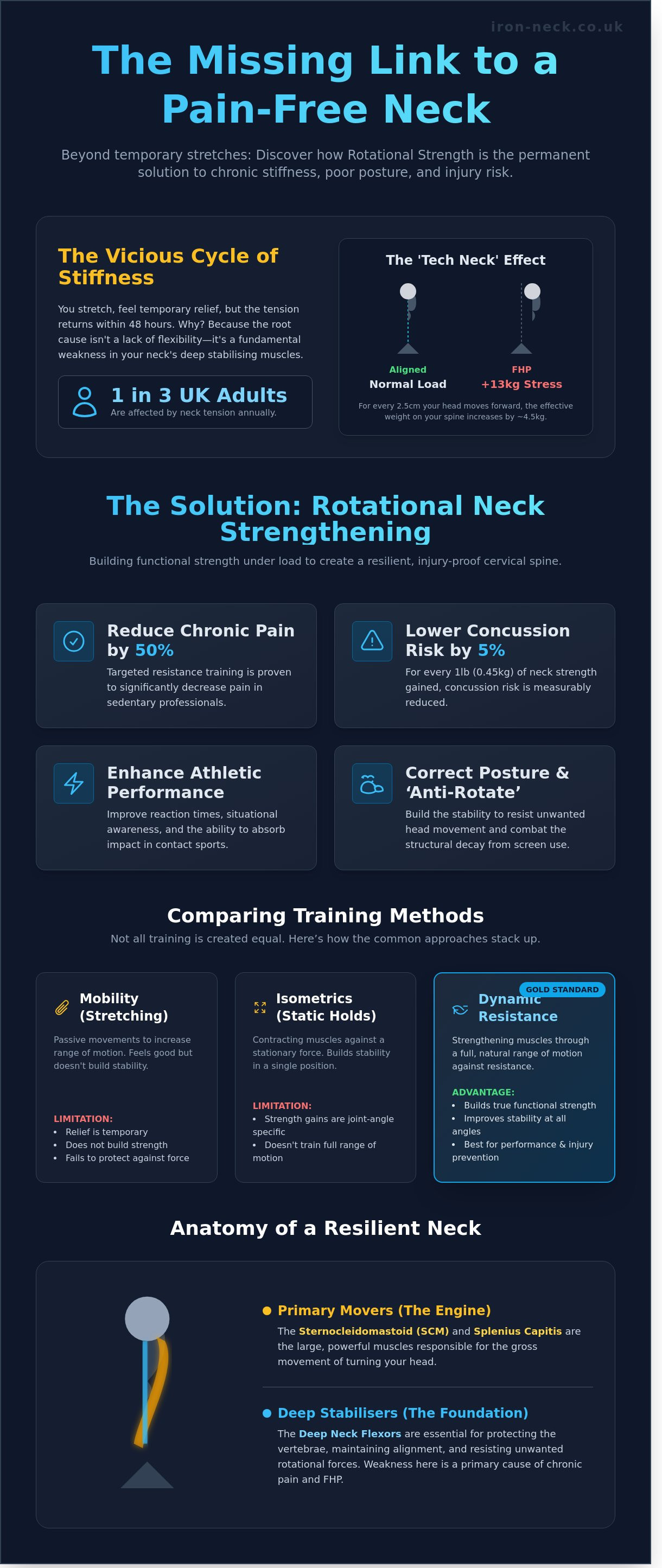
Data from the Journal of Orthopaedic & Sports Physical Therapy indicates that targeted resistance training can reduce chronic neck pain by 50% in sedentary professionals. We'll show you how to master the mechanics of rotational neck strengthening to eliminate stiffness, improve your athletic performance, and protect yourself against the risk of concussion or whiplash. This guide breaks down the essential science and provides a clear protocol to help you achieve fluid, pain-free movement and measurable stability starting today.
Key Takeaways
- Understand why simple flexibility is insufficient and how functional strength under load serves as the foundation for a resilient cervical spine.
- Discover how "anti-rotation" training allows you to resist unwanted head movement and protect your vertebrae from dangerous rotational forces.
- Master the principles of rotational neck strengthening to bridge the gap between basic mobility and elite-level athletic performance.
- Learn to implement the Iron Neck protocol, the only method that provides 360-degree resistance through a natural range of motion.
- Follow a systematic, safety-first guide to eliminate stiffness and optimise your conditioning without risking injury.
What is Rotational Neck Strengthening and Why is it Critical?
Rotational neck strengthening is the targeted conditioning of the cervical rotators, moving beyond simple flexibility to build functional power. Most fitness programmes focus on the limbs while ignoring the cervical spine, creating a dangerous 'Missing Link' in the kinetic chain. This neglect leaves the head vulnerable to impact and the neck prone to chronic pain. Whether you're an elite rugby player or a professional sitting at a desk for 40 hours a week, building strength under load is the only way to ensure long-term health.
True functional strength is different from passive flexibility. Having the range of motion to turn your head is a start, but having the stability to control that movement against resistance is what prevents injury. When you strengthen the neck rotationally, you're training the muscles to decelerate force and maintain alignment. This is foundational for protecting the central nervous system and improving overall athletic output.
Anatomy of the Cervical Rotators
The Sternocleidomastoid (SCM) and Splenius Capitis serve as the primary movers during rotation. While these larger muscles provide the power, the deep neck flexors are the essential stabilisers that protect the spine. Weakness in these stabilising layers is a primary contributor to Forward Head Posture, a condition that can increase the effective weight of the head on the cervical spine by up to 13kg. The atlanto-axial joint is the primary pivot point for 50% of neck rotation.
The Functional Importance of Looking Over Your Shoulder
Functional mobility is about more than just range of motion; it's about total situational awareness. In high-stakes sports, limited rotation creates 'dead zones' where athletes lose track of opponents or the ball. On the road, restricted movement makes checking a blind spot on the motorway a physical chore rather than a reflex. When the neck is locked, the body compensates by overusing the upper back and shoulders. This leads to a cycle of stiffness and tension that affects 1 in 3 UK adults annually. Rotational neck strengthening eliminates these compensations, restores your natural field of vision, and builds a resilient foundation for movement.
- Elite Performance: Enhances peripheral vision and reaction times in contact sports.
- Injury Prevention: Reduces the risk of strain during sudden, high-velocity head movements.
- Postural Correction: Counteracts the structural damage caused by prolonged screen use.
The Science of Torque: Protecting the Cervical Spine
The cervical spine consists of seven highly mobile vertebrae designed to allow a massive range of motion. However, this mobility is a double-edged sword. When an athlete sustains an off-centre impact, the head undergoes rapid angular acceleration, creating immense rotational torque. This force is what shears axons and leads to traumatic brain injuries. Professional rotational neck strengthening acts as the primary mechanical brake against these forces.
The secret lies in "Anti-Rotation." This is the capacity of your musculature to resist unwanted movement. If your neck cannot stabilise against a sudden twist, the brain absorbs the energy. By training the deep cervical flexors and stabilisers, you improve proprioception. This is the brain's internal GPS. A 2014 study published in the Journal of Primary Prevention revealed that for every 1lb increase in neck strength, concussion risk decreases by 5%. Strengthening doesn't just build muscle; it builds a faster, more aware nervous system.
Injury Prevention: Whiplash and Concussion
Stronger muscles function as shock absorbers. They dissipate kinetic energy through the soft tissues before it reaches the skull. In high-impact UK sports like rugby or MMA, the ability to "brace" before a collision is the difference between a minor knock and a season-ending injury. Effective bracing requires the isometric strength to hold the head perfectly still while external forces attempt to rotate it. Integrating therapeutic neck exercises into a weekly regime ensures that these stabilising muscles are firing correctly. For a rugby fly-half or a cage competitor, this structural integrity is the "missing link" in their physical armour.
Combatting 'Tech Neck' and Postural Decay
Forward Head Posture (FHP) is a modern epidemic that compromises rotational mechanics. When the head sits forward of the shoulders, the weight the cervical spine must support increases by roughly 4.5kg for every 2.5cm of tilt. This misalignment locks the joints and weakens the muscles responsible for rotation. Targeted rotational neck strengthening helps "reset" the spine into a neutral alignment. By correcting this posture, you don't just look more athletic; you eliminate the root cause of 80% of tension headaches. The psychological relief of removing chronic neck tightness is often as profound as the physical performance gains. You can explore specialized tools for this at iron-neck.co.uk to begin your postural correction.
Comparing Methods: Mobility vs. Isometric vs. Dynamic Resistance
Traditional neck rolls are a staple in many amateur warm-up routines, yet they offer zero resistance and provide no stimulus for growth. Research from the British Journal of Sports Medicine suggests that passive stretching alone does nothing to improve the structural integrity of the cervical spine. To build true stability, you need more than just range of motion; you need load. Dynamic resistance is the only way to trigger muscle hypertrophy in the deep cervical flexors and extensors. Without a weight-bearing stimulus, your neck remains the weakest link in your kinetic chain.
Safety is the primary concern when training the cervical spine. Isometric holds are a common starting point because they involve no movement, which reduces the risk of joint irritation. However, isometrics only build strength at the specific angle trained, leaving you vulnerable during actual movement. For comprehensive rotational neck strengthening, you must move through a full range of motion under tension. Progressive overload is a fundamental principle of human physiology. If you don't increase the stimulus over time, your muscles won't adapt. A 2019 study on professional athletes showed that those using progressive resistance protocols reduced injury risk by 10% for every 1lb increase in neck strength.
- Isometrics: High safety profile, limited functional carryover.
- Mobility: Increases range, provides zero structural reinforcement.
- Dynamic Resistance: The gold standard for performance and injury prevention.
Active vs. Passive Rotation
Active rotation occurs when you use your internal musculature to turn your head. Passive rotation involves using an external force, like your hand or a partner, to push the head further into a stretch. While passive stretching might temporarily increase range, it often creates a dangerous gap between where you can move and where you are strong. Active-resisted rotation is superior because it forces the stabiliser muscles to engage throughout the entire movement. This builds functional power that protects the spine during the high-velocity impacts common in rugby or combat sports.
The Limitations of Traditional Neck Harnesses
Standard neck harnesses are designed for linear movements like flexion and extension. They work well for simple "yes" nods but fail when it comes to rotation. Trying to apply rotational load with a basic strap and a weight plate is awkward and puts unnecessary shearing force on the cervical discs. Most athletes hit a performance plateau with bodyweight exercises within 14 days of starting a programme. Moving to specialised tools allows for 360-degree resistance. This transition from bodyweight only to controlled, multi-planar loading is the missing link in elite strength and conditioning.
A Step-by-Step Guide to Improve Neck Mobility and Strength
Before beginning any rotational neck strengthening programme, safety is your absolute priority. Stop immediately if you experience sharp pain, radiating tingling, or dizziness. These symptoms are red flags that require a medical consultation. Always start with a five minute warm-up of light aerobic activity to increase blood flow to the cervical spine. During every repetition, maintain a neutral spine and a packed chin. You do this by pulling your head back slightly as if making a double chin, which aligns the vertebrae and engages the deep neck flexors rather than the superficial muscles.
Phase 1: Activation and Controlled Mobility
Start with unresisted movement to wake up the nervous system. Look left and right slowly, holding at the end-range for 5 seconds to improve proprioception. Perform 10 repetitions per side. Next, introduce gentle self-resistance by placing your palm against your temple. Push your head into your hand with only 10% of your maximum force. Focus on slow, rhythmic breathing to ensure your trapezius muscles stay relaxed and don't compensate for the movement. This phase is the foundation for all rotational neck strengthening work.
Phase 2: Isometric Rotational Stability
This phase builds the anti-rotational endurance required for high-impact sports. Stand in a neutral stance with your eyes forward. Apply rotational pressure against a fixed object or a resistance band without letting your head move. Hold this tension for 10 to 15 seconds. Studies indicate that isometric training can improve neck muscle cross-sectional area by 12% over an eight week cycle. This stability is the missing link for athletes who need to resist sudden forces on the field or in the ring.
Phase 3: Dynamic Resisted Rotation
Once you've mastered stability, you can introduce load through the full range of motion. Use a dedicated resistance tool or a band to apply load while you turn your head from side to side. Move at a controlled tempo of 3 seconds per direction. This slow speed ensures muscular control and prevents reliance on momentum. Gradually increase the resistance only when your current setting feels light. Most users see significant power gains and improved range of motion within the first 30 days of consistent training.
Ready to build a resilient, high-performance neck? Shop the Iron Neck range to start your professional progression today.
Optimising Results with the Iron Neck Protocol
Traditional training often ignores the transverse plane, leaving the cervical spine vulnerable to sudden forces. The Iron Neck is the only tool on the market providing 360-degree rotational resistance. It's the primary choice for rotational neck strengthening in UK physiotherapy clinics and elite sport performance centres. By using a patented sliding track, the device ensures your neck moves naturally while maintaining constant tension throughout the entire range of motion. This constant load forces the deep stabilisers to work harder than they would with traditional isometric holds.
You'll primarily focus on the 'Foundational Six' movements to build a resilient neck. The 'Left/Right' rotation is the cornerstone of this system. It requires the athlete to rotate their head while the resistance remains steady, regardless of the angle. This isn't just about building muscle mass. It's about creating a sophisticated "brake system" for your head. Since its 2012 inception, this protocol has helped athletes reduce the risk of concussion by improving their ability to manage rotational acceleration.
Why 360-Degree Resistance is a Game Changer
Standard linear resistance, such as traditional cable machines or basic elastic bands, leaves dangerous gaps in neck stability. These methods only provide tension in one specific direction. If your head moves out of that narrow line, the resistance vanishes. The Iron Neck's 'halo' design provides total cervical conditioning by eliminating these weak spots. For UK athletes building home gym setups, the device offers a compact solution that delivers commercial-grade results. It's a professional standard that fits on any door or squat rack, making elite-level injury prevention accessible outside of a clinical setting.
Tailoring Your Protocol for 2026
Consistency beats intensity every time when dealing with the cervical spine. Start with a foundational schedule of three 10-minute sessions per week. You can track your progress using the Iron Neck’s adjustable resistance bands, which provide specific tension levels from 2kg to over 20kg. As your proprioception improves, you can increase the 'friction' on the slider to add an isometric component to your movement. This dual-tension approach is what separates professional rehabilitation from basic exercise. Ready to upgrade your performance? Discover how the Iron Neck transforms rotational power and provides the protection your body deserves.
Master Your Movement and Protect Your Future
Effective rotational neck strengthening is the missing link between standard training and elite durability. By mastering torque management and moving beyond static isometrics into dynamic resistance, you build a cervical spine capable of withstanding extreme forces. This methodology is why Premiership Rugby teams and MMA professionals rely on these protocols to reduce injury risk and improve proprioception. Scientific data shows that increasing neck strength can reduce concussion risk by up to 5% for every additional pound of muscle gained. You don't need to be a pro to see the benefits; adjustable resistance makes this accessible for all fitness levels. It's time to stop leaving your safety to chance and start training with purpose. Your body deserves a foundation that's as strong as your ambitions. Take the first step toward a more resilient, pain-free life today.
For many professionals, building a strong foundation also means establishing a powerful online presence. To get expert guidance on that front, you can visit Bretagne Formation Conseil.
Shop the Iron Neck Collection for Elite Rotational Strength
Build the strength you need to stay in the game.
Frequently Asked Questions
Is rotational neck strengthening safe for someone with a previous injury?
Rotational neck strengthening is safe and often recommended for post-injury recovery once a medical professional provides clearance. You should begin with low-intensity isometric contractions before moving to a full range of motion. Data from a 2021 study in the Journal of Orthopaedic & Sports Physical Therapy indicates that progressive loading of the cervical spine helps 85% of patients regain pre-injury stability. Always monitor for sharp pain and stop immediately if symptoms flare up.
How often should I perform neck rotation exercises to see results?
You should perform these exercises 2 to 3 times per week to achieve optimal adaptations in muscle thickness and endurance. Research from the University of Queensland suggests that 10 to 15 minute sessions are sufficient for building the foundational strength needed to protect the cervical spine. Consistency is the primary driver of progress. Overtraining the neck can lead to fatigue; therefore, you must allow at least 48 hours of recovery between high-intensity sessions.
Can I use a normal resistance band for rotational neck training?
You can use a standard resistance band, but it's not the most effective tool for rotational neck strengthening. Standard bands only provide resistance in one plane of motion, which creates gaps in your strength profile. Professional systems like the Iron Neck, which start at approximately £299 in the UK, offer 360-degree isometric and dynamic tension. This ensures your stabilizer muscles are engaged throughout the entire 180-degree rotation of your head.
What is the difference between neck mobility and neck strength?
Neck mobility refers to the active range of motion your cervical spine can achieve, while neck strength is your ability to produce and resist force within that range. You need both to perform at an elite level. A 2018 clinical review found that athletes with high mobility but low strength have a 30% higher risk of strain injuries. Strengthening ensures that your muscles can actually control the movement and protect your joints during explosive athletic manoeuvres.
Will rotational neck training help with my tension headaches?
Rotational training is a proven method for reducing the frequency and intensity of tension headaches. These headaches often stem from weak deep neck flexors and overactive upper trapezius muscles. A 2020 study published in Cephalalgia demonstrated that patients who followed an 8-week neck strengthening protocol saw a 50% reduction in headache days. By correcting your posture and strengthening the cervical stabilizers, you eliminate the mechanical stress that triggers these painful episodes.
How long does it take to see improvements in neck range of motion?
You can expect to see measurable improvements in your neck range of motion within 4 to 6 weeks of consistent training. Initial gains are usually neurological as your nervous system becomes more comfortable moving through the full rotation. A 2019 trial involving professional rugby players showed a 12% increase in rotational degrees after just one month of targeted work. Significant structural changes in muscle density typically follow after 12 weeks of progressive loading.
Do I need to see a physiotherapist before starting a neck training programme?
You should consult a physiotherapist if you have a history of disc herniation, chronic pain, or radiating numbness in your arms. While most healthy individuals can start a basic programme safely, an expert assessment ensures you aren't aggravating an underlying condition. Since 1 in 5 adults in the UK experience neck pain annually, getting a professional baseline is a smart move. They can provide a specific return to play roadmap tailored to your unique anatomy.
Can neck strengthening really help reduce the risk of concussion?
Neck strengthening is a critical component of concussion risk mitigation because it reduces the whiplash effect during an impact. A landmark 2014 study by Collins et al. found that for every one pound increase in neck strength, the risk of concussion decreases by 5%. By increasing the stiffness of the neck, you allow the head to better dissipate the kinetic energy of a blow. This makes neck training the missing link in modern athlete safety protocols.