

Neck Training Benefits and Risks: The Expert Guide to Performance and Protection
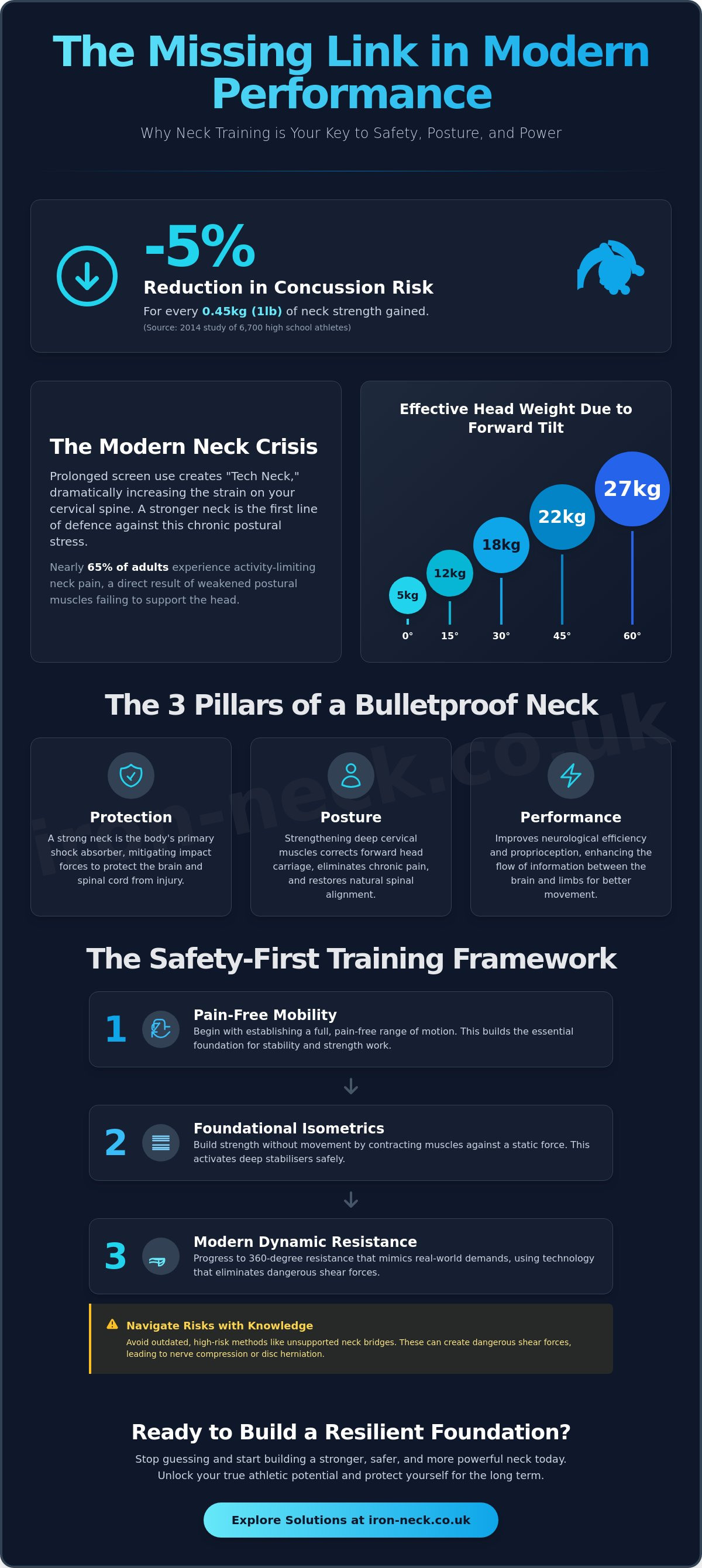
Did you know that for every 0.45kg increase in neck strength, your risk of concussion drops by 5%? This data, derived from a landmark 2014 study involving 6,700 high school athletes, highlights why the cervical spine is the true missing link in modern performance. You've likely felt the nagging stiffness of tech neck after a long day or felt a flash of anxiety about potential disc injuries when considering contact sports. It's natural to feel cautious when the stakes involve your spinal cord and cognitive health.
We understand that you want the protection of a stronger neck without the gamble of outdated, high-risk methods. This guide clarifies the neck training benefits and risks so you can stop guessing and start building a resilient foundation. You'll learn exactly how targeted resistance training mitigates impact forces and why scientific protocols are the only way to ensure long-term safety. We're going to break down the anatomy of a bulletproof neck and provide a methodical approach to elite cervical health that eliminates pain and maximises your athletic potential.
Key Takeaways
- Understand why the cervical spine is the "missing link" in athletic performance and how a strong neck serves as the foundational bridge between your brain and body.
- Discover the science-backed role of neck strength in concussion mitigation by effectively absorbing linear and rotational kinetic energy during impact.
- Navigate the biomechanical reality of neck training benefits and risks to move beyond outdated, "sketchy" methods and protect against nerve compression or disc herniation.
- Learn a safety-first framework for building resilience, starting with pain-free mobility and foundational isometrics to stabilise the cervical spine.
- See how modern halo-design engineering eliminates dangerous shear forces while providing customisable resistance for elite performance and postural correction.
The Missing Link: Why Neck Training is No Longer Optional
Neck training is the systematic application of resistance to the muscles surrounding the cervical spine. It's far more than an aesthetic pursuit for bodybuilders. Your neck acts as the critical bridge between the brain and the rest of the body, serving as the conduit for every neurological signal that dictates movement. In 2026, we've reached a 'Modern Neck Crisis' where sedentary lifestyles and 'tech neck' have weakened our collective structural integrity. For the modern athlete or office professional, understanding neck training benefits and risks is the first step toward reclaiming physical resilience.
Recent data from UK health surveys indicates that nearly 65% of adults will experience neck pain that limits their daily activities. This isn't just a result of poor posture; it's a failure of the neck to support the head's weight during hours of screen time. For those in contact sports, the stakes are even higher. Neck strength is now a foundational pillar for both longevity and elite performance, acting as the primary shock absorber for the skull. By prioritising these protocols, you can balance the neck training benefits and risks to build a body that's truly resilient.
The Anatomy of the Cervical Spine
The neck's architecture is a sophisticated blend of deep cervical flexors and superficial stabilisers. While the larger muscles like the trapezius are visible, the deep flexors provide the essential stability required to protect the spinal cord. These muscles are also densely packed with sensory receptors that govern proprioception, which is your body's ability to sense its position in space. The trunk-neck-head coupling mechanism ensures that force is distributed safely across the entire kinetic chain during movement.
From Rehab to Performance
Neck training has transitioned from physiotherapy clinics to elite rugby and MMA gyms across the UK. The industry has moved away from building "thick necks" for aesthetics to developing "stable necks" for functionality. Pioneers like Iron Neck have driven this shift by offering 360-degree resistance that mimics real-world athletic demands. While training is vital, athletes must avoid the risks of neck manipulation when performed without clinical supervision.
- Structural Integrity: Supporting the 4-5kg weight of the human head against gravity.
- Injury Mitigation: Reducing the acceleration of the head during sudden impact or falls.
- Neurological Efficiency: Improving the flow of information between the central nervous system and the limbs.
- Postural Correction: Reversing the "forward head carriage" caused by prolonged smartphone and laptop use.
The Core Benefits: Protection, Posture, and Performance
Neck training is the missing link in most strength and conditioning programmes. If you aren't training your cervical spine, you're leaving both safety and performance on the table. Understanding the balance of neck training benefits and risks begins with recognising the neck as the most critical bridge in the human body. It isn't just about aesthetics; it's about creating a robust foundation for every movement you make.
Reducing Concussion and TBI Risk
In contact sports, a strong neck acts as a seatbelt for the brain. Scientific data from the Journal of Primary Prevention indicates that for every 1lb increase in neck strength, concussion risk decreases by 5%. This protection occurs because a reinforced neck absorbs linear kinetic energy and resists the rotational "slosh" of the brain within the skull. By increasing cervical stiffness, athletes can decelerate the head more effectively during impact, providing a vital layer of protection against traumatic brain injuries.
Eliminating Tech Neck and Improving Posture
The average human head weighs approximately 5kg in a neutral position. However, when you lean forward to check a phone or type at a desk, the effective weight on your spine can spike to 27kg. This forward head posture leads to chronic kyphosis and intense tension in the trapezius muscles. Strengthening the posterior chain of the neck helps pull the skull back into its natural alignment. For those looking to correct these imbalances, incorporating easy neck strengthening exercises into a daily routine can alleviate modern postural stress. Beyond the physical relief, better posture is clinically linked to improved hormone profiles and increased confidence.
Athletic Power and Rotational Stability
Power is generated in the lower body, but it must be transferred through the core and neck to reach its final destination. A weak neck creates a "leak" in this kinetic chain, causing force to dissipate during explosive movements like sprinting, jumping, or striking. Athletes must also maintain visual tracking while moving at high speeds, which requires extreme multi-directional stability. Using The Iron Neck Device allows for 360-degree resistance training, ensuring the stabiliser muscles are strong enough to keep the head steady and the eyes on the target. This level of control is essential for staying on the ball and reacting to opponents in fast-paced environments.
Finally, a comprehensive look at neck training benefits and risks must address chronic pain management. Strengthening the deep neck flexors reduces the frequency of tension-type headaches and general stiffness. When these muscles are weak, the larger superficial muscles overcompensate, leading to the "tight" feeling many office workers experience. Building a foundation of strength through targeted resistance solves the problem at its source, rather than just masking the symptoms.
Navigating the Risks: Myth vs. Biomechanical Reality
Traditional methods like the wrestler’s bridge have given neck work a "sketchy" reputation. These exercises often force the cervical spine into extreme hyperextension while supporting the entire body’s weight. This creates massive compression on the posterior elements of the vertebrae. The biomechanical reality is that your neck isn't designed to be a primary weight-bearing pillar in compromised, end-range positions. Real risks include disc herniation and ligamentous strain when load exceeds the tissue’s structural integrity. Understanding neck training benefits and risks is the first step toward building a resilient body that can withstand high-impact forces.
Ego lifting is particularly dangerous in this context. Heavy linear loading, such as using a head harness with excessive plates, often leads to compensation. You’ll see athletes shrugging their shoulders or using momentum to move the weight. This bypasses the deep stabilisers and places the stress on the superficial muscles. The primary risk factor, however, is shear force. This occurs when you introduce uncontrolled rotation under load. Without proper stabilisation, these forces can cause micro-trauma to the facet joints and spinal discs. This is the missing link in most strength programmes; athletes train for power but ignore the underlying structural safety required to support it.
Common Training Mistakes and Pitfalls
Many athletes fail because they prioritise intensity over intent. Using momentum instead of controlled muscle activation turns a precision exercise into a gamble. You must engage the deep cervical flexors rather than just the traps. Over-training the superficial muscles creates an imbalance that pulls the head forward. If you hear "clicking" or "grinding" during movement, stop. These signals often indicate joint instability or soft tissue interference that requires professional assessment. Ignoring these warning signs leads to chronic inflammation and long-term joint wear.
Nerve Impingement and Disc Health
Improper loading frequently leads to radiculopathy, which is shooting pain or numbness travelling down the arm. This happens when a disc or bone spur impinges on a nerve root. Maintaining a neutral spine is the foundation of safety. While research on neck training for pain relief shows that targeted resistance is beneficial, more is not always better. High volume in the cervical region can lead to chronic fatigue of the support structures. Focus on quality repetitions that reinforce postural alignment. Elite performance requires a stable foundation, not just a bigger neck size. Balance your neck training benefits and risks by prioritising controlled, eccentric movements over raw weight.
The Safety-First Framework: How to Train Your Neck Correctly
Understanding neck training benefits and risks requires a methodical approach that prioritises structural integrity over raw power. You can't treat the cervical spine like a bicep; it's a complex system of 20+ muscles designed for stability and precise movement. Before adding any weight, you must establish a baseline of pain-free mobility. If you can't move your chin to your collarbone or look over your shoulder without discomfort, you aren't ready for resistance. Start by testing your range of motion in all planes to ensure there are no underlying mechanical blocks.
The Power of Isometrics
Isometrics are the safest entry point for beginners because they build foundational stability without the shearing forces of repetitive movement. We define isostatic tension as the foundation of cervical health, providing the necessary stability before dynamic loading begins. To perform a "4-way" isometric hold, use your hand or a wall to provide gentle resistance against the front, back, and sides of your head. Hold each position for 10 to 15 seconds. This method is exceptionally effective for rehab patients as it activates the deep neck flexors without risking joint irritation. It teaches the brain how to recruit stabilizer muscles effectively.
Moving to 360-Degree Resistance
Traditional neck harnesses often limit athletes to linear "up and down" movements, which fails to prepare the body for real-world impacts. In sports or daily life, forces rarely come from a single direction. To fully realize neck training benefits and risks, you must train in 360 degrees. This includes flexion, extension, lateral flexion, and rotation. A critical concept here is "Centration," which involves keeping the head perfectly aligned over the shoulders. By maintaining centration during rotational movements, you ensure the load is distributed across the musculature rather than the intervertebral discs. This mirrors the multi-directional demands of contact sports and reduces the risk of strain.
Loading, Tempo, and Recovery
Progressive overload in neck training isn't just about adding more kilograms. It's about increasing time-under-tension (TUT) and improving control. 2-3 sessions per week is the sweet spot for most individuals, allowing 48 hours for the delicate tissues of the cervical spine to recover. Focus on slow eccentrics, taking 3 to 4 seconds to return to the neutral position. This deliberate tempo builds tendon resilience and improves proprioception. For those ready to progress, you can explore more Advanced Neck Strength Training Protocols to further enhance your performance.
Ready to build a stronger, more resilient neck with the world's leading equipment? Shop the Iron Neck collection today.
The Iron Neck Solution: Modern Engineering for Cervical Health
Traditional training methods often fail because they ignore the mechanical complexity of the cervical spine. The Iron Neck solves the "Shear Force" problem through its patented halo design. Unlike static weights that pull the head into precarious positions, this system creates a 360-degree field of tension. It allows you to strengthen the deep neck flexors and stabilizers without the vertical compression that typically causes discomfort. It's the 2026 standard for performance because it treats the neck as a three-dimensional pivot point rather than a simple hinge.
The Friction Dial is the core of this modern engineering. It lets you customise rotational resistance, meaning you can scale from gentle rehabilitation to elite athletic output. High-impact athletes use this to build the "missing link" in concussion prevention. Data indicates that for every 1lb increase in neck strength, concussion risk decreases by 5%. By training against rotation, you're building the specific decelerative capacity needed to survive a collision. Understanding neck training benefits and risks starts with recognizing that linear strength isn't enough; you need rotational stability to truly protect the brain.
Iron Neck vs. Traditional Harnesses
Traditional harnesses focus on linear loading. They move up and down or side to side. This is useful for basic hypertrophy, but it's fundamentally limited. The Iron Neck enables rotational work that harnesses can't touch. For those with previous disc issues, the Iron Neck is often a safer alternative because it distributes load across the entire cervical range rather than concentrating force on a single vertebrae. If you're just starting your journey, the Alpha Head Harness provides a budget-friendly entry point for linear work, but it doesn't offer the 360-degree capability of the halo system.
Getting Started with Iron Neck UK
Choosing the right model depends on your specific goals. The Iron Neck Pro is the gold standard for clinical settings and professional athletes, featuring the most adjustable friction dial for precise tension control. The Starter model offers a streamlined experience for those focusing on posture and general health. Both systems rely on Iron Neck Resistance Bands to provide scalable, progressive tension. Whether you're a rugby player in the Premiership or a desk worker in London, these tools allow you to manage neck training benefits and risks with professional precision.
Ready to upgrade your resilience? Explore the full Iron Neck range and protect your future.
Secure Your Foundation: The Future of Cervical Performance
Neglecting the cervical spine is no longer an option for those serious about longevity. Understanding neck training benefits and risks is the first step toward building a resilient body that resists injury and maintains perfect posture. You've seen the data; proper resistance training doesn't just build muscle. It creates a protective shield for your brain and nervous system. By prioritizing biomechanical safety and using controlled, rotational movements, you're addressing the missing link in your athletic profile.
The Iron Neck isn't a casual accessory. It's a professional-grade tool utilized by 100+ NFL, NBA, and UFC teams to reduce injury risk and fix chronic postural issues. Leading UK physiotherapists and strength coaches advocate for this system because our 360-degree rotational resistance technology provides the only way to strengthen the neck through its entire range of motion safely. You don't have to settle for stiffness or vulnerability. Take control of your performance today and move with total confidence.
Invest in your protection—Shop the Iron Neck Collection
Frequently Asked Questions
Is neck training safe for someone with a history of neck pain?
Targeted neck training is often the missing link for those recovering from chronic discomfort. A 2020 study in the Journal of Orthopaedic & Sports Physical Therapy found that specific resistance exercises reduced chronic neck pain by 75% in participants. You must start with low-intensity isometrics to stabilise the cervical spine before progressing to dynamic movements. Consulting a UK-registered physiotherapist ensures your programme addresses your specific structural needs safely.
Can neck training actually prevent concussions in contact sports?
Stronger neck muscles significantly reduce the acceleration of the head during an impact, which is a primary cause of brain injury. Research published by Collins et al. in 2014 demonstrated that for every 1lb increase in neck strength, concussion risk decreases by 5%. Understanding the neck training benefits and risks is vital for athletes in rugby or MMA who face high-velocity collisions. It's about building a robust foundation to absorb and dissipate force.
How long does it take to see results from a neck strengthening programme?
Most athletes experience improved stability and neural drive within 2 to 4 weeks of consistent training. For visible muscle hypertrophy and significant force-production gains, a 12-week protocol is typically required. Data from the University of Exeter indicates that performing specific exercises twice weekly leads to measurable strength increases of 15% after 6 weeks. Consistency is the key to unlocking these performance gains and ensuring long-term protection.
Will neck training make my neck look bulky or thick?
Hypertrophy depends entirely on your specific training volume and nutritional intake. While some athletes aim for a thicker neck to aid performance, others focus on functional stability without significant size increases. To gain 1 or 2 centimetres of circumference, you generally need to train in the 8 to 12 repetition range at 70% of your one-rep max. Most users simply see improved posture and a more defined, athletic appearance.
What is the best age to start neck training for young athletes?
Young athletes can safely begin foundational neck work between the ages of 12 and 14, coinciding with their peak height velocity. The NHS suggests starting with bodyweight movements and isometric holds to develop proprioception and control. You shouldn't introduce heavy external resistance until the athlete demonstrates 100% technical proficiency under supervision. Early intervention helps build the resilient foundation necessary for high-level competition in later years.
Can I train my neck every day, or do I need rest days?
Your cervical spine muscles require recovery time just like any other muscle group in your body. Training 2 to 3 times per week is the optimal frequency for most performance programmes. Balancing the neck training benefits and risks requires allowing 48 hours between intense sessions to prevent overtraining and fatigue. Overtraining these stabiliser muscles can lead to stiffness, which counteracts the mobility goals you're trying to achieve.
What should I do if I feel a sharp pain while training my neck?
Stop the exercise immediately and seek a professional medical assessment. Sharp, radiating, or electric sensations often indicate nerve compression or acute ligamentous strain rather than simple muscle fatigue. Statistics show that 90% of training-related neck injuries occur when athletes push through pain or use excessive momentum. Don't risk your long-term health for one more rep; consult a doctor to rule out structural issues before resuming your routine.