

Neck Strengthening Equipment for Whiplash Recovery UK: The 2026 Rehab Guide
That soft foam cervical collar you were given might be the very thing stalling your progress. While the instinct is to immobilize, 2026 clinical guidelines from NICE emphasise that passive rest often leads to long-term cervical instability. If you're searching for the most effective neck strengthening equipment for whiplash recovery UK, you've likely realized that basic NHS stretching sheets aren't enough to clear the lingering dizziness or "brain fog" that follows a collision. You need a solution that moves beyond surface-level relief.
It's frustrating to feel like your neck is "fragile" or to live in fear of a simple shoulder check while driving. You deserve to return to work or sport with a neck that feels bulletproof. This guide will show you how active, multi-directional resistance equipment can safely rebuild your deep stabiliser muscles and restore your full range of motion. We'll explore the science of cervical rehab and preview the tools that bridge the gap between basic mobility and peak performance.
Key Takeaways
- Moving beyond the "immobilization trap" is essential to prevent muscle atrophy and ensure your cervical spine regains its foundational strength.
- Identify the specific neck strengthening equipment for whiplash recovery UK that allows for controlled, multi-directional resistance without risking re-injury.
- Understand how targeting the deep neck flexors helps eliminate chronic tension headaches and restores the proprioception lost during a collision.
- Follow a methodical step-by-step framework to transition from basic mobility exercises to high-performance stability training safely.
- Explore why elite UK clinics prioritize rotational resistance over linear loading to achieve a complete recovery and a confident return to sport.
Understanding Whiplash Recovery: Why Passive Support Isn’t Enough
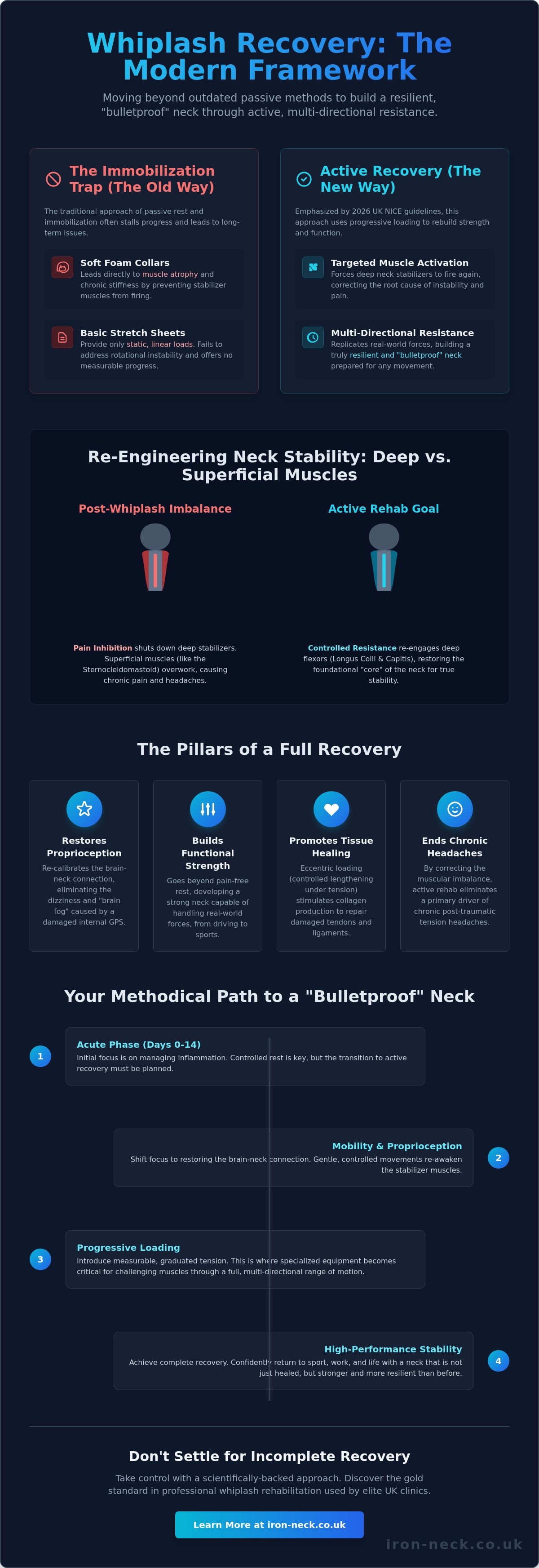
Understanding Whiplash Recovery requires a fundamental shift in how we view soft tissue injuries. Whiplash isn't a static condition; it's a dynamic disruption of the cervical spine's stabilizer muscles. For decades, the standard response was immobilization. We now know this is a mistake. The "immobilization trap," characterized by the prolonged use of soft foam collars, leads directly to muscle atrophy and chronic stiffness. When you stop moving, your stabilizer muscles stop firing. By 2026, UK clinical standards have moved decisively toward "Active Recovery." This approach recognizes that the cervical spine requires a transition from initial rest to progressive loading to heal correctly. Active cervical resistance is the application of controlled force to restore muscle firing patterns. Without this stimulus, the tissues remain weak, leaving you vulnerable to re-injury and persistent "brain fog" caused by cervical instability.
The Limitations of Traditional NHS Rehab Sheets
Most patients in the UK are discharged with a basic double-sided A4 sheet of isometric stretches. These exercises often fail because they don't address rotational instability. Pressing your hand against your forehead provides a static load, but it doesn't replicate the complex, multi-planar movements of real life. There's a massive gap between being "pain-free" at rest and being "functionally strong" enough to handle a 70mph shoulder check on the motorway. Without specialized neck strengthening equipment for whiplash recovery UK, it's nearly impossible to achieve progressive overload. You can't measure the resistance of your own hand. To rebuild a "bulletproof" neck, you need measurable, graduated tension that challenges the muscles through their full range of motion.
Transitioning from Acute Care to Strength Training
Identifying the "Green Light" for strengthening is a methodical process. Once the acute inflammatory phase subsides, usually within the first 14 days post-accident, the focus must shift to restoring proprioception. This is the brain-neck connection that tells your body where your head is in space. Whiplash often shatters this internal GPS, leading to dizziness and poor posture. UK physiotherapists are increasingly moving toward equipment-based home rehab to bridge this gap. Using dedicated neck strengthening equipment for whiplash recovery UK ensures that patients aren't just "moving" their necks, but are actively recruiting the deep cervical flexors. This methodical transition from mobility to load-bearing stability is the only way to eliminate chronic tension headaches and return to peak physical performance.
The Science of Active Resistance for Cervical Spine Rehabilitation
True recovery from a cervical acceleration-deceleration injury requires more than just "taking it easy." It demands a scientific approach to re-engaging the deep neck flexors, specifically the longus colli and longus capitis. These muscles act as the foundational "abs" of your neck. When whiplash occurs, these stabilizers often shut down due to pain inhibition, forcing superficial muscles like the sternocleidomastoid to overwork. This imbalance is a primary driver of chronic post-traumatic pain. By utilizing neck strengthening equipment for whiplash recovery UK, you can force these deep stabilizers to fire again through controlled, graded resistance. This isn't just about building muscle mass; it's about restoring the structural integrity of the C1-C7 vertebrae.
Whiplash doesn't just damage soft tissue; it frequently disrupts the vestibular system. Your neck is packed with mechanoreceptors that tell your brain where your head is in space. When these are damaged, you experience the dizziness and "spaciness" common in whiplash survivors. When implementing a safe neck strengthening protocol in the UK, the goal is to use resistance to "re-calibrate" these sensors. Unlike traditional linear training that only moves up and down, multi-directional loading is essential. Real-world trauma happens at unpredictable angles. Training in 360 degrees ensures that every stabilizer muscle is prepared to protect the spine from every possible direction.
The eccentric phase of movement, or the "controlled lengthening" under tension, is the secret to rebuilding damaged tendons and ligaments. Scientific research indicates that eccentric loading stimulates collagen production and realigns fibers in a way that static stretching cannot. High-performance neck strengthening equipment for whiplash recovery UK allows you to focus on this lowering phase safely. This methodical approach reduces the risk of re-injury while significantly accelerating the healing of micro-tears in the cervical connective tissue. You can view our full range of professional rehabilitation tools to understand how this resistance is applied in a clinical setting.
Restoring the Cervical Curve and Posture
Whiplash often results in a loss of the natural lordotic curve, leading to "Forward Head Posture." This misalignment adds up to 13kg of extra pressure on your spine for every inch your head moves forward. 360-degree resistance provides a mechanical advantage by allowing you to perform "retraction" exercises under load. This pulls the skull back into alignment over the shoulders. Traditional head harnesses often fail here because they only provide linear, vertical loading, which can sometimes exacerbate existing postural imbalances rather than fixing them.
Proprioceptive Training: Re-mapping the Neck
Neurological recovery is just as vital as physical strength. Advanced rehab equipment often incorporates "laser-guided" training, where you track a visual target while maintaining resistance. This creates a biofeedback loop that forces the brain to re-map the neck's movement patterns. This visual feedback accelerates motor control recovery and has been linked to a significant reduction in post-concussion symptoms. By integrating visual and physical challenges, you turn a simple strength exercise into a comprehensive neurological reset for the cervical spine.
Comparing Neck Strengthening Equipment for Post-Trauma Recovery
Selecting the right neck strengthening equipment for whiplash recovery UK is a decision that directly impacts your long-term spinal health. In the UK market, options range from basic head harnesses found on discount retail sites to professional grade rotational devices used in elite sports clinics. For someone recovering from trauma, the stakes are higher than for a typical athlete. You aren't just building muscle; you're stabilizing a compromised structure. Safety release mechanisms are the non-negotiable "must have" for whiplash survivors. If a resistance band snaps or a weight slips without a quick release system, the resulting jerk can reset your recovery by months. You need equipment designed for precision, not just raw power.
Traditional Head Harnesses: Pros and Cons for Rehab
Traditional harnesses are designed for linear weight loading, typically used by bodybuilders to add mass. However, linear loading presents a significant "shear force" problem for a recovering cervical spine. When you hang a weight from a harness, the force pulls vertically; this often puts undue pressure on the intervertebral discs. This can lead to compression rather than the stabilization you need. While a harness might be appropriate for late stage hypertrophy once the neck is already stable, it is often too aggressive for the early phases of whiplash rehab. The lack of lateral or rotational resistance means you're only training a fraction of the neck's functional movement, leaving the most vulnerable planes of motion untouched.
Rotational Resistance Devices: The Modern Standard
Modern rehabilitation has shifted toward rotational resistance, specifically the "Halo" mechanism. This technology provides constant tension through every degree of rotation, allowing you to strengthen the neck in the exact planes where whiplash damage occurs. Adjustable friction is critical here. It allows you to start with near zero resistance and progress by tiny, measurable increments. This methodical progression ensures you don't overtax the delicate stabilizer muscles. Anti rotation training is another key benefit. By resisting a force that wants to turn your head, you build the "braking" strength needed to protect your spine against sudden, unexpected movements in daily life.
Choosing equipment that fits into a UK home or office is vital for consistency. Professional rotational devices are surprisingly portable, often weighing less than 1kg and attaching to any standard door frame. From a cost benefit perspective, the initial investment in high quality neck strengthening equipment for whiplash recovery UK often pays for itself within six months. When you calculate the average cost of private physiotherapy sessions in cities like London or Manchester, owning the equipment for daily use becomes the more economical and effective path to a full recovery. You gain the ability to perform high level rehab on your own schedule, which is the missing link for many survivors.
Implementing a Safe Neck Strengthening Protocol in the UK
Consult a professional first. HCPC-registered physiotherapists in London and Glasgow provide the gold standard for post-trauma assessment. You must follow a methodical five-step framework to ensure your recovery is both safe and permanent. Jumping into heavy resistance too early is a common mistake that leads to setbacks. A structured protocol allows your nervous system to adapt to new loads without triggering a pain response.
Step 1 requires a full clinical assessment. Step 2 involves establishing your baseline range of motion (ROM) without any resistance. You need to know exactly where your "pain-free" zone ends before you introduce neck strengthening equipment for whiplash recovery UK. Step 3 introduces isometric holds. These "wake up" the deep stabilizer muscles by requiring them to resist force without moving the cervical spine. Step 4 is the gradual introduction of dynamic, rotational movements. This is the stage where you begin to rebuild the functional strength needed for daily life. Finally, Step 5 is continuous monitoring for "Red Flags" like sudden dizziness or radiating pain. If these occur, you must immediately reduce the load.
Finding Physiotherapy for Whiplash Injury in Glasgow and the UK
Glasgow and London host some of the UK's most advanced private rehab clinics. These facilities often bypass long NHS waiting lists and offer access to specialized gear that isn't available in standard primary care. When choosing a clinic, ask specifically if they utilize rotational resistance devices in their cervical protocols. You should ask your physio how to integrate your own neck strengthening equipment for whiplash recovery UK into your home sessions. This ensures your home training aligns perfectly with your clinical goals, creating a seamless path to recovery.
The "Little and Often" Rule for Injured Tissues
Consistency is more valuable than intensity. Ten minutes of daily stabilization training is significantly more effective than one heavy weekly session. Injured tissues respond best to frequent, low-intensity stimulus that promotes blood flow and neurological re-mapping. You can use Iron Neck Resistance Bands to perform a quick three-minute "warm up" before starting your workday. This helps prime the stabilizers and reduces the risk of postural fatigue. Tracking your progress is essential. Use a "Pain vs. Function" log to record not just how much it hurts, but how your range of motion and ability to perform daily tasks improve over time. This data-driven approach provides the confidence needed to keep pushing toward a bulletproof neck.
Iron Neck: The Gold Standard for Professional Whiplash Rehabilitation
Iron Neck is the definitive choice for clinical grade cervical restoration. It's the primary tool used by Premiership Rugby teams and specialized UK clinics to manage high velocity trauma. While previous sections detailed the science of resistance, the hardware itself is what makes this protocol actionable. It's the only device providing the multi-planar tension required to move beyond basic stability. This represents the "Missing Link" in your journey. Most rehab programs stop once you're out of pain, but Iron Neck facilitates the transition to true performance. By using professional neck strengthening equipment for whiplash recovery UK, you ensure your cervical spine is prepared for the unpredictable forces of daily life.
Selecting the right model is vital for a safe progression. The Iron Neck 3.0 Pro is specifically engineered for survivors of whiplash. Its variable friction dial allows you to increase resistance by tiny, measurable increments, preventing the "all or nothing" loading that often causes setbacks. UK users, from professional athletes to those recovering from road traffic accidents, consistently report that this active stimulus was the only intervention that finally eliminated their lingering tension headaches. It provides the confidence needed to move your head without hesitation.
Key Features for Rehab: Variable Friction and Linear Projection
The variable friction mechanism is a game changer for sensitive tissues. It allows you to start with near zero resistance, ensuring you never exceed your current physiological threshold. This methodical approach is what separates professional neck strengthening equipment for whiplash recovery UK from standard fitness accessories. Linear projection training is equally essential. It forces you to resist a forward pull, which is the most effective way to correct the "Forward Head Posture" that often follows a collision. Many users perform these exercises during breaks at their UK home office to maintain alignment and reduce end of day fatigue.
Taking the Next Step in Your Recovery Journey
You don't have to accept a life of fragility. Reclaiming your stability requires the right tools and a structured plan. Ordering your device is straightforward, with fast shipping available across the country. Every purchase includes access to our training app, which features guided protocols designed by medical professionals. These videos remove the guesswork, showing you exactly how to progress from initial isometric holds to advanced rotational strength. It's a comprehensive system for long term health.
Rebuild your strength and reclaim your life with Iron Neck UK & Europe.
Reclaim Your Stability and Performance
Passive rest is no longer the standard for cervical health. You've learned that active, multi-directional resistance is the foundational requirement for rebuilding deep stabilizer muscles and correcting the postural imbalances caused by whiplash. By transitioning from simple mobility to a structured strength protocol, you're not just managing symptoms; you're building a resilient, high-performance neck. Choosing the right neck strengthening equipment for whiplash recovery UK is the final step in moving from chronic stiffness to functional freedom.
Iron Neck is the missing link in this journey. Our technology is used by over 500 professional sports teams and clinics worldwide and is endorsed by leading UK physiotherapists for its precision and safety. We're committed to your recovery, which is why every device comes with a 30-day money-back guarantee for peace of mind. You don't have to live with the limitations of a compromised cervical spine. Take control of your rehabilitation today and unlock your full physical potential.
Shop the Iron Neck Collection for Professional Rehab
Your path to a pain-free life starts with a single, methodical step toward strength. We're here to support you in building the foundation for all movement.
Frequently Asked Questions
Is neck strengthening equipment safe to use immediately after a whiplash injury?
No, you should not use resistance equipment during the acute inflammatory phase. Most clinical guidelines suggest resting for the first 48 to 72 hours following the trauma. Once you pass the initial 14 day mark and receive a clearance from a medical professional, you can begin a methodical transition to isometric loading. Early mobilization is encouraged, but active resistance must be introduced gradually to avoid aggravating damaged soft tissues.
How does the Iron Neck differ from a standard neck harness for rehab?
Standard harnesses only provide linear, vertical loading which often creates dangerous shear force on compromised intervertebral discs. Iron Neck provides 360 degree rotational resistance, allowing you to strengthen the cervical spine through every functional plane of motion. It's the only device featuring a variable friction dial. This allows for the micro-adjustments in tension that are essential for a safe, progressive recovery from a whiplash injury.
Can strengthening my neck help with whiplash-related headaches and dizziness?
Yes, targeted strengthening addresses the foundational cause of these symptoms. Dizziness and cervicogenic headaches often stem from damaged mechanoreceptors and weak stabilizer muscles that fail to support the skull. Utilizing professional neck strengthening equipment for whiplash recovery UK helps recalibrate your vestibular system and restores the natural cervical curve. This reduces chronic pressure on the suboccipital nerves and improves the brain-neck connection known as proprioception.
Do I need a physiotherapist to help me use neck strengthening equipment?
A consultation with a UK-registered physiotherapist is highly recommended before starting any new rehab protocol. While our equipment is designed for home use, a professional assessment helps establish your safe baseline range of motion. They can provide a structured plan and ensure your form is perfect during the initial stages. This professional oversight ensures that your transition from passive rest to active resistance is handled with clinical precision.
How long does it take to see results from neck strengthening after whiplash?
Most survivors report a measurable improvement in stability and a reduction in chronic tension within 4 to 6 weeks of consistent training. Neurological adaptations, such as improved motor control and reduced dizziness, often occur faster than physical muscle growth. To see these results, you must follow the "little and often" rule. Performing 10 minutes of daily stabilization is significantly more effective than one long, heavy session per week.
What is the best neck strengthening equipment for whiplash recovery available in the UK?
The Iron Neck 3.0 Pro is the gold standard for individuals seeking the highest level of safety and efficacy. It's the premier neck strengthening equipment for whiplash recovery UK because it combines rotational resistance with a safety-release system. Unlike basic harnesses or elastic bands, it provides measurable, graduated tension. This is why it's the trusted choice for over 500 professional sports teams and specialized rehabilitation clinics across the country.
Can neck strengthening prevent future whiplash injuries?
Yes, building a "bulletproof" neck is the best defense against future cervical trauma. A strong neck acts as a foundational shock absorber that dissipates energy during an impact before it reaches the brain or spine. Scientific research indicates that increasing neck strength can significantly reduce the acceleration of the head during a collision. This structural integrity is the missing link in long-term protection for athletes and daily commuters alike.
What should I do if I feel pain while using the equipment?
Stop the exercise immediately and reduce the resistance level for your next session. Rehabilitation should be challenging but never painful. If you experience radiating pain, numbness in your arms, or severe dizziness, you must consult your clinician before continuing. These are signs that your nervous system isn't yet ready for dynamic movement. You may need to return to basic isometric holds to "wake up" the stabilizers safely.