

Neck Pain from Gaming Posture: The 2026 Guide to Strength & Recovery
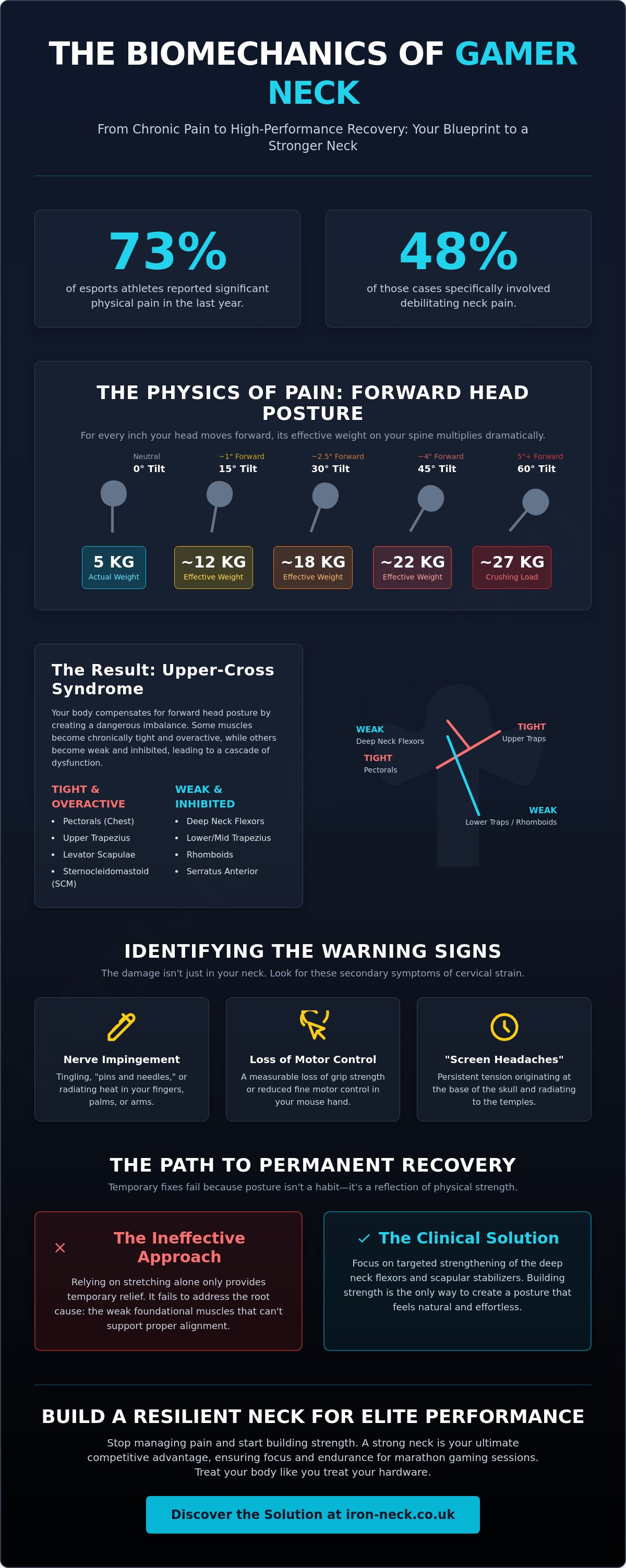
Did you know that 73% of esports athletes reported significant physical pain in the last year, with 48% of those cases specifically involving the neck? If you're struggling with neck pain from gaming posture, you've likely been told to just sit up straight or buy a more expensive chair. However, your posture isn't a habit to be broken with willpower; it's a physical weakness that requires a targeted, scientific solution. You shouldn't have to choose between the games you love and a life free from chronic tension.
We understand the frustration of persistent tension headaches and that stiff, restricted feeling when you try to turn your head after a long session. You want a posture that feels natural and a neck strong enough to support your performance for hours on end. This guide provides the biomechanical blueprint to eliminate gamer neck through clinical strengthening protocols. We'll show you how to move from temporary relief to a permanent, high-performance recovery strategy that treats your body with the same respect you give your hardware.
Key Takeaways
- Understand the biomechanical reality of how forward head tilt increases the effective weight of your skull from 5kg to nearly 27kg.
- Discover why stretching often fails to resolve neck pain from gaming posture and why your recovery must focus on eccentric loading and muscle strengthening.
- Master the Pro-Gamer Recovery Protocol, including critical monitor height adjustments and scapular retraction drills to reset your spinal alignment.
- Learn how the Iron Neck’s unique 360-degree resistance protocols specifically target the deep neck flexors to support long-duration performance.
Understanding "Gamer Neck": Why Your Posture Is Causing Chronic Pain
"Gamer Neck" is more than a colloquialism; it describes a clinical condition known as Cervical Kyphosis. This is a modern postural adaptation where the natural curve of the neck flattens or reverses due to relentless screen engagement. When you experience neck pain from gaming posture, your body isn't just tired. It's physically remodeling itself to accommodate a dysfunctional position. Your muscles are adapting to a state of constant, low-grade strain that eventually alters your skeletal alignment.
This transition starts as simple acute stiffness, but it quickly evolves into chronic musculoskeletal dysfunction. The hallmark signs are unmistakable: rounded shoulders, a collapsed thoracic spine, and a protruding chin. This cluster of issues is often categorized as Upper-Cross Syndrome. Beyond the physical toll, chronic pain erodes your mental edge. It limits your focus, increases irritability, and ultimately degrades your performance during high-stakes sessions. You can't maintain a competitive "flow state" when your nervous system is flooded with pain signals.
The Mechanics of Forward Head Posture
Neutral alignment allows the cervical spine to distribute the weight of the skull efficiently. In contrast, the forward-leaning "gamer" state, or Forward Head Posture, creates a severe mechanical disadvantage that forces the posterior muscles to work overtime. Over time, your proprioception, which is your brain's internal map of where your body is in space, becomes skewed. Your nervous system begins to accept this distorted alignment as the "new normal." You can use a chin tuck as a diagnostic tool rather than just an exercise. If pulling your chin straight back feels restricted or causes sharp discomfort, it's a clear indicator of structural shortening rather than simple muscle tightness.
Identifying the Symptoms of Gaming-Induced Cervical Strain
The damage isn't always localized to the neck. You might notice secondary symptoms that seem unrelated to your desk setup. These include:
- Tingling or "pins and needles" sensations in the fingers and palms.
- A measurable loss of grip strength or fine motor control in your mouse hand.
- Persistent "screen headaches" originating at the base of the skull and radiating toward the temples.
These headaches are frequently caused by the suboccipital muscles. These tiny muscles at the top of your neck become hyper-tonic as they struggle to keep your eyes level with the screen. It's vital to differentiate between simple muscle fatigue and actual nerve impingement. While fatigue feels like a dull, heavy ache, impingement often presents as radiating heat or sharp, electrical sensations. Addressing neck pain from gaming posture requires identifying these signals before they lead to permanent neurological deficits.
The Biomechanics of Gaming: Why Your Head Feels Like a 27kg Weight
To understand the root of neck pain from gaming posture, you must first understand the physics of the "lever arm." In a neutral, upright position, the average human head weighs approximately 5 kilograms. This weight is easily managed by the cervical spine and the surrounding musculature. However, as you lean into your screen during an intense session, the center of mass shifts. For every single inch your head moves forward, you add roughly 4.5 kilograms of effective weight to your spine. The math is simple; the physiological impact is devastating.
When your head shifts five inches forward, the effective weight on your cervical spine balloons to nearly 27 kilograms. This creates massive mechanical stress at the C7-T1 junction, the area where your neck meets your upper back. To protect the spinal cord from this crushing load, the body often develops a fatty or bony deposit known as a "dowager’s hump." This isn't just a cosmetic issue. It's a structural emergency. The Sternocleidomastoid (SCM) muscles, located on the sides of your neck, become chronically short and tight as they struggle to pull your head forward and down toward the screen.
The Overactive vs. Underactive Muscle Imbalance
Your body is a master of compensation. When certain muscles fail, others overwork to prevent total collapse. In the context of gaming, your chest (pecs), upper traps, and levator scapulae become hyper-active and "locked" in a state of tension. Meanwhile, the deep neck flexors and lower rhomboids become inhibited and weak. This is a primary driver of neck pain from gaming posture. Because the structural muscles are too weak to maintain alignment, the brain sends signals to the superficial muscles to tighten up, providing a form of "artificial stability" that feels like permanent stiffness. Breaking this cycle requires more than just rest; it requires targeted resistance training with the Iron Neck to wake up those dormant, underactive muscles.
Long-Term Consequences: From Tension Headaches to Disc Issues
Ignoring these biomechanical red flags leads to a predictable downward spiral. Chronic compression of the cervical vertebrae often results in premature disc degeneration and nerve impingement. This isn't a theoretical risk. A 2026 systematic review on musculoskeletal disorders in gamers confirmed that the neck is one of the most frequently injured regions due to prolonged postural strain. Furthermore, this forward collapse compromises your breathing mechanics. As the ribcage becomes depressed, your diaphragm cannot expand fully, leading to shallow chest breathing and increased systemic stress. If left unaddressed, "text neck" in younger gamers can progress into permanent spinal remodeling, making recovery significantly more difficult as you age.
Beyond Stretching: Why Strength is the Ultimate Posture Correction
Passive stretching is the most common recommendation for neck pain from gaming posture, yet it rarely produces lasting results. This is because the muscles at the back of your neck are not short; they are locked in a state of chronic elongation. When you sit with a forward head carriage, the posterior muscles are under constant tension, working to prevent your head from falling further. This is known as eccentric loading. Stretching a muscle that is already overextended and weak only serves to destabilize the cervical spine further. You don't need more flexibility; you need the structural integrity that only resistance can provide.
The posterior chain of the neck is the essential foundation of your upright posture. It consists of the splenius capitis, splenius cervicis, and the deep stabilizers of the cervical spine. These muscles must be capable of generating enough tension to counteract the forward pull of gravity. Relying on willpower to "sit up straight" is a losing battle because your muscles lack the endurance to maintain that position. True correction requires a shift toward isometric and rotational resistance. These protocols train the neck to maintain its natural alignment under load, turning a forced posture into a natural, unconscious habit.
The Limits of Passive Mobility Exercises
Why does stretching feel good initially but fail to fix the problem? It’s often due to the stretch reflex. When your brain senses that a muscle is too weak to protect a joint, it sends a signal to tighten that muscle as a protective mechanism. By stretching a "tight" neck without building strength, you are removing your body's only defense against further misalignment. This often leads to increased instability and a recurring cycle of pain. You must transition from mobility-only routines to stability-first protocols that prioritize muscle recruitment over simple range of motion.
Building Posterior Chain Resilience
The splenius capitis and cervicis muscles act as the vital guy-wires for your skull. In a high-performance gaming environment, these muscles need to be resilient enough to support your head for hours. Multi-directional strength is the key to achieving a pain-free, 360-degree range of motion. When you build a stronger neck, you effectively reduce your overall perception of effort during long sessions. A resilient posterior chain makes your head feel lighter and keeps your focus on the game rather than the mounting tension in your upper back. Strength is not just about power; it's about the endurance to remain precise and focused when the stakes are highest.
The Pro-Gamer Recovery Protocol: Ergonomics and Targeted Training
Transitioning from chronic discomfort to peak performance requires a systematic approach that combines environmental optimization with high-level physical conditioning. You cannot out-train a desk setup that actively sabotages your spine. Conversely, even the most expensive ergonomic chair cannot compensate for weak, inhibited musculature. This protocol is designed to eliminate neck pain from gaming posture by addressing both the external environment and your internal structural resilience.
- Step 1: Monitor Height Calibration. Position your primary display so the top third of the screen is at eye level. This prevents the chin-tuck or forward-protrusion that occurs when looking too high or too low.
- Step 2: Scapular Retraction Drills. Every 60 minutes, perform ten repetitions of pulling your shoulder blades back and down. This resets the thoracic spine and prevents the "slump" that leads to secondary neck strain.
- Step 3: 360-Degree Resistance. Integrate multi-directional loading to combat the static fatigue of long sessions. This builds the dynamic stability required to hold your head in neutral alignment without conscious effort.
- Step 4: Hydration and Micro-Breaks. Soft tissue elasticity depends on hydration. Take two-minute breaks every hour to move your neck through its full range of motion, keeping the fascia from "gluing" into a hunched position.
- Step 5: Progressive Overload. Treat your neck with the same scientific rigor as your legs or chest. Gradually increase resistance levels to stimulate hypertrophy and long-term structural support.
Optimising Your Gaming Station for Spinal Health
A neutral spine is the foundation of endurance. While the "slump" position might feel comfortable initially, it places the posterior ligaments under extreme tension. Effective lumbar support is critical because the curve of your lower back directly dictates the position of your head. If your lower back collapses, your neck must lean forward to compensate. Ensure your armrests are adjusted to a height that allows your elbows to rest at a 90-degree angle; this unloads the upper traps and prevents the "shrugged" posture that triggers tension headaches. Secure your physical longevity and eliminate neck pain from gaming posture by upgrading your training with the Iron Neck Device.
The Iron Neck Protocol for Gamers
Static loading is the enemy of the digital athlete. To counter this, we utilize the "360-degree spin" exercise, which provides total cervical engagement by forcing the stabilizers to adapt to a changing resistance profile. This is followed by the "Look Left, Look Right" drill. By performing these rotations under light, consistent resistance, you restore the natural glide of the vertebrae and break up the stiffness caused by staring at a fixed point. Consistency is the primary driver of adaptation. Training for 10 minutes every day is significantly more effective than a single one-hour session per week. Frequent, low-volume stimulation keeps the deep neck flexors active and ready to support your performance.
Iron Neck: Scientific Strength Training for the Modern Digital Athlete
Generic home remedies often fall short because they lack the specificity required for cervical rehabilitation. While traditional resistance bands offer simple linear pull, they cannot replicate the complex, multi-planar movements of the human neck. Iron Neck UK & Europe stands as the definitive solution for neck pain from gaming posture by integrating both linear and rotational resistance into a single protocol. Its patented halo-style design is engineered to isolate the deep neck flexors, providing the structural support needed to sustain high-performance digital environments for hours on end.
This equipment shifts the focus from reactive rehab to proactive prehab. Instead of waiting for stiffness to become a chronic injury, you should be building a neck that is immune to the demands of your setup. Treating your cervical spine as a critical piece of your performance kit is what separates casual players from professional digital athletes. Whether you're a competitive gamer or a software developer, your ability to remain focused depends entirely on your physical resilience. You wouldn't use outdated software for a tournament, so you shouldn't rely on outdated recovery methods for your spine.
Multi-Directional Resistance for Modern Lifestyles
The system provided by Iron Neck UK & Europe utilizes a unique friction dial that allows for precise, measurable progression. This ensures that your training evolves as your strength increases, preventing the plateaus common with static exercises. By applying rotational load, the device forces the posterior chain to engage actively, pulling the cervical spine back into its natural alignment and fixing the forward head carriage. This isn't just a fitness accessory; it's a piece of clinical-grade equipment utilized by professional athletes and health experts to build a foundation of durability. It bridges the gap between ergonomic theory and actual physical correction. The ability to adjust resistance in small, incremental steps allows you to tailor your recovery to your specific needs, ensuring safe and effective progress.
From Pain Management to Performance Gains
Transitioning from pain management to performance gains is the ultimate goal for any digital athlete. A stable, strong neck does more than just stop the ache; it enhances your peripheral awareness and visual tracking capabilities. When your cervical stabilizers are firing correctly, your head remains still, allowing your eyes to scan the screen with greater precision and speed. This translates to faster reaction times in-game and reduced mental fatigue. Investing in this equipment is an investment in your spinal longevity, ensuring that your career or hobby isn't cut short by preventable musculoskeletal decline. By choosing Iron Neck UK & Europe, you are opting for a solution that prioritizes long-term health and athletic performance over temporary relief.
View the Iron Neck UK & Europe range and start your recovery journey today.
Secure Your Performance and Longevity
Structural alignment isn't a passive state; it's the result of functional strength. You now understand how the biomechanics of head tilt multiply the load on your spine and why stretching alone fails to fix the underlying weakness. Eliminating neck pain from gaming posture requires a transition from passive habits to active, scientific conditioning that prioritizes stability over simple mobility. By training the deep stabilizers of the neck, you ensure your body can withstand the rigors of any digital environment without collapsing into chronic tension.
Iron Neck UK & Europe provides the only clinically backed design featuring 360-degree rotational resistance technology. This is why it remains the trusted choice for elite NFL, UFC, and F1 athletes who demand the highest standards of injury prevention and structural resilience. It's time to treat your body with the same precision and care you give your high-performance hardware. You have the tools and the protocols to rebuild your foundation and unlock your latent potential. Your best gaming sessions are still ahead of you.
Invest in your spinal health with the Iron Neck UK & Europe 2026 Collection
Frequently Asked Questions
Is "gamer neck" permanent or can it be reversed?
Gamer neck is generally reversible through consistent mechanical intervention and targeted resistance training. While your body adapts to poor positions over years, it remains capable of remodeling soft tissue and restoring natural alignment. By shifting from passive rest to active structural correction, you can retrain your muscles to support a neutral cervical curve. This process requires a methodical approach to strengthening the deep stabilizers that have become inhibited by long-term screen use.
How long does it take to see results from neck strengthening exercises?
Initial neural adaptations, such as improved muscle recruitment and reduced tension, often occur within the first two to three weeks of consistent training. However, structural changes in muscle hypertrophy and permanent postural shifts typically require eight to twelve weeks of progressive loading. Consistency is the primary driver of these results. Short, daily sessions are significantly more effective for long-term recovery than infrequent, high-volume workouts that can lead to excessive fatigue.
Can I use a traditional neck harness to fix my gaming posture?
Traditional neck harnesses are insufficient for correcting posture because they only provide linear resistance. These devices focus on basic flexion and extension, which fails to address the rotational and lateral stability required for the cervical spine. To truly fix the mechanical imbalances caused by gaming, you need 360-degree rotational resistance. This specific type of loading engages the deep stabilizers that a standard harness simply cannot reach, providing a much more comprehensive solution.
Will a standing desk help reduce my neck pain while gaming?
A standing desk is a valuable tool for postural variety, but it does not fix the underlying muscle weakness responsible for neck pain from gaming posture. Even while standing, many gamers continue to lean forward or tilt their heads toward the display. While standing can prevent a collapsed lower back, it won't automatically correct a forward head carriage. You must pair ergonomic adjustments with resistance training to build the endurance needed to maintain alignment in any position.
Are neck strengthening exercises safe to do at home without a coach?
Yes, neck strengthening is safe to perform at home if you use clinically backed equipment and follow structured, evidence-based protocols. Modern devices like the Iron Neck are designed with safety as a priority, utilizing smooth resistance to prevent the jarring movements that cause injury. It's essential to start with low resistance levels and focus on controlled, precise movements. Following a methodical program ensures you build strength safely while systematically dismantling your postural limitations.
How do I know if my neck pain is a serious medical issue or just poor posture?
Serious medical issues often present with "red flag" symptoms that go beyond simple muscular stiffness. If you experience radiating pain into your arms, persistent numbness in your fingers, or a sudden loss of grip strength, these may indicate nerve impingement or disc issues. While most neck pain from gaming posture is musculoskeletal, you should consult a professional if your symptoms include sharp, electrical sensations or if the pain persists despite making ergonomic and training adjustments.
Can neck training help with the headaches I get while playing games?
Strengthening your neck is one of the most effective ways to eliminate the tension headaches associated with long gaming sessions. These headaches are often triggered by hyper-tonic suboccipital muscles at the base of the skull. When your neck is weak, these tiny muscles work overtime to keep your eyes level with the screen. By building a resilient posterior chain, you reduce the strain on these trigger points, effectively cutting off the source of the pain.
What is the best exercise for someone just starting to fix their posture?
The fundamental starting point for any recovery protocol is the isometric chin tuck. This exercise teaches you how to engage the deep neck flexors and pull your head back into neutral alignment without using the superficial muscles of the throat. Once you master this basic movement, you can progress to rotational drills under light resistance. Starting with these foundational stability exercises ensures your nervous system is prepared for the more advanced 360-degree protocols required for total recovery.