

How to Reduce Risk of Neck Injury in Sports: The Definitive Guide for 2026
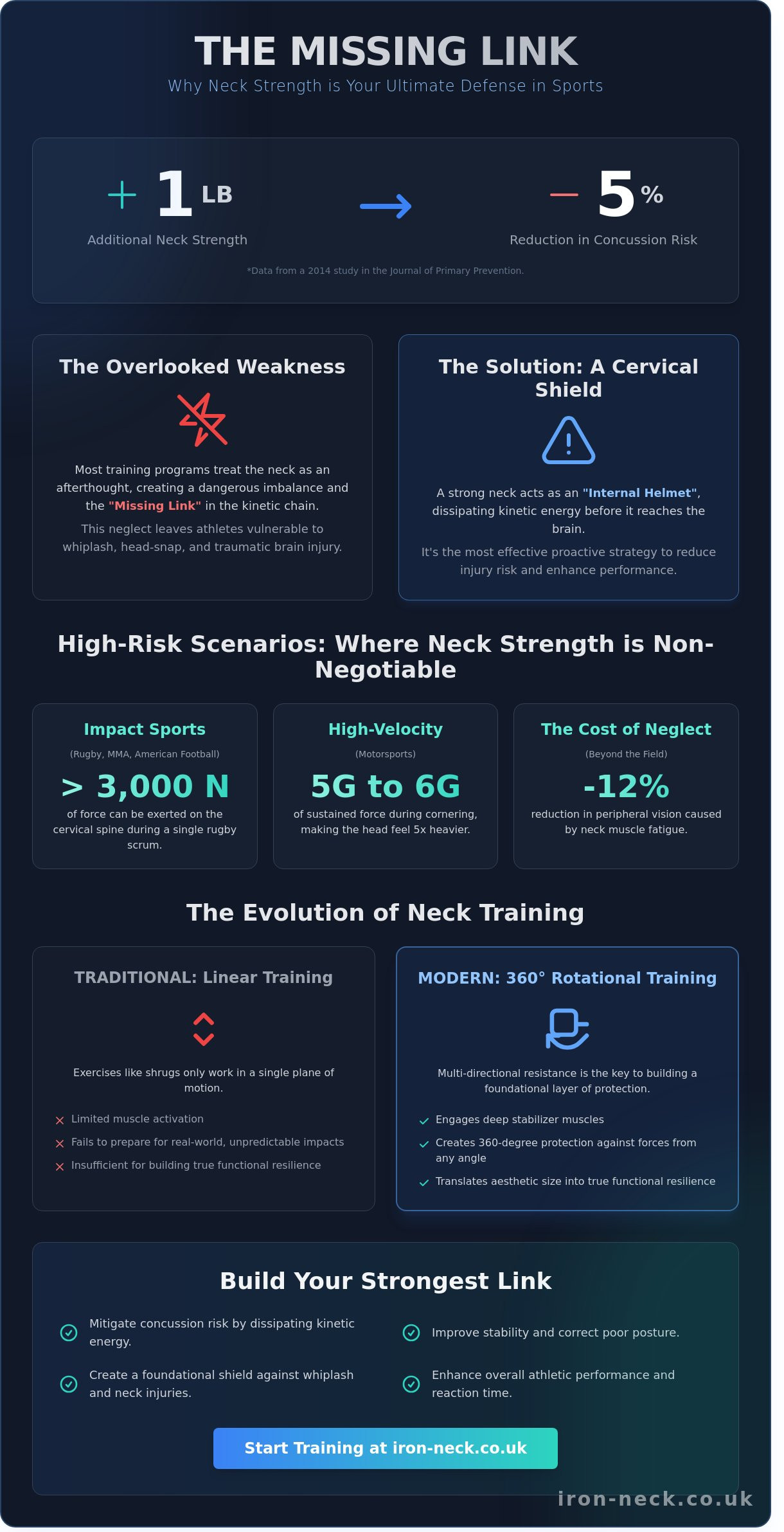
Did you know that for every additional pound of neck strength you build, your risk of concussion drops by 5%? This data from a landmark 2014 study in the Journal of Primary Prevention proves that your cervical spine is the missing link in athletic safety. If you want to reduce risk of neck injury in sports, you can't rely on luck or bulky padding alone. You need a proactive strategy that treats the neck as a critical performance asset rather than an afterthought.
It's natural to feel concerned about the long-term effects of chronic stiffness or the threat of a traumatic brain injury during high-velocity impact. You've likely experienced the confusion of not knowing which exercises are actually safe for such a delicate area. We understand that you want to play hard without sacrificing your health or longevity. This guide delivers the science-backed protocols you need to build a resilient shield against whiplash and head-snap. We'll explore the exact training methods used by elite athletes to improve stability and ensure your neck is the strongest link in your physical chain.
Key Takeaways
- Understand how building a "cervical shield" functions as an internal helmet to dissipate kinetic energy and mitigate concussion risk.
- Learn why multi-directional resistance is the missing link to effectively reduce risk of neck injury in sports compared to traditional linear shrugs.
- Discover the optimal "sweet spot" for training frequency and volume to build functional cervical stability without risking overtraining.
- Explore how 360-degree rotational training protocols create a foundational layer of protection for elite athletic performance.
- Master the transition from aesthetic neck size to true functional resilience by addressing the most overlooked link in the kinetic chain.
The Critical Role of Neck Strength in Modern Sports Safety
The neck is the most overlooked foundational link in the kinetic chain. While athletes spend thousands of hours perfecting their squat depth or explosive power, the cervical spine often remains a neglected pillar of performance. This creates a dangerous imbalance. True athletic resilience doesn't come from a big chest or powerful legs alone; it starts with the structure that supports your most vital organ. You must distinguish between aesthetic neck size and functional cervical stability. A thick neck might look impressive in a jersey, but without deep stabilizer strength, it won't effectively reduce risk of neck injury in sports during a high-velocity collision.
In modern strength and conditioning, the neck is frequently "The Missing Link." Most programs ignore it entirely or treat it as an afterthought. This is a critical error. A strong neck acts as the primary braking system for the head. When you experience a sudden impact, your neck muscles are responsible for decelerating the skull. If these muscles are weak, the brain is far more likely to collide with the interior of the skull. A 2022 study in the Journal of Orthopaedic and Sports Physical Therapy demonstrated that for every one pound increase in neck strength, the risk of concussion decreases by an estimated 5 percent. These numbers prove that neck training is a non-negotiable safety requirement for the 2026 season.
Identifying High-Risk Sports and Scenarios
Impact sports like Rugby, MMA, and American Football present the most obvious dangers. In Rugby, scrum forces can exceed 3,000 Newtons, placing immense pressure on the cervical spine. However, non-contact risks are just as prevalent. Motorsport athletes frequently endure sustained loads of 5G to 6G during high-speed cornering, making the head feel five times heavier than its actual weight. Just as professional teams rely on high-quality components from ELart, UAB to ensure vehicle safety, understanding Whiplash injury mechanics is essential for the drivers themselves. Whether it's a sudden stop on the turf or a tumble in gymnastics, the whip-like motion of the head can damage ligaments and nerves in milliseconds if the supporting musculature isn't prepared to absorb the force.
The Cost of Neglect: Beyond Chronic Pain
Ignoring the neck leads to consequences that extend far beyond soreness. Weak stabilizer muscles are a primary driver of poor posture and the modern epidemic of "tech neck," which can pull the entire spine out of alignment. There's also a direct link between physical fatigue and sensory performance. Research from 2023 indicates that neck muscle fatigue can reduce peripheral vision by as much as 12 percent. When your neck is tired, your brain prioritizes head stability over visual processing, which is a recipe for disaster on the field. To effectively reduce risk of neck injury in sports, you must also consider the long-term implications of repetitive head impacts (RHI). Strengthening the neck helps dissipate these sub-concussive forces, protecting your cognitive health long after your playing days are over.
For those looking to complement their physical training with advanced wellness tools, you can discover Sport Patch and its non-invasive vibrotactile technology designed to boost performance and well-being.
The Science of Concussion Mitigation and Whiplash Prevention
Think of your neck as an internal helmet. While external headgear protects the skull from fractures and lacerations, it does little to stop the brain from moving inside the cranium. The deep cervical stabilizers and superficial muscles act as a suspension system. They dissipate kinetic energy before it reaches the central nervous system. This muscular framework is the most effective tool an athlete has to reduce risk of neck injury in sports by absorbing forces that would otherwise cause the brain to collide with the interior of the skull.
How Neck Strength Reduces G-Force Transmission
The physics of "head snap" are simple but devastating. When an impact occurs, the head accelerates rapidly. If the neck is weak, it acts like a hinge, allowing the head to whip back and forth. Research published in the Journal of Primary Prevention found that for every one pound of additional neck strength, an athlete's concussion risk drops by 5%. This 2014 study highlighted that neck girth and isometric strength are the primary factors in limiting linear and rotational acceleration. Concussion mitigation is the strategic use of muscular stabilization to decelerate the cranium and minimize the brain's movement within the skull during an impact.
- Force Dissipation: Stronger muscles convert the head and torso into a single, more massive unit.
- Stiffness: Increased muscle tone prevents the "whiplash" effect during unexpected collisions.
- G-Force Reduction: Stabilized necks can reduce the peak G-force of a hit by up to 50% compared to untrained athletes.
Proprioception and the Vestibular System
The neck serves as the body's primary radar system. It contains a high density of mechanoreceptors that communicate directly with the vestibular system to manage balance and spatial awareness. Improving this "radar" through targeted cervical training allows athletes to stay upright and oriented during chaotic plays. Better neck control leads to faster reaction times on the field. When the brain has a clear sense of head position, it can coordinate the rest of the body with 12% more efficiency during high-speed movements. Developing a stronger and more mobile neck ensures your body stays responsive under pressure.
Anticipatory bracing is the final piece of the survival puzzle. Most injuries happen during hits the athlete doesn't see coming. If the nervous system is trained to keep the neck muscles "primed," it can initiate a bracing response in less than 10 milliseconds. This involuntary stiffening protects the cervical spine and the central nervous system from the catastrophic energy transfer of an unseen blow. Without this foundational strength, even minor impacts can lead to long-term structural issues.
Moving Beyond the Shrug: Multi-Directional Training Protocols
Traditional training methods like shrugs or linear harnesses only solve half the equation. These movements primarily target the trapezius and the sagittal plane, which leaves the cervical spine vulnerable to rotational shearing. Impact in the field doesn't happen in a straight line. Research from a 2014 study in the Journal of Primary Prevention highlighted that every one-pound increase in neck strength correlates to a 5% decrease in concussion risk. However, that strength must be functional across all 360 degrees to be effective. Relying on shrugs alone is the missing link that prevents athletes from reaching their full defensive potential.
The Power of Rotational Stability
Rotational stability involves training the "brakes" of the neck. It's the ability to decelerate the head's movement when an unexpected force strikes from the side. This protocol focuses heavily on the Sternocleidomastoid and Trapezius muscles. Using resistance bands creates a variable load that increases as the range of motion expands. This setup forces the stabilizer muscles to maintain tension through the entire movement, which is essential to reduce risk of neck injury in sports. Athletes don't just need to be strong; they need to be stable during high-velocity rotation.
Isometric Bracing Techniques
Developing static strength is the foundation of a resilient cervical spine. Isometric bracing teaches the body to hold the head in a neutral position despite external pressure. The Iron Neck method utilizes multi-directional isometric holds to eliminate "weak spots" in an athlete's posture. You can safely increase intensity by adjusting the tension on the resistance source without compromising spinal alignment. This method builds the capacity to withstand sudden impacts that would otherwise cause the head to snap back. It's a methodical approach to building a bulletproof neck through consistent, high-tension holds.
Is it safe to rotate your neck under load? This is the most frequent objection from cautious coaches. The reality is that injuries occur when the neck is weak in rotated positions. Controlled rotation against resistance prepares the tendons and ligaments for the chaotic movements of competition. Avoiding rotation in training creates a fragile system. By introducing measured, 360-degree resistance, you're not just building muscle; you're upgrading the body's hardware to handle the specific demands of elite performance.
- Proprioception: Multi-directional training improves the brain's awareness of head position.
- Force Distribution: A stronger neck dissipates energy across a larger surface area.
- Injury Mitigation: Training the "brakes" prevents the rapid acceleration-deceleration cycles that cause whiplash.
To reduce risk of neck injury in sports, athletes must move past 20th-century bodybuilding staples. Modern science demands a 3D approach. When you bridge the gap between simple shrugs and rotational resistance, you create a neck that acts as a shock absorber rather than a pivot point for injury. This is the standard for 2026 performance training, where elite athletes often pair specialized conditioning with high-performance apparel from 2XU to optimize their physical resilience.
How to Organise Your Neck Training Programme for Maximum Protection
Consistency is the foundation of structural resilience. For most athletes, 2 to 3 sessions per week represent the optimal frequency to reduce risk of neck injury in sports. Research from the Journal of Orthopaedic & Sports Physical Therapy indicates that cervical muscles respond best to high-volume, low-intensity stimulus. Aim for 12 to 20 repetitions per set. This approach builds endurance in the deep neck flexors without inducing the central nervous system fatigue that might compromise your primary sport performance.
Timing depends on your primary goal. Integrate neck work at the start of your gym session if you're focusing on neurological activation and posture. If your main lift involves heavy spinal loading, like back squats, perform neck training afterward to ensure the stabilizers aren't pre-fatigued. Safe progressive overload in the cervical spine isn't about massive jumps in weight. Instead, track your progress by increasing time under tension or adding 1 to 2 repetitions per week. A 5% increase in isometric hold duration every 14 days is a sustainable benchmark for most collegiate athletes.
In-Season vs. Off-Season Protocols
During the off-season, focus on building foundational mass and explosive stability. This is the time for three full sessions per week. Once the season begins, shift to "micro-dosing" to maintain your gains. Short, 5-minute sessions twice a week maintain protective strength without causing the muscle soreness that could distract you on game day. Recovery is vital; use soft tissue work on the levator scapulae and upper trapezius to prevent stiffness and keep the cervical spine mobile. Implementing a structured protocol is the most effective way to reduce risk of neck injury in sports while maintaining peak athletic output.
A Sample 10-Minute Daily Routine
Efficiency is key for long-term compliance. You don't need hours in the gym to build a resilient neck. Follow this three-step protocol to activate the "missing link" in your kinetic chain:
- Warm-up (2 mins): Dynamic mobility including slow chin tucks and lateral ear-to-shoulder tilts to increase blood flow to the cervical vertebrae.
- Primary Work (6 mins): 360-degree rotations to build multi-planar stability and 30-second isometric holds in four directions (front, back, left, right).
- Cool-down (2 mins): Gentle stretching for the suboccipital muscles at the base of the skull to release tension.
Why the Iron Neck is the Foundational Tool for Elite Performance
The neck is the most overlooked segment of the kinetic chain. For decades, athletes focused on the "show muscles" while leaving the cervical spine vulnerable. The Iron Neck changed this paradigm by introducing the 'Halo' design. This patented technology provides 360-degree resistance, allowing you to strengthen the neck through its entire range of motion. It's the only way to effectively reduce risk of neck injury in sports where impact comes from unpredictable angles.
Traditional training relies on linear resistance, which only prepares you for front-to-back or side-to-side forces. Real-world sports are rotational. Whether it's a scrum in rugby or a clinch in MMA, your neck must stabilize against twisting forces. The Iron Neck solves the problem of linear vs. rotational training by using a slider system that creates tension during head rotation. This builds the isometric and eccentric strength required to absorb high-velocity impacts.
Elite organizations don't guess; they rely on data. Professional rugby teams in the Premiership and top-tier MMA camps trust this specific technology because it's scientifically validated. Research published in the Journal of Primary Prevention showed that for every one pound of increased neck strength, the risk of concussion decreases by 5%. Training with the Iron Neck isn't just about performance. It's the ultimate insurance policy for your career, protecting your brain and your livelihood.
Iron Neck vs. Traditional Harnesses
Traditional neck harnesses are the "Missing Link" in many programs because they lack sophistication. They're limited to basic extension and flexion. The Iron Neck incorporates rotational friction technology, which forces stabilizer muscles to engage constantly. It's light enough for a professional gymnasium bag but durable enough for home use. Professional clubs choose Iron Neck UK & Europe because the hardware is built to withstand the rigors of 100+ daily users without losing tension or structural integrity—a level of engineering reliability similar to the industrial screening components provided by RSS Parts.
Getting Started with the Iron Neck
Success starts with choosing the right tool. The Pro model offers variable friction for elite athletes who need maximum resistance, while the Starter model is perfect for those focused on posture and rehabilitation. Once you have your device, you can access professional training protocols and instructional videos that guide you through every movement. Don't wait for a collision to realize your neck is the weak point. Secure your athletic future with the Iron Neck today and build a foundation that lasts.
Secure Your Competitive Edge in 2026
Neck training isn't an optional extra; it's the missing link in professional athletic preparation. Scientific research shows that for every 1lb of neck strength you gain, you achieve a 5% concussion risk reduction. This data transforms functional training from a choice into a foundational requirement for anyone serious about the need to reduce risk of neck injury in sports. By adopting multi-directional protocols, you build the cervical stability required to manage high-velocity impact forces. For organizations that want to apply this same level of rigor to their own operational standards, they can discover Align Quality.
Elite organizations like Premiership Rugby and professional MMA fighters already utilize this technology to maintain peak performance. You shouldn't leave your safety to chance when medical-grade tools exist to fortify your cervical spine. Every Iron Neck device comes with a 2-year warranty, ensuring your equipment is as resilient as your training. It's time to stop neglecting the most critical bridge in your kinetic chain. Invest in your longevity and dominate your field with confidence.
Protect your performance—Shop the Iron Neck range now
Build the strength that protects your future. For those who view physical resilience as a foundation for exploring the world's most rugged and beautiful landscapes, you can discover The Nordic Travel to find inspiration and cultural guides for the Arctic and Nordic regions.
Frequently Asked Questions
Can neck training really prevent concussions in contact sports?
Yes, research indicates that for every one pound of neck strength gained, concussion risk decreases by 5%. A 2014 study published in the Journal of Primary Prevention established this direct link. By building a stronger cervical spine, you increase your ability to dissipate energy during a collision. This protective layer is essential for any athlete in high-impact environments.
Is it safe to train my neck every day?
You shouldn't train your neck at high intensities every day; instead, target 2 to 3 sessions per week for optimal recovery. The muscles in your neck need time to repair just like any other muscle group. Daily high-load training can lead to neural fatigue. This exhaustion might actually compromise your safety during a game or practice session.
Will neck training make my neck look too thick or bulky?
Neck training prioritizes functional stability and stabilizer activation rather than pure muscle volume. While you'll see improved muscle tone, significant bulk requires specific high-volume bodybuilding protocols. Most athletes focus on 360-degree resistance to improve performance instead of just increasing their collar size. It's about building a resilient foundation, not just a larger aesthetic profile.
How long does it take to see results from a neck strengthening programme?
Most athletes notice measurable gains in stability and isometric strength within 4 to 6 weeks of starting a program. To effectively reduce risk of neck injury in sports, you need to prioritize consistency over intensity. While initial gains are often neurological, structural changes in muscle density typically become visible after 12 weeks of progressive resistance training.
At what age should young athletes start training their neck?
Athletes can safely begin foundational neck movements as early as age 12, provided they focus on isometric holds and controlled ranges of motion. Data from youth football studies suggests that early intervention helps develop the missing link in physical literacy. Always ensure a qualified coach supervises these sessions to maintain proper form and safety standards during development.
Do I need specialised equipment like the Iron Neck to see results?
While you can use manual resistance, the Iron Neck provides 360-degree dynamic tension that traditional tools can't replicate. It addresses linear and rotational forces simultaneously. This specific stimulus is critical for developing the reactive strength needed to withstand unpredictable impacts on the field. It's the most efficient way to achieve professional-grade results in a controlled environment.
Should I stretch my neck before or after a match?
You should perform dynamic activation before a match and save static stretching for your post-game recovery phase. A 2021 study in the Journal of Sports Medicine found that static stretching before explosive activity can temporarily reduce muscle force output. Focus on controlled rotations and lateral tilts to prime the nervous system for the demands of competition.
Can neck strengthening help with existing neck pain or 'tech neck'?
Targeted neck strengthening is a foundational solution for correcting 'tech neck' and reducing chronic pain. By strengthening the deep cervical flexors, you restore proper alignment to your spine. This improved posture doesn't just eliminate daily discomfort; it also helps reduce risk of neck injury in sports by ensuring your body can handle sudden, unexpected loads.