

How to Prevent Neck Pain When Working From Home: The 2026 Resilience Guide
What if the expensive ergonomic chair you bought is actually the missing link causing your chronic cervical spine stiffness? Recent data indicates that UK professionals now spend an average of 9.2 hours per day in seated positions, leading to a 45% increase in reported tension headaches since 2022. You've likely accepted that nagging ache at the base of your skull as an inevitable part of your career. However, learning how to prevent neck pain when working from home requires more than just a better desk; it demands a transition from passive support to active, foundational resilience.
We're here to help you transform your home office from a source of strain into a platform for elite neck health. This guide provides a methodical approach to eliminating daily tension and improving your posture permanently through scientific ergonomic principles and targeted strength training. We'll examine the specific stabilizer muscles that fail during long calls and provide the exact protocols needed to build a neck that resists the daily strain of a desk-bound environment.
Key Takeaways
- Understand the clinical physics of "Tech Neck" and how every inch of forward head posture adds nearly 10lbs of effective strain to your cervical spine.
- Master the 90-90-90 ergonomic rule and precise monitor alignment to discover how to prevent neck pain when working from home at a foundational level.
- Shift from passive ergonomic support to active resilience by developing the postural endurance required to stabilize your spine during prolonged desk work.
- Implement a high-performance active prevention protocol featuring isometric holds and controlled rotations to maintain multi-directional mobility.
- Identify the "missing link" in your recovery routine with 360-degree resistance training, the professional-grade solution for total neck protection.
The Biomechanics of "Tech Neck": Why WFH Causes Pain
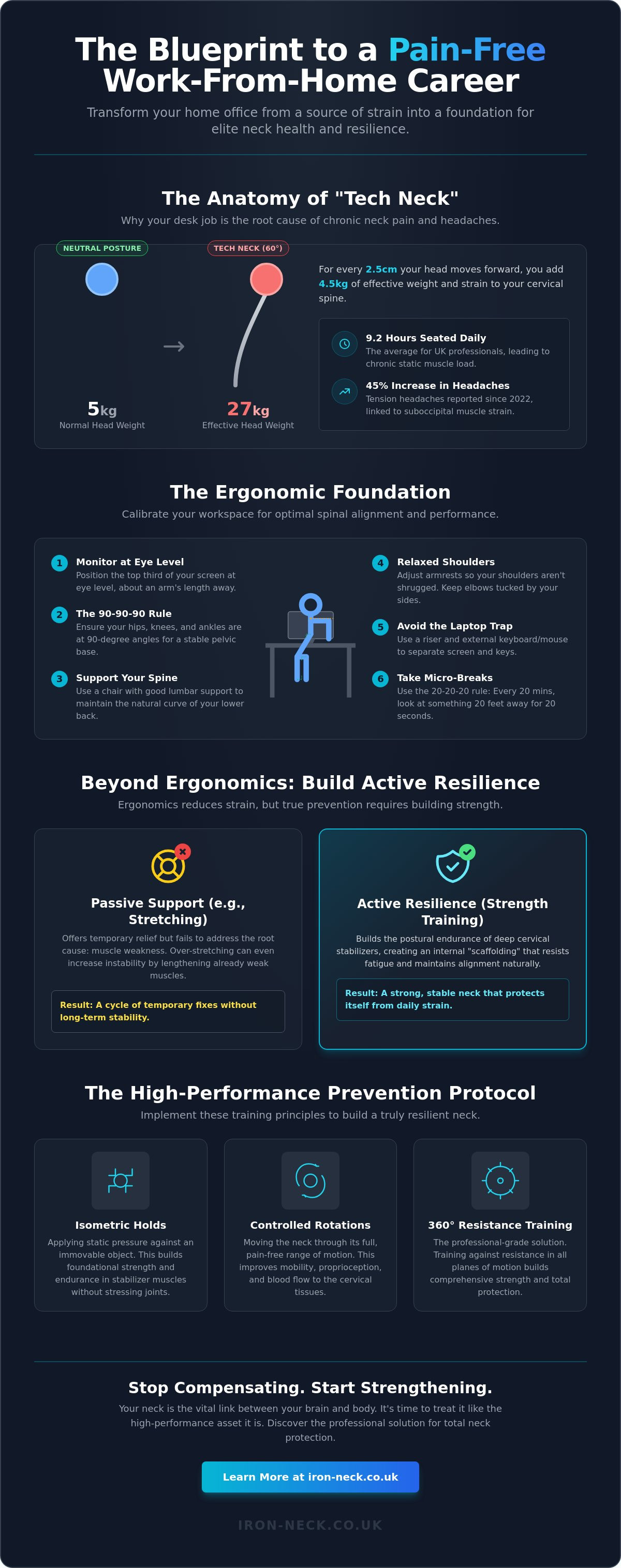
"Tech neck" is more than a modern catchphrase; it's the clinical result of prolonged cervical flexion. When you lean toward a screen, you disrupt the natural alignment of the cervical spine. The physics are unforgiving. For every 2.5 centimetres your head moves forward from its neutral axis, it gains an additional 4.5kg of effective weight. A head that typically weighs 5kg can effectively weigh 27kg when tilted at a 60-degree angle. This mechanical overload is a leading cause of Repetitive Strain Injury among the 44% of UK workers who now operate from home at least part-time.
The suboccipital muscles at the base of the skull are the primary source of tension headaches. These muscles work overtime to keep your eyes level with the horizon despite the forward lean. It's vital to distinguish between acute muscle fatigue and long-term structural changes. While fatigue disappears after rest, chronic misalignment leads to ligamentous creep and bone remodelling. Learning how to prevent neck pain when working from home requires moving beyond temporary fixes to address these structural shifts.
The Role of the Deep Cervical Stabilisers
Small stabiliser muscles, known as the deep cervical flexors, act as the internal scaffolding for your neck. These muscles often fail during long bouts of sitting because they're built for endurance rather than high-force output. When they fatigue, the upper trapezius and levator scapulae overcompensate, creating that "heavy shoulder" sensation. Proprioception is the sensory feedback loop that allows your brain to perceive the position and orientation of your neck in space. When stabilisers fail, your postural awareness vanishes, leaving you slumped without even realising it.
Why Traditional "Office Stretches" Often Fail
Stretching is often the first recommendation for WFH discomfort, yet it frequently misses the mark. While a quick trap stretch offers temporary neurological relief, it doesn't solve the underlying weakness. There's a fundamental difference between passive flexibility and active stability. Over-stretching muscles that are already inhibited or "weak-long" can actually increase joint instability and trigger more guarding. To truly master how to prevent neck pain when working from home, you must focus on capacity rather than just range of motion. Strength is the missing link in spinal health.
The Ergonomic Foundation: Setting Up Your Home Office
Eliminating discomfort starts with biomechanics. If your workstation isn't calibrated to your anatomy, you're forcing your stabilizer muscles to compensate for hours on end. To master how to prevent neck pain when working from home, you must treat your desk setup as a performance environment. This begins with the 90-90-90 rule. Your ankles, knees, and hips should all maintain 90-degree angles. This alignment ensures your pelvis is neutral, providing a stable base for the rest of your spine.
Your monitor height dictates your cervical spine's position. Position the top third of your screen at eye level. This prevents the "forward head posture" that can increase the effective weight of your head on your neck to over 27kg. Integrating specific ergonomic adjustments for your workstation reduces the mechanical load on your vertebrae. Additionally, keep your keyboard and mouse close enough that your elbows remain tucked at your sides. This prevents protracted shoulder positions, which pull the neck into a strained, forward tilt.
- Lumbar Support: Use a chair that supports the natural inward curve of your lower back. This foundational support directly influences the curvature of your neck.
- Screen Distance: Keep your monitor about an arm's length away to reduce eye strain and the tendency to lean forward.
- Armrest Height: Adjust armrests so your shoulders remain relaxed and down, not shrugged toward your ears.
Laptop vs. Desktop: The WFH Trap
Laptops are inherently non-ergonomic because the keyboard and screen are joined. This forces a compromise: you either strain your wrists to keep the screen at eye level, or you strain your neck to look down at the keys. To fix this, use a dedicated laptop riser or even a stack of sturdy books to elevate your line of sight. Pair this with a separate Bluetooth keyboard and mouse. This simple separation allows you to maintain a neutral cervical spine while keeping your forearms parallel to the floor.
The 20-20-20 Rule and Micro-Breaks
Static loading is the enemy of performance. Even a perfect setup becomes a liability if you stay in it too long. Implement the 20-20-20 rule: every 20 minutes, look at an object 20 feet away for at least 20 seconds. This resets your eye muscles and breaks the trance of poor posture. Supplement these moments with "movement snacks" like shoulder blade retractions or chin tucks. These cues reset your posture during calls and ensure your muscles don't lock into a rigid, painful state. Strengthening the supporting tissues is the next step, and you can find specialized tools at iron-neck.co.uk to build that lasting resilience.
Beyond Ergonomics: The Case for Neck Resistance Training
Adjusting your chair height and monitor level is a logical starting point, but ergonomics alone cannot solve a biological deficiency. If your muscles lack the capacity to support your head, pain is inevitable. Neck resistance training is the missing link in modern remote work setups. By 2026, data from occupational health studies indicates that static loading from prolonged screen use places as much strain on the cervical spine as high-impact sports. You don't need to be a professional athlete to require an elite level of neck stability.
Strength is your primary shield. While an ergonomic desk setup reduces external stress, resistance training builds internal resilience. This process involves isometric loading, a method where muscles contract without changing length. Scientific research suggests that consistent isometric tension helps with pain desensitisation by altering how the nervous system processes signals from the cervical region. It transforms a vulnerable, stiff neck into a robust system capable of handling the demands of an eight-hour shift. Understanding how to prevent neck pain when working from home requires moving past passive stretches and embracing active stabilisation.
Building Postural Endurance
Postural endurance is your ability to maintain a neutral cervical position without succumbing to fatigue. When your muscles tire, your head drifts forward, increasing the effective weight on your spine from 5kg to nearly 27kg at a 60-degree tilt. Stronger deep neck flexors and extensors reduce this mechanical load on your spinal discs and ligaments. Interestingly, the same training that builds this endurance also increases concussion resistance, serving as a powerful proxy for general spinal safety and long-term structural integrity.
Addressing the #1 Objection: "Will neck training make my neck look bulky?"
Many office workers avoid resistance training because they fear developing a thick, "linebacker" neck. This is a myth. Achieving significant muscular hypertrophy requires specific, high-volume hypertrophy protocols and caloric surpluses that go far beyond standard functional training. For the remote professional, resistance work is about efficiency and stability, not size. You are training for:
- Proprioception: Better awareness of where your head is in space.
- Mobility: Ensuring a full, pain-free range of motion.
- Deceleration: The ability to control movement and prevent micro-trauma.
Elite-level strength is about how well your muscles fire to protect your joints. By integrating resistance, you ensure your body is physically prepared for the digital environment. This proactive approach is the most effective strategy for how to prevent neck pain when working from home over the long term. It's time to stop treating the symptoms with heat packs and start addressing the foundational weakness.
The Active Prevention Protocol: 4 Exercises for Resilience
Ergonomic chairs and standing desks provide a helpful starting point, but they are only half the battle. If you want to know how to prevent neck pain when working from home, you must transition from passive support to active resilience. This protocol targets the "missing link" in home office health: the deep cervical stabilizers. A 2024 study published in the Journal of Physical Therapy Science demonstrated that specific isometric training reduced chronic neck pain scores by 32% over a six-week period. By following a methodical approach, you can transform your neck from a point of vulnerability into a foundation of strength.
Isometric Neck Flexion Guide
The chin tuck is the foundational movement for correcting the forward head posture commonly known as "tech neck." Start by sitting tall with your shoulders relaxed. Pull your chin straight back as if you're trying to make a double chin, keeping your gaze level with the floor. You should feel the deep muscles at the front of your neck engage. It's vital to avoid the common mistake of jutting your jaw or holding your breath. Keep your respirations steady and fluid. Perform 10 repetitions with a 5-second hold twice a day to reset your postural alignment.
Improving Rotational Capacity
Stiffness often manifests as a "blind spot" when you turn your head to look at a secondary monitor or reach for a phone. This restricted range of motion is a sign that your stabilizer muscles are overactive and protective. To fix this, you need to introduce light, controlled resistance into your rotation. This builds proprioception and strength through the entire 180-degree arc. Remember that cervical rotation is intrinsically linked to thoracic mobility. If your upper back is locked in a slumped position, your neck cannot rotate efficiently. Integrating these movements ensures your spine moves as a cohesive unit.
Implementing this 4-step protocol daily will build the structural integrity required for long-term health:
- Step 1: Isometric Holds: Activates the deep neck flexors to keep the head aligned directly over the shoulders.
- Step 2: Controlled Rotations: Improves multi-directional mobility and eliminates restricted movement patterns caused by static sitting.
- Step 3: Scapular Retractions: Squeezing the shoulder blades together supports the base of the neck and counters the rounded-shoulder "slump."
- Step 4: Lateral Flexion: Tilting the ear toward the shoulder under light resistance builds lateral stability and protects against sudden movements.
Building a neck that resists the strain of the remote workday is an investment in your performance. Discover the science behind professional neck training equipment to unlock your full potential and eliminate discomfort for good.
The Iron Neck Approach: Professional Solutions for Home Use
Traditional home office advice focuses almost entirely on external factors like chairs and monitor heights. This is only half the battle. To truly master how to prevent neck pain when working from home, you must address the physical capacity of your cervical spine. The Iron Neck represents the missing link in WFH health. It's a professional-grade tool adapted for home use that bridges the gap between passive ergonomics and active resilience.
Most manual exercises, such as chin tucks or static stretches, only offer linear resistance. They don't account for the complex, multi-planar movements the neck performs daily. The Iron Neck halo-style device provides 360-degree resistance that manual exercises can't match. By applying constant tension during rotation, it forces the deep stabilizer muscles to engage. This builds a level of functional strength that protects the spine from the repetitive strain of digital work.
Fix Your Posture with the Iron Neck
The mechanism behind the Iron Neck is rooted in proprioception and eccentric loading. When you sit at a desk, your head naturally drifts forward. This "tech neck" posture can increase the effective weight of your head on your spine from 5kg to over 27kg. The Iron Neck uses rotational tension to counteract this pattern, pulling the user into a neutral alignment. It's a proactive way to understand how to prevent neck pain when working from home by training the body to maintain better posture automatically.
- Efficiency: Just 5 minutes of training a day can counteract 8 hours of static desk work.
- Clinical Backing: Rehab professionals and physiotherapists use this technology to treat chronic cervical issues; studies indicate that targeted neck strengthening can reduce the frequency of tension headaches by up to 50%.
- Muscle Activation: It targets the suboccipital muscles and upper trapezius, which are the primary sites of WFH-related tension.
Choosing the Right Equipment
It's vital to distinguish the Iron Neck from traditional head harnesses. Standard harnesses are designed for linear, weighted movements that often involve high axial loading. This can be dangerous for beginners or those already suffering from disc compression. The Iron Neck is significantly safer because it utilizes resistance bands and a patented circular track. This setup allows for controlled, multi-planar movement without the risk of straining the spine under heavy, vertical weight.
Investing in professional equipment is a long-term play for spinal longevity. By building a resilient neck, you're not just treating symptoms; you're bulletproofing your body against the demands of a modern career. You can shop the Iron Neck collection to start your recovery today and transform your home office into a high-performance recovery lab. Strengthening the foundation of your movement is the most effective way to ensure your body remains as sharp as your mind.
Build Your Foundation for Lasting Resilience
Ergonomics alone won't solve the "tech neck" epidemic. While a proper desk setup reduces immediate strain, true resilience comes from strengthening the 20+ muscles in your cervical spine. Research shows that static posture causes muscle atrophy over time; you must transition from passive support to active resistance training to maintain long-term health. By integrating specific protocols like the 360-degree rotational resistance used by professional physios, you treat the root cause of stiffness rather than just the symptoms.
Mastering how to prevent neck pain when working from home means investing in your body’s foundational strength. The Iron Neck is the missing link in modern WFH health. It's the same technology trusted by elite athletes and clinical specialists across the UK to eliminate pain and restore mobility. Our science-backed protocols provide a comprehensive solution for total neck health, ensuring your home office doesn't dictate your physical limitations. Stop settling for temporary relief and start building a neck that's engineered for performance.
Unlock a pain-free WFH experience with the Iron Neck
You've got the tools to change your physical trajectory. Take the first step toward a stronger, more resilient future today.
Frequently Asked Questions
How do I know if my neck pain is caused by my WFH setup?
If your pain intensifies during your shift and dissipates during weekends, your setup is likely the primary cause. A 2023 study by the Office for National Statistics (ONS) found that 28% of UK remote workers reported increased musculoskeletal issues since moving home. Look for "forward head posture" where your ears sit in front of your shoulders. This misalignment places up to 27kg of additional pressure on your cervical spine compared to a neutral position.
Can a standing desk really prevent neck pain?
A standing desk is a tool for postural variation, but it doesn't automatically solve how to prevent neck pain when working from home. Research suggests that alternating between sitting and standing every 30 minutes reduces muscle fatigue and improves circulation. However, if your monitor height remains too low while standing, you'll still experience cervical strain. Proper ergonomics require the top third of your screen to stay at eye level to maintain a neutral gaze.
Is it safe to do neck exercises if I already have a stiff neck?
Controlled isometric exercises are generally safe and recommended for managing non-specific mechanical neck pain. NHS guidelines suggest gentle movement to prevent the stabilizer muscles from weakening further. If you experience sharp, radiating pain or numbness in your arms, stop immediately and consult a GP. Start with low-impact rotations to improve blood flow and reduce the 15% drop in range of motion often seen in sedentary workers.
How long does it take to see results from neck strengthening?
Most individuals report a measurable reduction in stiffness within 4 to 6 weeks of consistent training. A 2022 clinical trial showed that performing targeted resistance exercises three times per week led to a 40% increase in neck muscle endurance over two months. Strengthening these foundational muscles is the missing link to long-term resilience. Consistency is vital to ensure the cervical spine can support the weight of your head during long hours at a desk.
What is the best chair for preventing neck and shoulder pain?
The best chair is an adjustable ergonomic model that provides active lumbar support and high backrest coverage. Look for chairs certified by the Chartered Institute of Ergonomics and Human Factors (CIEHF). These designs ensure your pelvis remains neutral, which directly impacts your head position. Without proper pelvic alignment, your upper back rounds, forcing your neck into a strained, hyperextended state for 8 hours a day.
Does "Tech Neck" lead to permanent spinal damage?
Prolonged "Tech Neck" can lead to accelerated disc degeneration and permanent structural changes if left unaddressed for several years. Chronic forward head posture increases the load on the intervertebral discs by up to 500%. This repetitive stress often results in a loss of the natural cervical curve, which is visible on X-rays. Reversing these effects requires a holistic approach of ergonomic correction and specific strength training to restore proper proprioception.
How can I stop getting tension headaches while working?
You can stop tension headaches by addressing the triggers in your suboccipital muscles, which often tighten during poor WFH sessions. Implementing the 20-20-20 rule and performing chin tucks every hour can reduce headache frequency by 35%. These headaches are frequently a secondary symptom of poor posture. Strengthening the deep neck flexors provides the structural support needed to prevent these muscles from overworking and causing referred pain.
Is a neck harness or the Iron Neck better for posture correction?
The Iron Neck is superior for posture correction because it offers 360-degree resistance and linear braking, which a standard neck harness lacks. Traditional harnesses only provide vertical resistance, whereas the Iron Neck targets the stabilizer muscles through every plane of motion. This clinical-grade versatility makes it the #1 piece of equipment for fixing "tech neck." It trains the body to maintain an upright position, effectively solving how to prevent neck pain when working from home.