

How to Avoid Neck Strain: A Science-Backed Guide to Prevention in 2026
What if the persistent tension in your cervical spine is more than just a nuisance, but a structural failure waiting to happen? You likely accept that hours spent hunched over a laptop or smartphone are the primary culprits behind those recurring tension headaches. It's a reality for the 70% of UK office workers who report neck discomfort annually according to recent health surveys. You understand that chronic stiffness isn't just uncomfortable; it's a direct barrier to your peak physical performance and long-term health.
Learning how to avoid neck strain requires more than just ergonomic furniture or occasional stretching. You need a proactive, methodical approach to cervical health. This guide reveals the professional-grade strategies and foundational strengthening protocols used by elite athletes to eliminate pain and build lasting resilience. We'll examine the clinical science of stabilizer muscles and provide a science-backed routine to transform your posture and protect your spine against impact injuries for 2026 and beyond.
Key Takeaways
- Understand the biomechanics of the "bowling ball" effect and how static loading leads to micro-tears in the cervical spine.
- Discover how to avoid neck strain by moving beyond temporary stretching and addressing the foundational weakness at the core of "tech neck."
- Optimise your workspace with elite ergonomic standards that maintain a neutral spine and eliminate unnecessary structural stress.
- Learn a professional-grade routine of isometric holds and dynamic movements designed to build lasting cervical resilience.
- Explore why 360-degree resistance is "The Missing Link" for athletes looking to bulletproof their neck and unlock peak physical performance.
Understanding the Mechanics of Neck Strain and "Tech Neck"
Neck strain is often misunderstood as simple stiffness, but the clinical reality is more complex. It involves micro-tears in the muscle fibres or tendons, typically triggered by overextension or prolonged static loading. When these tissues are stretched beyond their elastic limit, the body initiates an inflammatory response to repair the damage. Understanding this biological process is the first step in learning how to avoid neck strain and maintaining long-term cervical health.
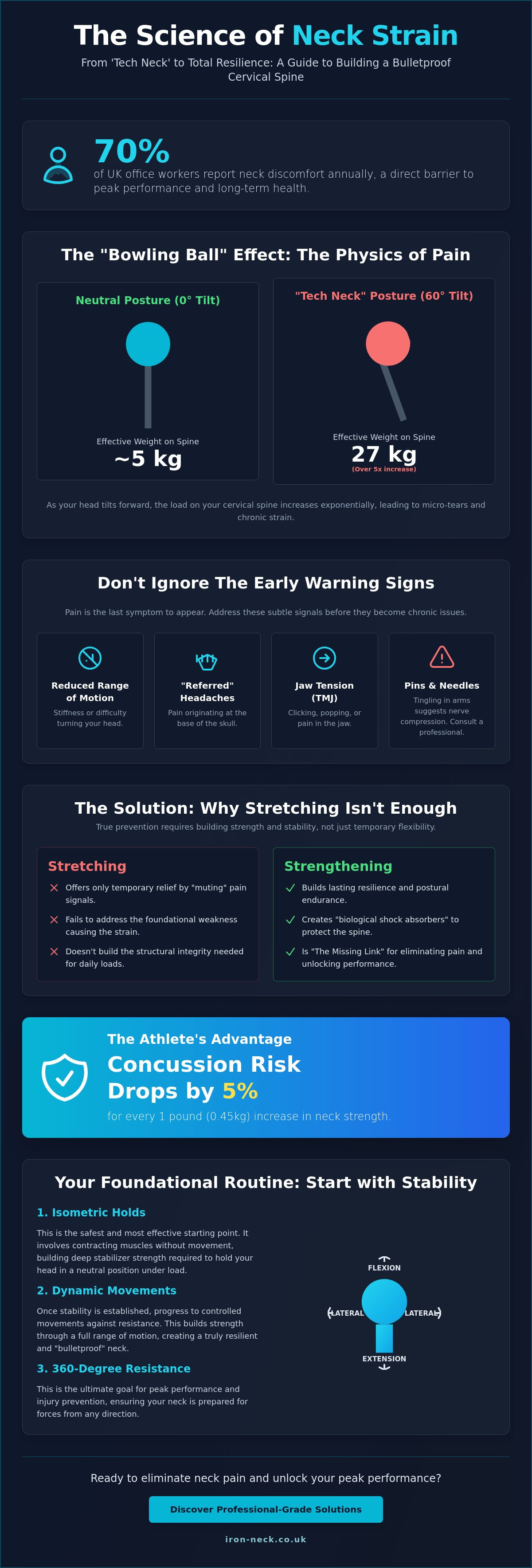
The human head functions much like a bowling ball balanced on a narrow column. In a neutral, upright position, the average adult head weighs between 4.5kg and 5.5kg. However, physics dictates that as the head tilts forward, the effective weight on the cervical spine increases exponentially. At a 60-degree angle, common when looking at a smartphone, the load on your neck structures reaches approximately 27kg. This "bowling ball" effect places immense pressure on the primary muscles involved in head stabilisation, specifically the trapezius, levator scapulae, and sternocleidomastoid.
It's vital to distinguish between the two types of injury. Acute strain occurs from sudden, high-force movements, such as a sports collision or whiplash. Chronic strain is a repetitive stress injury that develops over months or years of poor mechanics. For those seeking a deeper clinical classification of these conditions, Understanding Neck Pain provides a comprehensive overview of cervicalgia and its diagnostic pathways.
The Impact of Prolonged Static Loading
Holding a single position at a desk for hours leads to muscle ischaemia. This is a condition where blood flow is restricted, depriving tissues of oxygen and allowing metabolic waste products to accumulate. This environment causes rapid muscle fatigue and weakens the deep neck flexors, which are the internal stabilisers responsible for postural integrity. Tech Neck is a repetitive stress injury caused by forward-head posture.
Identifying Early Warning Signs
Pain is often the final symptom to appear, not the first. Early indicators include a reduced range of motion and "referred" headaches that originate at the base of the skull. You should also monitor for jaw tension, as Temporomandibular Joint (TMJ) issues are frequently linked to upper cervical strain. If you experience "pins and needles" or a tingling sensation radiating down the arms, this suggests nerve root compression. In the UK, the NHS recommends an immediate professional consultation if these neurological symptoms occur, as they may indicate a more serious disc issue rather than a simple muscle strain. Mastering how to avoid neck strain requires responding to these subtle signals before they escalate into chronic dysfunction.
The Science of Prevention: Why Stretching is Only Half the Battle
Most people reach for a stretch the moment they feel tightness. While this offers temporary relief, it fails to address the underlying cause of discomfort. If you want to understand how to avoid neck strain for the long term, you have to look beyond flexibility. Stretching effectively "mutes" the pain signal, but it doesn't provide the structural integrity required to support the 5kg weight of your head during a ten-hour workday.
Neck strength is "The Missing Link" in modern physical health. Stronger muscles act as biological shock absorbers for the cervical spine. They dissipate external forces before they can reach your vertebrae or intervertebral discs. This protective capacity is measurable. Data from the Datalys Center indicates that for every one pound of increased neck strength, concussion risk in high-impact scenarios drops by 5%. Whether you're an elite athlete or a remote professional, a resilient neck is your first line of defence against injury.
Following Harvard's Guide to Neck Pain Prevention is a great starting point for ergonomic adjustments, but true prevention requires active loading. Strength creates a stable environment that allows the nervous system to relax, effectively reducing the "protective guarding" that we often mistake for simple muscle tightness.
Isometric Strength and Cervical Stability
Isometric training involves contracting muscles without changing their length. It's the safest entry point for neck training because it eliminates the shear forces associated with rapid, multi-directional movement. By holding a fixed position against resistance, you build the stability required to keep the cervical spine neutral under pressure. This foundational stability does more than stop pain; it improves peripheral vision and reaction time by providing a steady, vibration-free platform for your eyes and vestibular system.
Building Proprioception in the Neck
A strong neck is also a "smart" neck. This is due to proprioception, your body's ability to sense its position and movement in space. Your suboccipital muscles, located at the base of the skull, are densely packed with sensory receptors. When these muscles are properly conditioned, they function like an internal GPS. They auto-correct your posture the moment you begin to slouch, preventing the repetitive stress that leads to chronic issues. Training for proprioception ensures your neck can react to 2026’s digital demands with precision.
Building this foundation ensures your body can handle the daily rigours of modern life without breaking down. If you're ready to move beyond basic stretches, exploring advanced neck training systems can help you build the resilience your cervical spine deserves.
Ergonomic Mastery: Setting Up Your Environment for Success
Your workspace shouldn't be a source of chronic injury. If you spend eight hours a day in a fixed position, your environment dictates your anatomy. Mastering how to avoid neck strain starts with a clinical approach to your desk setup. Position your monitor so the top third of the screen aligns with your neutral eye level. This prevents the cervical spine from tilting into constant flexion or extension, which are primary drivers of muscular fatigue. Adjust your chair height so your feet rest flat on the floor with your hips slightly above your knees. This alignment tilts the pelvis forward, naturally supporting the spine's lumbar curve and reducing the compensatory strain on your neck stabilizer muscles.
Modern communication habits often sabotage posture. Use a headset for all calls to eliminate "phone-ear" shrugging. This habit forces the upper trapezius into a sustained contraction, leading to trigger points and tension headaches. When using mobile devices, prop tablets or phones at a 45-degree angle. Looking straight down at a device increases the effective weight of your head on your neck to approximately 27kg. By raising the device, you maintain a neutral gaze and protect the integrity of your cervical discs.
The "Micro-Break" Strategy
Consistency beats intensity when it comes to postural health. Implement the 20-20-20 rule: every 20 minutes, look at an object 20 feet away for 20 seconds. This resets your visual focus and encourages a shift in neck position. During these intervals, perform "chin tucks" for 30 seconds. This corrective exercise activates the deep neck flexors, the foundational muscles responsible for stability. This Harvard Medical School guide to preventing neck pain emphasizes that small, frequent movements are more effective than one long stretching session at the end of the day. If you use a standing desk, ensure your screen height is adjusted independently of your keyboard to prevent "tech neck" while standing.
Sleep Posture and Spinal Alignment
Recovery is a critical component of how to avoid neck strain. Your sleep posture determines whether your muscles actually recover or remain under tension. Prioritise side or back sleeping over stomach sleeping. Stomach sleeping forces the neck into extreme cervical rotation for hours, which can lead to joint stiffness and nerve irritation. Choose a pillow height that keeps your neck parallel to the mattress. If the pillow is too high or too low, the neck is forced into a lateral bend. A firm mattress is also essential, providing the necessary resistance to keep your entire spine in a neutral, supported state throughout the night.
A Foundational Routine to Bulletproof Your Neck
Building a neck that resists injury requires more than occasional stretching. To understand how to avoid neck strain, you must implement a systematic approach that prioritises both stability and mobility. This routine serves as the "missing link" in most fitness programmes, moving beyond the surface level to target deep cervical stabilisers. A resilient neck acts as the foundation for all movement, protecting the central nervous system while enhancing overall athletic performance.
- Dynamic Warm-ups: Begin with slow, controlled rotations and side-to-side tilts. Perform 12 repetitions per side to increase synovial fluid flow and local tissue temperature. This prepares the cervical spine for the loads to follow.
- Isometric Holds: Apply resistance in four directions: front, back, left, and right. Hold each position for 10 to 15 seconds. These contractions build foundational tension without putting undue stress on the intervertebral discs.
- Eccentric Loading: Focus on the lowering phase of each movement. Controlling the muscle as it lengthens is proven to increase muscle fascicle length. This protocol significantly reduces the risk of strains during explosive movements.
Effective training requires a 360-degree perspective. Neglecting the lateral or rotational muscles creates imbalances that lead to chronic pain and reduced proprioception. By addressing every angle, you ensure the cervical spine remains protected regardless of the direction of force. This holistic approach is what separates elite conditioning from basic rehabilitation.
Integrating Resistance Bands
Resistance bands are essential for safe home training because they provide linear resistance. This means the load increases as the band stretches, allowing for a safer "ramp-up" of tension that protects delicate joints. The "face pull" is a critical exercise for this routine. It strengthens the posterior chain and pulls the scapulae into a neutral position, correcting the rounded shoulders associated with "tech neck." Secure your bands to a door anchor or a sturdy post at eye level to maintain proper mechanics and ensure consistent tension throughout the range of motion.
The Importance of Rotational Power
Data from sports medicine clinics indicates that a high percentage of cervical injuries occur during sudden, high-velocity rotation. Training the neck to resist these "whiplash" forces is non-negotiable for long-term health. Rotational exercises teach your muscles to decelerate movement effectively, providing a shield against unexpected impacts. When performing heavy compound lifts like deadlifts or squats, always maintain a neutral spine. This alignment is a fundamental rule for how to avoid neck strain; it ensures that your power is transferred efficiently through the torso rather than leaking through a weak cervical link.
Unlock your full athletic potential and protect your spine with Iron Neck training equipment.
Iron Neck: The Ultimate Tool for Long-Term Resilience
Traditional rehabilitation often fails because it treats the neck as a static pillar. To understand how to avoid neck strain in a world that constantly pulls your head forward, you must address the cervical spine's need for multi-planar stability. The Iron Neck is the only device on the market providing 360-degree isometric and dynamic resistance. Its patented "Halo" design allows for natural movement patterns, ensuring that your stabilizer muscles are engaged from every angle. This isn't just a fitness accessory; it's a scientific solution to a modern physiological crisis.
The system utilizes an adjustable friction dial to facilitate progressive overload. This feature allows users to increase resistance systematically as their strength improves, much like adding plates to a barbell. By applying consistent tension during rotation and flexion, the device helps restore proper biomechanics and eliminates the "missing link" in most strength programmes. It's a foundational investment in a future free from chronic pain and structural degredation.
Why Elite Athletes Prioritise Neck Training
Neck strength is a non-negotiable requirement in high-impact environments. In Formula 1, drivers use the Iron Neck to withstand lateral G-forces that can reach 5G during cornering. Similarly, professional Rugby and MMA athletes rely on this technology for concussion mitigation and injury prevention. A stronger neck acts as a shock absorber for the brain, reducing the acceleration of the head during a collision. This physical protection creates a psychological edge; athletes perform better when they feel structurally sound.
For the modern professional, this training translates to "postural endurance." The same muscles that protect a rugby player in a scrum are responsible for keeping your head aligned during a ten-hour workday. Strengthening these deep cervical flexors ensures your body doesn't collapse into a "tech neck" slump by mid-afternoon. Research indicates that even ten minutes of targeted resistance training can significantly reduce the frequency of tension headaches caused by postural fatigue.
Getting Started with Your Iron Neck
Choosing the right equipment depends on your specific performance goals. The "Starter" model is an excellent entry point for those focused on standard rehabilitation and fixing everyday postural issues. If you're an athlete or a high-performance enthusiast, the "Pro" model offers the full range of friction adjustments required for advanced strength gains. Both systems integrate with app-based coaching and verified training protocols to ensure you're moving safely and effectively from day one.
Consistency is the primary driver of long-term resilience. By incorporating these movements into your weekly routine, you're not just treating symptoms; you're building a robust physical foundation. Explore the Iron Neck range and start your journey to a stronger neck today.
Build a Foundation for Lifelong Resilience
Mastering your cervical health requires more than a standing desk or a quick stretch. You've learned that true resilience comes from addressing the mechanics of the spine and strengthening the stabilizer muscles that support your daily movement. Understanding how to avoid neck strain is the first step toward reclaiming your performance and eliminating the chronic fatigue associated with modern posture.
Iron Neck serves as the definitive solution for those ready to move beyond passive care. It delivers the 360-degree multi-directional training required to build a functional, bulletproof neck. This technology is currently utilized by over 500+ professional and collegiate athletic teams to reduce injury risk and enhance stability. Every claim is supported by peer-reviewed research, ensuring you're using a tool that's as effective as it's safe. Don't settle for managing discomfort when you can build the foundation for a life without physical limitations.
Unlock your potential with the world’s #1 neck trainer
The path to peak performance and a pain-free future is yours to take.
Frequently Asked Questions
How can I tell if my neck pain is serious?
You should seek immediate medical attention if your neck pain is accompanied by radiating numbness, weakness in your hands, or a loss of bladder control. According to the NHS, roughly 1 in 10 cases of neck pain involve nerve root compression or systemic issues that require specialist intervention. If your symptoms persist for more than 6 weeks or follow a high-impact trauma, consult a healthcare professional to rule out cervical spine instability or structural damage.
Can neck exercises help with tension headaches?
Yes, targeted neck exercises significantly reduce the frequency and intensity of tension headaches by strengthening the deep cervical flexors. A 2023 study published in the Journal of Orthopaedic & Sports Physical Therapy found that patients performing specific resistance training saw a 50% reduction in headache days over a 12-week period. Strengthening these muscles provides the missing link in postural support, preventing the muscular overcompensation that leads to tension-type pain.
How often should I train my neck to avoid strain?
You should perform specific resistance training 2 to 3 times per week to effectively learn how to avoid neck strain. Research from the University of Exeter suggests that muscles in the cervical region require 48 hours of recovery between high-intensity sessions to facilitate optimal protein synthesis. Consistency is vital; a 15-minute protocol twice weekly is more effective for building long-term resilience than infrequent, high-volume sessions that lead to excessive fatigue.
Is it safe to train your neck if you already have a stiff neck?
It's generally safe to perform low-intensity isometric holds or gentle range-of-motion movements, but you must avoid heavy resistance during an acute inflammatory phase. If your stiffness is caused by a minor muscular strain, light movement can increase blood flow by 20% to the affected tissues, which accelerates the healing process. However, if you experience sharp, lancinating pain during any movement, stop immediately and focus on recovery before reintroducing load to the spine.
Do I need a gym to strengthen my neck muscles?
You don't need a commercial gym membership to build a robust cervical spine, as portable resistance tools allow for professional-grade training at home. While bodyweight isometrics provide a basic starting point, 360-degree resistance training is the gold standard for developing total neck stability. Using a dedicated device for just 10 minutes a day can provide the mechanical load necessary to stimulate muscle growth and improve your posture without bulky gym machinery.
What is the best sleeping position for neck strain?
Sleeping on your back or side is the most effective way to maintain neutral cervical alignment and prevent overnight strain. Data indicates that stomach sleeping forces the neck into a 90-degree rotation for extended periods, which places 30% more stress on the facet joints. Using a contoured pillow that fills the 10-12 centimetre gap between your ear and the mattress ensures your spine remains in a foundational, supported position throughout the night.
Can "tech neck" be reversed with exercise?
You can reverse the structural and muscular imbalances caused by tech neck through a combination of posterior chain strengthening and cervical retraction exercises. A 2024 clinical review showed that participants who engaged in an 8-week corrective exercise programme improved their forward head posture by an average of 1.5 centimetres. Strengthening the stabilizer muscles acts as a corrective force against the 27 kilograms of pressure exerted on the spine when leaning forward at a 60-degree angle.
How long does it take to see results from neck strengthening?
Most individuals notice a measurable improvement in mobility and a reduction in daily discomfort within 4 to 6 weeks of starting a consistent programme. This timeframe aligns with the initial phase of neurological adaptation, where your brain becomes more efficient at recruiting existing muscle fibres. Understanding how to avoid neck strain involves committing to a long-term strategy, as significant hypertrophy and structural resilience typically peak after 12 weeks of progressive loading.