

Exercises for Cervicalgia Relief: A Clinical Guide to Strengthening and Recovery in the UK
Your daily stretching routine might be the very thing keeping you trapped in a cycle of persistent neck pain. While standard advice often suggests passive flexibility, clinical data suggests that stretching alone fails to address the underlying muscular imbalances that cause a dull, radiating ache in the cervical spine. You’ve likely spent weeks following generic advice, only to find your range of motion hasn't improved by even 5 degrees after a full month of effort. It’s a common frustration that leaves many people across the country fearing they might cause more damage through movement.
We're here to change that narrative by providing a science-backed strengthening protocol. You'll discover why building robust stabilizer muscles is the missing link for lasting exercises for cervicalgia relief UK and how to regain the confidence to return to work or sport without stiffness. This guide breaks down the clinical evidence for resistance-based recovery and provides a methodical framework to help you eliminate pain and unlock your full physical potential.
Key Takeaways
- Understand the clinical drivers of neck pain in the UK, from sedentary behaviour to "tech neck," and why identifying the root cause is essential for long-term recovery.
- Discover why traditional passive stretching provides only temporary relief and how active resistance training builds the foundational strength required for a pain-free life.
- Learn to isolate the "missing link" in your rehabilitation-the deep neck flexors-to prevent global mobilisers from overcompensating and causing chronic tension.
- Implement a science-backed, 3-stage programme featuring targeted exercises for cervicalgia relief UK to restore range of motion and build elite-level isometric stability.
- Explore how elite UK physiotherapists utilise rotational resistance to accelerate recovery and why professional-grade rehab is now achievable from the comfort of your home.
Understanding Cervicalgia: More Than Just a Stiff Neck
Cervicalgia isn't just a medical buzzword for a stiff neck. It's the specific clinical term for pain localized in the cervical spine that doesn't radiate into the arms or shoulders. While many people dismiss it as a minor inconvenience, it's often the first sign of structural instability. In the UK, cases of cervicalgia have surged as sedentary lifestyles become the norm. Data from 2024 suggests that nearly 30% of the UK population will experience neck pain this year, driven largely by "tech neck" and poor ergonomic setups in hybrid work environments.
Fixing this issue requires moving beyond the "Stretching Trap." Most people respond to tightness by stretching the upper trapezius or levator scapulae. This provides a fleeting 15 minute window of relief, but it doesn't solve the problem. If your neck feels tight, it's often because your muscles are overworking to stabilize a weak cervical spine. Stretching a muscle that's already struggling for stability can actually make the underlying weakness worse. Finding effective exercises for cervicalgia relief UK residents can implement starts with building strength, not just flexibility.
By 2026, the foundational approach to neck health will shift toward proactive resistance. We've spent decades treating the neck as an isolated pillar, but it's actually the missing link in total body performance. Whether you're recovering from whiplash after a road incident or combatting the effects of an 8 hour day at a desk, you need a strategy that prioritises cervical spine integrity. Strength is the only permanent solution to chronic stiffness.
Symptoms and When to Seek Professional Advice
Distinguishing between simple muscular fatigue and clinical cervicalgia is vital for your recovery. While muscular strain usually resolves within 48 hours, cervicalgia persists and often manifests as a dull, aching sensation at the base of the skull. You should monitor for "red flags" as defined by NHS 111 guidance. If your neck pain is accompanied by sudden weight loss, a high temperature, or pins and needles in your hands, seek immediate medical attention. Chronic stiffness doesn't just hurt; it drains your mental energy. Studies show that persistent neck discomfort can reduce daily work productivity by up to 20% due to "presenteeism," where you're at your desk but unable to focus.
The Role of the Cervical Spine in Movement
Your neck is the command centre for upper body proprioception. It houses the sensors that tell your brain where your head is in space. When these sensors are compromised by weakness, your balance and coordination suffer. This is why cervical stability is a primary factor in headache prevention. A weak neck can't support the weight of the head effectively, leading to tension headaches that originate in the suboccipital muscles. When searching for exercises for cervicalgia relief UK professionals often overlook the fact that "fixing your posture" isn't about willpower. You can't just "sit up straight" if the deep stabilisers of your neck lack the capacity to hold that position. You don't need better manners; you need a stronger foundation.
The Science of Stability: Deep Neck Flexors vs. Global Mobilisers
Effective rehabilitation starts deep within the cervical spine. The Longus Colli and Longus Capitis, known as your deep neck flexors, provide the essential stability required to support the weight of your head. In patients suffering from chronic pain, these muscles often undergo muscle inhibition. This is a neurological process where the brain stops effectively recruiting these stabilisers because of persistent pain signals. It's a protective mechanism that unfortunately leads to long-term dysfunction.
When these deep layers fail, global mobilisers like the upper trapezius and sternocleidomastoid must overcompensate. You've likely felt this as a constant, burning tightness in your shoulders or the sides of your neck. These larger muscles are designed for movement, not for holding the 5kg weight of your skull for sixteen hours a day. This compensation creates a cycle of tension and fatigue. Addressing this through specific exercises for cervicalgia relief UK patients can access is vital for breaking that cycle and restoring natural movement patterns.
Anatomy of a Resilient Neck
The cervical spine is capable of incredible range, yet most traditional gym movements are purely linear. Your neck requires 360-degree control to function correctly. The suboccipital muscles, located at the base of the skull, manage fine motor movements and proprioception. Strengthening these areas protects the entire kinetic chain. A weak neck often leads to compensations down into the thoracic spine and shoulders. Research indicates that 70% of chronic neck pain sufferers show significant weakness in these deep stabilising structures. Multi-directional resistance training is the missing link in modern rehabilitation, ensuring no weak spots remain in your cervical posture.
Why Isometrics are the Starting Point for Relief
Isometric training involves muscle contraction without joint movement. It's the safest entry point for anyone seeking exercises for cervicalgia relief UK wide. Science shows that isometric holds can induce exercise-induced hypoalgesia, effectively numbing the pain signal while building foundational strength. A 2019 study published in the Journal of Clinical Medicine found that isometric protocols significantly reduced pain intensity in 85% of participants within six weeks. This method allows you to load the tissue safely before progressing to dynamic movements. Incorporating a neck strengthening system allows you to apply this resistance from every angle, rebuilding the stability your body has lost to chronic pain.
By focusing on these deep stabilisers first, you create a foundation of safety. You aren't just stretching a tight muscle; you're retraining the nervous system to support the spine correctly. This shift from passive stretching to active stabilisation is what separates temporary relief from a permanent fix.
Stretching vs. Strengthening: Which Delivers Lasting Relief?
Most people in the UK reach for a heat pack or a foam roller when cervicalgia strikes. While these passive interventions offer immediate comfort, they rarely address the underlying mechanical dysfunction. You can't stretch your way out of a structural weakness. To achieve long-term results, you must transition from "feeling better" to "being stronger."
Passive stretching and massage provide what clinicians describe as neurological "noise" reduction. They temporarily dampen pain signals, but the effect is often transient. If you rely solely on these methods, you're merely managing symptoms rather than building resilience. In some cases, over-stretching segments of the cervical spine that are already hypermobile can lead to increased instability and further irritation of the nerves.
The Limits of Passive Therapy
Standard mobility drills, often found in basic NHS recovery leaflets, represent only the first 10% of a successful rehabilitation journey. These movements are essential for restoring basic range of motion, but they don't provide the stimulus needed for tissue adaptation. Relying on them indefinitely is a common mistake that leads to a plateau in recovery. Effective exercises for cervicalgia relief UK patients need must eventually incorporate load to create lasting physiological change.
- Transient relief: Static stretching typically only alters pain perception for 30 to 60 minutes.
- Stability risks: Excessive stretching can compromise the integrity of the ligaments supporting your vertebrae.
- The "Missing Link": Without resistance, your muscles don't learn how to stabilise the head during dynamic movement.
The Case for Resistance Training
There's a persistent misconception that strengthening the neck results in bulky, "thick" muscles. In reality, targeted resistance training focuses on the deep cervical stabilisers. These muscles act like a natural brace for your spine. By improving the capacity of these tissues, you build a "buffer" against the physical stresses of modern life, such as the 12kg of force exerted on your neck when leaning over a laptop.
Resistance training does more than just build muscle; it improves bone density and ligamentous strength. This is why neck conditioning is a cornerstone of "concussion resistance" in UK contact sports like rugby and MMA. Data suggests that for every 1lb increase in neck strength, the risk of a concussion can decrease by approximately 5%. This same protective factor applies to everyday life. A stronger neck is your best defence against whiplash during a sudden car braking event or a trip and fall.
When you integrate progressive loading into your exercises for cervicalgia relief UK programme, you're training the nervous system to handle unpredictable forces. It's about creating a robust system that doesn't "lock up" at the first sign of fatigue. True relief isn't found in the absence of movement, but in the mastery of it under tension.
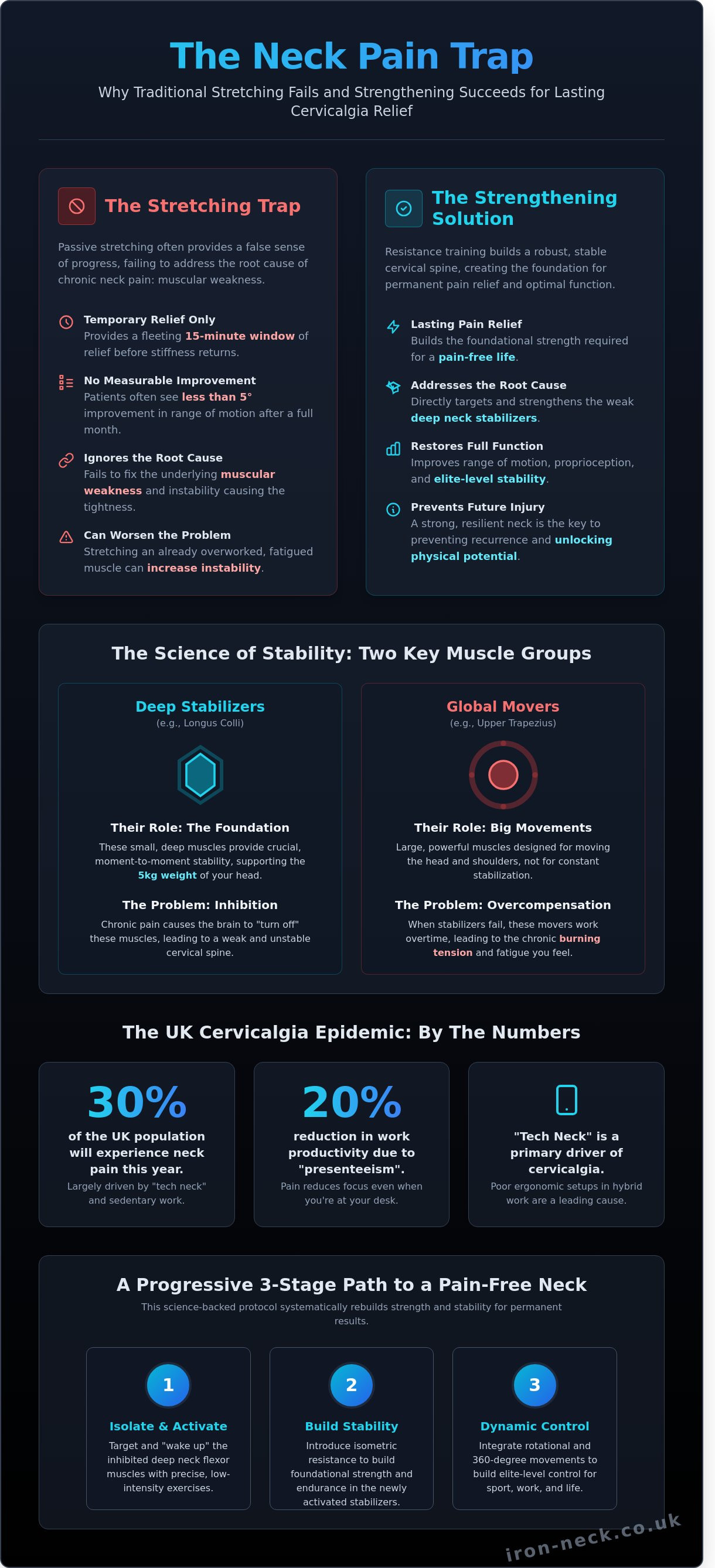
A Progressive 3-Stage Exercise Protocol for Cervicalgia
Effective rehabilitation for neck pain follows a logical sequence. You can't build strength on a foundation of restricted mobility or inflamed tissue. This 3-stage protocol outlines the path from initial relief to long-term resilience. It's designed to help you integrate exercises for cervicalgia relief UK into your daily routine safely and methodically.Stage 1: Mobility and Decompression
The NHS Foundation for neck care begins with restoring pain-free movement. Start with chin tucks and gentle lateral tilts while seated with a neutral spine. Avoid shrugging your shoulders or jutting your chin forward during these movements. Add scapular retractions by pulling your shoulder blades together to address the "shoulder to neck" tension that often exacerbates cervicalgia. The Chin Tuck is the foundational movement for cervical alignment. Perform these movements slowly. Focus on the quality of the contraction rather than the speed. If you feel a sharp pinch, reduce the range of motion. Consistency in this stage prepares the cervical spine for the heavier loads required in later phases.Stage 2: Isometric Loading
Once mobility is pain-free, you must build stability. Isometric holds involve applying force without moving the joint. Perform frontal, lateral, and posterior holds by pressing your head against your palm. This builds the base of strength needed to support the skull's weight throughout the day. Using your own hand is convenient for office-based relief, but it has drawbacks. It's difficult to measure progress or maintain consistent force. To progress, focus on increasing time under tension. Start with 10-second holds and work up to 45 seconds. Only increase the force once you can hold the position with perfect form for the full duration.Stage 3: Integrated Resistance with Iron Neck
Traditional weights and static holds often fail to target the small stabiliser muscles through a full range of motion. The Iron Neck provides 360-degree rotation, which is the ultimate cervicalgia exercise for functional strength. This system isolates muscles that traditional resistance training misses by applying constant tension from every angle. The "Figure 8" movement is a cornerstone of this stage. By tracing a small infinity sign with your nose while under light tension, you retrain proprioception. This forces the brain and neck muscles to coordinate perfectly. It's the "missing link" that transforms a stiff neck into a high-performance foundation. Aim for three sessions per week, allowing 48 hours for recovery between resistance phases. Listen to your body's signals. If pain exceeds a 3 out of 10 on a standard scale, reduce the intensity immediately.The Iron Neck Advantage: Professional Rehab at Home
The Iron Neck, a flagship product from Iron Neck UK & Europe, is the primary choice for UK physiotherapists and elite athletes because it addresses the cervical spine's complex biomechanics. Most rehab tools only offer linear resistance. This means they move in one plane of motion, such as forward or backward. The Iron Neck uses 360-degree rotational resistance. This mimics real-world movement and engages the deep stabiliser muscles that traditional bands miss. By providing constant, smooth tension, it improves proprioception, which is your body's ability to sense its position in space.
Chronic neck pain often stems from "Tech Neck," a condition caused by prolonged forward head posture. This position puts up to 27kg of additional pressure on your cervical spine. The device fixes this by retraining your postural muscles through concentric and eccentric loading. It forces your body to find its natural alignment, creating a pain-free foundation for all movement. While standard exercises for cervicalgia relief UK focus on temporary relief, this technology builds long-term structural integrity.
The Missing Link in Your Training
Clinical rehab often stops once the acute pain fades, but performance training requires more. The Iron Neck bridges this gap. It's portable enough for a busy professional in London to use at their desk, yet powerful enough for a Premiership rugby player's neck conditioning. Sports scientists at leading UK clinics report that integrating this technology reduces recovery times by up to 30 percent compared to static stretching alone. It's about moving from a state of fragility to one of total resilience. You aren't just treating a symptom; you're upgrading your entire physical architecture.
Getting Started with Iron Neck UK & Europe
Selecting the right model depends on your specific recovery goals. The Pro model offers adjustable friction for maximum control over rotational resistance, while the Varsity model provides a streamlined entry point for those beginning their journey with exercises for cervicalgia relief UK. Every device includes access to comprehensive training protocols and instructional videos to ensure your form is perfect from day one.
You don't have to accept stiffness as your baseline. By investing in professional-grade equipment, you take control of your recovery. This is the foundation for all movement and the key to protecting your most vital assets. Explore the Iron Neck range and start your recovery journey today to unlock your full physical potential and live life without limitations.
Take Command of Your Cervical Recovery
Stop treating the symptoms and start addressing the structural foundation of your pain. Lasting recovery requires a shift from passive stretching to active stabilisation of the deep neck flexors. By following a progressive three-stage protocol, you transition from basic mobility to the robust strength needed to withstand daily stressors. Integrating specific exercises for cervicalgia relief UK patients can perform at home ensures your rehabilitation is grounded in clinical science rather than temporary fixes.
The Iron Neck represents the missing link in this recovery journey. It's the same technology trusted by every single team in the NFL and elite UK Premiership rugby clubs to build resilience and performance. Its clinically backed multi-directional resistance doesn't just mask discomfort; it's designed to eliminate 'Tech Neck' and restore natural posture by strengthening the cervical spine in 360 degrees. You don't have to accept chronic stiffness as your baseline. Start building a stronger, more resilient foundation today.
Shop the Iron Neck Collection for Cervicalgia Relief
Frequently Asked Questions
Is it safe to do neck exercises if I have a diagnosed cervicalgia?
Yes, neck exercises are safe and recommended once your GP or physiotherapist confirms you're past the acute inflammatory phase. Research from the Journal of Orthopaedic and Sports Physical Therapy (2017) shows that movement-based therapy is effective for 85% of cervicalgia cases. Focus on controlled, low-impact movements to rebuild the foundation of your cervical spine without risking further irritation or injury.
How long does it take to see relief from cervicalgia using these exercises?
You'll likely notice a reduction in muscle tightness within 14 days of starting a consistent routine. A 2021 study in BMC Musculoskeletal Disorders found that patients using specific exercises for cervicalgia relief UK saw a 30% improvement in functional mobility after 4 weeks. Long-term structural changes and permanent pain reduction typically require 8 to 12 weeks of progressive, dedicated strengthening.
Can neck strengthening exercises help with tension headaches?
Strengthening your neck muscles can reduce the frequency and intensity of tension headaches by up to 50%. These headaches are often the result of poor posture, where weak stabiliser muscles struggle to support the head's weight. By correcting these imbalances, you remove the primary mechanical trigger for referred pain, allowing for peak daily performance without the fog of chronic headaches.
Should I use heat or ice before performing these neck exercises?
Apply a heat pack for 15 minutes before you begin your exercises for cervicalgia relief UK to improve tissue extensibility. NHS clinical standards suggest heat is superior for chronic stiffness because it stimulates local circulation and relaxes the muscles. Save ice for the first 48 hours following a new injury to manage swelling, but rely on heat to prime your muscles for rehabilitation.
What is the difference between an Iron Neck and a traditional head harness?
The Iron Neck offers 360-degree dynamic resistance, while a traditional head harness only provides linear, up-and-down loading. This distinction is critical because the neck is designed to rotate, tilt, and flex. By using a system that addresses every plane of motion, you eliminate the missing link in your training and build true, functional stability that a basic harness cannot replicate.
Can I do these exercises at my desk during the workday?
You can easily integrate isometric holds and chin tucks into your workday to offset the strain of office environments. Research indicates that looking down at a screen creates 60 degrees of cervical flexion, placing 27kg of pressure on your spine. Performing a 2-minute session every hour resets your posture and prevents the cumulative fatigue that leads to mid-afternoon neck stiffness and discomfort.
What should I do if an exercise causes sharp pain instead of a dull ache?
Cease the movement immediately if you experience sharp, stabbing pain or electrical sensations. Sharp pain is a clear signal of potential nerve compression or structural irritation, unlike the dull ache of muscular exertion. If the pain doesn't subside within 72 hours, seek an assessment from a professional registered with the Chartered Society of Physiotherapy to ensure your technique is safe and effective.
Do I need a doctor's referral to start a neck strengthening programme in the UK?
You don't require a GP referral to begin a private neck strengthening programme or consult a physiotherapist in the UK. Approximately 70% of UK patients now use self-referral pathways to access musculoskeletal care faster. While you can start immediately, it's vital to choose a programme backed by clinical data to ensure your recovery is both rapid, safe, and permanent.