

Can You Train Your Neck Every Day? Frequency, Safety, and Performance Science
What if the secret to a resilient cervical spine isn't doing more work, but doing it with more precision? You're likely tired of the persistent stiffness from sedentary work or the nagging worry about sustaining a concussion during a high-impact match. When performance is on the line, it's natural to wonder, can you train your neck every day to accelerate your results? Most athletes assume that daily volume is the fastest path to a thicker, more stable neck, but the physiological reality is far more nuanced.
Consistency is the foundation of any elite training program, but overreaching can lead to neurological fatigue and increased injury risk. In this guide, you'll discover the scientific reality of neck training frequency and how to build a resilient cervical spine without the trap of overtraining. We'll examine the updated 2026 ACSM guidelines recommending a targeted weekly volume of 10 sets for hypertrophy. You'll also learn how consistent resistance training can reduce concussion risk by 30% and get a clear, phased schedule to improve your posture and performance safely.
Key Takeaways
- Distinguish between restorative mobility work and high-intensity resistance training to ensure your central nervous system recovers effectively.
- Learn why the high density of spindle cells in the cervical spine dictates a unique recovery window compared to larger muscle groups.
- Understand the specific protocols for when can you train your neck every day to correct postural issues versus the rest periods required for muscle growth.
- Identify how 360-degree rotational resistance provides more comprehensive stability and fewer fatigue "hot spots" than traditional linear loading.
- Establish a tiered training framework that prioritizes either pain mitigation or peak athletic performance based on your current physical baseline.
The Short Answer: Is Daily Neck Training Safe or Counterproductive?
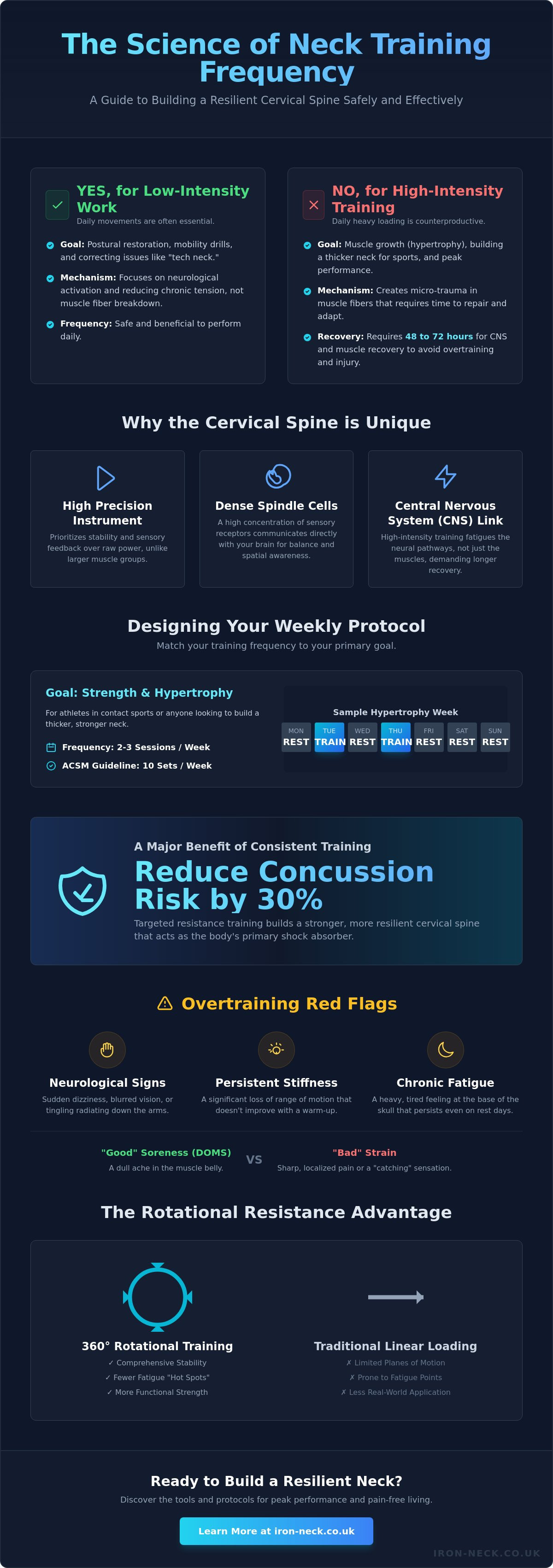
Determining if can you train your neck every day requires a clear distinction between restorative movement and high-intensity load. The neck is a unique anatomical structure. It supports a ten to twelve pound head while housing a high density of spindle cells that communicate directly with your vestibular system. Because of this, it is more resilient than many people think, yet far more sensitive to neurological fatigue than your biceps or quads. The "Yes, but..." rule applies here. You can perform low-intensity postural work daily, but high-intensity resistance training for hypertrophy demands 48 to 72 hours of recovery to be effective.
Elite athletes and health professionals view the neck as the body's primary shock absorber. If your goal is to build a thicker, more resilient cervical spine for contact sports, daily heavy training is counterproductive. Muscle tissues require time to repair and adapt to the stress of progressive overload. Without this window, you risk chronic inflammation rather than structural growth. However, if you're battling the effects of a sedentary lifestyle, daily low-load movements are not just safe; they're essential for maintaining proper spinal alignment.
The "Threshold of Intensity" Rule
Intensity dictates frequency. Low-intensity stimulus includes isometric holds and mobility drills designed to reset your posture after hours of looking at a screen. These exercises focus on neurological activation rather than muscle fiber breakdown. Daily "tech neck" corrections fall into this category because they help maintain the cervical curve and reduce chronic tension. They don't require the same recovery window as heavy resistance work.
High-intensity training involves significant resistance that pushes the muscle toward failure. Understanding the Science of Cervical Recovery is critical when you're using specialized equipment to build strength. When you apply heavy loads, you're creating micro-trauma in the muscle fibers. If you ask can you train your neck every day at this level, the answer is a firm no. Overlapping high-intensity sessions without rest leads to a plateau in performance and increases the likelihood of a strain.
Signs You Are Overtraining Your Neck
Overtraining the cervical spine manifests differently than other muscle groups. Because the neck is so closely tied to the central nervous system, the first red flags are often neurological rather than physical. You must listen to your body's signals to avoid crossing the line into injury. Watch for these specific indicators:
- Neurological Red Flags: Sudden bouts of dizziness, blurred vision, or radiating tingling down the arms during or after training.
- Persistent Stiffness: A significant reduction in your natural range of motion that doesn't improve after a warm-up.
- Chronic Fatigue: A heavy, "tired" feeling in the base of the skull that persists even on rest days.
There's a clear difference between "good" delayed onset muscle soreness (DOMS) and "bad" cervical strain. DOMS feels like a dull ache in the muscle belly, whereas a strain often presents as sharp, localized pain or a "catching" sensation when you turn your head. If you experience the latter, it's a sign your frequency is too high for your current level of conditioning.
The Science of Cervical Recovery: Why the Neck is Unique
The neck isn't just a pillar for the head; it's a high-precision instrument. Unlike the large muscle groups of the legs or back, the cervical spine is controlled by a complex web of small muscles that prioritize stability and sensory feedback over raw power. When you consider if can you train your neck every day, you must look beyond simple muscle soreness. The hidden bottleneck in cervical training is the Central Nervous System (CNS). Because the neck houses the spinal cord and is the primary conduit for neural signaling, the CNS manages cervical stability with millisecond precision. High-intensity training doesn't just fatigue muscle fibers; it exhausts the neural pathways responsible for balance and spatial awareness.
Recovery in the neck also differs due to blood flow and nutrient delivery. While the larger limbs benefit from massive arterial supply during movement, the deep stabilizers of the neck rely on subtle postural changes and consistent spinal alignment to facilitate nutrient exchange. This is why the neck reacts differently to loading styles. Isometric loading, which involves static tension, is the neck's natural state and generally allows for more frequent training. In contrast, heavy eccentric loading, or lengthening under tension, creates significant micro-trauma. Integrating a tool like the Iron Neck allows for precise control over these loading variables, ensuring you hit the right stimulus without overwhelming the CNS.
Muscle Spindle Density and Proprioception
The muscles of the neck act as sensory organs for the brain. They contain one of the highest densities of muscle spindles in the human body. These spindles are specialized receptors that detect changes in muscle length and position, feeding critical data to your vestibular system. If you overtrain these tissues, you won't just feel sore; you'll likely experience a "foggy" feeling or reduced balance. For contact sports athletes, maintaining "neurological freshness" in these spindles is vital for reacting to impacts. Training every day without regard for this sensory fatigue can actually leave you more vulnerable to injury by slowing your reactive stability.
Recovery Windows for the Sternocleidomastoid and Trapezius
The superficial muscles, such as the sternocleidomastoid (SCM) and the upper trapezius, are the powerhouses of the neck. They generally have better blood supply and recover faster than the deep cervical flexors. However, their recovery is still heavily influenced by your daily habits. Poor spinal alignment throughout the day creates a "static load" that prevents these muscles from fully relaxing. To optimize recovery, prioritize sleep quality and hydration. Dehydrated cervical discs and fascia lose their elasticity, making them more prone to strain during your next session. Deep stabilizers require a minimum of 48 hours to recover from high-intensity work, even if the larger superficial muscles feel ready to go sooner.
Strengthening vs. Postural Restoration: Defining Your Frequency
Are you training for absolute impact resistance or simply trying to survive a ten hour workday at a desk? Your specific objective dictates how often you should load the cervical spine. When determining if can you train your neck every day, you must categorize your movements into two distinct buckets: high-intensity strengthening and low-load postural restoration. The human head weighs approximately 10 to 12 pounds. Supporting this weight in a misaligned "forward head" position creates a massive mechanical disadvantage that requires daily corrective attention. Conversely, building the muscle thickness required to withstand a 20G impact in sport requires a completely different physiological approach.
A comprehensive program often blends these goals. You might perform high-intensity work twice weekly while engaging in light mobility every morning. This tiered system ensures you're addressing the structural integrity of the spine without pushing the deep cervical stabilizers into a state of chronic exhaustion. If you're recovering from a previous injury like whiplash, your frequency will likely be high but your intensity will be exceptionally low, following a physio-led protocol designed to restore basic movement patterns before adding external resistance.
The Hypertrophy Protocol (The "Bulking" Phase)
To increase neck thickness and functional strength, you must respect the principles of progressive overload. Current 2026 ACSM guidelines suggest a total weekly volume of approximately 10 sets per muscle group for hypertrophy. Attempting to hit this volume daily is a mistake. Rest days are when the actual muscle protein synthesis occurs. If you don't allow for a 48 to 72 hour recovery window, you'll see diminishing returns and increased joint irritation. Most elite athletes integrate their neck work into a standard "Push/Pull/Legs" or "Upper/Lower" split, training the neck 2 to 3 times per week using tools like the Alpha Head Harness or Iron Neck Resistance Bands to provide consistent, scalable tension.
The Postural Maintenance Protocol
Postural work is about neurological re-education, not muscle failure. These low-load isometrics are designed to "wake up" the deep cervical flexors that often go dormant during long periods of sitting. Because the intensity is low, these exercises can and should be performed daily. A 5-minute daily routine can act as a "system reset" for your spine. Focus on chin tucks and light rotational isometrics to counter the "tech neck" position. These movements don't require significant recovery because they don't cause the same micro-trauma as heavy resistance training. They simply remind your brain how to hold your head in an optimal, ergonomic position.
Designing Your Protocol: A Weekly Frequency Framework
Building a resilient neck requires a methodical approach that balances stimulus with systemic recovery. To answer the question, can you train your neck every day, you must look at your weekly schedule as a tiered system. High-intensity sessions should not happen daily, but low-load postural resets can. Use the following five-step framework to build your protocol. First, identify your primary objective. Performance goals require higher resistance and more rest, while pain relief focuses on frequent, low-load activation. Second, assess your baseline. If you have a history of cervical instability or recent strain, your initial frequency must be conservative.
Third, distribute your intensity across the seven-day week to avoid "stacking" high-stress sessions. Fourth, monitor recovery markers. A drop in morning grip strength or a significant spike in resting heart rate often indicates central nervous system fatigue. Finally, adjust your volume based on your external sport load. If you have a heavy rugby scrummaging session or a high-impact Brazilian Jiu-Jitsu class, reduce your direct neck training volume to compensate for the isometric stress already placed on the cervical spine. Optimise your weekly protocol with the Iron Neck training system to ensure 360-degree stability without overreaching.
Sample 7-Day "Hybrid" Neck Programme
This hybrid structure allows for daily engagement while respecting the 48 to 72 hour recovery window for muscle hypertrophy. It addresses both the deep stabilizers and the larger superficial muscles. Following this rhythm prevents the "foggy" feeling associated with neurological overtraining.
- Monday/Thursday: High-intensity rotational work. Focus on 3 sets of 10 to 12 repetitions of slow, controlled circles or "figure-eights" using resistance.
- Tuesday/Friday/Sunday: Low-load mobility and suboccipital release. These sessions involve gentle range-of-motion drills and chin tucks to reset posture.
- Wednesday/Saturday: Active recovery or isometric holds. Hold a neutral position against light resistance for 30 seconds to build endurance.
Adjusting for Contact Sports
Athletes in contact sports must manage a "Total Load" that includes both gym training and field impacts. Never train your neck to failure the day before a match or a heavy sparring session. You need your cervical muscles fresh and responsive to react to unpredictable forces. During the competitive season, shift your focus toward maintenance and reactive stability. Use the Alpha Head Harness for heavy linear strength days in the off-season to build the foundational thickness required for impact resistance. In-season, prioritize the Iron Neck to maintain rotational strength and proprioceptive clarity without adding excessive fatigue to your already taxed nervous system.
Optimising Every Day: Why the Iron Neck Changes the Rules
Traditional head harnesses are built for a bygone era of strength training. They rely on linear loading patterns that create focal stress on specific cervical segments, often leading to joint irritation rather than structural resilience. This "all or nothing" approach to resistance is why many athletes struggle with consistency. If you're wondering, can you train your neck every day with a standard harness, the answer is usually no due to the risk of joint shearing. The Iron Neck changes this equation by introducing 360-degree rotational resistance. This technology distributes the load across the entire musculature, eliminating the "hot spots" of fatigue that lead to overtraining.
Professional coaches now prioritize variable resistance for daily micro-dosing. Instead of hitting the neck with heavy linear loads twice a week, the Iron Neck allows for "Active Recovery" sessions at low resistance. These sessions aren't designed to reach failure. They're designed to flush the cervical tissues with oxygenated blood and maintain neurological clarity. This constant, low-level stimulus reinforces the vestibular system and keeps the deep stabilizers active. By varying the tension, you can effectively engage in daily work that supports recovery rather than hindering it.
Multi-Directional Stability vs. Traditional Lifting
The science of "Centration" is the key to safe daily training. Centration refers to the ability to keep the spine in a neutral, packed position while under load. Traditional lifting often pulls the head out of alignment, creating dangerous shearing forces on the intervertebral discs. The Iron Neck's circular track allows you to move through a full range of motion while the resistance remains constant and centered. This makes daily rotational work not only safe but superior for building functional stability. It trains the brain to maintain spinal integrity regardless of the head's position, which is a critical skill for any high-level athlete.
Building the "Unshakeable" Athlete
Top-tier UK strength coaches are moving away from periodic neck training in favor of daily, high-frequency protocols. Clinical data from 2025 indicates that consistent resistance training can reduce concussion risk by 30% in contact situations. Achieving this level of protection requires more than just raw strength; it requires a neck that is perpetually "on" and responsive. Using the Iron Neck to pre-habilitate against whiplash and impact ensures that your cervical spine remains the body's strongest shock absorber. Don't leave your safety to chance with outdated equipment. Explore the Iron Neck range for your daily performance routine and start building a more resilient, unshakeable foundation today.
Master Your Cervical Resilience
Building a high-performance neck requires a precise balance between stimulus and recovery. You've seen that while high-intensity hypertrophy work demands 48 to 72 hours of rest, low-load postural corrections are essential daily resets for the modern spine. When determining can you train your neck every day, the secret lies in matching your frequency to your specific physiological goals. By integrating these tiered protocols, you can eliminate chronic stiffness and significantly reduce the risk of impact-related injuries.
The elite athletes of the NFL, UFC, and professional rugby teams don't leave their cervical health to chance. They rely on clinically backed, 360-degree rotational training technology to ensure every movement is safe and effective. Whether you're rehabbing a strain or preparing for the next match, you need equipment that evolves with your progress. It's time to move beyond linear loading and embrace a comprehensive solution for spinal stability.
Upgrade your training with the Iron Neck: The world’s #1 neck trainer. Take the first step toward an unshakeable foundation and unlock your true physical potential today.
Frequently Asked Questions
Can training my neck every day cause headaches?
Training too frequently at high intensities can trigger tension headaches, particularly if you're overworking the suboccipital muscles at the base of the skull. This often occurs when your body hasn't adapted to the load or when form breaks down. If you're wondering if can you train your neck every day without this issue, the key is keeping daily work at a low, restorative intensity rather than pushing to failure.
How long does it take to see results from neck training?
You'll typically experience neurological adaptations, such as improved stability and reduced stiffness, within two to four weeks of consistent training. However, visible muscle hypertrophy and significant increases in neck thickness generally require eight to twelve weeks of progressive resistance. Adhering to the 2026 ACSM volume guidelines of 10 sets per week is the most efficient way to ensure these structural changes occur on schedule.
Should I stretch my neck before or after strengthening exercises?
Perform dynamic mobility work before your session to increase blood flow and prepare the nervous system for load. Save static stretching for after your strengthening exercises to help down-regulate the nervous system and restore resting muscle length. This sequence optimizes performance and reduces the risk of creating joint instability by over-stretching cold tissues before they're required to stabilize the head during resistance work.
Is it better to use a neck harness or the Iron Neck for daily work?
The Iron Neck is superior for daily use because its 360-degree rotational technology distributes stress across the entire cervical complex, preventing the joint irritation common with linear loading. Traditional harnesses are excellent for heavy, linear strength sessions but often lack the versatility required for frequent, restorative work. For daily micro-dosing, the variable resistance of the Iron Neck provides a safer, more comprehensive stimulus for the deep stabilizers.
Can neck exercises help with tech neck and posture?
Specific neck exercises are the most effective way to reverse "tech neck" by strengthening the deep cervical flexors that become inhibited during prolonged screen use. Consistent training restores the natural cervical curve and pulls the head back into a neutral, ergonomic position. This structural realignment reduces the mechanical load on your spine and mitigates the chronic pain associated with sedentary, modern lifestyles by addressing the root cause of misalignment.
What should I do if my neck feels stiff after training?
If stiffness persists, it's a sign that your training volume or intensity has exceeded your current recovery capacity. Switch to very low-load active recovery movements or suboccipital release techniques to encourage blood flow without adding further stress. Persistent stiffness that limits your range of motion indicates you should increase the rest periods between your high-intensity sessions to allow for full tissue repair and central nervous system recovery.
Are isometric neck exercises safer for daily use than dynamic ones?
Isometric exercises are significantly safer for daily application because they provide stability without the repetitive joint friction found in dynamic movements. They allow you to build neurological "freshness" and endurance without the micro-trauma associated with eccentric loading. While dynamic work is vital for athletic performance, isometrics should form the backbone of any high-frequency protocol designed for long-term spinal health and postural maintenance without overtaxing the joints.
How many sets and reps should I do for a daily neck routine?
For a daily routine focused on postural restoration, aim for two to three sets of 15 to 20 repetitions or 30-second isometric holds at approximately 20% of your maximum effort. This low-intensity approach ensures you're stimulating the muscles without triggering the heavy recovery demands of a hypertrophy session. Save your heavier, lower-rep work for the two to three sessions per week dedicated to building absolute strength and thickness for impact resistance.