

Best Neck Posture Corrector Device UK: Active Strength vs Passive Braces (2026)
Your £20 posture brace is likely doing more harm than good by training your muscles to become lazy. While many search for a neck posture corrector device UK to solve persistent stiffness, most passive belts fail to address the underlying structural weakness causing tension headaches. You likely already feel the daily toll of 'tech neck' and worry that spinal degeneration is becoming inevitable. It's frustrating to waste money on elastic straps that provide a few minutes of relief but no lasting change to your cervical health.
The 'missing link' in postural correction isn't found in a strap; it's found in active resistance. You'll discover why active strength training is the only permanent way to restore your natural cervical curve and unlock your full athletic potential. This article compares the latest active technology against traditional passive braces to help you choose a science-backed path toward a pain-free life and improved confidence. For those who also want to build their self-assurance in professional communication, confidence.me offers specialized training to help you break through the fear of speaking English.
Key Takeaways
- Understand why passive braces fail to solve the UK's 'tech neck' epidemic and how to recalibrate your centre of gravity for permanent results.
- Discover the critical role of proprioception and deep neck flexor strength in maintaining a pain-free, neutral cervical alignment.
- Compare the clinical efficacy of active resistance tools against traditional harnesses to find the most effective neck posture corrector device UK for your lifestyle.
- Learn how to perform a professional-grade wall test to assess your postural deviation and safely integrate corrective training into your daily routine.
- Uncover why elite-level engineering is the "missing link" for long-term cervical health, supported by dedicated UK-based expertise and rapid delivery.
Why Your Search for a Neck Posture Corrector Device in the UK Often Fails
A neck posture corrector device UK residents typically search for encompasses any tool designed to realign the cervical spine and restore its natural lordotic curve. However, most consumers fail to find long-term relief because they confuse external support with internal strength. The market is flooded with passive solutions that address the symptoms of poor alignment while ignoring the underlying muscular weakness that causes it. To fix the issue, you must distinguish between tools that prop you up and tools that build you up.
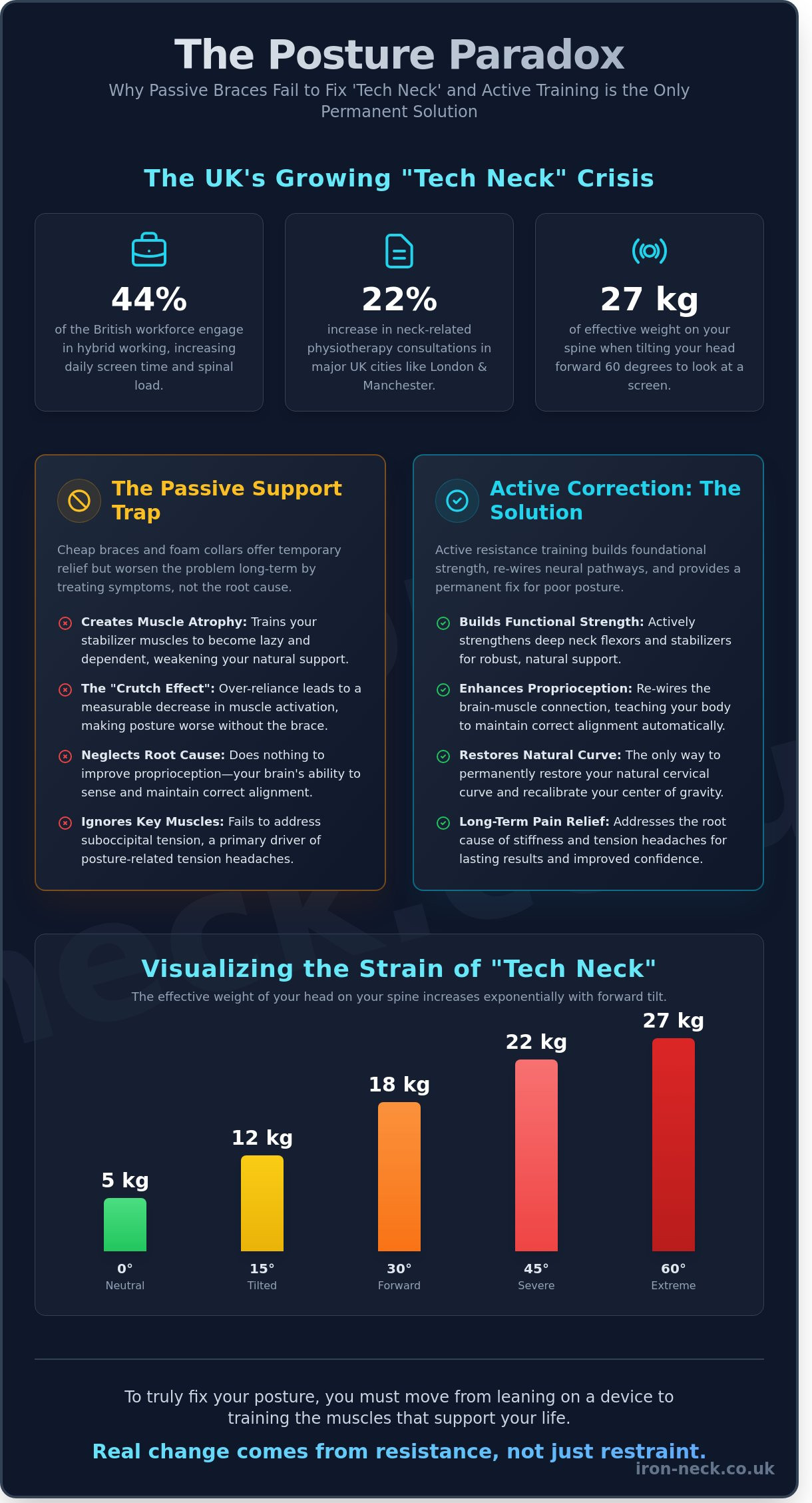
The UK is currently facing a "tech neck" epidemic. With 44% of the British workforce engaging in some form of hybrid working as of 2024, our daily centre of gravity has shifted. We spend hours hunched over laptops in makeshift home offices, forcing the cervical spine to bear loads it wasn't designed for. Understanding The Science of Active Correction is the first step in moving beyond temporary fixes and toward a foundational solution that restores performance and eliminates pain.
The Reality of 'Tech Neck' in British Offices
Cervical complaints have surged in major UK business hubs. In London and Manchester, private physiotherapy clinics reported a 22% increase in neck-related consultations between 2022 and 2025. This isn't just about a stiff neck; it's a structural crisis. When you tilt your head forward to check a notification, the effective weight on your spine increases exponentially. At a 60-degree angle, your head exerts roughly 27kg of pressure on the vertebrae, which is equivalent to carrying an average eight-year-old child around your neck. Posture is not a static position to be held, but a dynamic capability to be trained.
Why Cheap Braces Provide Only Temporary Relief
High-street retailers often promote foam collars and elasticated braces as a quick fix. These tools create a "Passive Support Trap" where the body begins to rely on the external structure rather than its own musculature. Finding the right neck posture corrector device UK professionals actually need requires a shift in mindset away from these crutches. Over time, the stabilizer muscles responsible for holding the head upright begin to atrophy from disuse, leading to a cycle of dependency.
- Suboccipital Tension: Passive braces rarely address the suboccipital muscles at the base of the skull. These are the primary drivers of posture-related tension headaches.
- The Crutch Effect: Relying on a brace for more than 2 hours a day can lead to a measurable decrease in muscle activation, making your posture worse once the brace is removed.
- Root Cause Neglect: Braces do nothing to improve proprioception, which is your brain's ability to sense and maintain correct alignment without thinking.
The missing link in most recovery programmes is the transition from passive bracing to active strengthening. To truly fix your posture, you must move from leaning on a device to training the muscles that support your life. Real change comes from resistance, not just restraint.
The Science of Active Correction: Why Strength is the Foundation of Posture
Passive braces treat the symptom rather than the cause. To achieve lasting results with a neck posture corrector device UK, you must address the neurological and muscular foundation of the cervical spine. This process begins with proprioception. This is your brain's internal map of where your head sits in space. When you spend hours looking at a screen, this map becomes distorted. Your nervous system begins to accept a forward-leaning position as the new "normal".
Active correction works by re-wiring these neural pathways. Research published in 2023 highlights the efficacy of active protocols when comparing corrective approaches to cervical alignment. By introducing controlled resistance, you force the brain to recalibrate. You aren't just holding your head up; you're teaching your body how to maintain that position automatically. This is why resistance training is the "missing link" in postural health. It transforms a conscious effort into an unconscious habit.
A common misconception suggests that neck resistance training is reserved for elite rugby players or MMA fighters. This is false. While contact athletes use these methods to mitigate concussion risk, the average desk-bound professional needs them to combat the 27 kilograms of pressure exerted on the spine when leaning forward at a 60-degree angle. Strengthening the deep neck flexors provides the internal "scaffolding" required to support the weight of the skull without fatigue.
Proprioception and Muscle Memory
The Iron Neck device utilizes a unique 360-degree biofeedback system to help users locate their neutral spine position. Unlike a static brace, the dynamic resistance requires constant micro-adjustments from the stabiliser muscles. Feeling the resistance is vital. It creates a "closed-loop" feedback system where the brain receives immediate data on postural deviations. This sensory input is what builds long-term muscle memory. Improved neck stability also enhances overall balance and movement efficiency, as the vestibular system relies on a stable platform to process spatial information.
Strengthening the Posterior Chain
True posture correction extends beyond the cervical vertebrae. It involves the entire posterior chain, specifically the muscles spanning from the mid-back to the base of the skull. The trapezius and levator scapulae must work in tandem with the cervical spine to prevent the shoulders from rounding forward. Cervical kyphosis is a clinical condition where the natural C-shaped curve of the neck reverses or straightens, often due to prolonged "tech neck" habits. Active resistance training reverses this progression by strengthening the extensors that pull the head back into alignment. Strengthening these deep stabilisers is how you reclaim your natural alignment and eliminate the structural weaknesses that lead to chronic tension.
Comparing UK Neck Posture Devices: Braces vs Harnesses vs Iron Neck
Selecting the right neck posture corrector device UK requires a framework that moves beyond surface-level comfort. To achieve lasting physiological change, you must evaluate equipment based on clinical safety, ease of use, and the longevity of results. Most consumer-grade solutions focus on passive support, which fails to address the underlying muscular imbalances responsible for forward head posture.
The UK market is flooded with "Neck Clouds" and traction pillows, often retailing for under £30 on platforms like Amazon. These devices provide temporary decompression by stretching the cervical spine. While they offer a brief window of relief, they lack a strengthening component. Without active resistance, your muscles remains weak, and your head inevitably drifts back into a slumped position the moment you sit at your desk.
- Clinical Safety: Does the device risk muscle atrophy or nerve impingement?
- Ease of Use: Can it be integrated into a 10-minute daily routine?
- Longevity: Does it build the "foundational strength" required to maintain posture without the device?
Static Braces and Cervical Collars
Static braces are often the first port of call for those seeking a neck posture corrector device UK. They provide immediate relief by offloading the weight of the skull from the tired muscles of the upper back. However, this relief comes at a significant cost. Relying on a passive brace leads to muscle atrophy; your neck muscles stop working because the brace is doing the job for them. This creates a cycle of dependency. These collars also carry a social stigma and restrict natural movement, making them unsuitable for anything other than acute injury recovery under strict medical supervision.
Dynamic Resistance Devices (The Iron Neck Advantage)
Dynamic resistance is the definitive solution for "tech neck." Unlike the traditional Alpha Head Harness, which only provides linear, up-and-down resistance, modern halo-style devices allow for 360-degree movement. This is the missing link in posture correction. Your neck doesn't just move in one plane; it rotates, tilts, and protracts.
Multi-directional training solves the forward head lean by engaging the deep stabiliser muscles of the cervical spine. By applying rotational resistance, you force the neck to maintain stability through a full range of motion. This builds functional strength that translates directly to daily life. You can explore how this differs from basic weight-lifting setups in our Iron Neck vs. Neck Harness comparison article. Active training ensures your body is capable of supporting itself, eliminating the need for restrictive, passive harnesses.
How to Organise Your Posture Correction Routine at Home
Transitioning from a passive brace to an active training routine requires a methodical approach. To fix your posture, you must treat your neck like any other muscle group by applying scientific principles of hypertrophy and motor control. Relying on a neck posture corrector device UK users can trust involves more than just wearing equipment; it requires a structured daily commitment to rewrite your body's biomechanical habits.
Assessing Your Forward Head Posture
Before starting any programme, you need a baseline. Use the "Wall Stand" test to identify the severity of your cervical deviation. Stand with your heels, glutes, and shoulder blades pressed firmly against a flat wall. If the back of your head doesn't naturally touch the surface, you have forward head posture. Measure the gap between the wall and your skull; a distance exceeding 2.5 centimetres suggests your deep neck flexors are inhibited. To track your progress, take a side-profile photo every 30 days. You should see this gap close as your structural integrity improves. If you experience "red flags" such as radiating numbness in your arms or a loss of grip strength, pause your training and consult a UK physiotherapist immediately.
The 10-Minute Daily Protocol
Consistency is the foundation of cervical health. British office workers spend an average of 35.7 hours per week at their desks, often in a hunched position. You can counteract this by dedicating just 10 minutes a day to active resistance training. This protocol focuses on the stabilizer muscles that passive braces ignore. Perform the following movements using your device:
- Left-to-Right Rotations: 3 sets of 10 repetitions to improve range of motion.
- Protraction and Retraction: 12 repetitions of "chin tucks" to engage the deep cervical flexors.
- Isometric Holds: Hold your head in a neutral position against resistance for 30 seconds at 45-degree angles.
"Consistency in neck training beats intensity every single time for postural correction."
Integrating a neck posture corrector device UK into a busy schedule is simple if you treat it as a "movement snack." Use it for 10 minutes before your morning commute or during your lunch break. Start with the lowest resistance setting to ensure your form is perfect. Following the principle of progressive overload, increase the resistance by approximately 5% every two weeks. This gradual increase forces the muscles to adapt without risking strain. By combining resistance bands with your primary device, you create a holistic environment for the cervical spine to thrive.
To start building a more resilient cervical spine today, explore our range of active posture correction tools.
Why Iron Neck is the Ultimate Posture Corrector Device for the UK Market
The Iron Neck represents the pinnacle of cervical spine engineering. It wasn't built as a quick fix for a temporary problem; it was developed for high-level clinical rehabilitation and perfected for elite athletic performance. For those seeking a neck posture corrector device UK, this represents the definitive shift from passive, restrictive bracing to active, functional resilience. While traditional braces attempt to hold your head in place, Iron Neck trains your body to maintain that position naturally through 360-degree resistance.
The engineering excellence behind the device addresses the "Missing Link" in human strength. By focusing on the stabilizer muscles that support the cervical spine, it corrects the imbalances caused by hours of sedentary desk work or intense physical contact. British sports scientists and professional rugby clubs have already integrated these protocols into their daily regimes. When you invest in this technology, you're joining a growing Iron Neck UK community backed by professional endorsements from the highest levels of sports medicine and physiotherapy.
A Professional-Grade Solution for Every Desk
Choosing an Iron Neck is a foundational investment in your long-term health, not a passing fitness fad. Unlike plastic alternatives or elastic straps that lose tension after a few months, these devices are built with industrial-grade durability. They're designed to withstand the rigours of a professional gym while being portable enough for a home office. The system forces your muscles to engage through proprioception, teaching your nervous system how to hold your head correctly without conscious effort.
If you're looking for a secondary, budget-friendly entry point for strengthening, the Alpha Head Harness provides a robust alternative. It lacks the sophisticated rotational resistance of the flagship models but offers a heavy-duty solution for linear strengthening. Both options ensure you're building real tissue capacity rather than relying on a fabric corset that causes muscles to atrophy over time.
Direct Support for UK Customers
British customers benefit from rapid, free UK delivery options, removing the hurdles of international shipping and customs delays. Buying from a local specialist means you receive direct support and expert guidance tailored to your specific goals. We recommend reading our comprehensive 2026 guide, "What Is The Iron Neck?", to fully understand the science of cervical loading before you begin your journey.
Stop masking the symptoms of "tech neck" with temporary fixes. Passive braces are a sticking plaster for a structural problem. It's time to stop masking the pain and start building the strength your spine deserves. You have the power to fix your mechanics and reclaim your performance through science-backed training.
Take Control of Your Spinal Health Today
Passive braces are a temporary bandage for a structural problem. They don't train the stabiliser muscles of your cervical spine; they simply prop you up while your strength continues to fade. To eliminate "tech neck" and chronic stiffness, you must transition from passive support to active resistance. Iron Neck is the definitive neck posture corrector device UK athletes and clinicians use to build a foundation of lasting postural health. Our 360-degree rotational resistance technology is the missing link in modern recovery, moving beyond static harnesses to provide dynamic, functional strength that lasts.
Endorsed by elite UK sports scientists and professional performance coaches, this system is designed for those who refuse to let physical limitations dictate their potential. You'll benefit from rapid UK shipping and local expert support, ensuring your journey to a stronger, more resilient neck starts without delay. Stop relying on flimsy straps that provide a false sense of security. It's time to invest in the scientific standard for spinal alignment and athletic resilience. You've got the tools and the data to make a permanent change. Now, it's time to execute.
Shop the Iron Neck Collection: The #1 Posture Corrector Device in the UK
Frequently Asked Questions
Is a neck posture corrector device safe to use every day?
Yes, using a neck posture corrector device UK is safe for daily use provided you follow specific time constraints. Passive braces should be limited to 15 or 20 minutes per session to prevent your muscles from becoming dependent on the support. Active training devices like the Iron Neck are designed for 3 to 4 structured sessions per week. This balance ensures you build internal strength rather than relying on an external frame.
How long does it take to see results with a posture corrector device?
You'll likely feel a reduction in muscle tension immediately, but permanent structural changes typically take 8 to 12 weeks of consistent use. This duration aligns with the standard physiological cycle for muscle hypertrophy and neuromuscular adaptation. Most users report a 50% improvement in "tech neck" symptoms after 21 days of active training. Consistency is the foundation for transforming your cervical spine alignment.
Can I use the Iron Neck if I already have a diagnosed neck injury?
You must consult a medical professional before starting any new exercise programme if you have a diagnosed cervical injury. While the Iron Neck is used by 90% of NFL teams for rehabilitation and injury prevention, your specific clinical needs must come first. A physiotherapist can help you integrate the device into a controlled recovery plan. This ensures you're targeting the stabilizer muscles without overstressing damaged tissues.
What is the difference between a neck harness and the Iron Neck for posture?
A traditional neck harness only provides linear resistance, which limits you to basic up and down movements. The Iron Neck is the missing link because it offers 360-degree rotational resistance. This allows you to strengthen all 20+ muscles in the neck through every plane of motion. It's a sophisticated tool for functional stability, whereas a harness is a basic weightlifting accessory for the posterior chain.
Do I need any other gymnasium set equipment to use these devices at home?
You don't need a full commercial gymnasium setup to use these devices effectively at home. Most Iron Neck kits include a door anchor or a cinch strap that attaches to any stable post or door frame. This portability allows you to maintain your posture routine in an office or hotel room. You only need approximately 2 square metres of floor space to complete a full range of motion exercises.
Will strengthening my neck help with tension headaches caused by office work?
Strengthening your stabilizer muscles is a proven way to eliminate tension headaches caused by sedentary desk work. Research shows that 70% of UK office workers suffer from headaches linked to poor cervical posture. By building strength, you reduce the strain on your upper trapezius muscles. This prevents the chronic fatigue that typically triggers cervicogenic headaches during long shifts at a computer.
How do I know which size Iron Neck device I need?
The Iron Neck features a "one size fits most" design, so you don't need to worry about complex measurements. Each unit comes with a kit of interchangeable foam pads in three different thicknesses. These pads allow you to customise the internal fit for head circumferences ranging from 50cm to 65cm. This ensures the device remains secure and comfortable during high-intensity rotational training or isometric holds.
Is it better to use a device or just do bodyweight neck stretches?
Using a dedicated neck posture corrector device UK is significantly more effective than relying on bodyweight stretches alone. While stretching can improve temporary mobility, it doesn't build the "postural endurance" required to support your head for 8 hours a day. Scientific data indicates that resistance training is 3 times more effective at reducing chronic neck pain than stretching protocols. Strength provides the foundation for long-term health.