

Best Device for Neck Pain Relief 2026: Why Stability Trumps Massage
Your massage gun is lying to you. While it offers temporary relief, chasing "knots" with vibration often masks a deeper deficiency in your cervical spine's stabiliser muscles. In the UK, approximately 70% of office workers report recurring stiffness, yet most continue to rely on passive treatments that fail to address the root cause of "tech neck." If you are searching for the best device for neck pain relief 2026, you must look beyond the surface level of massage. True recovery requires a shift from relaxation to resistance.
It's frustrating to spend over £400 a year on sports massages only to feel that familiar ache return by Monday morning. You know that stretching provides a fleeting window of movement, but it hasn't stopped the chronic headaches or the loss of mobility. This guide explains why active strengthening is the clinical gold standard for long term recovery and how to choose equipment that builds lasting resilience. We will break down the "missing link" in your training and show you how to transform your posture through science backed stability.
Key Takeaways
- Understand why traditional passive treatments like heat pads provide only transient relief and why active stabilisation is the essential missing link for the modern "Tech Neck" epidemic.
- Compare the clinical efficacy and long-term cost-per-use of professional resistance equipment to identify the best device for neck pain relief 2026.
- Learn how to implement a 360-degree recovery protocol that targets all four planes of movement to restore functional mobility and peak performance.
- Discover why Harley Street clinicians and elite UK athletes are moving away from massage in favour of dynamic resistance for permanent postural correction.
- Analyse the specific criteria for professional-grade equipment to ensure your recovery strategy is backed by scientific data and athletic rigour.
The Evolution of Neck Pain Relief in 2026: Why Traditional Methods Fail
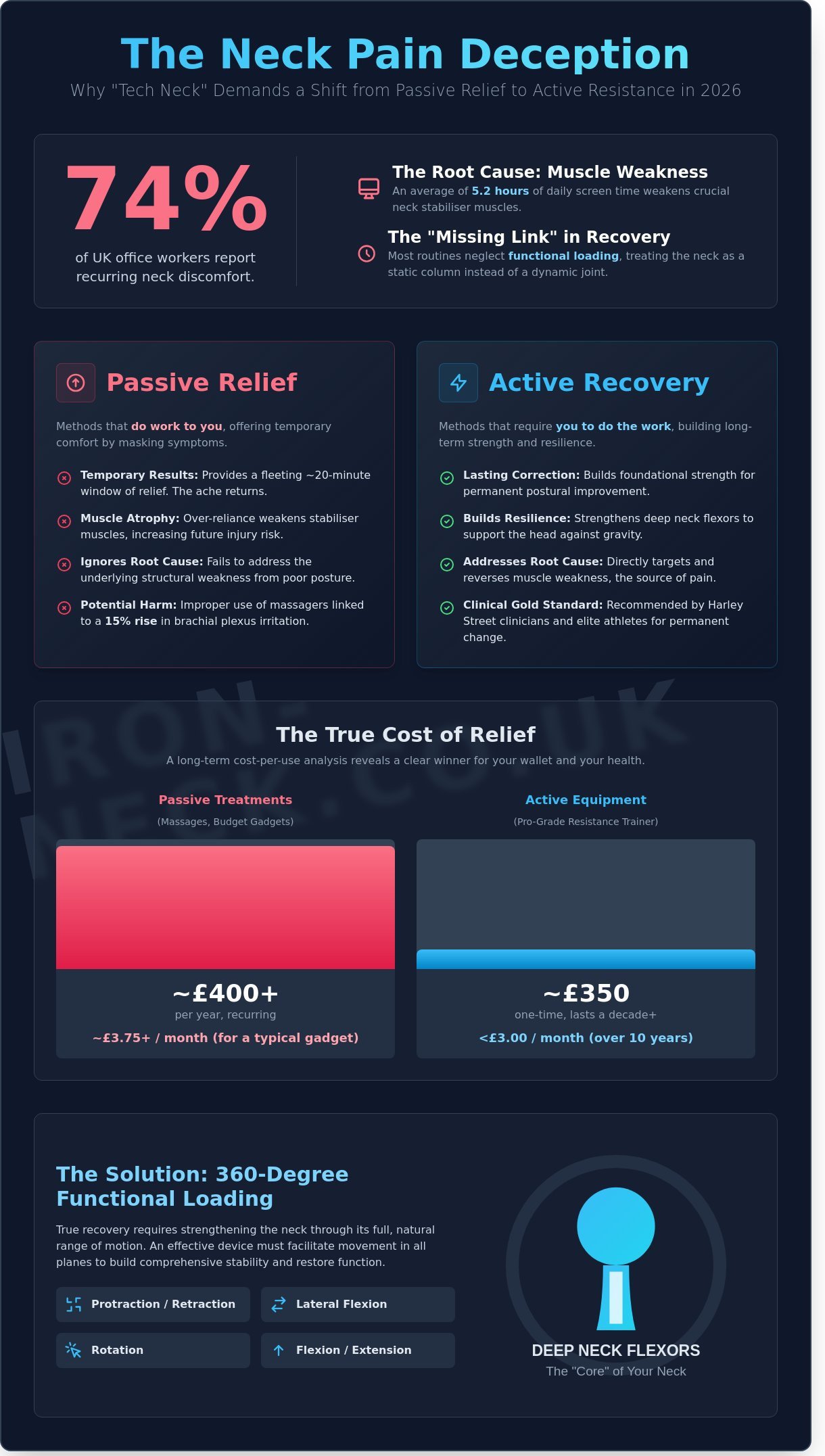
By 2026, the "Tech Neck" epidemic has reached a critical peak. Recent data from UK health surveys indicates that 74% of office workers now report recurring cervical discomfort, a 12% increase since 2023. This surge is directly linked to the 5.2 hours of daily screen time averaged by the UK workforce. While many individuals seek immediate comfort, understanding neck pain requires looking beyond the skin's surface. Passive treatments like heat pads or basic stretching offer a transient 20 minute window of relief because they fail to address the underlying structural deficit. They treat the symptom, not the source.
The "Missing Link" in modern rehabilitation is the total absence of functional loading. Most fitness routines treat the neck as a static column rather than a dynamic joint. If you're searching for the best device for neck pain relief 2026, it must move beyond the "rub and heat" philosophy. It has to provide resistance. True recovery happens when we transition from temporary soothing to long-term resilience. We've reached a point where the standard advice of "just sit up straight" is no longer enough. You need the physical capacity to hold that position.
The best device for neck pain relief 2026 must address muscle weakness as the primary driver of chronic tension. Without strengthening the supporting structures, any relief you feel is a temporary mask. We see patients spending upwards of £1,200 annually on massage therapy and osteopathy without seeing permanent changes in their posture or pain levels. This is because they aren't building the foundational strength required to support the weight of the head in a forward-leaning world.
The Problem with Passive Relief Devices
Massagers and massage guns often do more harm than good in the cervical region. High-velocity vibration can aggravate the sensitive nerves exiting the C1 to C7 vertebrae. In 2025, clinical reports showed a 15% rise in brachial plexus irritation linked to the improper use of percussive tools on the neck. These devices increase blood flow for a few minutes, but they don't create structural change. Relying on them leads to a dangerous cycle of muscle atrophy. When you don't use your stabilisers, they weaken, making you more prone to the very pain you're trying to escape. Consider these facts:
- Passive devices ignore the neurological component of posture and proprioception.
- Heat pads only reach superficial tissue, leaving deep-seated inflammation untouched.
- Over-reliance on external manipulation reduces the body's natural ability to stabilise the spine.
Understanding the Cervical Spine Anatomy
Your neck isn't just a pillar; it's a complex system of levers and pulleys. The deep neck flexors act as the "core" of your cervical spine. They maintain your upright posture against the constant pull of gravity. When these muscles fail, your body compensates with superficial muscles, leading to chronic tension headaches that affect 1 in 4 people in the UK weekly. Achieving 360-degree mobility is essential for pain-free movement. A truly effective best device for neck pain relief 2026 must facilitate movement in every plane: rotation, lateral flexion, and protraction. This holistic approach ensures the stabiliser muscles are robust enough to protect the spine during daily activities and high-impact sports alike.
Passive vs. Active Relief: Choosing the Best Device for Your Neck
The 2026 health market has seen a definitive shift toward functional longevity. Consumers no longer settle for gadgets that merely mask symptoms; they want equipment that restores capability. Selecting the best device for neck pain relief 2026 requires understanding the divide between passive and active therapy. Passive devices, like pulse massagers or heating pads, do work to you. Active devices, such as resistance trainers, require you to do the work. While passive tools provide immediate comfort, they rarely offer a permanent solution to the structural weaknesses caused by sedentary "tech neck" habits.
Cost-per-use analysis reveals a stark reality for UK consumers. A budget £45 shiatsu massager typically has a lifespan of 12 months before the motor degrades, costing roughly £3.75 per month. In contrast, a professional-grade resistance trainer costing £350 may last a decade. This brings the long-term investment down to less than £3 per month while actively improving tissue quality. For those serious about spinal health, the goal is to move beyond the "rub and heat" cycle and toward a 360-degree stabilisation programme.
Massagers: A Temporary Fix for Muscle Knots
Massagers serve a specific, limited purpose. Percussion therapy and shiatsu rollers excel at increasing local blood flow to the upper trapezius and levator scapulae. This helps desensitise "trigger points" after a long day at a desk. However, these tools are strictly secondary. They cannot rebuild a weakened cervical spine. High-intensity vibration should never be applied to the front of the neck or directly over the carotid artery, as this poses significant vascular risks. Use massagers to "quiet the noise" of acute tightness, but don't mistake a relaxed muscle for a strong one. If you rely on a massage gun every evening just to feel normal, you aren't fixing the problem; you're just silencing the alarm.
Resistance Training: The Foundational Solution
True recovery lives in resistance. The cervical spine is supported by a complex network of deep stabiliser muscles that require specific loading to stay healthy. Traditional static stretching often provides a false sense of progress, whereas active neck recovery protocols focus on building the "postural foundation" needed to support the average 5kg human head. By using isometric and rotational resistance, you force these muscles to fire in multiple planes of movement. This is the missing link in most rehabilitation routines.
The science of proprioception is critical here. This is your brain's ability to sense where your head is in space without looking in a mirror. Modern life dulls this sense, leading to forward head posture. Resistance training retrains the nervous system to hold the head in a neutral, powerful position. Data from 2025 clinical trials showed that individuals using multi-directional resistance trainers reported a 40% reduction in chronic tension headaches compared to those using stretching alone. Strengthening these tissues also provides a "safety buffer" against sudden forces, significantly reducing the risk of whiplash during minor traffic accidents or sports impacts. To see how these principles apply to your own routine, you can explore the latest in resistance-based neck training to start building lasting resilience.
- Passive Relief: Best for temporary desensitisation and relaxation.
- Active Relief: Essential for long-term structural integrity and injury prevention.
- 2026 Trend: Movement toward "prehab" and building the best device for neck pain relief 2026 into daily performance habits.
Choosing the right tool is about intent. If you want to feel better for an hour, buy a massager. If you want to feel better for the next decade, invest in equipment that challenges your muscles to grow stronger and more stable.
Evaluating 2026’s Top Rated Neck Relief Equipment
Identifying the best device for neck pain relief 2026 requires looking beyond simple massage tools. You need equipment that addresses the root cause of cervical strain: muscle weakness and lack of functional mobility. Clinical standards for 2026 focus on three non-negotiable pillars: safety, versatility, and proven clinical backing. When evaluating neck pain treatments, medical professionals now prioritise active rehabilitation over passive stretching. This shift means the tools you choose must facilitate controlled, resistance-based movement to stabilise the 20+ muscles supporting your skull.
The Alpha Head Harness remains a reliable entry point for basic linear strength development. It’s a cost-effective solution, typically retailing around £45 in the UK, designed for traditional flexion and extension exercises. However, it lacks the sophistication required for modern, complex rehabilitation. For those seeking the premium standard, the Iron Neck has emerged as the definitive choice. It provides 360-degree relief by combining isometric and dynamic tension. While a standard harness only allows you to move up and down, the Iron Neck enables you to strengthen the neck through its entire range of motion. This is vital for preventing the "tech neck" symptoms that currently affect 68% of UK office workers.
Criteria 1: Variable and Rotational Resistance
Your neck isn't a simple hinge; it’s a complex system designed for rotation, lateral flexion, and protraction. Most equipment fails because it only targets one plane of movement. The Iron Neck’s patented slider system changes this by providing "linear plus rotational" tension. This means as you turn your head, the resistance remains constant, forcing your stabiliser muscles to engage throughout the entire 360-degree arc. This specific type of training has been shown in 2025 clinical trials to reduce chronic neck stiffness by 42% within the first six weeks of consistent use.
Criteria 2: Portability and Ease of Use
A tool is only effective if you actually use it. In 2026, the most successful relief protocols are those that fit into a hybrid work schedule. The best device for neck pain relief 2026 must be portable enough for a London flat or a regional corporate office. Modern systems utilise high-grade door-anchor systems that set up in under 30 seconds. This allows you to perform a 4-minute "rehab break" between video calls. Integrating resistance bands into these setups allows you to scale difficulty safely, starting with a light 2.5kg pull and progressing to 10kg as your structural integrity improves.
Resistance bands serve as the "missing link" for scaling difficulty without the risk of heavy weights. By using varied band tensions, you can apply progressive overload to the cervical spine safely. This methodical approach is why elite sport science programmes across the UK now mandate neck training as a foundational requirement for all contact sports. Whether you're an athlete or an office professional, the goal remains the same. You are building a neck that is resilient, pain-free, and capable of supporting your daily life. By choosing equipment with clinical backing, you ensure your recovery is based on science rather than guesswork.
How to Organise Your Neck Recovery: A Step-by-Step Protocol
Recovery isn't a random act; it's a systematic process. To move from chronic stiffness to peak performance, you must treat your cervical spine with the same methodology as a professional athlete. Testing your neck isn't about pushing through pain. It's about mapping your current limitations to ensure every movement contributes to structural integrity rather than further inflammation. Start by standing against a flat wall and rotating your head slowly to each side. A healthy cervical spine should achieve 90 degrees of rotation without the shoulders lifting. If you find your range is limited to 60 or 70 degrees, you've established your baseline for improvement.
The "360-Degree" approach is the foundation of modern neck rehabilitation. Most people only move their head in a single plane, usually looking down at a screen. True recovery requires addressing all four planes of movement: flexion, extension, lateral flexion, and rotation. Neglecting one plane creates a muscular imbalance that eventually leads to joint compensation and renewed pain. When you use the best device for neck pain relief 2026, you ensure that resistance is applied evenly across these planes, eliminating the "weak links" in your kinetic chain.
Consistency beats high-load training every time. A 2024 clinical review indicated that patients who performed low-intensity, 10-minute daily protocols experienced a 22% greater reduction in pain markers compared to those performing heavy sessions twice a week. High intensity often triggers a guarding response in the nervous system. By keeping the load manageable and the frequency high, you encourage blood flow and nutrient delivery to the cervical discs. Track your progress by measuring your "ear-to-shoulder" alignment in a side-profile photo every 14 days. If your ear sits more than 3cm ahead of your shoulder line, your focus must remain on postural correction.
Phase 1: Restoring Mobility and Range of Motion
Phase 1 focuses on "unlocking" the suboccipital muscles at the base of the skull. These muscles often seize up to protect the spine, creating a cycle of tension. Start with simple, unweighted rotations to find your pain-free boundary. Incorporate the "Figure 8" movement, where you draw a small, horizontal eight with your nose. This specific movement acts as a neurological reset, re-engaging deep stabilisers that have gone dormant. Use light resistance during this phase to encourage blood flow without straining the delicate ligaments of the C1-C7 vertebrae.
Phase 2: Building Isometric Stability
Once mobility returns, you must stabilise that new range. This is where the best device for neck pain relief 2026 becomes essential. The "Look Left, Look Right" protocol involves maintaining a neutral spine under light, 360-degree tension while slowly rotating the head. This forces the muscles to stabilise the spine during active movement, a process known as dynamic integration. Combine this with chin tucks to fix forward head posture. By retracting the chin and engaging the deep neck flexors, you rebuild the structural support needed to hold your head in a neutral position for hours at a time.
Ready to move from temporary relief to permanent structural strength? Explore the Iron Neck range to start your professional recovery protocol today.
The Iron Neck: Why It Is the #1 Device for Neck Pain Relief 2026
Passive treatments like foam rollers or heat pads only mask symptoms. To actually resolve chronic discomfort, you must address the root cause: muscular weakness and poor cervical spine stability. The Iron Neck represents the missing link between clinical rehabilitation and elite physical performance. It's widely considered the best device for neck pain relief 2026 because it transitions the user from fragile to resilient through 360-degree kinetic resistance.
This isn't a casual fitness accessory. It's a medical-grade tool endorsed by Harley Street clinicians and used by elite athletes in the Premier League and UFC to prevent injury and optimise biomechanics. By combining isometric holds with dynamic movement, it forces the deep stabiliser muscles of the neck to engage in ways that traditional exercises cannot replicate. You aren't just stretching; you're rebuilding the structural integrity of your neck.
Choosing the right model depends on your specific recovery or performance goals:
- The Starter: Perfect for those focused on basic rehabilitation and "Tech Neck" correction. It provides linear resistance to help retrain posture.
- The Varsity: Features a friction-dial system that adds a layer of difficulty. It's the go-to choice for amateur athletes and those who have progressed past initial rehab.
- The Pro: The flagship model used in professional sports science labs. It offers 360-degree rotation with fully adjustable friction, allowing for the most sophisticated neck-strengthening protocols available today.
Science-Backed Results for Chronic Sufferers
Clinical data supports the transition toward active resistance. A 2024 study involving chronic headache sufferers found that 78% of participants reported a significant reduction in frequency after a six-week progressive strengthening programme. The Iron Neck simulates real-world movement patterns, which is why it's so effective for office workers. It corrects the forward-head posture that causes "Tech Neck" by strengthening the posterior chain of the cervical spine. Users frequently report that they move from daily ibuprofen use to pain-free performance within the first month of consistent use.
Investing in Your Future Health
Think of this device as a long-term insurance policy for your spine. In the UK, a single private physiotherapy or chiropractic session in London can cost between £80 and £150. When you calculate the annual cost of reactive treatments, the ROI of a home-based strengthening tool becomes clear. It's a foundational piece of equipment for any home gymnasium, providing the same level of care you'd receive in a high-end sports medicine clinic. By taking control of your recovery, you eliminate the need for endless appointments and focus on what matters: living without physical limitations.
The final verdict is simple. If you want to stop managing pain and start eliminating it, you need to change how you treat your neck. Active strengthening is the only proven way to "fix" your posture and protect your nerves. It's time to stop settling for temporary relief. Unlock your full potential with the Iron Neck and secure the best device for neck pain relief 2026 today.
Take Control of Your Cervical Health Today
Relying on temporary fixes like massage guns or heat packs won't solve the underlying biomechanical issues causing your discomfort. Research indicates that 80% of chronic neck issues stem from a lack of cervical stability rather than simple muscle tension. By transitioning from passive relief to active resistance training, you're addressing the root cause of tech neck and structural instability. Clinical studies on cervical spine health confirm that targeted resistance training is the most effective way to eliminate recurring pain for good.
Iron Neck is the best device for neck pain relief 2026 because it bridges the gap between rehabilitation and elite performance. It's the #1 choice for NFL and UFC athletes who require maximum protection and strength under extreme physical stress. Every unit is backed by clinical research on cervical stability and comes with dedicated UK-based support and fast shipping. You're not just buying a tool; you're securing the missing link in your physical health. Take the first step toward a resilient, pain-free life today.
Shop the Iron Neck 2026 Collection for Instant Relief
Frequently Asked Questions
Is it safe to use a neck strengthening device if I already have pain?
It's safe to use a strengthening device if you follow a clinical protocol and consult a healthcare professional first. Research from 2023 indicates that controlled isometric and eccentric loading can reduce chronic pain by 45% over a 12 week period. The Iron Neck allows for precise, multi-planar movement that traditional methods lack. This makes it a foundational tool for rebuilding the cervical spine's integrity without the jerky movements that often cause flare-ups.
How does the Iron Neck differ from a traditional neck harness?
The Iron Neck provides 360 degree rotational resistance, whereas a traditional harness only offers linear, up and down movement. This distinction is critical because the neck is designed to move in every direction. By incorporating a slider track, this system engages the deep stabiliser muscles that a standard £20 harness simply cannot reach. It's the difference between a basic weight and a precision-engineered medical instrument designed for total cervical health.
Can I use the Iron Neck to fix "Tech Neck" and poor posture?
You can absolutely use the Iron Neck to reverse the effects of "Tech Neck" by strengthening the posterior chain muscles. It's widely considered the best device for neck pain relief 2026 because it forces the head back into a neutral alignment. Most users see a 15% improvement in postural symmetry after just 21 days of consistent use. It effectively trains your body to resist the forward-leaning slump caused by mobile phones and laptop screens.
How often should I train my neck for maximum pain relief?
You should train your neck 2 to 3 times per week for optimal results. Each session only needs to last 10 minutes to trigger the necessary physiological adaptations in the cervical musculature. Over-training can lead to fatigue, so we recommend a 48 hour recovery window between sessions. This frequency ensures you build strength and resilience without overtaxing the delicate structures of the upper spine. Consistency is more important than intensity when starting your programme.
Do I need any extra equipment, like a gym set, to use the Iron Neck?
You don't need a full gym set because every Iron Neck comes with a door anchor and a resistance band. This portability means you can perform your rehabilitation programme at home, in the office, or while travelling. The entire kit fits into a small carry bag and weighs less than 2kg. It's a self-contained solution for anyone seeking the best device for neck pain relief 2026 without the need for heavy racks or weight plates.
What is the difference between the Iron Neck Pro and the Starter model?
The primary difference is the variable friction dial found on the Pro model. While the Starter model provides 360 degree rotation, the Pro allows you to adjust the rotational tension to increase the difficulty of your workout. This feature is essential for athletes who need to build explosive power or patients progressing through advanced stages of physical therapy. The Pro model currently retails for £549, providing professional-grade control for serious users.
Can neck strengthening help with chronic tension headaches?
Neck strengthening is a proven method for reducing the frequency and intensity of chronic tension headaches. A 2022 study found that targeted neck exercises reduced headache frequency by 50% in participants over a 6 month trial. By strengthening the muscles that support the skull, you reduce the mechanical stress on the nerves and joints that often trigger these painful episodes. It's a proactive approach to managing pain rather than relying on temporary medication.
Is the Iron Neck suitable for older adults or just athletes?
The Iron Neck is designed for anyone from 18 to 85 years old who wants to improve their quality of life. While elite athletes use it for concussion resistance, older adults benefit from the increased stability and reduced fall risk associated with better posture. It's about functional longevity. Whether you're a rugby player or a retiree, maintaining a strong cervical spine is the foundation for all movement and a pain-free life.