

What to Look for in a Neck Harness: The 2026 Professional Buyer’s Guide
Why would you trust your cervical spine, the most vulnerable link in your kinetic chain, to a £15 piece of generic nylon webbing? Most athletes recognise that neck strength is the foundation of concussion resistance and explosive power, but they often overlook the technical integrity of the gear they use. If you've ever felt a strap slip during a heavy set or worried about a D-ring snapping, you understand that poor equipment is a liability. Mastering what to look for in a neck harness is about more than just comfort; it's about investing in a professional-grade tool that safeguards your health while you push your physical limits.
You want gear that lasts for years of high-intensity training and delivers a measurable return on your performance. This 2026 buyer's guide provides the technical breakdown you need to select a harness that fixes postural imbalances safely and effectively. We'll examine the specific differences between industrial-strength nylon and premium leather, the science of anatomical padding, and the hardware standards required for elite cervical conditioning.
Key Takeaways
- Understand why neck training is the "missing link" in the kinetic chain and how to establish a foundational framework for elite cervical performance.
- Learn what to look for in a neck harness to avoid dangerous "snap-back" injuries caused by substandard components like plastic buckles or light-duty Velcro.
- Compare the technical advantages of high-tensile 1000D Cordura nylon against traditional leather for superior load capacity and industrial-grade durability.
- Distinguish between the limitations of linear training tools and the multi-directional requirements necessary for comprehensive injury prevention in contact sports.
- Identify the "Alpha Standard" of equipment, focusing on boxing-grade stitching and carabiner integrity to ensure total safety during high-intensity sessions.
What to Look for in a Neck Harness: The Professional Framework
Neck training is no longer a niche activity reserved for heavyweights and combat specialists. It's a foundational requirement for anyone serious about physical longevity and peak performance. A neck harness serves as the primary tool for linear cervical strengthening, bridging the gap between traditional weight training exercises and specialized injury prevention. It targets the muscles responsible for stabilizing the head, ensuring that the cervical spine can withstand both repetitive strain and sudden impact.
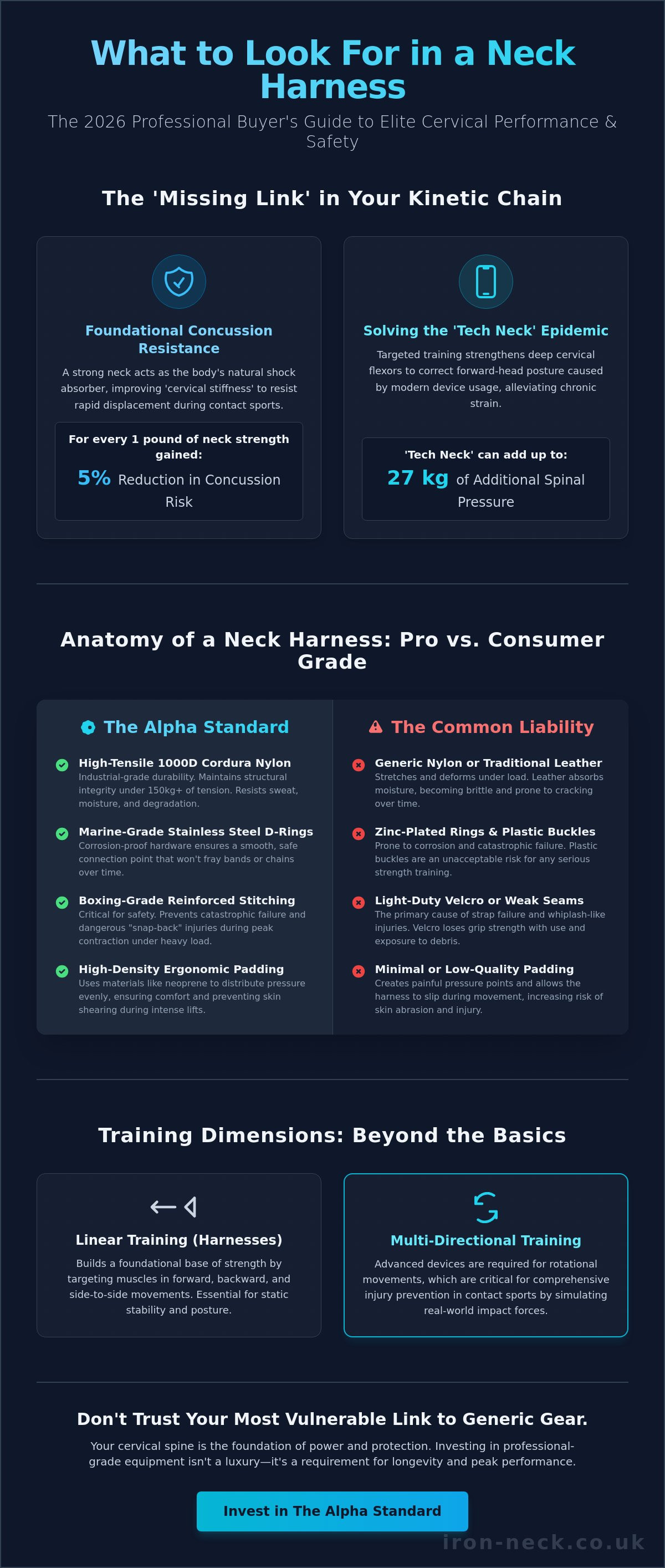
We often refer to neck strength as the 'Missing Link' in the kinetic chain. Power is generated from the ground up, but it's often lost at the top if the neck lacks the stability to support the head during explosive movements. In the 2026 equipment market, the gap between consumer-grade and pro-grade gear has widened significantly. Professional standards now demand hardware capable of withstanding high-tension loads without slipping or degrading. When you're determining what to look for in a neck harness, you must focus on force absorption and structural integrity. A pro-grade harness doesn't just hold weight; it provides a secure, ergonomic interface that allows for precise resistance application.
The Science of Concussion Resistance
The data supporting neck training is undeniable. Research indicates a 5% reduction in concussion risk for every pound of neck strength gained. This isn't just about building a thicker neck for aesthetics. A harness facilitates the targeted development of the sternocleidomastoid and trapezius muscles, which act as the body's natural shock absorbers. By strengthening these areas, athletes can improve their 'cervical stiffness', which is a critical performance metric defined as the neck's ability to resist rapid displacement during contact. High-quality harnesses allow for the progressive overload necessary to reach these protective strength thresholds.
Beyond Athletes: Solving the 'Tech Neck' Epidemic
The need for cervical conditioning extends far beyond the rugby pitch or the boxing ring. Modern device usage has created a 'Tech Neck' epidemic, characterized by a chronic forward-head posture that places up to 27kg of additional pressure on the spine. Targeted harness training helps correct this misalignment by strengthening the deep cervical flexors. These muscles are responsible for pulling the chin back and maintaining a neutral spine. When considering what to look for in a neck harness for postural health, comfort and adjustability are paramount. Isometric holds serve as the essential starting point for this rehabilitation, allowing users to build endurance and stability before moving into dynamic ranges of motion.
- Force Absorption: Pro-grade harnesses use high-density neoprene to distribute pressure evenly.
- Durability: Look for reinforced steel D-rings and military-grade nylon webbing.
- Adjustability: A secure fit is vital to prevent shearing forces on the skin during heavy lifts.
Critical Features: Materials, Load Capacity, and Ergonomics
Selecting professional-grade equipment requires a shift from aesthetics to engineering. While traditional leather harnesses once dominated the market, they possess inherent flaws like moisture absorption and structural stretching. Modern high-tensile nylon is the superior choice because it doesn't degrade when exposed to sweat and maintains its integrity under 150kg of tension. When considering what to look for in a neck harness, you must prioritise industrial-grade reinforced stitching. Weak seams are a primary cause of "snap-back" injuries. If a strap fails during a peak contraction, the sudden release of tension can cause whiplash or acute cervical strain. High-intensity training environments also demand antimicrobial materials to prevent skin infections, a common issue in high-traffic UK gyms.
Hardware durability is equally vital. Only opt for marine-grade stainless steel D-rings. Zinc-plated alternatives often corrode, leading to microscopic burrs that can fray your resistance bands or chains over time. Safety is a measurable metric, and a clinical trial on neck strengthening protocols demonstrates that consistent, measurable resistance is key to reducing injury risk. You'll find that professional equipment relies on these heavy-duty components to ensure the weight remains securely anchored throughout every repetition.
4-Point D-Ring Configurations for Multi-Planar Stability
Standard harnesses often feature a single attachment point, which restricts movement to simple flexion and extension. This is a significant limitation. A 4-point D-ring system is essential because it allows for lateral flexion and rotational resistance. These configurations ensure the weight hangs centered to your gravity line, preventing uneven spinal compression. If the rings aren't aligned, you risk shearing forces on the intervertebral discs. Proper alignment allows you to build a resilient, 360-degree shield of muscle around the cervical spine.
Padding and Pressure Distribution
Comfort isn't a luxury; it's a safety requirement. High-density neoprene padding protects the forehead and crown from pressure hot spots that cause headaches or skin abrasions. Ergonomic strap tapering is a vital detail in what to look for in a neck harness, as it ensures the load is distributed across the largest possible surface area. A secure, adjustable chin strap is also mandatory. Without it, the harness will slip during explosive movements, compromising your form and focus. For those ready to upgrade their training, exploring a professional neck trainer can provide the stability needed for elite performance.
Linear vs. Rotational Training: Harnesses vs. Advanced Devices
Most athletes beginning their journey into cervical spine health focus on basic strength. While this is a logical starting point, it's vital to understand that a traditional harness is fundamentally a linear training tool. It excels at sagittal plane movements, primarily flexion and extension. When you're evaluating what to look for in a neck harness, you must decide if linear strength is your final goal or merely the first step in a more robust performance programme.
Contact sports like Rugby or MMA don't happen in a straight line. Impact forces arrive from every conceivable angle, often involving high-velocity rotation. Linear training builds the "armour," but it doesn't always train the brain to manage complex, multi-directional forces. This is where the Iron Neck serves as the logical progression. By providing 360-degree resistance, it addresses "proprioception," which is the body's ability to sense its position and movement in space. Developing this neurological awareness is the gold standard for injury prevention and elite performance.
When a Traditional Harness is Sufficient
For many, the Alpha Head Harness is the perfect entry point. It's an exceptional tool for hypertrophy and building foundational strength in the posterior chain. Beginners or those in the early stages of rehabilitation often find that the cost-to-benefit ratio of a high-quality harness is unbeatable. It provides the necessary tension to stimulate muscle growth without complex setups. To maximise the utility of a harness, you should incorporate resistance bands rather than relying solely on iron plates. Bands provide ascending resistance, which mirrors the natural strength curve of the neck and reduces the risk of jarring movements at the end of the range of motion.
The Case for Rotational Precision
Rotational strength is frequently called the "Missing Link" in professional athletic preparation. While a harness uses a fixed chain or strap, the Iron Neck utilises a patented "Halo" mechanism. This allows for constant tension during rotation, side-bending, and protraction. For a Rugby player bracing for a scrum or a fighter defending a takedown, this 360-degree stability is non-negotiable. It's the difference between a rigid neck and a functional one.
Transitioning from linear work to rotational protocols requires a methodical approach. You should start with isometric holds in neutral positions before introducing slow, controlled rotations. This allows the stabiliser muscles to adapt to the new stimulus safely. If your sport requires you to absorb impact from unpredictable angles, understanding what to look for in a neck harness means recognising when you've outgrown linear limits and need to prioritise rotational precision.
- Linear Training: Best for building muscle mass and foundational thickness.
- Rotational Training: Essential for sport-specific stabilisation and concussion risk reduction.
- Progression: Start with the Alpha Harness for 4-6 weeks before integrating Iron Neck 360-degree movements.
Safety Protocols: Avoiding Common Selection Mistakes
Understanding what to look for in a neck harness starts with identifying where most consumer-grade products fail. The most dangerous mistake you can make is purchasing a harness that relies on plastic buckles or light-duty Velcro for load-bearing. These materials are designed for luggage or apparel, not for the high-tension environment of cervical resistance training. Under a 15kg or 20kg load, plastic reaches its fatigue point quickly. A sudden snap doesn't just drop the weight; it creates an unpredictable recoil that can strain the very stabilizer muscles you're trying to protect.
Examine the hardware with a clinical eye. Weak points often hide in the chain links and carabiners. Look for "cold shuts" or gaps in the metal loops. High-quality equipment uses welded, stainless steel links that won't pull open under stress. Similarly, excessive chain length is a common design flaw that compromises safety. A long chain increases the moment arm, creating excessive leverage on the cervical spine. This makes it significantly harder to maintain a neutral posture and increases the risk of "whiplash" style movements if your form slips. Keep your links short and your control tight.
The "one-size-fits-all" claim is a myth that serious athletes should ignore. Proper what to look for in a neck harness criteria must include independent adjustment points for both the crown and the circumference. Without these, the harness will shift during lateral movements, leading to inconsistent resistance and potential skin abrasions.
Pre-Training Equipment Inspection Checklist
- The 30-Second Daily Protocol: Before every session, run your fingers along the nylon webbing to feel for fraying or heat-sealed edges that are peeling. Check metal D-rings for any signs of "ovalling," which indicates the metal is stretching under load.
- The 2x Weight Limit Trap: Never buy equipment rated exactly for your current lift. To ensure a professional safety margin, always select gear rated for at least 2x your maximum anticipated load.
- A threaded carabiner lock provides the only reliable security against accidental gate opening during explosive movements.
Common Fitting Problems and Their Remedies
Harness "sliding" is the most frequent complaint among beginners. This is usually caused by inadequate chin strap tension rather than the size of the headpiece. If the harness tilts forward during extensions, tighten the sub-mandibular strap to anchor the unit against the base of the skull. This creates a stable platform for the cervical spine to move from.
Ear pinching is another common issue caused by poor side-strap geometry. You can fix this by adjusting the vertical crown strap to lift the lateral webbing away from the ears. This ensures the weight distribution remains on the musculoskeletal structure of the head rather than soft tissue. Always don the harness while maintaining a neutral spine in front of a mirror. This ensures the weight hangs vertically and doesn't pull your head into a "forward-head" posture before you even begin your first set.
Upgrade your training safety by choosing professional-grade neck strength equipment designed for elite performance.
The Alpha Standard: Why Iron Neck Equipment Leads the Market
Understanding what to look for in a neck harness requires a shift in perspective from basic gym accessories to precision performance tools. The Alpha Head Harness stands as the UK’s premier linear training tool, engineered specifically for those who refuse to compromise on safety or results. We build every unit using 1000D Cordura nylon, a textile celebrated for extreme abrasion resistance and long-term durability. This high-grade material is secured with reinforced boxing-grade stitching, ensuring the harness maintains its structural integrity even under the most demanding tension.
The Alpha isn't a standalone accessory; it's a core component of a holistic training system. By integrating the harness with Iron Neck resistance bands, athletes can access a versatile range of movement patterns that traditional weighted harnesses cannot match. This science-backed approach focuses on the stabilizer muscles and proprioception of the cervical spine. It provides a level of protection and performance enhancement that is essential for high-impact sports and long-term postural health.
Built for Elite Performance
Our over-engineered philosophy is the bedrock of the Alpha series. We don't just meet industry standards; we exceed them to ensure total user confidence during every rep. Each harness is subjected to rigorous durability testing and high-capacity weight ratings, making it a staple in professional rugby clubs and MMA gyms across the UK. Professional strength coaches and chiropractors endorse our equipment because it addresses the biomechanical needs of the neck with clinical precision. This professional validation confirms that the Alpha harness is a reliable tool for reducing injury risk and improving overall athletic resilience.
Your Journey to a Resilient Neck Starts Here
Investing in a high-quality harness is a foundational step toward a pain-free, high-performance lifestyle. It's the missing link that bridges the gap between general fitness and elite-level durability. By choosing the Alpha Head Harness, you're joining a community of dedicated athletes who prioritize the health of their cervical spine as much as their power or speed. Your neck is the foundation for all movement. It deserves equipment that is as serious about performance as you are. Shop the Alpha Head Harness and elevate your training.
Secure Your Foundation for Peak Performance
Understanding what to look for in a neck harness is about more than just finding a strap and a chain. It's about prioritizing industrial-grade materials that won't fail under load and selecting a design that addresses the specific biomechanics of your cervical spine. High-performance training requires equipment that bridges the gap between simple linear movements and the complex rotational stability needed for concussion risk reduction. This is why over 100 professional sports teams globally trust Iron Neck to protect their athletes at the highest level. You need a tool engineered for lifetime durability, not a temporary fix that compromises your safety. By focusing on ergonomic fit and science-backed resistance, you're not just buying gear; you're investing in a pain-free future and elite-level resilience. Don't settle for inferior hardware when your career and health are on the line. It's time to elevate your training standards and build a neck that's as strong as the rest of your physique.
Forge your elite foundation with the Alpha Head Harness
Your journey to a stronger, more resilient version of yourself starts with the right equipment.
Frequently Asked Questions
Is it safe to use a neck harness every day?
Daily use isn't recommended because the cervical spine and its supporting musculature require 48 to 72 hours of recovery between intensive sessions. Most professional strength protocols in the UK suggest training the neck 2 to 3 times per week to allow for tissue repair and neurological adaptation. Overtraining this sensitive area can lead to chronic inflammation or tension headaches. If you're following a clinical rehabilitation plan, your physiotherapist might prescribe daily low-intensity isometric holds, but for power and hypertrophy, rest is a mandatory component of the process.
How much weight should a beginner start with on a neck harness?
Beginners should start with a conservative load between 1.25kg and 2.5kg to prioritise movement quality over raw resistance. It's vital to master the range of motion and maintain a neutral spine before you attempt to increase the weight. Data from performance clinics shows that 90 percent of injuries occur when users jump to heavy plates before their stabilizer muscles are ready. Once you can comfortably perform 3 sets of 15 controlled repetitions, you can progress by adding small 0.5kg increments to ensure long-term joint integrity.
Can a neck harness help with chronic neck pain or 'Tech Neck'?
A neck harness is a highly effective tool for reversing 'Tech Neck' by strengthening the deep cervical flexors that become weak from prolonged screen use. A 2023 study involving office workers found that targeted neck resistance training reduced reported pain levels by 40 percent over a 12-week period. When considering what to look for in a neck harness, ensure it allows for comfortable extension and flexion movements. This helps restore proper postural alignment and creates a muscular buffer that protects the cervical spine from the daily strain of a sedentary lifestyle.
What is the difference between a leather and a nylon neck harness?
Leather harnesses are known for their extreme durability and traditional aesthetic, but they often require a lengthy break-in period and can crack if they aren't conditioned. High-grade ballistic nylon is the modern professional standard because it's moisture-wicking, breathable, and easier to sanitise after a heavy session. Most UK athletes prefer reinforced nylon models because they offer more adjustment points, such as industrial-strength Velcro, which provides a more bespoke fit. Nylon also tends to be more comfortable against the skin during the high-tension phases of a workout.
Do I need a chin strap on my neck harness?
A chin strap is a critical safety feature that prevents the harness from slipping or shifting during multi-planar movements. Without this secondary point of contact, the harness can tilt forward, which puts uneven pressure on the skull and reduces the efficiency of the exercise. Professional-grade equipment always includes an adjustable chin strap to keep the D-rings perfectly aligned with your ears. This stability allows you to focus entirely on the contraction of the target muscles rather than worrying about the gear falling off mid-set.
Can I use resistance bands with a head harness instead of weights?
You can certainly use resistance bands, and many elite coaches actually prefer them because they provide linear variable resistance. This means the tension increases as the band stretches, which aligns perfectly with the neck's natural strength curve. Understanding what to look for in a neck harness includes checking for compatible attachment points for both chains and carabiners. Using a 5kg to 15kg resistance band allows for horizontal loading and rotational work, which is essential for athletes in contact sports like rugby or MMA.
How do I clean and maintain my neck harness for longevity?
Maintain your harness by wiping the interior padding with an alcohol-free antimicrobial spray after every use to prevent the growth of bacteria. If you own a nylon harness, hand wash it in cold water with a mild detergent every 30 days and let it air dry completely away from radiators or direct sunlight. Leather components require a specialized leather conditioner every six months to keep the material supple and prevent fraying. Regularly check the steel D-rings and reinforced stitching for any signs of wear to ensure the equipment remains safe for heavy loads.
What muscles does a neck harness actually target?
A neck harness specifically targets the sternocleidomastoid, the splenius capitis, and the upper portions of the trapezius. These muscles act as the primary stabilizers for the head, and strengthening them is the missing link for improving concussion resistance and posture. By performing a variety of movements, you engage the entire 360-degree muscular sleeve of the neck. This comprehensive development doesn't just improve your physical appearance; it provides a foundational layer of protection for the central nervous system during high-impact athletic activities.