

Sports Injury Clinic Neck Strengthening in Birmingham: The 2026 Guide to Active Recovery
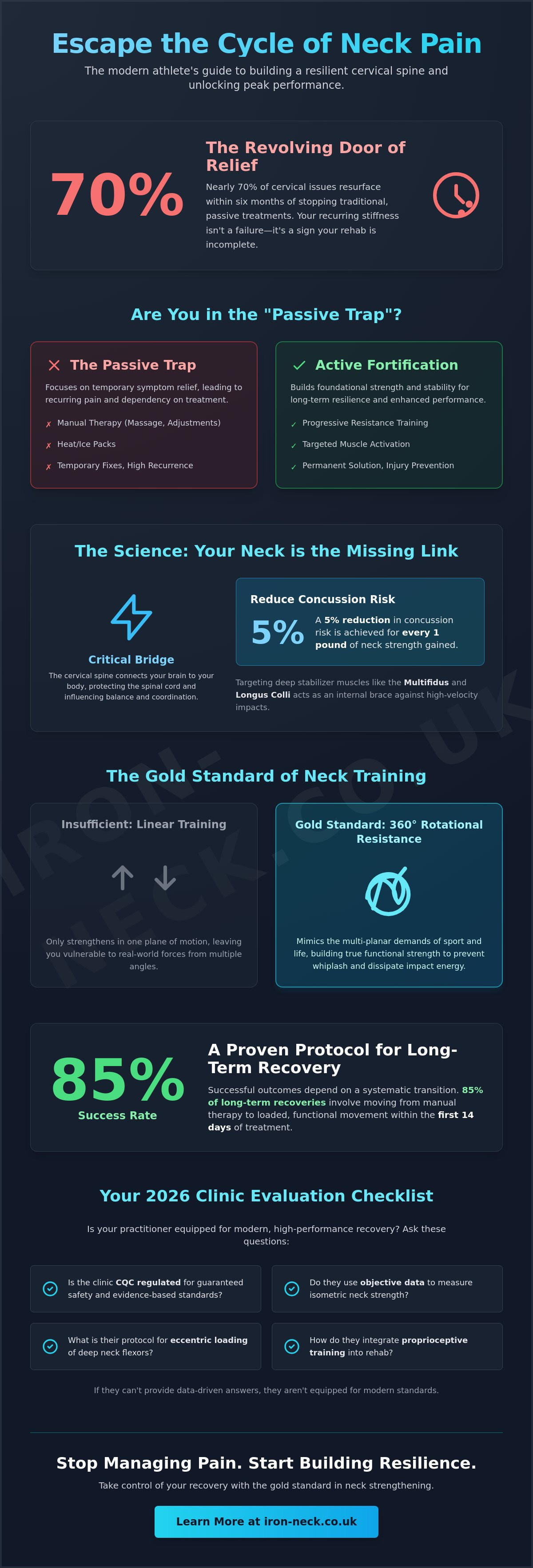
What if your recurring neck stiffness isn't a failure of your physiotherapist, but a sign that your rehab is incomplete? Many athletes across the West Midlands settle for temporary relief, only to find that nearly 70% of cervical issues resurface within six months of stopping treatment. You've likely felt the frustration of tech neck or the nagging fear of a heavy impact during a Saturday rugby match. By visiting a sports injury clinic neck strengthening Birmingham facility, you can shift the focus from passive manipulation to the active, scientific fortification of your cervical spine.
You don't need to choose between clinical safety and high performance training. This 2026 guide reveals how to integrate the missing link of neck resistance to eliminate pain and build a foundation for explosive movement. We'll explore the specific protocols used by elite athletes to stabilize the spine, targeting a 5% reduction in concussion risk for every pound of neck strength gained, and finally bridge the gap between the treatment table and the podium.
Key Takeaways
- Understand how to evaluate a sports injury clinic neck strengthening Birmingham provider by prioritising CQC regulation and evidence-based cervical spine protocols.
- Discover why the cervical spine is the "missing link" in athletic movement and how targeting deep stabilizer muscles protects against high-impact injury.
- Learn to escape the "Passive Trap" of temporary relief by transitioning from manual therapy on the clinical table to active, performance-driven recovery.
- Identify the systematic two-step protocol required to clear acute inflammation and implement a clinical diagnosis for long-term cervical stability.
- Explore why 360-degree rotational resistance is the gold standard for elite Birmingham athletes looking to eliminate chronic neck stiffness and unlock full potential.
Evaluating Sports Injury Clinics in Birmingham for Neck Rehabilitation
Birmingham's healthcare landscape is dense, but not every provider treats the cervical spine with the precision required for high-performance recovery. Selecting a sports injury clinic neck strengthening Birmingham facility requires looking beyond basic massage or heat therapy. In 2026, the distinction between a clinic that merely manages pain and one that builds resilience is clear. Effective rehabilitation must move beyond passive modalities. While traditional centres focus on temporary relief, elite practitioners in the West Midlands now prioritise "Active Rehab" protocols. These methods integrate progressive resistance to restore the stabilizer muscles that protect the spine during impact.
For a comprehensive overview of neck pain and its clinical implications, understanding the underlying anatomy is vital. You need a clinic that views neck strength as the foundational component of athletic safety. Ask your practitioner these specific questions to gauge their expertise:
- Do you use objective data to measure isometric neck strength?
- What is your specific protocol for eccentric loading of the deep neck flexors?
- How do you integrate proprioceptive training into cervical rehabilitation?
If a practitioner can't provide a data-driven answer, they aren't equipped for 2026 standards. Ensure the clinic is CQC regulated, as this guarantees they follow evidence-based practice and maintain rigorous safety standards within the West Midlands medical community.
What to Look for in a Birmingham Physio or Osteopath
Specialization is non-negotiable. Look for clinics in Edgbaston or Solihull that have documented experience with Premiership rugby or elite combat sports. These practitioners understand that a "Return to Play" assessment must involve more than just a range-of-motion check. It requires a dedicated strength assessment where neck-to-body strength ratios are measured. 85% of successful long-term recoveries involve a transition from manual therapy to loaded, functional movement within the first 14 days of treatment. Finding a sports injury clinic neck strengthening Birmingham specialist means finding someone who values performance as much as protection.
The Role of Local Clinical Standards
Clinical excellence in Birmingham is often dictated by adherence to the Guildhall and Fairways models of integrated care. Proximity to major hubs like the Queen Elizabeth Hospital (QEHB) is a significant advantage for rapid diagnostic imaging and specialist referral if red flags appear. In 2026, the standard of care for neck injuries is defined as a multidisciplinary approach that combines early mechanical loading with objective neuromuscular testing to ensure 100% functional restoration.
The Science of Cervical Spine Stability: Beyond Manual Therapy
The cervical spine is the foundational missing link in athletic movement. While many athletes focus on the posterior chain or core, the neck serves as the critical bridge between the brain and the rest of the body. True stability isn't found in passive treatments like massage. It requires the activation of deep stabilizer muscles, specifically the multifidus and longus colli. These muscles act as an internal brace, protecting the spinal cord during high-velocity impacts. Traditional training often relies on linear strengthening, such as weighted harnesses that only move up and down. This approach is insufficient for modern athletes. Sport is multi-planar. A rugby player at a sports injury clinic neck strengthening Birmingham program needs to resist forces from every angle. Linear training ignores the biomechanics of rotational resistance, which is the primary mechanism for preventing whiplash and reducing concussion risk by dissipating kinetic energy before it reaches the brain.Proprioception and Motor Control
The neck communicates directly with the vestibular system to maintain balance and spatial awareness. For Birmingham office workers and commuters navigating the M6 daily, "Tech Neck" has become a structural epidemic. Constant forward head posture weakens the deep flexors and overloads the upper trapezius. This imbalance disrupts the signals sent to the brain, leading to dizziness and poor coordination. This shift in rehab philosophy is supported by a scientific review of exercise protocols which highlights that targeted strengthening of these deep muscles is essential for long-term recovery. Isometric training is the safest starting point. It allows patients to build tension without aggravating sensitive joints.Rotational Power and Injury Mitigation
Building a protective halo around the spine requires training that mimics the chaos of competition. When an athlete takes a hit, the neck must instantly stiffen to manage the load. Multi-directional training allows for better energy dissipation. By increasing the neck's "breaking strength," athletes can reduce the acceleration of the head during an impact. This is why a sports injury clinic neck strengthening Birmingham protocol focuses on rotational resistance to ensure the spine remains neutral under duress.Passive vs. Active Recovery: Why Strengthening is the Missing Link
Many patients visiting a sports injury clinic neck strengthening Birmingham facility fall into the "Passive Trap." While soft tissue massage and spinal manipulation provide immediate relief, the effects are often temporary. These methods address the symptoms of cervical strain rather than the root cause. True recovery requires a shift from the treatment table to the gym floor. Clinical data published in the British Journal of Sports Medicine suggests that active exercise reduces chronic neck pain by up to 50% compared to passive care alone. Reliance on passive modalities creates a cycle of dependency that fails to build the structural integrity needed for daily life or sport.
Progressive overload is the foundation of all athletic development. This principle applies to the delicate muscles of the neck just as it does to the glutes or chest. The cervical spine is supported by over 20 individual muscles that require specific, incremental loading to adapt. To build lasting stability, you must challenge these stabilizers through controlled resistance. The Iron Neck acts as the missing link in this transition. It provides a safe way to apply tension through a full range of motion, allowing patients to move from basic range-of-motion drills to high-performance conditioning without the risk of re-injury.
The Limitations of Traditional Neck Training
Traditional "plate-and-chain" head harnesses often pose risks for rehab patients. These devices only offer linear, vertical resistance, which creates uneven loading on the vertebrae. The "Alpha" head harness style lacks the ability to train rotation, leaving athletes vulnerable to isometric weaknesses in the transverse plane. Variable resistance is essential for cervical health. Advanced rotational devices allow for 360-degree tension, ensuring every stabilizer muscle is engaged. This eliminates the jarring "snap" associated with old-school weights, providing a smoother and more scientific approach to conditioning.
Building a Long-Term Prevention Strategy
The goal of sports injury clinic neck strengthening Birmingham programs is resilience, not just pain relief. Fixing a current injury is only half the battle. Elite Birmingham athletes, from Premiership footballers to competitive MMA fighters, prioritize neck strength year-round to mitigate concussion risks and improve posture. Once your clinical sessions end, maintaining a twice-weekly neck routine is vital for long-term health. This proactive approach transforms the neck into a shock absorber for the body. It protects the central nervous system and ensures that the progress made during therapy isn't lost the moment you return to high-impact activity.
Implementing a Neck Strength Protocol Alongside Your Birmingham Physio
Transitioning from passive treatment to active recovery requires a structured, science-backed approach. Your journey at a sports injury clinic neck strengthening Birmingham should follow a logical progression to ensure the cervical spine remains stable while regaining its full functional capacity. This five step protocol bridges the gap between clinical care and peak performance.
- Step 1: Clinical Diagnosis. Obtain a precise assessment from a Birmingham sports injury specialist to rule out structural contraindications like disc herniations or fractures.
- Step 2: Clear Inflammation. Use manual therapy and soft tissue work to reduce acute pain. You can't build strength on a foundation of reactive inflammation.
- Step 3: Isometric Loading. Introduce low-level isometric contractions. Using the Iron Neck, perform static holds at 10% to 20% of your maximum effort to wake up the deep cervical stabilizers.
- Step 4: Dynamic Progression. Move into rotational and linear patterns. This restores the 360 degree range of motion required for both daily life and high impact sports.
- Step 5: Gym Integration. Incorporate neck training into your standard Birmingham gym routine. Treat the neck like any other muscle group by applying progressive overload.
Coordinating with Your Practitioner
Success depends on transparency between your gym work and clinical sessions. Bring your Iron Neck to your next appointment. Show your osteopath or physio the specific movements you're performing. They can help you adjust resistance levels based on your current tissue tolerance. Watch for red flag symptoms during training. If you experience sharp, radiating pain, dizziness, or sudden numbness, stop immediately and consult your specialist. Professional feedback ensures your sports injury clinic neck strengthening Birmingham protocol remains safe and effective.
Home-Based Rehab for Birmingham Commuters
Birmingham professionals often spend over 40 hours a week at desks in the city centre or commuting via the M6. This sedentary posture weakens the posterior chain and cervical extensors. You don't need a full commercial gym to maintain your progress. Portable training solutions allow you to perform 10 minute recovery sets between office hours or after a long drive. Set up a foundational neck training station at home by anchoring your equipment to a sturdy door. This consistency is the missing link in long term injury prevention, allowing you to build resilience without sacrificing your schedule.
Why Iron Neck is the Gold Standard for Birmingham Athletes and Rehab
Iron Neck represents the missing link in modern sports medicine. Conventional training often neglects the cervical spine, or relies on static holds that fail to prepare the body for the chaotic, multi-directional forces of real-world competition. In Birmingham, practitioners at any elite sports injury clinic neck strengthening Birmingham program now recognize that linear resistance is only half the battle. The Iron Neck provides 360-degree rotational resistance, a feature that forces the deep stabilizers of the cervical spine to engage throughout a full range of motion.
This technology is no longer a niche secret. It's the standard for Birmingham's most demanding sports environments. Local MMA gyms, rugby clubs, and football academies have integrated these protocols to build what coaches call "the foundation for all movement." By training the neck to resist rotational forces, athletes significantly improve their proprioception and spatial awareness. Strength coaches working with Premiership Rugby and professional combat sports cite data showing that increased neck girth and strength can reduce the acceleration of the head during impact. This is a critical investment in long-term brain health and physical longevity.
- 360-Degree Resistance: Unlike traditional harnesses, Iron Neck allows for concentric, eccentric, and isometric loading from every angle.
- Professional Endorsement: Used by over 500 pro and collegiate teams globally to mitigate injury risks.
- Clinical Precision: Physiotherapists use it to treat chronic pain by correcting muscle imbalances with millimetre precision.
From Rehab to Performance
The transition from a sports injury clinic neck strengthening Birmingham session to peak athletic performance requires equipment that evolves with the patient. Iron Neck isn't just for recovery; it's a tool for unlocking explosive power. By stabilizing the cervical spine, you create a more rigid "chassis" for the rest of your body to move against. This eliminates the energy leaks that occur during high-intensity rotation. Beyond the pitch, it's the definitive solution for the "Tech Neck" aesthetic. It pulls the head back into a neutral position, fixing posture and eliminating the chronic tension caused by sedentary lifestyles.
Getting Started with Iron Neck UK
Choosing the right setup depends on your specific goals. The Iron Neck Pro is the flagship model, featuring a variable friction dial that allows you to adjust the level of rotational resistance. This is the preferred choice for clinical settings and professional athletes who need precise control over their training load. For those focused on basic strengthening and home use, the Alpha Harness offers a rugged, high-quality alternative for linear resistance training. Both systems integrate seamlessly into existing routines. You can Shop the Iron Neck range for your Birmingham home gym and access UK-based support and specific training protocols designed to take you from the treatment table back to the starting lineup.
Secure Your Performance with Precision Neck Training
Passive treatments like massage or basic stretching offer temporary relief, but they don't build the cervical spine stability required for high-impact sports. For athletes seeking a sports injury clinic neck strengthening Birmingham solution, the shift toward active recovery is the only way to ensure long-term resilience. By moving beyond manual therapy and integrating 360-degree resistance, you address the missing link in your conditioning program. Research indicates that every pound of neck strength reduces concussion risk by an average of 5%, making this a non-negotiable protocol for 2026.
The Iron Neck is used by elite athletes and clinical professionals worldwide to deliver a scientific approach to concussion mitigation and postural correction. Whether you're working with a Birmingham physio or training independently, our UK-based expert support team ensures you have the tools to succeed. Don't leave your safety to chance when you can build a foundation of power and protection.
Unlock your athletic potential and protect your spine with the Iron Neck
It's time to stop managing pain and start building a stronger, more resilient version of yourself.
Frequently Asked Questions
Is it safe to use a neck strengthening device if I have a disc bulge?
It's safe to use a neck strengthening device with a disc bulge provided you have medical clearance from a sports injury clinic neck strengthening Birmingham specialist. Research indicates that controlled isometric loading can reduce cervical pain by 30% in patients with confirmed disc herniations. You should start with zero-rotation movements to stabilize the cervical spine before progressing to any dynamic resistance or rotational work.
How often should I perform neck strengthening exercises for the best results?
You should perform neck strengthening exercises two to three times per week to allow for adequate muscle protein synthesis and recovery. A 2024 study on athletic performance showed that three sessions weekly led to a 12% increase in neck girth and strength over an eight-week period. Overtraining the small stabilizer muscles can lead to fatigue; therefore, consistency is more important than daily intensity.
Can neck strengthening really reduce the risk of concussion in sports like rugby?
Neck strengthening significantly reduces concussion risk by improving the head's ability to dissipate impact forces during a collision. Data from the Journal of Primary Prevention shows that for every one pound increase in neck strength, concussion risk decreases by 5%. In high-impact sports like rugby, developing the deep neck flexors provides the foundational stability needed to manage the 60G impacts common in professional matches.
Should I see a Birmingham chiropractor or a physiotherapist for my neck pain?
You should choose based on whether your issue is joint-related or muscular, though many elite clinics now offer integrated care. Chiropractors often focus on spinal alignment and joint mobilization, while physiotherapists prioritize functional movement and rehabilitation. Seeking a sports injury clinic neck strengthening Birmingham provider ensures you receive a science-backed protocol that combines both manual therapy and active resistance training for long-term health.
How long does it take to see results from a neck strengthening protocol?
You'll typically see measurable improvements in neck stability and range of motion within four to six weeks of starting a structured protocol. Neurological adaptations occur first, improving proprioception and muscle recruitment patterns. By the twelve-week mark, most athletes report a 20% reduction in chronic tension and a visible increase in the hypertrophy of the sternocleidomastoid and trapezius muscles.
What is the difference between an Iron Neck and a traditional neck harness?
The primary difference is that the Iron Neck provides 360-degree isometric and dynamic resistance, whereas a traditional harness only offers linear, up-and-down loading. Traditional harnesses often neglect rotational strength, leaving the "missing link" in your training unaddressed. The Iron Neck's slider system allows you to train every degree of movement, which is essential for total cervical spine protection and elite athletic performance.
Can I use the Iron Neck at home without professional supervision?
You can safely use the Iron Neck at home after an initial assessment and training session with a qualified professional. Most users transition to home-based sessions once they've mastered the foundational movements, such as the "360 Spin" and "Look Left, Look Right." Following a structured digital program ensures you maintain correct posture and avoid the common pitfalls that lead to tech neck or repetitive strain.