

Signs of a Weak Neck: Is Your "Missing Link" Causing Chronic Pain?
What if the chronic tension in your upper traps isn't a muscle tightness issue, but a structural "missing link" in your physical foundation? You likely feel like your head is far too heavy for your shoulders after just three hours at your desk, leading to that familiar, pounding tension headache. It's a frustrating cycle, especially since a 2023 study published in the Journal of Orthopaedic Surgery found that 67% of adults will suffer from cervical issues. Identifying the signs of a weak neck is the first step toward breaking this pattern and protecting your cervical spine from long-term degeneration.
We understand that you want more than just temporary relief; you're looking for a high-performance solution that addresses the root cause. This article provides a scientific deep dive into cervical instability, showing you exactly how to assess your current strength levels using professional-grade metrics. We'll explore the subtle indicators of muscle fatigue and provide a methodical approach to rebuilding your neck's foundational stability. By the end of this guide, you'll have a clear, data-driven path to eliminate pain and optimise your posture for good.
Key Takeaways
- Understand why the cervical spine is the "Missing Link" in traditional fitness programmes and how to define true neck strength under load.
- Learn to identify the five critical signs of a weak neck, including forward head posture and the persistent "heavy head" sensation that signals structural instability.
- Discover the physiological connection between weak cervical stabilisers and chronic issues like cervicogenic headaches and overactive trapezius muscles.
- Master a physio-approved self-assessment, featuring the Deep Neck Flexor Endurance Test, to accurately measure your current performance baseline.
- Transition from ineffective stretches to a foundational strengthening protocol using multi-directional resistance to build a pain-free, resilient foundation.
Understanding Neck Strength and the Modern "Weakness Epidemic"
Neck strength is not merely about the size of the muscles visible in the mirror. It is the functional capacity of the cervical spine to maintain neutral alignment while under load. For decades, traditional fitness programmes have ignored the cervical spine, focusing instead on the legs, back, and chest. We call the neck the "Missing Link" in human performance. It is the vital connection point between the brain and the rest of the body, yet it remains the most neglected area in the weight room.
Your neck relies on a delicate balance between global movers and deep local stabilisers. Global muscles like the trapezius and sternocleidomastoid (SCM) are designed for large movements and power. In contrast, the deep local stabilisers provide the fine-tuned control necessary for joint integrity. When the local system fails, the global muscles must overcompensate. This imbalance is one of the primary common causes of neck pain seen in both high-performance athletes and sedentary professionals.
The Anatomy of a Stable Cervical Spine
The deep cervical flexors act as the internal bracing system for your skull, providing the essential stability required for every movement you make. Because the neck serves as the primary conduit for the central nervous system, any loss of stability can compromise neural drive and physical output. Proprioception is the body’s ability to sense its position in space. Without robust neck strength, this sensory feedback loop becomes distorted, increasing the risk of injury during dynamic activities.
Why Modern Life is a Recipe for Weakness
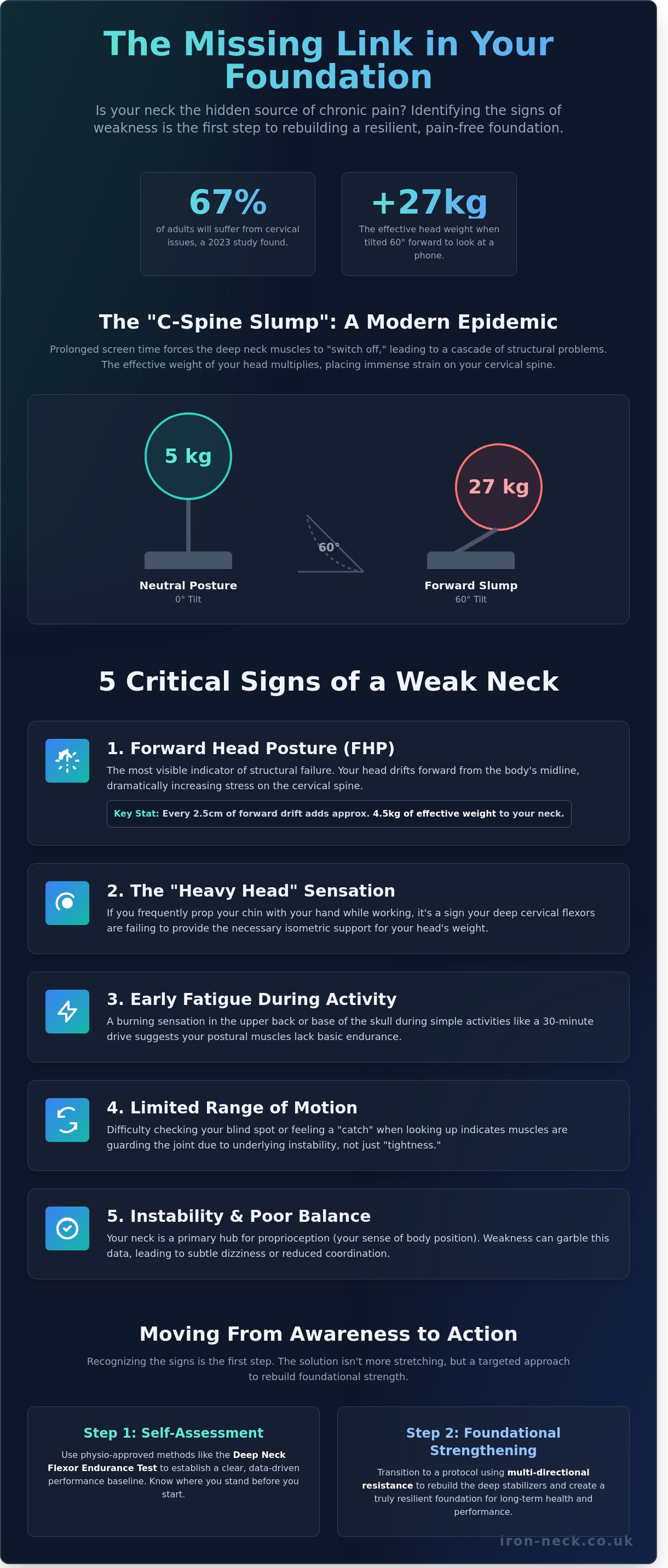
The "C-Spine Slump" has become a modern epidemic. When you look down at a smartphone or laptop, the effective weight of your head increases significantly. A 2014 study published in Surgical Technology International found that while a human head weighs roughly 5kg in a neutral position, tilting it forward to a 60-degree angle increases the effective load to 27kg. This tripling of weight forces the deep flexors to "switch off" as they become chronically overstretched and inhibited.
- Muscle Inhibition: Prolonged sitting causes the deep stabilisers to atrophy from disuse.
- Neural Fatigue: Constant strain on the cervical spine leads to chronic tension headaches and reduced cognitive focus.
- Postural Decay: Ignoring the signs of a weak neck leads to permanent structural changes, including forward head carriage.
Recognising the signs of a weak neck early is the only way to reverse this trend. If you spend more than four hours a day at a desk, your deep stabilisers are likely underactive. Long-term neglect doesn't just cause stiffness; it compromises the integrity of the entire kinetic chain, leaving you vulnerable to chronic pain and reduced athletic potential.
5 Critical Signs of a Weak Neck You Should Not Ignore
Identifying the signs of a weak neck early is the difference between peak performance and a life dictated by chronic discomfort. Your neck supports a head weighing roughly 5kg; when the supporting musculature fails, the structural integrity of your entire upper body is compromised. Recognising these five indicators allows you to intervene before temporary stiffness becomes a permanent pathology.
- Forward Head Posture (FHP): This is the most visible indicator of structural failure. For every 2.5cm your head shifts forward from the midline, its effective weight on the cervical spine increases by approximately 4.5kg.
- The "Heavy Head" Sensation: If you find yourself frequently propping your chin up with your hand while working, your deep cervical flexors are likely failing to provide necessary isometric support.
- Early Fatigue During Activity: A burning sensation in the upper back or base of the skull during a 30-minute drive or a short walk suggests your postural muscles lack the endurance required for basic daily life.
- Limited Range of Motion: Difficulty checking your blind spot while driving or feeling a "catch" when looking up indicates that your muscles are guarding the joint due to underlying instability.
- Instability and Poor Balance: The neck is a primary hub for proprioception. Weakness here garbles the spatial data sent to your brain, often resulting in subtle dizziness or reduced coordination.
Visual Indicators: The Mirror Test
Stand sideways in front of a mirror in your natural, relaxed stance. Your ear canal should align directly over the centre of your shoulder. If your ear sits forward of this line, you have identified a clear weakness. This misalignment forces "compensator" muscles like the levator scapulae and upper traps to work overtime. These muscles are designed for short bursts of power, not 16 hours of postural support. This overactivity often leads to rounded shoulders as the body attempts to create a new, albeit dysfunctional, centre of gravity. Building a resilient cervical spine is the only way to pull your posture back into a healthy, neutral alignment.
Sensory and Functional Red Flags
Functional weakness often manifests as a persistent burning sensation in the suboccipital muscles at the base of your skull. This isn't just "tension"; it is a cry for help from muscles that are physically exhausted. This strain often migrates to the jaw, where clenching and TMJ issues become secondary symptoms of cervical instability. Integrating expert-approved neck exercises into your routine can help alleviate this pressure. You may also notice a decline in hand-eye coordination or a general feeling of clumsiness. Because your neck houses the vestibular system's foundation, a weak "link" here directly impacts how you move through and interact with your environment.
The Connection Between Neck Weakness, Headaches, and Posture
Your neck is the foundation for all movement. When it's compromised, the rest of your posture follows. A weak neck isn't just about aesthetics; it's the root cause of a debilitating cycle of chronic pain. When your deep cervical stabilisers fail, your body compensates. The upper trapezius muscles, designed for shoulder movement, take on the burden of holding up your 5kg head. This creates the "traps up to your ears" look. It's one of the most visible signs of a weak neck. This constant tension isn't just uncomfortable. It triggers a "postural cascade" where the mid-back collapses into kyphosis to support the forward head position. You can't simply "sit up straight" to fix this. Without a strong cervical column, your body will always revert to the path of least resistance, leading to permanent structural changes.
Tension Headaches vs. Cervicogenic Pain
Cervicogenic headaches are often mistaken for standard migraines or tension headaches. However, they're actually referred pain from the cervical spine. When muscles fatigue, they compress the suboccipital nerve, causing chronic, throbbing symptoms. Standard painkillers might provide temporary relief for £10 a box, but they ignore the mechanical failure. Research shows that up to 20% of chronic headaches are actually cervicogenic. Identifying symptoms of neck muscle strain early is vital to stopping this cycle before it becomes a daily occurrence. If you don't address the underlying muscular deficiency, the pain will return every time you sit at a desk or look at your phone.
The "Scapular Winging" and Neck Strength Link
Your neck and shoulders function as a single unit. The serratus anterior and the neck stabilisers must work together to maintain upper body integrity. Weakness in the neck often manifests as chronic pain between the shoulder blades or scapular winging. This is why signs of a weak neck often show up in your back first. Strengthening the cervical spine provides the stable base your shoulders need for explosive movement and safety. A 2021 study showed that targeted cervical training improved scapular control by 22% in sedentary professionals. It's a holistic fix. You don't just train the neck; you rebuild your entire upper kinetic chain to unlock your full performance potential.
How to Test Your Neck Strength: A Physio-Approved Self-Assessment
Identifying the signs of a weak neck requires moving beyond subjective feelings of "stiffness". To understand your cervical health, you must measure functional capacity against clinical benchmarks. These tests expose the "missing link" in your training by highlighting where your stabilisers are failing to support your skull.
The Deep Neck Flexor Endurance Protocol
This assessment isolates the small, deep muscles responsible for cervical stability. To perform it, lie flat on your back without a pillow. Tuck your chin as if making a double chin, then lift your head exactly 2.5cm off the floor. Your goal is to maintain this position without losing the chin tuck or resting your head.
- Target Times: Clinical data from the Journal of Manipulative and Physiological Therapeutics suggests healthy men should average 38 seconds, while women average 29 seconds.
- Cheat Movements: Watch for the "chin poke" where your jaw juts forward. This indicates your superficial muscles are taking over because the deep flexors have fatigued.
- The Shudder: If your head begins to shake or "judder" within the first 10 seconds, it's a clear indicator of poor motor control.
Assessing Rotational Stability
Rotational strength is the gold standard for athletes in rugby or combat sports. It represents your ability to absorb impact from any angle. There is a vital distinction between passive flexibility (how far someone can push your head) and active strength (how well you control that movement).
Slowly rotate your head 90 degrees to the left and right while seated upright. Look for "dead spots" where the movement feels jerky or weak. If you can reach a range of motion passively but struggle to hold your head steady at the end-range of that rotation, your active stabilisers are failing. This discrepancy is one of the primary signs of a weak neck that leads to chronic strain during daily tasks.
The Wall Test for Postural Endurance
Stand with your heels, glutes, upper back, and the back of your head firmly against a flat wall. Maintain this "stacked" alignment for two minutes. This test measures postural endurance rather than raw power. If you feel a burning sensation between the shoulder blades or an urge to tilt your head back, your cervical extensors lack the stamina to support your posture throughout the day.
Once you've identified these deficits, you can begin a targeted recovery programme. You can view the Iron Neck range to see how professional-grade resistance training corrects these specific weaknesses.
Moving From Awareness to Action: Strengthening Your Foundation
Identifying the signs of a weak neck is the first step toward recovery, but true relief doesn't come from passive rest. It requires active stabilisation. Most people reach for a stretch when they feel tension; however, this often makes the problem worse. If your muscles are tight because they are weak, stretching simply pulls on an unstable joint. You don't need more flexibility; you need a structural shield for your cervical spine.
Why Resistance is Better Than Stretching
Strengthening creates the stability your nervous system requires to feel safe. When your deep stabiliser muscles are robust, your superficial muscles can finally stop "guarding" and relax. Traditional training often relies on linear movements, like the up and down motion of a standard weight harness. This is insufficient for a 3D joint. The neck is designed to rotate, tilt, and protract.
This principle of building foundational strength with specialized tools is universal. In industrial sectors, for example, creating durable structural bonds requires high-quality equipment, a field where specialists like Sharkhead Nordic AB excel. Similarly, rebuilding your cervical spine requires a targeted approach that goes beyond generic exercises.
The Iron Neck provides 360-degree resistance that traditional equipment lacks. This allows for eccentric loading, which is a critical component of injury prevention. By resisting rotation, you train the tissues to absorb and dissipate force. Research indicates that even a 5% increase in neck strength can significantly reduce concussion risk and chronic strain. Strengthening the "missing link" ensures your head remains balanced over your shoulders, regardless of the direction of movement.
Building Your Neck Training Routine
You don't need to spend hours training your neck to see results. A focused, 10-minute routine performed three times per week is often enough to eliminate the signs of a weak neck. Start with the "Foundational Four" movements to build a base of proprioception and control:
- 360 Spin: Rotate your body while keeping your head fixed to build multi-directional stability.
- Look Left, Look Right: Controlled rotation against resistance to improve range of motion.
- Protraction and Retraction: Essential for correcting "tech neck" and reinforcing proper posture.
- Side-to-Side: Lateral flexion to strengthen the scalenes and traps.
Integrate these movements into your existing gym programme or use the Iron Neck at home during a break from your desk. Recovery is just as vital as the training itself. Allow 48 hours between resistance sessions to let the cervical muscles adapt and grow stronger. Over time, you'll find that the "knots" you used to stretch away simply stop appearing. Explore the Iron Neck range to start your journey to a stronger foundation.
Strengthen Your Foundation and Reclaim Your Performance
Ignoring the signs of a weak neck isn't just a matter of minor discomfort; it's a direct compromise on your long-term health and athletic potential. We've explored how cervical instability often acts as the "missing link" behind chronic headaches and the debilitating posture that plagues modern life. You've identified the red flags and conducted your self-assessment. Now, you must move from awareness to action to protect your cervical spine and enhance your physical resilience.
Iron Neck offers the only system scientifically designed to provide 360-degree rotational resistance, specifically targeting the stabiliser muscles that traditional training misses. It's why our technology is a staple in the training rooms of Premiership Rugby, UFC, and NFL teams to assist with concussion risk reduction. Over 500 professional sports organisations worldwide trust this equipment to deliver measurable results. You don't have to settle for persistent stiffness or limited mobility when an elite-level solution is available for your home or gym.
Take control of your recovery and build a body that's prepared for any challenge. Browse the Iron Neck Collection and Fix Your Posture Today. You're one step away from a stronger, pain-free future.
Frequently Asked Questions
Is a weak neck serious?
A weak neck is a serious clinical concern because it undermines the structural integrity of your cervical spine and increases injury risk. Research from the Journal of Orthopaedic & Sports Physical Therapy indicates that poor deep neck flexor endurance is present in 70% of chronic neck pain cases. Without adequate muscular support, your vertebrae absorb 100% of daily micro-traumas; this leads to accelerated disc degeneration and increased vulnerability to acute injuries like whiplash.
Can a weak neck cause dizziness or vertigo?
Cervicogenic dizziness occurs when weak or hypertonic neck muscles provide faulty sensory input to your vestibular system. The neck contains the highest density of muscle spindles in the human body, which are responsible for spatial awareness and balance. When these stabilisers fail, the brain receives conflicting data about head position. A 2022 clinical review found that 85% of patients with cervicogenic dizziness showed measurable improvement after a targeted eight-week cervical strengthening programme.
How long does it take to strengthen a weak neck?
You can expect to see measurable strength improvements within 4 to 6 weeks of consistent, targeted training. While initial neurological adaptations occur in the first 14 days, true muscular hypertrophy requires a minimum of 60 days of progressive overload. Studies show that a 15% increase in neck circumference can correlate with a 50% reduction in head acceleration during impact. Consistency is vital for transforming the signs of a weak neck into a resilient foundation.
What is the best exercise for a weak neck?
The most effective exercise involves 360-degree rotational resistance that engages the stabiliser muscles through a full range of motion. Traditional shrugs or static stretches don't address the complex mechanics of the cervical spine. Using a dedicated resistance system allows you to perform "Figure 8s" and "Left-to-Rights," which activate the suboccipital and sternocleidomastoid muscles simultaneously. This holistic approach builds the functional strength required to eliminate the signs of a weak neck and improve posture.
Can a weak neck cause tingling in the arms or hands?
Tingling in the extremities, known as cervical radiculopathy, is frequently caused by muscular imbalances that allow for nerve impingement. When your neck muscles are too weak to maintain a neutral spine, the head shifts forward into a position often called "Tech Neck." This posture increases the effective weight of the head on the spine by up to 27kg. This added pressure can compress the C5 to C8 nerve roots, leading to paresthesia or "pins and needles" in your fingers.
While this article focuses on postural and lifestyle-related neck weakness, it is important to acknowledge that severe neurological and muscular issues can also arise from other circumstances, such as medical events during childbirth. For families navigating these specific challenges, you can discover Birth Injury Law Firm for compassionate legal guidance.
Why does my neck feel weak after a workout?
Your neck feels weak after a workout because the small postural stabilisers fatigue much faster than larger prime movers like the traps or lats. If you're performing heavy deadlifts or overhead presses, your neck works overtime to stabilise the spine under load. A 2021 study revealed that neck fatigue reduces proprioceptive accuracy by 20% immediately post-exercise. This temporary weakness is a signal that your cervical muscles require dedicated recovery or specific conditioning to match your primary lifts.
Is it safe to train your neck every day?
Training your neck every day is counterproductive and increases the risk of overstrain in the delicate cervical ligaments. Like any other muscle group, the cervical extensors and flexors require 48 hours of recovery to repair micro-tears and build strength. An optimal protocol involves 2 to 3 sessions per week using controlled, low-impact resistance. Elite athletes typically follow a 72-hour rotation to ensure peak performance and avoid the cumulative fatigue that leads to poor form.
Can a weak neck cause eye strain or vision problems?
Visual disturbances and eye strain are linked to cervical weakness through the cervico-ocular reflex, which coordinates eye movements with head position. When neck muscles are weak, they become chronically tight to compensate, which disrupts the neural pathways between the spine and the ocular muscles. Research indicates that 60% of individuals with chronic neck tension report difficulty with visual tracking. Strengthening the neck restores proper mechanical function, reducing the load on your eyes during prolonged screen use.