

Neck Pain Relief Exercises at Home UK: The 25-Minute Strength-First Guide
That temporary relief you feel after a £60 massage is a symptom, not a solution. It’s a frustrating cycle. You endure that persistent, dull ache from hours at your desk, worry about ‘trapped nerves,’ and spend your hard-earned money on treatments that only last a day. You're right to be skeptical of quick fixes that don't address the root cause: a fundamental lack of strength and stability in your cervical spine.
This guide breaks that cycle for good. Forget ineffective stretching. Here you will discover a science-backed protocol of neck pain relief exercises at home UK residents can use to not just manage pain, but to eliminate it by building foundational strength. We'll give you the professional rehab techniques to forge a resilient, injury-proof neck and immediately improve your posture. In just 25 minutes, you can begin a clear, progressive plan that moves beyond temporary fixes towards permanent power and a pain-free life.
Key Takeaways
- Discover the biomechanical reason 'Tech Neck' is rampant in the UK's hybrid workforce and the first step to reversing its effects.
- Learn why common stretching routines can actually destabilise your cervical spine and what to do instead for true stability and control.
- Follow a progressive 3-stage protocol of neck pain relief exercises at home UK designed to first desensitise pain and then rebuild foundational strength.
- Find out why adding resistance is the 'missing link' for transitioning from a pain-free neck to a high-performance, resilient one.
Understanding the Root of Neck Pain in the UK
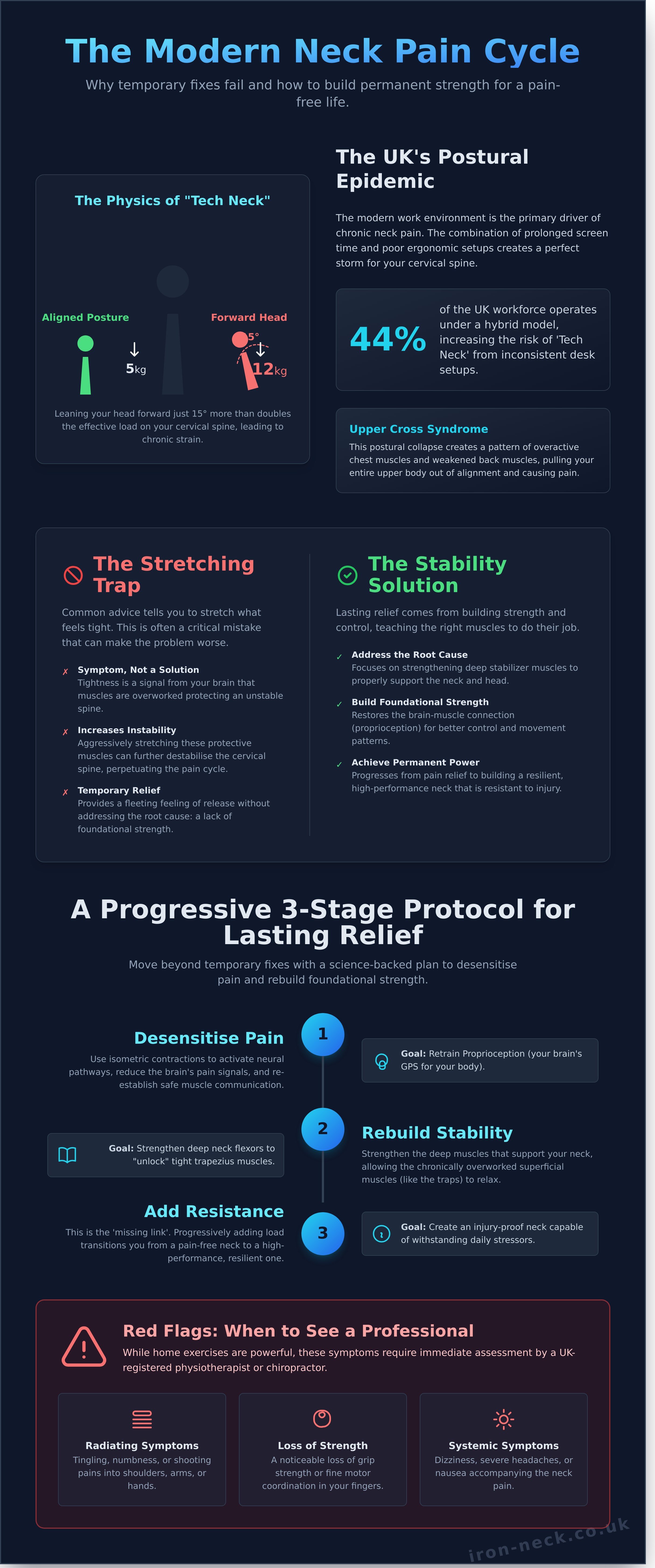
Your neck pain isn't just a random ache. It's a direct consequence of the modern UK work environment. With over 44% of the UK workforce operating under a hybrid model since 2023, the postural epidemic known as 'Tech Neck' has become a primary driver of chronic discomfort. This condition, a direct result of prolonged screen time and poor ergonomic setups, places unprecedented stress on your cervical spine. A deeper dive into Understanding the Root of Neck Pain reveals a network of interconnected causes, confirming that what feels like a simple stiff neck is often a complex biomechanical issue demanding a sophisticated solution.
The cervical spine is your body's most vulnerable bridge, a delicate structure of seven vertebrae tasked with supporting your head and enabling its complex range of motion. When posture is compromised, this bridge begins to fail. Standard NHS mobility drills offer a starting point by restoring basic movement, but they often fail to address the core instability that allowed the pain to develop. They provide temporary relief, not a permanent fix. To achieve lasting freedom from pain, you must identify 'The Missing Link': the critical difference between simply stretching a tight muscle and actively strengthening the deep stabilizer muscles to support the joint.
The Biomechanics of Modern Posture
The physics of poor posture are unforgiving. Your head weighs approximately 5kg, but leaning it forward just 15 degrees to view a screen triples the effective load on your cervical spine to nearly 12kg. This sustained tension overworks the deep suboccipital muscles at the base of your skull, a primary trigger for debilitating tension headaches and the persistent 'brain fog' that destroys focus. This postural collapse, fueled by the UK's increasingly sedentary lifestyle, culminates in a condition called 'upper cross syndrome'-a pattern of overactive chest muscles and underactive, weakened back muscles that pulls your entire upper body out of alignment.
When to See a Professional
While a programme of targeted neck pain relief exercises at home UK can be transformative, some symptoms are non-negotiable red flags that demand immediate professional assessment. Do not ignore:
- Tingling, numbness, or shooting pains that radiate into your shoulders, arms, or hands.
- A noticeable loss of grip strength or coordination in your fingers.
- Dizziness, severe headaches, or nausea accompanying the neck pain.
If you experience any of these, it's imperative to seek a diagnosis from a UK-registered physiotherapist or a member of the British Chiropractic Association. A professional can rule out serious conditions and provide a clinical foundation for your recovery. Their guidance is essential for transitioning safely from initial rehabilitation to a home-based performance training programme designed to build lasting resilience and eliminate pain for good.
The Biomechanics of Relief: Mobility vs. Stability
To conquer neck pain, you must understand the battlefield. The common approach is to stretch what feels tight. This is often a critical mistake. That sensation of tightness in your upper traps and neck is frequently a symptom of underlying instability, not a lack of flexibility. This is the 'Stretching Trap': aggressively stretching muscles that are overworked and desperately trying to protect an unstable cervical spine can actually increase instability and perpetuate the pain cycle.
Lasting relief comes from a two-pronged attack. First, restore proper movement patterns (mobility). Second, build the endurance and strength to control them (stability). This process begins by re-educating your brain. Proprioception, your nervous system's internal GPS for your body, is crucial. It tells your brain where your head is in space without you having to look in a mirror. Chronic poor posture degrades this sense, leading to faulty movement and pain. We must first retrain this connection.
The science of isometric contraction provides a powerful tool for this. By contracting muscles against an immovable force, you activate neural pathways and desensitise the pain response. Studies from the Journal of Pain show that sustained isometric contractions can produce an analgesic effect, reducing perceived pain by re-establishing safe communication between the muscle and the brain. The goal isn't just to perform exercises; it's to re-establish control. This control is what allows you to 'unlock' chronically tight muscles. When the deep neck flexors at the front of your neck are strong and active, your over-stressed trapezius muscles finally get the signal that they can stand down.
Mobility: Clearing the Path
Healthy mobility isn't about extreme flexibility; it's about controlled, pain-free movement. An optimal cervical spine should demonstrate approximately 45-50 degrees of rotation left and right, 45 degrees of lateral flexion (ear to shoulder), and a combined 110-140 degrees of flexion and extension. Before attempting any complex neck pain relief exercises at home UK, you must ensure you can move through these basic ranges. Dynamic stretching, which involves gentle, controlled movements, is proven to be more effective than static stretching for reducing injury risk before activity. The foundational movement for all neck health is the Chin Tuck. It directly activates the deep neck flexors while releasing tension in the suboccipital muscles, a common source of tension headaches.
Stability: Building the Foundation
Your deep stabilizer muscles are the 'first responders' to any neck strain or impact. They are designed for endurance, firing constantly to support your head against gravity. When they weaken due to a sedentary lifestyle or 'tech neck', larger, more powerful muscles must take over a job they weren't designed for. This leads to fatigue, strain, and pain. The core principle of stability is maintaining 'Cervical Neutral'-the posture where your ears align directly over your shoulders. This is the spine's strongest, most efficient position. The ultimate goal of a rehabilitation programme is to build the strength to hold this position under stress. To put it simply: cervical stability is the ability to maintain spinal alignment against external forces. Building this foundation requires targeted, progressive resistance, which is why understanding how to systematically strengthen your cervical spine is the key to long-term results.
A Progressive 3-Stage Home Exercise Protocol
Lasting relief from neck pain isn't found in random stretches. It's built through a systematic, science-backed protocol that restores function and builds resilience. True strength development is a process. This 3-stage protocol is engineered to first calm irritated tissues, then correct the underlying postural deficits, and finally, build the strength required to prevent future episodes. This is how you transition from temporary relief to permanent resolution.
This entire system is designed to be integrated into a busy schedule, proving that finding effective neck pain relief exercises at home UK workers can consistently perform is not only possible, it's essential for long-term health.
Stage 1 & 2: The Foundation for Stability
The initial stages focus on two critical goals: desensitising the nervous system to reduce pain signals and activating the deep stabilising muscles of the cervical spine. We combine these because they are interdependent; you cannot build stability on a foundation of pain, and you cannot maintain a pain-free state without stability. These foundational movements retrain your neuromuscular system for optimal function.
- Step-by-Step: The Supine Chin Tuck. This is the gold standard for activating the deep neck flexors. Lie on your back with your knees bent and feet flat on the floor. Without lifting your head, gently nod your chin towards your chest, as if making a slight double chin. You should feel a gentle stretch at the back of your neck. Hold this position for 5 seconds, focusing on your breath. Perform 2 sets of 10 repetitions.
- The 'Wall Slide'. This exercise integrates the neck with the scapular stabilisers. Stand with your back against a wall, feet about 6 inches away. Place your arms against the wall in a 'W' position, with elbows and wrists touching the surface. Slowly slide your arms up the wall into a 'Y' position, keeping your shoulders down and away from your ears. Perform 2 sets of 8-12 repetitions.
- Side-Lying Thoracic Rotations. Your neck's function depends on the mobility of the spine below it. Lie on your right side with your knees bent at a 90-degree angle. Extend both arms straight out in front of you. Keeping your hips still, lift your left arm and rotate your torso to the left, aiming to touch your left shoulder blade to the floor. Follow your hand with your eyes. Hold for 2-3 seconds and return to the start. Complete 10 repetitions per side.
Stage 3: Building Long-Term Resilience
Once you've established pain-free mobility and can activate the correct muscles, the next objective is to introduce load. Strength is your armour against the physical stresses of daily life, from long hours at a desk to demanding physical activity. This stage introduces isometric resistance, a safe and highly effective method for building foundational neck strength without compromising joint integrity.
-
Manual Isometrics: The 'Four-Way Neck' Protocol. Use your own hand to provide resistance. For each direction, apply gentle pressure and match it with your neck muscles, holding a static contraction for 10 seconds.
- Forward Flexion: Place your palm on your forehead and gently press your head forward into your hand.
- Extension: Clasp your hands behind your head and gently press your head backward into your hands.
- Left Lateral Flexion: Place your left palm on the left side of your head and press your head into your hand.
- Right Lateral Flexion: Place your right palm on the right side of your head and press your head into your hand.
Mastering this protocol builds the essential muscular endurance and control that serves as the gateway to more advanced training. It prepares the cervical spine for dynamic and rotational loads, creating the necessary foundation before progressing to elite tools like the Alpha Head Harness, which unlock the next level of performance and injury prevention.
The 5-Minute 'Micro-Break' for Your Work Week
Consistency is the key to success. Integrate these movements into your day by using a "micro-break" strategy. Set an alarm to go off every 60 minutes during your workday. When it sounds, step away from your desk and perform one set of Wall Slides or Thoracic Rotations. This simple habit prevents the cumulative stiffness that leads to chronic pain and transforms these exercises into a powerful, preventative routine.
Safety and Common Mistakes in Home Neck Rehab
Executing any rehabilitation protocol without a foundational understanding of safety is counterproductive. The cervical spine is a resilient and dynamic structure designed for movement, yet it's often treated with excessive caution. The myth of the 'fragile' neck leads to fear and immobilisation, which science shows can worsen stiffness and atrophy the deep stabiliser muscles. True progress is built on intelligent movement, not avoidance.
A primary error is 'cranking' the neck into a stretch, forcing it into a painful range of motion. This aggressive approach can trigger muscle guarding and inflammation, setting your recovery back. Instead, focus on controlled, active movements within a pain-free range. Another critical mistake is ignoring your breathing. Shallow, chest-dominant breathing patterns constantly engage the scalene muscles in your neck, which are meant to be secondary breathing muscles. This chronic overuse is a major source of tension and trigger points. Over time, this dysfunctional pattern sabotages any stretching or strengthening you perform.
Finally, the impulse to 'crack' your own neck for relief is a high-risk, low-reward habit. The audible pop is merely gas releasing from a joint capsule (cavitation). It provides a fleeting sensation of release due to a temporary neurological reset, but it doesn't address the root cause, which is typically muscular imbalance or joint restriction. Repeatedly forcing this can lead to hypermobility and ligamentous laxity, creating long-term instability.
The 'Traffic Light' System for Pain
To safely navigate your exercises, use this simple biofeedback system. This protocol is non-negotiable for anyone performing neck pain relief exercises at home in the UK and is used by elite physiotherapists to guide rehabilitation.
- Green Light: A mild stretch sensation or muscular discomfort that disappears within 10-15 seconds after the exercise. This is a productive zone. Proceed with the exercise.
- Amber Light: A sharp, specific pain that lingers or a significant increase in baseline pain. This is a warning sign. Reduce your range of motion or the intensity of the exercise immediately.
- Red Light: Any exercise that causes radiating pain, numbness, tingling down your arm, dizziness, or a sudden, severe headache. Stop immediately. This may indicate nerve irritation and requires professional assessment.
Optimizing Your Home Environment
Your environment directly impacts your recovery. For those working from home, your setup must comply with UK DSE (Display Screen Equipment) standards. The Health and Safety Executive (HSE) guidelines state the top of your monitor should be roughly at eye level, preventing the 'tech neck' posture that strains posterior neck muscles. Your sleeping position is equally critical. A pillow that is too high or too flat can strain your cervical spine for 8 hours straight, negating your daytime rehab efforts. Side sleepers generally require a firmer, thicker pillow to fill the space between the ear and the shoulder, maintaining neutral alignment.
You don't need a complete gymnasium. However, a simple mirror is one of the most powerful tools for biofeedback. It allows you to monitor for common form errors like the chin jutting forward during retractions or the shoulders elevating during stretches. This visual confirmation ensures you're activating the correct muscles and building proper motor patterns.
While these safety principles are foundational, achieving elite-level neck health requires targeted, progressive resistance. Explore the Iron Neck system to see how professionals build a truly resilient cervical spine.
Beyond Bodyweight: Why Resistance is the 'Missing Link'
The bodyweight movements detailed earlier are essential for restoring mobility and alleviating immediate discomfort. They are the first step. But to build a truly resilient, high-performance neck that resists future injury, you must introduce resistance. This is the missing link between being merely 'pain-free' and becoming 'bulletproof'. Moving from rehabilitation to fortification requires a tool engineered for the unique complexity of the cervical spine.
This is where the Iron Neck excels. It's the world's premier neck training device, delivering 360-degree rotational resistance that bodyweight or simple bands cannot replicate. It's the reason elite athletes across the UK, from the punishing scrums of Premiership Rugby to the G-force demands of Formula 1 and the dynamic combat of MMA, rely on Iron Neck not just for performance, but for career longevity. They understand that a strong neck is the foundation for all movement and the first line of defence against impact.
The Science of Rotational Strength
Your neck isn't designed for simple, one-directional movement. It's a complex system built to look, turn, and absorb force from every angle. Traditional neck harnesses fail because they only train linear movements like flexion and extension. The Iron Neck's patented design, however, simulates real-world forces, forcing the deep stabiliser muscles of your neck to fire and strengthen through every plane of motion. Engineered with principles from sports science, the Iron Neck was specifically designed to mitigate concussion risk by strengthening the cervical spine, which increases the head's 'effective mass' and reduces its acceleration during impact.
Investing in Your Longevity
Chronic pain is expensive. Consider this: the average private physiotherapy session in the UK costs between £50 and £90. A recurring course of treatment for chronic neck pain can easily exceed £500 annually, treating symptoms without always building foundational strength. The Iron Neck is a one-time investment in permanently solving the problem. It transforms your approach to neck pain relief exercises at home UK, shifting the focus from temporary fixes to building permanent strength. Getting started is simple with the 'Beginner's Protocol':
- 360 Spin: With light resistance, slowly rotate your head in a full circle, keeping your body stationary.
- Look Left, Look Right: Gently turn your head from side to side against the resistance.
- Protraction & Retraction: Push your head forward and pull it back, activating the muscles that fight 'tech neck'.
Just five minutes, three times a week, is all it takes to begin building the foundational strength for a pain-free life. It’s the single most effective addition you can make to your home gym, closing the gap in a training system that too often ignores the body's most vital pillar of support. Don't just manage pain; eliminate it. Unlock your full potential with the Iron Neck UK collection.
Build Your Foundation for a Pain-Free Future
You now have a clear, progressive plan. You've learned that while mobility offers temporary comfort, true stability comes from building foundational strength. The protocol in this guide provides the essential neck pain relief exercises at home UK residents can use to begin their journey. But to achieve lasting results and build a truly resilient cervical spine, you must introduce resistance-the 'missing link' for long-term health and peak performance.
It's why elite athletes in the Premiership and UFC integrate Iron Neck into their training to prevent injuries and enhance power. Our science-backed design isn't just for professionals; it's for anyone ready to take definitive action against pain. With dedicated UK-based support and fast shipping, you can start building a stronger, more resilient neck this week. Don't just manage your pain. Eliminate it.
Discover why Iron Neck is the #1 piece of neck training equipment in the UK.
Frequently Asked Questions About Neck Pain Relief Exercises
Is it safe to do neck exercises at home if I have a bulging disc?
No, you must consult a medical professional before starting any exercises with a diagnosed bulging disc. Your GP or a registered physiotherapist in the UK can provide a safe, tailored protocol based on your specific diagnosis. The cervical spine is a complex structure, and improper movement can exacerbate nerve root compression. Professional guidance is essential to ensure your exercises aid recovery, not cause further injury. Your safety is the non-negotiable first step.
How long does it take to see results from neck strengthening exercises?
You can expect to feel initial relief from pain and stiffness within 2 to 4 weeks of consistent training. However, achieving measurable improvements in muscle strength and postural control typically requires 6 to 8 weeks of dedicated effort. Neuromuscular adaptations happen first, followed by physiological changes in the muscle tissue. Consistency is the key to unlocking long-term stability and eliminating chronic pain. Stay committed to the protocol for foundational, lasting results.
Can neck exercises help with tension headaches and migraines?
Yes, targeted neck exercises are proven to reduce both the frequency and intensity of cervicogenic and tension-type headaches. A 2011 study in the journal Cephalalgia showed that a consistent strengthening programme can reduce headache frequency by over 50%. By correcting muscular imbalances and improving cervical spine stability, you alleviate the trigger points and nerve irritation that are often the root cause of these debilitating conditions. It's a foundational solution for head and neck pain.
Do I need special equipment to start training my neck muscles?
No, you don't need any special equipment to begin. Foundational exercises like chin tucks and isometric holds utilise your body's own resistance to activate and strengthen deep cervical flexors. These are excellent starting points for building neuromuscular control. As you progress, incorporating resistance tools can accelerate strength gains, but the initial phase of your neck pain relief exercises at home UK can be equipment-free, making it accessible to everyone.
What is the best exercise for 'Tech Neck' posture correction?
The chin tuck, or cervical retraction, is the most effective exercise for combating 'Tech Neck'. This movement directly targets and strengthens the deep cervical flexor muscles, which become weakened from prolonged forward head posture. By repeatedly pulling your head back over your shoulders, you retrain your neuromuscular system to maintain proper alignment. Perform 10-15 repetitions multiple times throughout the day to counteract the effects of screen time and build a stronger postural foundation.
How often should I perform these neck relief exercises?
Perform gentle mobility and stretching exercises daily to alleviate stiffness and improve your range of motion. For specific strengthening protocols, aim for 3 to 4 non-consecutive days per week. This frequency allows for the 48 hours of recovery your muscles need for repair and adaptation, which is critical for building genuine strength. Always listen to your body; never train through sharp pain. Consistency over intensity yields the best long-term outcomes.
Can strengthening my neck really reduce the risk of sports-related concussions?
Yes, a stronger neck is your first line of defence against concussion. Research has shown that for every one-pound increase in neck strength, the odds of concussion decrease by 5%. A well-conditioned neck can better absorb and dissipate impact forces, reducing the violent acceleration of the head after a collision. This is why elite athletes in the UK and worldwide now consider neck training a non-negotiable part of their safety and performance protocol.
What should I do if my neck feels stiffer after exercising?
You should stop the specific exercise that caused stiffness and apply a cold pack for 15 minutes. Some mild muscle soreness, known as DOMS, is normal 24-48 hours after a new routine. However, sharp pain or significant joint stiffness is a red flag indicating you may have used improper form. Rest for a day and if the stiffness persists, consult a physiotherapist before resuming your neck pain relief exercises at home UK.