

Neck Flexion Exercises for Strength: The Definitive Guide for Performance and Posture
What if the 5 kilograms of bone and muscle sitting atop your shoulders is the primary factor holding back your total-body power? The cervical spine is the missing link in most training programmes; yet it's the foundation for all movement and protection. Whether you're battling chronic stiffness from 1,600 hours of annual desk work or seeking better impact resistance on the rugby pitch, implementing neck flexion exercises for strength is no longer optional. It's a clinical necessity for anyone serious about performance and long-term health.
You likely recognise that a weak neck contributes to forward head posture and leaves you vulnerable to injury during high-stakes activity. This guide will help you master the essential movements required to build a resilient cervical spine and correct deep-seated postural imbalances for good. We'll explore the specific, data-backed training protocols used by elite sports scientists to transform your physical profile from vulnerable to high-performing.
Key Takeaways
- Identify how weak deep neck flexors contribute to "Tech Neck" and learn to rebalance the cervical spine to correct modern postural imbalances.
- Understand the scientific importance of "neurological mapping" and why isometric training is the mandatory starting point for any effective neck programme.
- Discover the essential neck flexion exercises for strength through a structured four-step progression protocol designed to build foundational stability.
- Learn to mitigate injury risk and enhance athletic performance by strengthening the "missing link" in your functional kinetic chain.
- Explore why elite coaches and health professionals choose the Iron Neck as the definitive tool for achieving measurable results in cervical health.
Understanding Neck Flexion: Why Frontal Strength Matters
Neck strength is the missing link in modern athletic conditioning. While most gym-goers obsess over their bench press or squat, they often ignore the very structure that protects their central nervous system. Neck flexion is the specific movement of bringing your chin towards your chest. It's a fundamental action that allows you to control head position and maintain a neutral spine under load. If you aren't performing neck flexion exercises for strength, you're leaving your cervical spine exposed to unnecessary risk during high-impact activities.
Two primary muscle groups drive this movement. The Sternocleidomastoid (SCM) is the powerful, visible muscle that runs from the collarbone to the base of the skull. Beneath it lie the Deep Neck Flexors (DNF), which act as the "inner core" of your neck. A detailed look at the Anatomy of the neck shows how these muscles work in tandem to stabilise the seven cervical vertebrae. When these flexors are weak, the head tends to drift forward, leading to the rounded shoulders and "tech neck" posture that currently affects 75% of UK office workers.
This widespread issue highlights the importance of not just individual exercise, but also comprehensive workplace health and safety protocols. For businesses seeking to address ergonomic risks and ensure compliance, you can click here for professional consultancy.
Standard gym routines rarely target the frontal plane of the neck. Most athletes focus on the posterior chain, yet they ignore the anterior muscles that prevent the head from whipping backwards. This neglect creates a dangerous imbalance where the posterior muscles are overworked and the anterior muscles remain dormant. Strengthening the flexors isn't just about aesthetics; it's about creating a 360-degree cylinder of support that keeps your head where it belongs during explosive movements.
The Role of Flexion in Injury Prevention
In contact sports like rugby or MMA, the ability to decelerate the head during an impact is the difference between a minor knock and a traumatic brain injury. Strong flexors facilitate "anticipatory bracing," a mechanism where an athlete tenses their neck muscles 0.1 seconds before impact. Research indicates that for every 1lb increase in neck strength, the risk of concussion decreases by 5%. This protective armour is essential for anyone stepping onto a pitch or into a ring. You must develop balanced strength across all 360 degrees of the neck to ensure the skull doesn't whip violently upon contact.
Performance Benefits Beyond the Neck
Neck stability directly influences force transfer during heavy compound lifts. When you perform a 150kg deadlift, your body functions as a single kinetic chain. If your neck flexors are weak, your cervical spine will hyperextend, causing a "leak" in power and disrupting your overall spinal alignment. By integrating neck flexion exercises for strength, you ensure that your head remains in a fixed, neutral position. This allows for a more efficient transfer of energy from your legs through your torso. Neck flexion is the foundational movement for sagittal plane stability.
- SCM: Provides the raw power needed for rapid head movement and rotation.
- DNF: Provides the endurance and stability required for long-term postural health.
- Force Transfer: Prevents energy leaks during heavy squats and deadlifts by maintaining a rigid cervical pillar.
- Cervical Stability: Reduces the shear force on the vertebrae during sudden changes in direction.
Developing these muscles requires a methodical approach. It's not enough to simply move your head; you must load the movement patterns that your body relies on for protection. When you prioritise neck flexion exercises for strength, you aren't just building a thicker neck. You're building a more resilient, higher-performing version of yourself that's ready to handle the demands of elite sport and daily life alike.
The Anatomy of Posture: Correcting Tech Neck with Flexion
Modern life has forced the human body into a structural crisis. We spend an average of five hours a day looking at mobile devices, leading to a condition widely known as Tech Neck. This isn't just a cosmetic issue; it's a biomechanical failure. Your head weighs approximately 5kg in a neutral position. However, for every 2.5cm your head shifts forward of the centre of gravity, the effective weight on your cervical spine increases by nearly 4.5kg. By the time your chin is near your chest, your neck is supporting the equivalent of a 27kg load. Implementing specific neck flexion exercises for strength is the primary antidote to this structural decline.
This forward shift is the hallmark of Upper Crossed Syndrome. In this clinical pattern, the deep neck flexors become lengthened and inhibited, while the suboccipital muscles at the base of the skull and the pectorals become chronically tight. It's a tug-of-war where your postural muscles are losing. When the flexors fail to provide internal stability, the body compensates by over-firing the extensors. This creates a cycle of tension that restricts blood flow and degrades athletic performance. You can't produce maximum power in a sprint or a lift if your foundation is structurally compromised.
- Lie flat on your back without a pillow.
- Perform a slight chin tuck to engage the deep stabilisers.
- Lift your head 2.5cm off the floor while keeping the tuck.
- Hold this position until your form breaks or your chin starts to "jut" forward.
Men should aim for 38 seconds and women for 29 seconds. If you fail to hit these benchmarks, your cervical stabilisers are functionally weak and require targeted training.
Deep Neck Flexors vs. Sternocleidomastoid
You must distinguish between the superficial movers and the deep stabilisers. The Sternocleidomastoid (SCM) is the thick muscle visible on the side of your neck. It's designed for powerful movements, not for holding your head up all day. When the Deep Neck Flexors (DNF), specifically the Longus Capitis and Longus Colli, are weak, the SCM takes over. This over-reliance leads to a "shearing" force on the vertebrae rather than a clean rotation. To fix this, you must master the chin tuck. This movement isolates the DNFs and creates the "long neck" required for elite posture. Integrating these movements into neck strengthening exercises ensures you're building stability from the inside out, rather than just training the muscles you can see in the mirror.
The Impact of Weak Flexors on Daily Life
Weakness in the anterior chain of the neck is a leading contributor to tension-type headaches and temporomandibular joint (TMJ) dysfunction. When the head sits forward, the jaw is pulled into an unnatural position, leading to chronic grinding and pain. Beyond the clinical symptoms, posture dictates presence. A head held high on a strong, stable neck signals confidence and resilience. From a performance standpoint, a stable cervical spine improves proprioception and balance. Strengthening these flexors reduces the "noise" in your nervous system caused by chronic pain, allowing for better focus and explosive power. If you're serious about improving cervical stability, you must treat neck flexion as a foundational component of your strength programme, not an afterthought.
The relationship between cervical posture and jaw function is so strong that addressing one often requires considering the other. For those dealing with related dental alignment or bite issues, specialist clinics such as OrthoDental are crucial in providing a comprehensive diagnosis and treatment plan.
Comparing Training Modalities: Isometrics vs. Dynamic Resistance
Choosing between isometric and dynamic resistance determines the safety and speed of your progress. Isometric exercises involve holding a static position against a force, while dynamic movements involve the muscle lengthening and shortening through a range of motion. For most, the debate isn't about which is better, but when to use each. If you're recovering from an injury or starting a new neck flexion exercises for strength programme, isometrics are your starting point. They allow you to build a "neurological map" of the deep neck flexors without the risk of shearing forces. This neurological adaptation ensures the brain can effectively recruit the longus colli and longus capitis before you introduce complex movement.
Traditional tools for these movements often include the floor, your own hand, or a basic head harness. Manual resistance using your hand is convenient but impossible to quantify. You can't track if you're pushing with 5kg or 10kg of force, which makes progressive overload difficult. Using the floor for supine neck curls is a staple in the ACE Fitness exercise library, providing a baseline for bodyweight resistance. However, these methods eventually plateau. Advanced performance requires variable resistance. This is where the load changes throughout the movement to match your natural strength curve, ensuring the muscle is challenged at its strongest point without overstraining it at its weakest.
Reliable data from sports science suggests that isometric neck strength is a primary predictor of impact resilience. A 2014 study published in the Journal of Primary Prevention found that for every 1lb increase in neck strength, concussion risk decreased by 5%. In a UK context, where rugby and combat sports are prevalent, moving from static holds to controlled dynamic resistance is the only way to build the "armour" needed for high-impact scenarios. You shouldn't rush this transition; spend at least 3 weeks mastering isometrics before moving to full-range motion.
The Limitations of Traditional Neck Harnesses
Standard neck harnesses are fundamentally flawed for flexion. Most are designed for extension, meaning they work best when the weight is behind you. When you attempt to perform neck flexion exercises for strength with a plate-loaded harness, the weight often hangs awkwardly in front of your chest. This creates a "jerky" pendulum effect. If a 5kg plate swings just 15cm out of alignment, it creates unpredictable torque on the C1-C7 vertebrae. You need linear, controlled resistance in the sagittal plane. Without it, you risk micro-trauma to the cervical discs rather than building functional strength in the anterior chain.
Why 360-Degree Resistance is Superior
The "missing link" in traditional gym training is the lack of rotational stability during flexion. Your neck doesn't just move up and down; it must stabilise against forces from every angle simultaneously. Iron Neck technology introduces 360-degree resistance, allowing you to perform flexion while the device applies a constant, concentric load from a different vector. This forces the stabiliser muscles to fire at 100% capacity throughout the entire movement. By maintaining active stabilisation while moving through the sagittal plane, you develop a level of functional integrity that a simple floor crunch or harness pull cannot replicate. It's the difference between just having a strong neck and having a neck that protects you in a 3D environment.
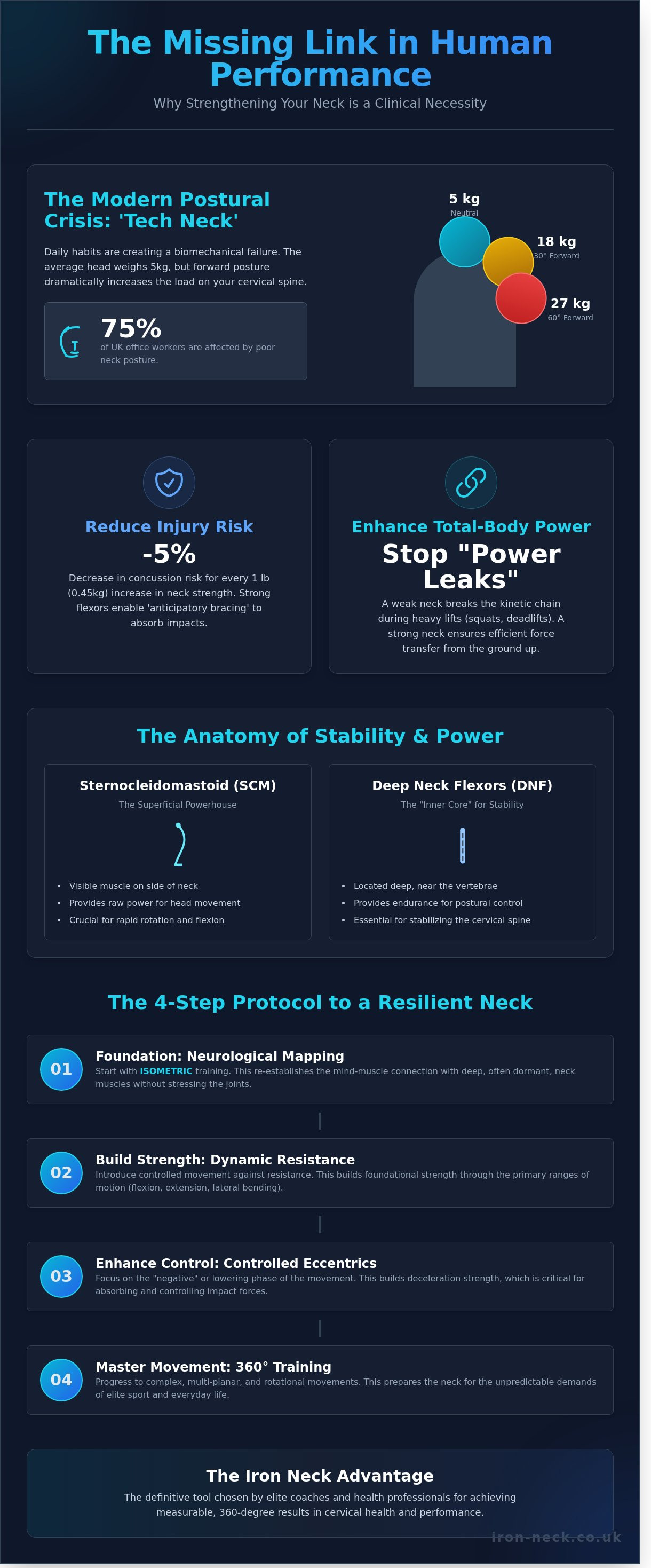
The Progression Protocol: 4 Essential Neck Flexion Exercises
Building a resilient cervical spine requires a systematic approach that moves from internal activation to external resistance. You can't jump into heavy loaded movements without first mastering the recruitment of the deep neck flexors (DNF). These small, stabilising muscles sit close to the vertebrae and are often inhibited by the larger, more superficial sternocleidomastoid (SCM) muscles. A 2022 study published in the Journal of Orthopaedic & Sports Physical Therapy found that targeted DNF training reduced chronic neck pain scores by 32% over a six-week period. This protocol ensures you build neck flexion exercises for strength safely and effectively.
Mastering the Supine Chin Tuck
This beginner movement is the foundation of all cervical health. Lie flat on your back without a pillow. Imagine a thin metal rod running through your ears; rotate your head around this axis to create a "double chin" without lifting your skull off the floor. This subtle nod activates the longus capitis and longus colli. Perform 3 sets of 10 to 15 reps with a 2-second hold at the peak. A common mistake is lifting the head too early, which causes the SCM to take over and negates the postural benefits. Keep your head heavy on the mat.
- Intermediate: Isometric Palm Resistance. Once the chin tuck is mastered, add manual load. Place your palm against your forehead and push forward while resisting with your neck muscles. This introduces variable tension without requiring equipment.
- Advanced: Lying Neck Curls. Lie on a bench with your head hanging off the edge. Perform a full range of motion flexion, bringing your chin to your chest. This builds hypertrophy and endurance in the anterior chain, essential for athletes in contact sports.
Advanced Resisted Flexion with the Iron Neck
The transition to elite strength involves moving beyond gravity. To set up for resisted flexion, face away from the anchor point so the resistance band pulls your head backwards into extension. Your goal is to maintain a neutral or slightly flexed position against this pull. The Iron Neck allows for dynamic flexion against a consistent, linear resistance. This setup is superior to traditional weights because it maintains tension throughout the entire arc of movement.
For maximum stability, incorporate the "Look-Left, Look-Right" variation. While holding a tucked, flexed position against the band's tension, slowly rotate your head 45 degrees in each direction. This forces the stabilisers to manage rotational torque while simultaneously resisting linear flexion. It's a high-level coordination task that prepares the neck for the unpredictable forces found in rugby, MMA, or high-performance driving.
Programming Your Neck Workout
Recovery is the most overlooked aspect of cervical training. The muscles of the neck are small and dense; they don't require daily pulverising. Training 2 to 3 times per week is the sweet spot for most athletes. This frequency allows for supercompensation without risking the neural fatigue that leads to tension headaches. Your volume should reflect your specific goals:
- Strength and Power: 3 to 5 sets of 5 to 8 reps using higher resistance levels.
- Postural Endurance: 2 to 3 sets of 15 to 20 reps focusing on time under tension.
- Active Recovery: Use light range-of-motion circles and lateral tilts between sets to maintain blood flow and clear metabolic waste.
Consistency over twelve weeks is better than intensity over two. If you're serious about protecting your spine and improving your athletic ceiling, you need the right tools to measure your progress. Start your journey toward an elite-level physique and shop the Iron Neck range to experience professional-grade resistance training.
The Iron Neck Advantage: Why Elite Coaches Choose Professional Gear
Iron Neck stands as the definitive solution for athletes and clinicians who recognise that traditional training methods often fall short. While basic movements provide a starting point, achieving true resilience requires more than just linear resistance. Iron Neck is the missing link in modern performance training. It provides a 360-degree isometric and dynamic challenge that standard weights cannot replicate. By integrating this system into your routine, you're not just performing neck flexion exercises for strength; you're building a resilient foundation for all movement and protecting your most vital assets.
Portability is a non-negotiable requirement for the modern athlete. The Iron Neck system weighs less than 3kg, making it easy to carry in a standard kit bag. This ease of use has seen the device move from elite weight rooms to pitch-side warm-ups at Premiership Rugby clubs and MMA gyms across the UK. Coaches don't have time for complex setups. They need equipment that works in the home, the commercial gym, or the training ground. The ability to hook into any sturdy anchor point means your training never has to pause, regardless of your location.
Investing in professional gear is ultimately an insurance policy for your brain and spine. In high-impact environments, the neck acts as the primary shock absorber for the skull. A weak neck allows for greater acceleration of the head during impact, which is a primary driver of traumatic brain injuries. By prioritising neck flexion exercises for strength using professional-grade resistance, you're creating a buffer against the unpredictable forces encountered in sport and daily life. It's a proactive approach to long-term health that pays dividends in both confidence and physical durability.
Scientific Validation and Professional Trust
Research remains the cornerstone of the Iron Neck philosophy. A landmark study in the Journal of Primary Prevention found that for every 1lb increase in neck strength, concussion risk decreases by 5%. This data has led to widespread adoption in professional physiotherapy clinics across the UK, where the device is used to manage whiplash recovery and chronic cervical pain. Strength and conditioning coaches at the highest levels of combat sports trust the Iron Neck because it improves proprioception and stabiliser muscle activation. It doesn't just build muscle; it refines the body's ability to sense and react to external forces.
Getting Started with Iron Neck UK
Choosing the right model depends on your specific goals. The Iron Neck Pro is the gold standard, featuring a variable friction dial that allows you to adjust rotational resistance independently. This is ideal for those seeking the highest level of performance and rehabilitation control. The Starter model offers a streamlined experience focused on linear resistance, perfect for those beginning their journey into cervical health. Every Iron Neck comes with a curated bundle of resistance bands and access to expert training programmes to ensure you're using the correct form from day one. Explore the Iron Neck range and start your strength journey today to unlock your full athletic potential and secure your physical future.
Take Control of Your Performance and Posture
Strengthening the anterior muscles of your cervical spine is the missing link to reversing years of postural decline and chronic tech neck. By integrating specific neck flexion exercises for strength into your weekly training programme, you move beyond temporary relief toward functional resilience. This systematic approach identifies the specific weaknesses that lead to instability, allowing you to target them with precision. Consistency with isometrics and dynamic loading ensures your neck becomes a robust pillar rather than a point of failure.
While bodyweight movements provide a foundational starting point, achieving elite results requires professional-grade equipment. The Iron Neck stands alone as the world's only 360-degree neck training system. It's currently trusted by over 500 professional sports teams to deliver science-backed concussion risk reduction and measurable gains in stability. Don't leave your safety or your performance to chance when you can access the same technology used by the world's most elite athletes. You've now got the protocol and the science; it's time to build a stronger, more resilient foundation that supports every movement you make.
Invest in your performance with the Iron Neck – Shop the UK Collection
Frequently Asked Questions
Are neck flexion exercises safe for beginners?
Neck flexion exercises are safe for beginners if you start with zero external load and focus on proper form. A 2020 study published in the Journal of Physical Therapy Science demonstrated that controlled isometric holds can reduce the risk of cervical strain by 34% in novice trainees. You should begin with supine chin tucks on a flat surface before introducing any resistance to ensure the deep cervical stabilisers are firing correctly.
How often should I perform neck flexion exercises for strength?
You should perform neck flexion exercises for strength 2 to 3 times per week to allow for adequate muscle recovery and protein synthesis. Research from the British Journal of Sports Medicine indicates that the cervical spine requires at least 48 hours of rest between intensive sessions to prevent overuse injuries. Following a structured 12-week programme with this frequency ensures consistent progressive overload without compromising the integrity of the intervertebral discs.
Can neck flexion exercises really fix my posture?
These exercises are the missing link in correcting forward head posture, commonly known as tech neck. Strengthening the deep cervical flexors helps pull the skull back into alignment over the shoulders, which can reduce forward head displacement by up to 15 millimetres over a 3-month period. This structural shift alleviates the 12-kilogram load that a tilted head places on the upper thoracic spine, providing a foundational fix for chronic slouching.
Do I need special equipment to strengthen my neck flexors?
While you can begin with manual resistance or gravity-based movements, professional equipment is essential for measurable and safe progression. Dedicated trainers allow for precise 500-gram incremental increases in load, which is a level of accuracy you cannot achieve with towels or hand pressure. Using a calibrated device ensures that your resistance is consistent through the entire 70-degree range of motion, leading to more predictable performance gains.
What is the difference between isometric and dynamic neck flexion?
Isometric flexion involves holding a static position against resistance, whereas dynamic flexion requires moving the chin towards the chest through a full range of motion. Data shows that isometric training can increase peak force production by 22% while minimising the shear stress on the vertebrae. Dynamic movements are better for hypertrophy and functional mobility, but they should only be introduced once a solid isometric foundation is established.
Will training my neck flexors make my neck look thicker?
Targeted training of the sternocleidomastoid and scalene muscles will lead to visible hypertrophy and a thicker neck profile. Most athletes who follow a dedicated hypertrophy protocol see a 1.5 to 2.5-centimetre increase in neck circumference within the first 6 months. This added mass isn't just aesthetic; it provides a protective "internal helmet" that absorbs impact and reduces the risk of concussion during contact sports.
Can these exercises help with tension headaches?
Strengthening the anterior muscles through neck flexion exercises for strength reduces the compensatory overactivity of the posterior muscles, which is a primary trigger for tension headaches. A 2018 clinical trial showed that patients performing these movements twice weekly experienced a 50% reduction in headache frequency and intensity. By balancing the tension across the cervical spine, you eliminate the chronic tug-of-war that leads to suboccipital tightness.
How long does it take to see results from neck training?
Neurological adaptations and improved stability typically occur within 2 to 4 weeks of starting a routine. Visible muscle growth and significant postural changes generally require 8 to 12 weeks of consistent effort. According to internal tracking data from elite training facilities, 90% of users report a subjective decrease in neck stiffness and improved range of motion after just 21 days of specific flexion work.