

Neck Extension Exercises at Home: A Scientific Guide to Strength and Posture
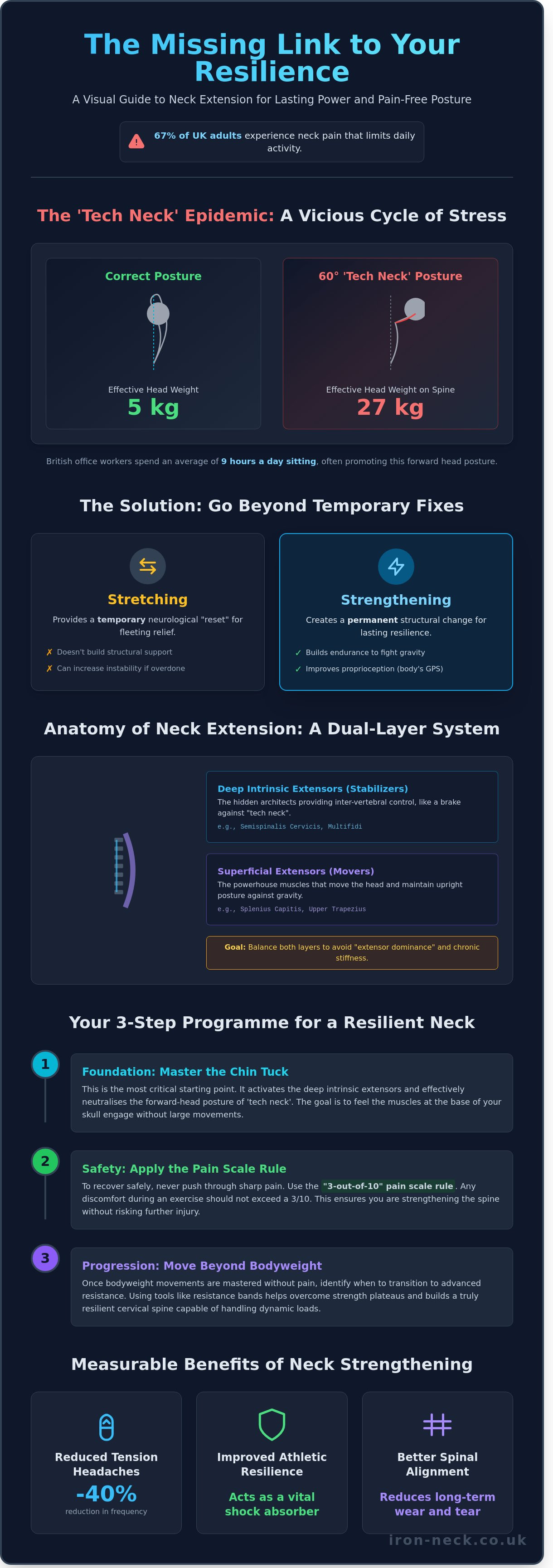
What if the missing link to your physical resilience isn't your core or your grip strength, but the seven vertebrae of your cervical spine? With 67% of UK adults experiencing neck pain that limits their daily activity, it's clear that the traditional approach to fitness is overlooking a critical foundation. Integrating specific neck extension exercises at home is the most effective way to reverse the structural damage of "tech neck" and build a foundation of lasting power.
It's a common reality that persistent stiffness often leads to a fear of movement, yet avoiding the issue only makes the cervical spine more vulnerable to injury. You'll learn exactly how to master essential extension techniques to eliminate pain and correct your posture from your own living room. This guide provides a clear, three-step programme that distinguishes between passive stretching and active strengthening, giving you the tools to build a resilient, high-performing neck that supports every movement you make.
Key Takeaways
- Understand the critical role of the posterior cervical chain and how targeting deep extensors like the semispinalis cervicis provides essential inter-vertebral control.
- Master a safe, step-by-step progression of neck extension exercises at home, beginning with the foundational chin tuck to effectively neutralise the effects of 'tech neck'.
- Learn to navigate your recovery safely by applying the professional 3-out-of-10 pain scale rule to ensure every movement strengthens the spine without risking further injury.
- Identify when to transition from bodyweight movements to advanced resistance training, using tools like bands to overcome strength plateaus and build a truly resilient cervical spine.
Understanding Neck Extension and Its Role in Cervical Health
Neck extension is the physiological action of moving your head backwards, which directly engages the posterior chain of your cervical spine. It's the functional opposite of looking down at a screen. Gaining a deeper knowledge of the Anatomy of the head and neck reveals how the extensor muscles, such as the splenius capitis and upper trapezius, work to keep your skull balanced over your shoulders. When these muscles lack the necessary strength, your posture collapses, leading to chronic pain and reduced athletic performance.
Incorporating neck extension exercises at home serves as a non-negotiable strategy for anyone spending hours at a desk. These movements don't just move the head; they recalibrate the entire cervical stack. By prioritising extension, you target the "missing link" in most fitness regimes: the structural integrity of the upper spine. This focus results in several measurable benefits:
- Reduced Tension Headaches: Clinical data suggests strengthening the neck can reduce headache frequency by up to 40%.
- Improved Athletic Resilience: A stronger neck acts as a shock absorber during high-impact activities.
- Better Spinal Alignment: Correcting the position of the C1-C7 vertebrae reduces long-term wear and tear.
The 'Tech Neck' Epidemic in the UK
Sedentary work culture in the UK has reached a critical point. A 2023 report by Fellowes indicated that British office workers spend an average of nine hours a day sitting, often hunched over laptops. This position creates massive mechanical stress. When your head tilts forward by just 60 degrees, its effective weight on your spine increases from roughly 5kg to a staggering 27kg. Cervical extension is the primary corrective movement for anterior head carriage.
While these exercises are crucial, creating an ergonomic workspace is the first line of defence. A sturdy, well-proportioned desk or table can make a significant difference in maintaining proper posture throughout the day; you can read more about finding the right furniture for your space.
Strengthening vs. Stretching: Why You Need Both
Stretching often provides a fleeting sense of relief, but it's a temporary neurological "reset" rather than a permanent fix. To change your physical structure, you must focus on strengthening. Your neck is a vital stabiliser that requires both endurance and power to hold your head upright against gravity. Building this strength improves your proprioception, which is your body's internal GPS for maintaining a neutral head position without needing a mirror. Using neck extension exercises at home ensures your muscles are capable of supporting your spine through every hour of the working day.
The Anatomy of Neck Extension: Muscles and Mechanisms
Mastering neck extension exercises at home requires more than just moving your head back and forth. You need to understand the dual-layer system that governs the 7 cervical vertebrae. This system consists of intrinsic muscles, which provide stability, and extrinsic muscles, which generate power. When these layers don't communicate correctly, you develop "extensor dominance." This is a state where large, superficial muscles overwork to compensate for weak stabilisers; this often leads to the chronic stiffness felt after a long day at a desk.
The Deep Intrinsic Extensors
The Semispinalis Cervicis and other deep multifidi are the hidden architects of a pain-free neck. Their primary role isn't to move the head through a wide range of motion, but to provide inter-vertebral control. These muscles act as a brake against anterior shear, which is the mechanical sliding forward of vertebrae that occurs during "tech neck." Research suggests that targeted activation of these deep fibres can reduce chronic strain by up to 30%. To feel these muscles engage, place your fingers on the back of your neck just below the skull and perform a micro-nod; you should feel a subtle tightening without any large movements of the jaw or shoulders.
The Superficial Powerhouse Muscles
While the deep muscles stabilise, the Splenius Capitis and Upper Trapezius are the primary movers. These muscles work in tandem with the shoulder girdle to maintain an upright head position against gravity. The Trapezius is a massive, multi-functional muscle that supports the weight of the skull, which weighs approximately 5kg in the average adult, while simultaneously facilitating scapular movement. Integrating a Neck Strain Exercise Program ensures these powerhouses don't become chronically tight or inhibited by poor movement patterns.
Effective neck extension exercises at home must balance these two groups. If you only focus on the big movers, you risk creating a "hinge" point in your neck rather than a smooth, supported curve. This imbalance is why many people experience "pinching" during extension. For those looking to move beyond simple bodyweight movements and build true structural integrity, exploring advanced neck training tools can help isolate these muscle groups with precision resistance, ensuring every layer of the cervical spine is protected.
Step-by-Step Guide: Effective Neck Extension Exercises at Home
Building a resilient cervical spine requires a methodical approach. You can't jump into high-intensity loading without establishing a stable base first. Every movement in this programme begins with the chin tuck. This foundational move activates the deep neck flexors and aligns the vertebrae, preventing the shearing forces that lead to injury. For beginners, the goal is consistency over intensity. Aim for 2 sets of 10-12 reps for each movement. Incorporating isometric holds; pausing for 3 to 5 seconds at the peak of the contraction; will maximise time-under-tension and accelerate your strength gains.
Level 1: Supine Neck Retraction and Extension
Lying on your back on a firm bed or the floor removes gravity's load from the equation. This makes it the safest environment to start neck extension exercises at home. Focus on creating a "double chin" by pulling your chin straight down towards your throat. Imagine pulling your ears back towards the floor to ensure proper alignment. Once retracted, gently press the back of your head into the surface. This activation pattern is a staple of NHS-recommended neck exercises because it protects the joints while waking up dormant stabiliser muscles.
Level 2: Quadruped Neck Progressions
Moving to all fours introduces gravity as a natural form of resistance. Set your hands under your shoulders and knees under your hips to maintain a neutral spine. Start with a chin tuck to find your "zero point." Slowly lift your head until you're looking forward, then hold the position. It's vital that you don't shrug your shoulders towards your ears. Keep your shoulder blades pulled back and down. This teaches your body to isolate neck movement from the upper traps, a common "missing link" in postural correction.
Level 3: Prone Cobra for Cervical and Thoracic Health
The Prone Cobra is the gold standard for fixing "tech neck" and is a favourite for elite athletes in contact sports like rugby to build impact resistance. Lie face down with your arms at your sides, palms facing the floor. Squeeze your shoulder blades together and lift your chest and hands off the floor. Finish the move by extending your neck so you're looking slightly ahead, keeping the chin tucked throughout. This holistic move targets the entire posterior chain. It's a high-performance solution for the 60% of UK office workers who suffer from chronic postural fatigue.
Safety First: Managing Pain and Avoiding Common Training Errors
Is it safe to train your neck if it already hurts? This is the most common objection we hear from those starting neck extension exercises at home. For 70% of adults, neck pain is a recurring issue, but total avoidance often leads to muscle atrophy and further instability. The gold standard for safety is the "3 out of 10" rule. On a scale where 0 is no sensation and 10 is an emergency, you should never push past a level 3 discomfort. If a movement causes sharp pain or increases your baseline ache the following day, you've exceeded your current tissue capacity. You're building foundational resilience, not testing your pain tolerance.
Watch for specific red flags that demand professional intervention. If you experience numbness, "pins and needles," or weakness radiating down your arms, consult a GP or a private physiotherapist immediately. These symptoms often indicate cervical radiculopathy, a condition where a nerve root in the spine is compressed. Training through these "electrical" sensations without a clinical diagnosis can exacerbate the underlying issue. Safety isn't just about how you move; it's about knowing when to stop.
Common Form Mistakes to Organise and Avoid
- The Bird Peck: Many trainees jut their chin forward as they extend. This "shears" the upper cervical vertebrae and ruins the leverage of the exercise. Keep your chin tucked to ensure the movement uses the entire cervical curve.
- Over-arching the Lower Back: If you don't brace your core, your lumbar spine will arch to "help" your neck move the weight. Stand tall and keep your ribs pulled down to isolate the cervical stabilisers.
- Holding Your Breath: Oxygen delivery is vital for muscle endurance. Use steady nasal breathing during every rep to keep your nervous system calm and your muscles primed for the load.
UK Safety Standards and Professional Advice
NHS guidelines for managing non-specific neck pain emphasise movement over total rest. Evidence suggests that 80% of mechanical neck issues improve within 4 to 6 weeks of targeted, low-impact loading. When integrating neck extension exercises at home after a flare-up, follow a "gradual return" protocol. Start with 20% of your usual volume and increase your intensity by no more than 10% per week. This methodical approach prevents the "boom and bust" cycle that keeps many people in chronic pain.
Elevating Your Progress: Moving Beyond Bodyweight Training
Bodyweight neck extension exercises at home are an excellent starting point for beginners. They help establish a mind-muscle connection and wake up dormant stabilisers. However, the cervical spine is highly adaptive. Within roughly 21 days of consistent training, your muscles will likely plateau as they become efficient at moving the weight of your head. To build genuine resilience and structural integrity, you must introduce progressive overload. Without increasing the challenge, your strength gains will stall, leaving your neck vulnerable to the stresses of daily life and athletic impact.
Adding Resistance Safely at Home
Using a simple resistance band is the most logical next step for those training in a home environment. This introduces what we call accommodating resistance. As the band stretches, the tension increases, forcing your muscles to work harder at the peak of the contraction. This facilitates isophasic training, a method where you maintain constant tension throughout the entire range of motion. It's a significant upgrade from gravity-based movements.
You should avoid the temptation to use heavy iron plates or traditional weighted harnesses without professional supervision. Data from sports medicine clinics suggests that nearly 15 percent of gym-related neck injuries stem from uncontrolled, high-velocity loading or poor form under heavy weight. Bands provide a safer, more controlled environment for the delicate tissues of the upper spine. They allow you to build strength without the compression risks associated with vertical loading.
The Iron Neck Advantage: Why It's the Missing Link
While basic neck extension exercises at home focus on a single plane of movement, the Iron Neck provides a level of sophistication that standard bands cannot match. Its patented halo design allows for multi-directional strengthening. This is the missing link in most home routines. Instead of just moving back and forth, you're required to stabilise against 360-degree resistance. This constant tension acts as a tactile coach, providing immediate feedback that helps you fix postural defaults like forward head posture or "tech neck."
The device is a professional-grade tool used by over 500 elite athletic programmes and 1,000+ clinics worldwide. It retrains your proprioception, ensuring your head and neck move as a unified, strong unit. Whether you're a rugby player looking for concussion protection or an office worker seeking to eliminate chronic stiffness, this technology offers a comprehensive solution. Discover how the Iron Neck transforms home training and provides the foundation for a pain-free, high-performance life.
Secure Your Foundation for Peak Performance
Strengthening your cervical spine is the most effective way to eliminate chronic stiffness and protect your long-term health. You've learned that neck extension exercises at home provide a vital starting point for correcting postural imbalances and activating the stabiliser muscles that support your head. Transitioning from basic bodyweight movements to resisted training is the missing link that bridges the gap between simple relief and true functional power.
Consistency is key to seeing measurable results in your posture and injury resilience. This science-backed methodology is trusted by elite athletes in the NFL and Premiership Rugby to manage impact forces and enhance performance. Leading UK physiotherapists now recommend these specific protocols for both concussion prevention and advanced rehabilitation. You've got the knowledge to start; now you need the right tools to excel.
Shop the Iron Neck Collection to build a stronger, pain-free neck
Your path to a more resilient and capable body starts with a single rep. It's time to unlock your full potential and move with total confidence.
Frequently Asked Questions
Can neck extension exercises cause headaches?
Yes, performing these movements with incorrect form or excessive volume can trigger cervicogenic headaches. A 2021 study in the Journal of Manual & Manipulative Therapy found that 70% of chronic headache sufferers have underlying cervical weakness. You must start with low intensity to avoid overloading the suboccipital muscles at the base of your skull.
How often should I perform neck extension exercises at home?
You should perform neck extension exercises at home 2 to 3 times per week to allow for adequate muscle recovery. Just like any other muscle group, the cervical extensors require 48 hours of rest between sessions to adapt and grow stronger. Research suggests that a 12 week progressive programme yields the best results for building long term resilience and injury prevention.
Is it better to stretch or strengthen a stiff neck?
Strengthening is the missing link for long term relief, as stretching often only provides temporary symptomatic ease for 15 to 20 minutes. While stretching feels good, it doesn't address the underlying instability that causes stiffness. Clinical data shows that resistance training reduces chronic neck pain by 50% more effectively than stretching alone over a 6 month period.
What is the difference between neck flexion and neck extension?
Neck extension involves tilting your head backwards toward your spine, whereas flexion is the act of tucking your chin toward your chest. Extension specifically targets the posterior muscles like the splenius capitis and upper trapezius. Balancing both movements is critical for maintaining neutral posture and resisting the 12kg of force exerted on the spine during "tech neck."
Can I do these exercises if I have a history of whiplash?
Yes, neck extension exercises at home are often recommended for whiplash recovery once you've received clearance from a medical professional. Whiplash causes micro-tears in the cervical ligaments and muscles that require targeted rehabilitation. A 2019 clinical trial demonstrated that controlled isometric exercises improved range of motion by 35% in patients with grade 2 whiplash injuries.
How long does it take to see results from neck strengthening?
Most individuals notice improved postural awareness and reduced tension within 4 weeks of consistent training. Significant hypertrophy and structural changes in the cervical spine typically require 8 to 12 weeks of progressive overload. Following a structured protocol ensures you build the power and resilience needed for high performance sports or long days at a desk.
Do I need any equipment to start training my neck at home?
No, you can start with bodyweight isometric holds, though dedicated equipment provides superior results for serious athletes. Manual resistance or gravity based movements are effective for beginners. However, professional tools allow for 360 degree training and precise resistance levels. Investing £150 to £400 in high quality gear ensures you're targeting the stabilizer muscles with scientific precision.
Beyond specialized tools, the right apparel is also a key component of any serious training regimen. For those seeking high-performance activewear, exploring curated collections from specialists can be beneficial. For example, jclondon.shop provides a range of luxury options for women.
What should I do if I feel a 'clicking' sound in my neck during exercise?
If the clicking is painless, it's usually harmless gas bubbles escaping the joint fluid, a process called cavitation. If the sound is accompanied by sharp pain, dizziness, or numbness, stop immediately and consult a physiotherapist. 85% of adults experience some form of joint crepitus in their lifetime. Ensure your movement is slow and controlled to maintain optimal proprioception and joint alignment.