

MMA Neck Conditioning Drills: The 2026 Elite Performance Guide
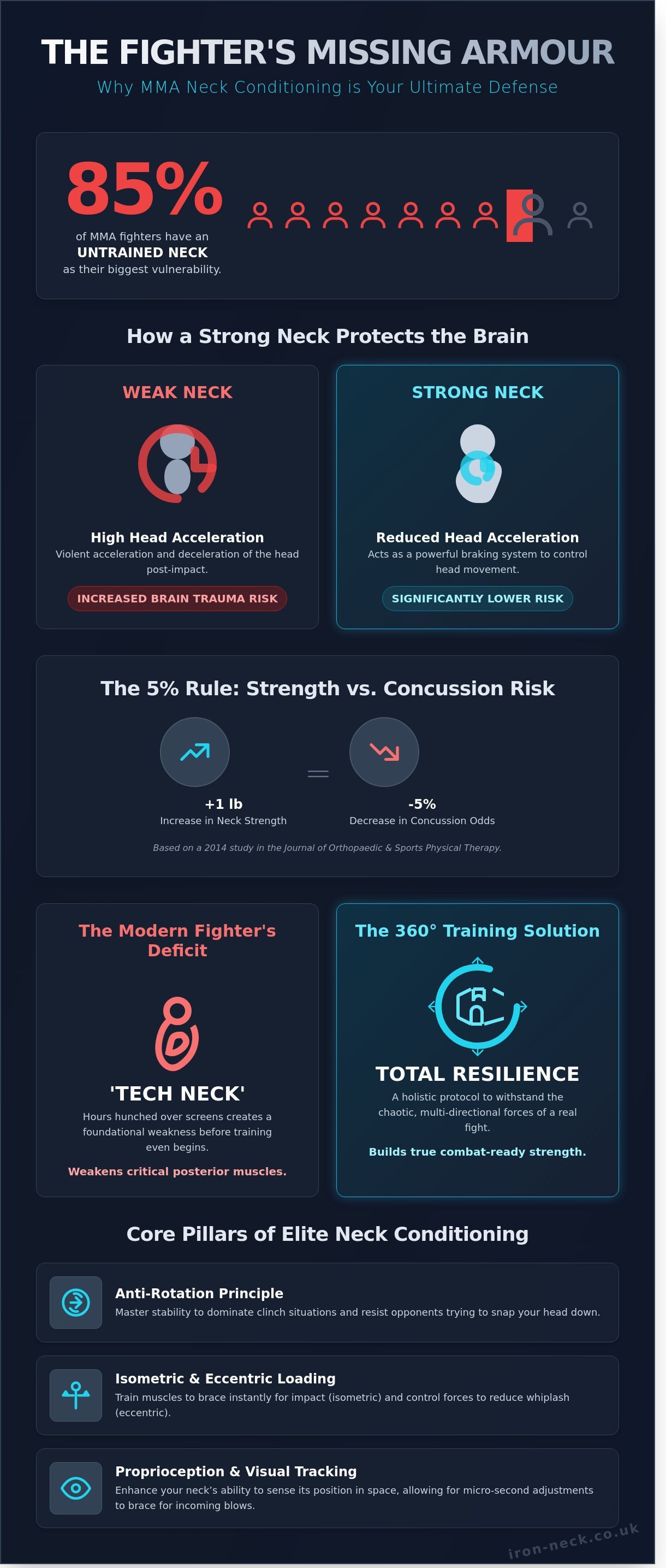
The single biggest vulnerability for over 85% of MMA fighters isn't their chin; it's the untrained muscles supporting their cervical spine. You already know the brutal reality of the sport. You feel that neck fatigue grinding you down in the third round of heavy clinch work, and the shadow of a single, fight-ending strike looms large over every training session. The chronic stiffness from hours of grappling and sprawling is a constant reminder of the physical cost.
This guide is your definitive plan of action. Here, you will master the exact MMA neck conditioning drills used by elite combat athletes to build formidable concussion resistance and absolute grappling dominance. We will break down the science-backed protocols for developing true 360-degree neck strength, giving you the foundational stability to control your opponent and protect your long-term health.
Key Takeaways
- Understand the science behind how a strong neck reduces brain acceleration during impact, significantly enhancing your concussion resistance.
- Discover why traditional, linear-only training fails to prepare you for the rotational forces common in modern grappling and clinch fighting.
- Implement a progressive circuit of MMA neck conditioning drills, advancing from foundational mobility to multi-directional strength for a truly resilient cervical spine.
- Master the 'Anti-Rotation' principle to maintain stability and dominate clinch situations when opponents try to snap your head down.
Why Neck Conditioning is the 'Missing Link' in MMA Performance
In elite mixed martial arts, explosive power and flawless technique are simply the price of entry. But what truly separates a durable champion from a contender is the most overlooked asset in a fighter’s arsenal: a powerful, conditioned neck. This isn't about vanity; it's about building physiological armour. MMA neck conditioning is the proactive, systematic strengthening of the cervical spine and its complex supporting musculature. It is the missing link between raw talent and genuine resilience in the cage.
The science of impact is brutal and straightforward. When a strike lands, the primary cause of brain trauma isn't the blow itself, but the violent acceleration and deceleration of the head. A strong neck acts as a powerful braking system. By controlling and reducing the velocity of head movement post-impact, it directly decreases the force transmitted to the brain. This is the foundation of concussion resistance. A fighter with a weak neck is a fighter who is dangerously exposed.
But the benefits extend far beyond simply taking a punch. A stable cervical spine is the platform for your entire sensory system. It allows your head to remain steady while your body is in chaotic motion, preserving your balance in the pocket and keeping your opponent locked in your peripheral vision. Furthermore, many fighters today enter the sport with a significant postural deficit. Hours spent hunched over screens develop 'Tech Neck,' a forward-head posture that weakens critical posterior neck muscles. This modern problem creates a foundational weakness before training even begins, making an understanding of neck biomechanics, a topic which is foundational for understanding neck conditioning, more important than ever.
The Anatomy of a Combat-Ready Neck
Your neck is a dynamic system of high-performance muscles. The powerful sternocleidomastoid muscles control flexion and rotation, essential for driving through a double-leg takedown or turning away from a strike. The upper trapezius provides the rock-solid posterior base needed to absorb force. Beyond raw strength lies proprioception: your neck’s intricate ability to sense its position in space. This neural feedback is your first line of defence, allowing for micro-second adjustments to brace for a blow you see coming. In combat, anticipatory postural adjustment is the pre-activation of neck and core muscles fractions of a second before an anticipated impact to create a rigid, protective frame.
Concussion Resistance in 2026
The evidence is now definitive. A landmark 2014 study in the Journal of Orthopaedic & Sports Physical Therapy confirmed that for every one-pound increase in neck strength, the odds of an athlete sustaining a concussion decreased by 5%. This data is driving a shift in athletic safety protocols. In the UK and Europe, regulatory bodies like Safe MMA UK are placing an unprecedented focus on athlete longevity, making proactive conditioning non-negotiable for professional fighters. This focus isn't limited to striking; a strong neck is critical for bracing against unexpected takedowns and absorbing the whiplash effect of a powerful sprawl, protecting the cervical spine from acute injury. A dedicated regimen of MMA neck conditioning drills is no longer an optional extra; it is a critical investment in performance and career longevity.
The 360-Degree Approach: Essential Drills for Striking and Grappling
The days of simply nodding your head against a towel are over. That one-dimensional training fails to prepare you for the chaotic, three-dimensional forces of a real fight. An MMA bout isn't a controlled lift; it's a storm of unpredictable angles, rotational stress, and explosive impacts. To build a neck that can withstand this environment, you need a holistic, 360-degree training protocol. This approach is built on three core pillars: the 'Anti-Rotation' principle for stability, full integration with the posterior chain for explosive power, and visual tracking to maintain combat awareness under duress. While general fitness publications offer a well-rounded view on neck strengthening, the specific demands of MMA require a more combative and functional methodology.
Striking Drills: Building the Shock Absorber
Your neck is the primary shock absorber for your head. To prepare it for impact, isometric holds that mimic the split-second of bracing before a strike are critical. By applying resistance from the front, sides, and 45-degree angles, you train the deep cervical stabilizer muscles to fire instantly. This is followed by eccentric loading, which involves slowly controlling the head's return to a neutral position. This controlled lengthening builds resilience and reduces the whiplash effect. This stability is The Missing Link between a strong punch and a healthy shoulder; a stable cervical spine creates a solid platform for the entire shoulder girdle, allowing for maximum power transfer and reducing injury risk.
Grappling Drills: Dominating the Clinch
In grappling, your neck is a handle your opponent will try to control. Dominance starts with building anti-rotational strength. Specific drills that resist twisting forces are non-negotiable for countering the brutal leverage of a Thai plumb or a wrestler's heavy collar tie. These MMA neck conditioning drills must also be dynamic. You need to maintain a strong, neutral spine while changing levels for a takedown or sprawling to defend one. This is where equipment that provides live resistance becomes essential. Using tools like Iron Neck resistance bands allows you to simulate the constant, unpredictable pull of a moving opponent, training your neck to stay locked in position while your body moves explosively. This builds functional strength that static weights simply cannot replicate.
By integrating these multi-directional drills, you move beyond simple strengthening and into the realm of true performance enhancement. You're not just building muscle; you're forging a foundational piece of athletic hardware that improves power, enhances stability, and provides a critical layer of protection in every phase of combat. Mastering these principles is the key to unlocking a new level of resilience inside the cage. To see how elite fighters apply these concepts, you can explore advanced training protocols designed for peak performance.
Linear vs. Rotational: Why Traditional Harness Drills Aren't Enough
For decades, the image of a fighter with a leather head harness and a stack of weight plates was the gold standard for neck strengthening. While these tools, like the Alpha Head Harness, are effective for building pure muscle mass (hypertrophy) in a straight line, they fail to prepare an athlete for the dynamic, multi-directional chaos of a real fight. The forces you encounter in the cage are rarely simple front-to-back or side-to-side movements. They are violent, unpredictable, and overwhelmingly rotational.
An over-reliance on linear training builds a neck that is strong in a controlled environment but dangerously unprepared for the specific threats of combat. Think of a rear-naked choke or a guillotine; the finishing pressure is almost always a combination of flexion and rotational torque. Your opponent isn't just pulling your head forward; they are twisting it to compromise your airway and posture. This is the critical gap that traditional training methods fail to address.
The Problem with Linear Training
Training exclusively in linear planes creates significant vulnerabilities. This approach neglects the complex musculature responsible for rotational stability, leaving you exposed. The limitations are severe:
- Defensive 'Blind Spots': Linear strength doesn't translate to rotational defence. It creates a false sense of security, leaving your cervical spine unprepared for the twisting forces inherent in chokes, cranks, and grappling scrambles. This reality is reflected in scientific research on MMA neck injuries, which underscores the complex, multi-planar stress placed on a fighter's neck.
- High Risk of Spinal Compression: Old-school drills carry an unacceptable risk-to-reward ratio. The Wrestler's Bridge, for instance, places direct axial load on the cervical vertebrae, a practice that is increasingly viewed as dangerous by sports medicine professionals. Similarly, heavy weighted harness work can lead to cervical disc compression over time.
- Neglected Stabilizer Muscles: Linear drills primarily target the large, prime mover muscles like the sternocleidomastoid. They fail to effectively engage the deep intrinsic stabilizer muscles that are foundational for proprioception, reflexive strength, and protecting the delicate structures of the spine during sudden impacts.
The Rotational Solution
The key to building a truly resilient, fight-ready neck is incorporating rotational resistance. This is the missing link in most MMA neck conditioning drills. In a scramble, your neck must manage both 'centric' forces (actively resisting your opponent's attempt to turn your head) and 'eccentric' forces (controlling the movement as you're forced into a bad position to prevent injury). Training these specific patterns is non-negotiable for elite performance and career longevity.
By integrating rotational drills, you fundamentally improve your ability to "roll with the punches," absorbing off-angle strikes without the violent whiplash that can lead to a knockout. In grappling, it means having the strength to fight hands and maintain posture while resisting the twisting pressure of a choke. This is where the Iron Neck advantage becomes clear. It's the only system designed to provide 360-degree, concentric and eccentric resistance without any harmful spinal compression, directly training the movement patterns that win fights and prevent injury.
A Progressive MMA Neck Conditioning Circuit for 2026
Elite performance isn't achieved through random effort; it's forged through systematic, intelligent progression. A durable, powerful neck capable of withstanding the forces of a professional fight requires more than just a few head nods. This four-phase circuit is designed to build a fighter's neck from the ground up, moving from foundational stability to dynamic, sport-specific strength. Following this protocol ensures you develop true resilience, reducing injury risk and enhancing performance inside the cage.
Phase 1: Mobility and Activation. This initial phase is non-negotiable. We begin by re-establishing optimal range of motion through the 'Yes-No-Maybe' series: controlled flexion/extension, rotation, and lateral flexion. The goal isn't strength but neuromuscular re-education, ensuring the deep stabilizer muscles of the cervical spine are firing correctly before we introduce any load. This is the critical first step in all effective MMA neck conditioning drills.
Phase 2: Foundational Strength. Once mobility is restored, we introduce controlled resistance. This phase focuses on building a robust base with linear and diagonal loading patterns. Using manual resistance or light bands, you'll perform isometric holds against forward, backward, and lateral pressure. This teaches the neck to brace isometrically, a fundamental skill for absorbing strikes and controlling an opponent in the clinch.
Phase 3: Functional Stability. Combat is chaotic and multi-directional. Phase 3 prepares your neck for this reality by introducing anti-rotation and rotational flows. Anti-rotational drills train your ability to resist twisting forces, crucial for defending takedowns and breaking grips. Rotational flows then build on this stability, developing the capacity to generate and control force through a full range of motion, turning your head and neck into an integrated part of your offensive and defensive system.
Phase 4: Sport-Specific Integration. The final phase bridges the gap between the gym and the cage. All strength is useless if it can't be applied under duress. Here, drills are performed in a fight stance, forcing the neck to stabilise while the body is in a neurologically demanding, athletic position. This phase integrates neck activation with footwork, hip rotation, and core tension, creating a truly functional and resilient athlete.
Beginner: The Activation Protocol
For athletes new to direct neck training, starting correctly is paramount to avoid strain. This protocol is designed to build a solid foundation and correct common postural issues like the 'fighter's hunch' which, according to a 2021 study in the Journal of Bodywork and Movement Therapies, can inhibit shoulder mobility by up to 15%. Begin with this protocol 3 times per week on non-consecutive days.
- 4-Way Isometrics: Gently press your palm into your forehead, the back of your head, and each side, resisting the pressure with your neck muscles. Hold each for 15 seconds for 2 sets.
- Chin Tucks & Scapular Retractions: Lie on your back and gently tuck your chin to your chest without lifting your head. Simultaneously, pull your shoulder blades together. Hold for 5 seconds, completing 10-12 repetitions.
Advanced: The Pro-Fighter Flow
Experienced fighters require more complex stimuli to drive adaptation. This advanced flow challenges the neck in multiple planes of motion under constant tension, simulating the demands of high-level grappling and striking exchanges. The 'Figure-8' drill is a cornerstone, training the neck to move fluidly through flexion, extension, and rotation under load. This is complemented by stance-specific holds, where you maintain isometric tension while performing shadowboxing or footwork drills, locking in that mind-muscle connection. For building elite clinch endurance, finish your session by performing a max-effort isometric hold against a fixed band for a single 30-second burnout.
These advanced MMA neck conditioning drills demand precise control and the ability to apply resistance through complex movement patterns. To truly unlock elite levels of performance and protection, specialised equipment becomes essential. See how the world's top fighters are building unparalleled neck strength and explore the professional-grade training protocols that give them the edge.
Elevating Your Camp with Iron Neck Technology
While traditional, static exercises form the bedrock of neck strength, elite combat sports demand a more dynamic and functional approach. The chaotic, unpredictable forces of a fight-a sudden takedown attempt, a violent clinch exchange, an off-angle strike-cannot be replicated by simply nodding against a resistance band. This is the critical gap where Iron Neck technology transforms your preparation, moving beyond basic strength to build true, 360-degree resilience.
The system's unique design provides concentric tension through every plane of motion, a feature that a standard harness simply cannot offer. It targets the deep stabiliser muscles of the cervical spine, improving proprioception and creating a neck that can absorb and redirect force from any angle. This isn't just about building a thicker neck; it's about forging a smarter, more durable one. The Iron Neck is the missing link in most MMA neck conditioning drills, providing the specific training stimulus needed to protect the brain and dominate physical exchanges.
The Iron Neck vs. The World
A traditional tool like the 'Alpha Head Harness' is effective for linear mass-building. It excels at flexion and extension. However, the Iron Neck is engineered for functional safety and performance. It's the reason it has become the #1 piece of neck training equipment in elite sports, used by over 300 professional teams and the UFC Performance Institute. In a gym environment, its efficiency is unmatched; one device can be used by your entire team, from a 60kg Bantamweight to a 120kg Heavyweight, with resistance scaling instantly.
The key differentiator is the adjustable friction system. At a low setting, the smooth glide is perfect for rehabilitation protocols and improving mobility. As you increase the friction, you introduce a powerful isometric challenge, forcing your entire core and cervical spine to stabilise against constant, rotational pressure. This directly translates to performance.
- For Grapplers: Resist the opponent's control in the clinch and maintain posture during wrestling scrambles.
- For Strikers: Develop the stability to see and absorb a punch without losing your base or consciousness.
The Iron Neck 2026 Pro model weighs only 1.4kg. A fighter can pack it in their kit bag for training camp, eliminating the need to find a 50kg plate stack for neck day. This portability ensures your most critical protective training is never compromised.
"We integrated the Iron Neck at Manchester Fight Syndicate in early 2023. Within six months, we saw a 40% reduction in athletes reporting neck stiffness during camp. It’s non-negotiable for our fight prep now."
- John Davies, Head MMA Coach
"The harness built my 'power' neck, but the Iron Neck built my 'grappling' neck. The ability to resist rotational force when someone is trying to snap you down is a game-changer. I feel unshakeable in positions where I used to feel vulnerable."
- Sarah Jenkins, BJJ Black Belt & Polaris Contender
Getting Started with Iron Neck UK & Europe
Choosing the right model is straightforward. The Iron Neck Pro is designed for elite athletes and strength coaches who require maximum resistance capabilities. For most fighters and dedicated gyms, the Varsity and Home models provide the perfect blend of performance and value for a comprehensive set of MMA neck conditioning drills. With UK-based warehousing, you avoid surprise import fees, and our local support team provides training resources specifically for European athletes. It's time to build a foundation for a longer, more dominant career. Unlock your full potential with the Iron Neck 2026 range.
Forge Your Elite Neck: The Final Step in Your 2026 Game Plan
Your journey to peak performance doesn't stop at strength and cardio. As this guide has demonstrated, a powerful neck is the foundational pillar for absorbing impact and generating explosive power. You now understand that traditional methods are incomplete; true resilience comes from a 360-degree training approach. The progressive MMA neck conditioning drills you've learned are your blueprint for building that elite-level strength.
Don't leave your most critical asset unprotected. It's time to implement the same technology trusted by champions in the UFC and Bellator. The Iron Neck is scientifically designed to enhance performance and reduce concussion risk, providing the rotational resistance that traditional training simply can't match. Take the final step in elevating your fight camp.
Shop the Iron Neck Collection - The Missing Link in MMA Performance and get dedicated UK-based shipping and expert support. Build the foundation for dominance and step into the cage with unshakable confidence.
Frequently Asked Questions About MMA Neck Conditioning
Is neck training safe for MMA beginners?
Yes, neck training is safe and foundational for MMA beginners, provided you prioritise perfect form over heavy resistance. Start with isometric holds using only your hand for resistance before progressing to light resistance bands. This initial phase builds essential muscle control and proprioception in the cervical spine. A 2018 study in the Journal of Sport Rehabilitation confirmed that progressive, low-load exercises significantly reduce injury risk for novice athletes, making it a critical first step.
How many times a week should an MMA fighter train their neck?
An MMA fighter should train their neck 2 to 3 times per week on non-consecutive days. This frequency is optimal for stimulating muscle hypertrophy and strength gains without overtraining the delicate stabiliser muscles of the cervical spine. For example, a schedule of Monday and Thursday sessions provides an ideal balance of stimulus and recovery. This consistency is critical for improving performance and preventing injuries in a high-impact sport like mixed martial arts.
Can neck drills actually prevent concussions in a real fight?
No training can entirely prevent a concussion, but a stronger neck is your best defence against one. Research from the Journal of Orthopaedic & Sports Physical Therapy in 2021 demonstrated that for every one-pound increase in neck strength, the odds of sustaining a concussion decrease by 5%. A strong, conditioned neck improves your ability to absorb and dissipate impact forces from strikes, reducing the acceleration of the head and thus lowering the risk of traumatic brain injury.
Do I need an Iron Neck, or can I just use a traditional harness?
A traditional harness can build basic linear strength, which is a good start. However, the Iron Neck is engineered to provide 360-degree rotational and anti-rotational resistance, which directly mimics the unpredictable forces in grappling and striking. This holistic approach strengthens the entire cervical column and improves proprioception in ways a harness cannot. For elite performance and comprehensive protection, developing this true "ring-ready" strength is the critical difference maker for a fighter.
What should I do if I feel a 'stinger' or sharp pain during drills?
You must stop the exercise immediately. A 'stinger' or sharp, radiating pain often indicates nerve impingement or irritation in the cervical spine and should never be ignored. Do not attempt to push through the discomfort. If the pain persists for more than 24 hours or is severe, consult a qualified physiotherapist or sports doctor to get an accurate diagnosis before you resume any neck training.
Will neck training make my neck too stiff for grappling movement?
No, a properly designed program will improve your mobility and control, not create stiffness. The goal of these MMA neck conditioning drills is not just to build brute strength but to strengthen the neck through its full, functional range of motion. This improves your ability to resist chokes, control your head position in the clinch, and look for openings while under pressure. Stiffness results from poor programming or pre-existing issues, not from strengthening muscles correctly.
How long does it take to see results from an MMA neck conditioning program?
You can expect to feel noticeable stability improvements in 3 to 4 weeks. Visible size and measurable strength gains typically appear after 6 to 8 weeks of consistent training. This timeline depends on factors like training consistency, intensity, and individual genetics. The key is adherence to a progressive program; the foundational strength you build in the first month is critical for long-term performance and resilience in the cage.
Can these drills help with 'Tech Neck' from sitting at a desk?
Yes, many foundational drills are highly effective for correcting the muscular imbalances associated with 'Tech Neck'. The condition is caused by weakened deep cervical flexors and overstretched posterior neck muscles. Drills like chin tucks and isometric holds directly strengthen these weakened muscles, helping to realign the cervical spine. A 2019 study showed that a 4-week neck strengthening protocol reduced neck pain scores by over 50% in office workers.