

Is Neck Training Important for Athletes? The Science of the Missing Link
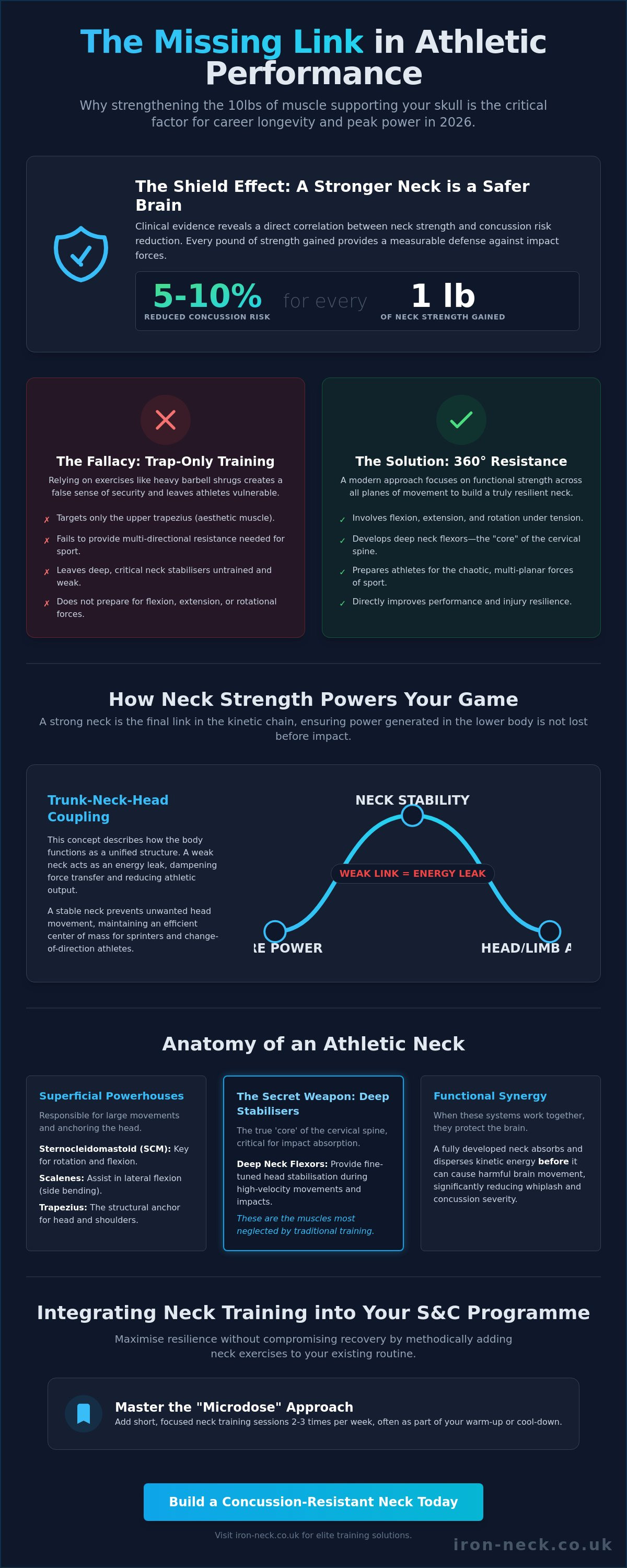
What if the most critical factor for your career longevity isn't your deadlift or your sprint speed, but the 10 pounds of muscle supporting your skull? While most elite training programmes in the UK focus heavily on the posterior chain, many sports scientists now argue that the cervical spine is the true foundation of athletic resilience. You might wonder, is neck training important for athletes who already spend hours in the gym? The answer lies in the 5% to 10% reduction in concussion risk for every one pound of neck strength gained, a statistic that is fundamentally changing how we approach contact and rotational sports.
We agree that building a powerful core and explosive legs is vital, yet ignoring the bridge between your brain and your body creates a dangerous performance plateau. This guide will show you why neck training is the critical missing link for athletic performance, injury prevention, and long-term brain health in 2026. We'll explore how targeted cervical strengthening improves force transfer through the kinetic chain, enhances your proprioception on the pitch, and provides a scientific shield against the chronic stiffness that often plagues high-level competitors.
Key Takeaways
- Understand why targeted strengthening of the cervical spine is the "missing link" for unlocking elite-level athletic potential and foundational stability.
- Explore how Trunk-Neck-Head Coupling enhances force transfer and visual stability, answering the critical question: is neck training important for athletes in high-impact sports?
- Review the clinical evidence demonstrating how increasing neck strength can significantly dissipate rotational forces and reduce concussion risk by 5% for every 1lb of strength gained.
- Master a methodical framework for "microdosing" neck exercises into your current S&C programme to maximize resilience without compromising recovery.
- Identify why multi-planar, 360-degree rotational resistance is the essential requirement for developing a truly concussion-resistant and performance-ready athlete.
The Missing Link: Why Neck Training is Essential in 2026
Neck training is the systematic strengthening of the cervical spine and its supporting musculature. For decades, this discipline was confined to the dark corners of boxing gyms and rugby clubhouses. In 2026, the perspective has changed. Elite performance directors now view the neck as the "missing link" in athletic development. It doesn't matter if you're a sprinter, a footballer, or a tennis player; your neck is the primary conduit for every signal sent from the brain to the limbs. If this connection is weak, you're leaving performance on the table. Many trainers are finally asking: is neck training important for athletes across all disciplines? The evidence says yes. It's no longer just about looking tough. It's about a dual-purpose strategy: maximising force transfer and mitigating the risk of life-altering injuries.
The Anatomy of an Athletic Neck
A resilient neck requires more than just thick muscles. It demands a complex synergy between superficial powerhouses and deep-seated stabilisers. The Sternocleidomastoid (SCM) and scalenes are responsible for the vital tasks of rotation and lateral flexion. These are the muscles that allow a goalkeeper to track a ball or a rugby player to scan the field. Behind them, the trapezius acts as the structural anchor for the head and shoulders. But the real secret to a bulletproof neck lies in the deep neck flexors. These muscles function like the "core" of the cervical spine, providing the fine-tuned head stabilisation required during high-velocity impacts. When these systems work together, they protect the cervical spine by absorbing and dispersing kinetic energy before it reaches the brain.
Beyond Shrugs: The Fallacy of Trap-Only Training
Many athletes fall into the trap of believing that heavy barbell shrugs constitute a complete neck programme. This is a functional error. Shrugs target the upper trapezius, which is largely an aesthetic muscle that moves the shoulder blades. They don't provide the multi-directional resistance needed for true cervical stability. Effective Strength training for the neck must involve 360-degree loading. A "look" of power is not the same as the functional ability to resist a rotational force at 20 miles per hour. To truly answer why is neck training important for athletes, you have to look at the physics of sport. Athletes need to train flexion, extension, and rotation under tension. Relying on shrugs alone creates a false sense of security while leaving the deeper, more critical stabilisers completely untrained and vulnerable.
Performance Benefits: How Neck Strength Powers Your Game
Performance is often measured by the power of your legs or the strength of your core, yet many competitors ignore the bridge that connects the body to the brain. So, is neck training important for athletes who want to maximise their physical output? The answer lies in "Trunk-Neck-Head Coupling." This concept describes how the body functions as a unified structure to transfer force. When you generate power through your glutes and core, that energy must travel through the cervical spine to reach its destination. If the neck is weak, it acts as a shock absorber in the worst way possible, dampening the force you've worked so hard to create.
Understanding why is neck training important for athletes requires looking at the body as a total system. A strong neck allows for better "stiffness" upon impact, ensuring that energy is directed into an opponent or a ball rather than being dissipated through unwanted head movement. This structural integrity is what separates elite performers from the rest of the field.
Force Transfer and the Kinetic Chain
The neck is the final link in the kinetic chain for athletes. It's the bridge. Energy leaks occur when the neck is the "weakest link" during impact or acceleration, leading to a loss of force that could have been used for a tackle or a sprint start. For sprinters and change-of-direction athletes, a stable cervical spine prevents the head from bobbing, which maintains a more efficient centre of mass. Rutgers researchers recommend specific strengthening to ensure the head and neck move in sync, which is vital for maintaining momentum during high-velocity movements.
Visual Stability and Situational Awareness
Beyond raw power, neck strength dictates how well you see the game. Neck proprioception influences an athlete’s ability to track targets by providing the brain with precise data about head position. Cervical muscles have a higher density of muscle spindles than almost any other muscle group in the body. These spindles are directly linked to the vestibular system, which controls balance and eye movement.
- Reaction Time: Higher spindle density allows for faster processing of spatial changes.
- Target Tracking: A stable neck provides a steady platform for the eyes, reducing "visual noise" during a sprint.
- Field Vision: This stability is critical for "reading the play" in field sports like football or rugby, where a split-second glance determines the next pass.
Balance and coordination are governed by the vestibular system located in the inner ear. Because the neck supports the housing for this system, any instability can lead to "vestibular mismatch," where the brain receives conflicting signals about movement. A stronger neck resolves this, allowing for more explosive rotational power. In sports involving high-speed turns, such as MMA or tennis, the ability to snap the head around while maintaining balance is a direct byproduct of cervical strength. To start building this foundational power, you can explore specialised training tools designed to target these deep stabilisers.
Injury Prevention: Reducing Concussion and Whiplash Risk
Injury prevention isn't just about ankle tape and knee braces. For athletes in contact or high-velocity sports, the neck is the most critical yet overlooked area of the body. When we ask is neck training important for athletes, the answer is found in the laws of physics. A strong neck acts as a shock absorber for the head, dissipating kinetic energy before it reaches the skull. This isn't just theory. Research published in the Journal of Primary Prevention found that for every 1lb increase in neck strength, an athlete's concussion risk drops by 5%. This compelling data is why Rutgers researchers on neck strength and concussion now advocate for specific cervical conditioning at every level of play.
Strength alone isn't the whole story. You also need the ability to brace before impact. This "anticipatory bracing" allows the cervical spine to become a rigid pillar, transferring force down into the larger muscles of the torso rather than letting the head snap back. Unlike genetic factors or the speed of an opponent, neck strength is a modifiable risk factor. You can change it. You can improve it. It's often the missing link between a season-ending Traumatic Brain Injury (TBI) and staying in the game.
The Science of Concussion Resistance
Concussions occur when the brain moves inside the skull, a phenomenon often called "brain-slosh." High neck stiffness reduces this acceleration significantly. The sternocleidomastoid and deeper stabilizer muscles work together to decelerate the head during a collision. While linear impacts are dangerous, rotational forces are the primary drivers of TBI. A weak neck allows the head to rotate violently upon impact, shearing neural pathways. Building rotational resistance is essential for protecting the brain's delicate structures and maintaining long-term cognitive health.
Mitigating Whiplash and Chronic Pain
Neck training provides benefits that last long after the final whistle. Athletes often suffer from chronic "stiff neck" issues caused by repetitive micro-trauma and poor posture. Strengthening the cervical spine creates a protective buffer that prevents these minor strains from becoming debilitating conditions. Understanding the Anatomy of Neck Pain helps athletes see how weak stabilizers contribute to nerve compression and headaches. If you've wondered is neck training important for athletes beyond the field, consider the long-term benefits. Investing in neck health now ensures better cervical spine function post-career, reducing the risk of degenerative disc disease and chronic neuralgia.
- Linear Force Dissipation: Reduces the "whiplash" effect of direct hits.
- Rotational Stability: Prevents the twisting motions that cause severe TBI.
- Post-Career Health: Protects against chronic cervical spine degeneration.
Integrating Neck Training into Your S&C Programme
Understanding is neck training important for athletes is only the first step; the real challenge lies in seamless integration. Most Strength and Conditioning (S&C) programmes are already packed with compound lifts and metabolic conditioning. Adding high-volume neck work can lead to central nervous system fatigue if it's not managed correctly. We recommend a "microdosing" approach. Instead of dedicating a single, exhausting hour to cervical work, you should sprinkle 10-minute sessions throughout the training week. This maintains high frequency without compromising your primary lifts.
Before you begin, you must establish a baseline. Use the Deep Neck Flexor Endurance Test to measure your current capacity. A 2014 study published in the Journal of Manual and Manipulative Therapy suggests that healthy individuals should hold this position for roughly 38 seconds. If you fall below 25 seconds, your initial focus must be on isometric holds. Determining is neck training important for athletes in your specific discipline often starts with identifying these hidden weaknesses in your kinetic chain.
The 360-Degree Approach to Training
Effective neck training requires a holistic view of the cervical spine. Training in just one plane, like standard flexion, leaves gaps in your armour. You need to address flexion, extension, lateral flexion, and rotation. This 360-degree approach ensures that the 20+ muscles in the neck are prepared for impact from any angle. Traditional harnesses often rely on linear, "stop-start" resistance which can be clunky. Modern rotational devices provide variable resistance. This forces the stabiliser muscles to stay engaged throughout the entire range of motion, mimicking the unpredictable forces found in rugby, MMA, or motorsport.
Sample Integration Weekly Schedule
You don't need hours in the gym to see results. A 10-minute "neck finisher" at the end of your main sessions three times per week is sufficient for most elite athletes. Focus on these specific parameters to balance growth and safety:
- Stability and Endurance: Perform 2-3 sets of 30-60 second isometric holds in each of the four planes.
- Hypertrophy: Aim for 3 sets of 12-15 controlled repetitions, focusing on a slow eccentric (lowering) phase to build muscle thickness.
- Rotational Power: Complete 2 sets of 10 slow, controlled rotations against light resistance to improve proprioception.
For those looking to push beyond the basics, you can explore Advanced Neck Training Protocols to further bulletproof your cervical spine. Consistency is the priority here. When you treat the neck as a foundational movement centre, you unlock a new level of performance and resilience.
Iron Neck: The Ultimate Tool for Elite Athletic Performance
Iron Neck stands as the definitive solution for multi-planar training. While standard harnesses limit you to linear movements like simple flexion and extension, this device introduces 360-degree rotational resistance. This unique tension forces your stabilizer muscles to fire constantly, mimicking the unpredictable, high-velocity forces found in contact sports. It bridges the gap between static strength and functional, athletic stability. Because it's lightweight and easy to set up on any rack or door, it fits seamlessly into a busy team environment or a personal training kit. You don't need a dedicated machine taking up floor space; you just need a system that works as hard as you do.
Traditional methods often ignore the rotational component of neck health, which is where most injuries occur. By using Iron Neck, you can train the cervical spine to manage force from every angle. This isn't just about building a thicker neck for aesthetics. It's about developing the reactive strength needed to keep the head stable during a collision. The ability to apply concentric, eccentric, and isometric loads in a single movement makes it the most versatile tool in any performance coach's arsenal.
Why Pro Teams Choose Iron Neck
Elite organisations don't leave performance or player safety to chance. Professional teams across the NFL, UFC, and the Premier League have integrated Iron Neck into their daily strength and conditioning protocols to protect their most valuable assets. These organisations choose this system because it provides measurable, trackable resistance levels. Coaches can finally move away from subjective "neck circles" and move toward data-driven progression. In a high-stakes environment where every millimetre of movement matters, having clinical-grade equipment is essential. The device features durable, high-quality construction designed to survive the rigours of a professional weight room while offering the precision needed for rehabilitation.
- Measurable Progress: Track resistance levels to ensure consistent hypertrophy and strength gains.
- Clinical-Grade Durability: Built to withstand high-volume use in professional training facilities.
- Versatile Application: Perfect for both peak performance training and delicate post-injury recovery.
Taking the First Step Toward a Stronger Neck
Stop viewing the neck as an accessory or an afterthought. When asking is neck training important for athletes, you must look at it as a foundational requirement for both safety and power. A strong neck is your primary shield against impact and the anchor for all upper-body movement. Strengthening this area improves proprioception and significantly reduces the risk of long-term strain. If you want to perform at your peak, you cannot ignore the muscles that support your most vital organ.
The evidence is clear: is neck training important for athletes who want longevity? Absolutely. Don't wait for a heavy collision or a nagging injury to start training the missing link in your physical preparation. Take a proactive, science-backed approach to your career and your health. Whether you're on the pitch, in the ring, or on the court, your neck is the foundation of your resilience.
Secure Your Performance and Protect Your Future
The evidence is definitive; the cervical spine is the foundation for athletic stability and explosive power. By addressing this often overlooked area, you're not just building muscle, you're actively safeguarding your brain. Research shows that targeted resistance training can reduce rotational acceleration by up to 50%, which is a critical factor in mitigating concussion risk. When you ask is neck training important for athletes, the answer lies in the data provided by over 500 professional and collegiate teams who have already integrated these protocols into their daily regimes.
Leading neurosurgeons and sports scientists endorse this methodical approach to injury prevention. It's the missing link that separates elite performers from the rest of the pack. You've spent years honing your skill and strength, so don't let a preventable injury sideline your career or limit your long-term health. It's time to adopt the same technology used at the highest levels of sport to ensure your body stays resilient under pressure.
Upgrade your training with the world’s #1 neck trainer
Take control of your physical longevity and start building a stronger, safer foundation today.
Frequently Asked Questions
Is neck training safe for athletes with previous injuries?
Neck training is safe and often recommended for athletes with previous injuries, provided they follow a progressive, low-impact protocol approved by a physiotherapist. Strengthening the stabilizer muscles around the cervical spine creates a protective internal brace that reduces future strain. A 2020 study in the Journal of Orthopaedic and Sports Physical Therapy highlights that targeted resistance training can decrease chronic neck pain by 50% over a 10-week period.
How often should an athlete train their neck for best results?
You should train your neck 2 to 3 times per week to achieve optimal performance gains without overtraining. These sessions don't need to be long; 10 to 15 minutes of dedicated work is sufficient for most elite athletes. Consistency is the key to building the foundational strength required for high-impact sports. Following this schedule allows for the 48 hours of recovery necessary for muscle tissue repair and neurological adaptation.
Can neck training really prevent concussions?
Scientific research indicates that neck training is a critical factor in reducing concussion risk by managing impact forces. A landmark 2014 study published in the Journal of Primary Prevention found that for every 1lb increase in neck strength, an athlete's concussion risk decreases by 5%. This data highlights why neck training is important for athletes in contact sports, as it improves the body's ability to absorb and dissipate energy during a collision.
Do I need a special device like Iron Neck, or is a harness enough?
While a traditional harness allows for basic linear movements, a 360-degree device is necessary for addressing rotational forces and stability. Harnesses often neglect the deep stabilizer muscles that manage whiplash motions. By incorporating 4-in-1 resistance, you can train every degree of movement. This is essential for athletes who need to maintain head position during complex, multi-directional plays on the pitch or in the ring.
Will training my neck make it look bulky or affect my flexibility?
Training your neck won't automatically result in a bulky appearance, but it'll significantly improve your functional flexibility and posture. Most athletes find that strengthening the cervical muscles actually increases their range of motion by 10% to 15% through better proprioception and reduced muscle guarding. Unless you're specifically training for hypertrophy with high-volume isolation, the primary result is a more stable, resilient, and mobile neck.
At what age should young athletes start neck strengthening?
Young athletes should begin foundational neck strengthening around age 12, coinciding with their entry into more competitive contact sports. At this stage, the focus should be on isometric holds and controlled movements rather than heavy resistance. Developing neuromuscular control early provides a protective advantage, as younger players often have a higher head-to-body mass ratio. This makes them more susceptible to acceleration-based injuries during impacts.
How long does it take to see performance results from neck training?
You can expect to see measurable improvements in neck stability and strength within 4 to 8 weeks of consistent training. Initial gains are often neurological, meaning your brain becomes more efficient at activating the existing stabilizer muscles. By the 12-week mark, most athletes report a significant reduction in neck fatigue and an increased sense of stiffness or readiness when absorbing contact during training or competition.