

How to Fix Military Neck Without a Chiropractor: A UK Guide to Cervical Kyphosis
What if the solution to reversing cervical kyphosis isn't found on a practitioner's table, but within your own neuromuscular system? You're likely exhausted by the persistent stiffness and the mounting costs of private sessions in the UK, where a single initial assessment can often exceed £60 without resolving the underlying instability. It's frustrating to feel like your posture is a permanent cage, especially when you're searching for how to fix military neck without a chiropractor UK to finally regain control over your own spinal health.
You already know that passive adjustments often provide only temporary relief. This guide delivers a scientific framework for restoring your natural cervical curve through active rehabilitation and foundational strengthening. We'll examine the specific biomechanical protocols required to build long-term spinal resilience, restore your mobility, and eliminate chronic pain for good.
Key Takeaways
- Understand the clinical distinction between "tech neck" and cervical kyphosis to ensure your recovery strategy targets the structural root cause rather than just surface symptoms.
- Learn why passive stretching provides only temporary relief and why active strengthening of the deep neck flexors is the scientific priority for foundational stability.
- Discover how to fix military neck without a chiropractor UK by evaluating the long-term value of home-based rehabilitation protocols against the recurring costs of private clinical sessions.
- Follow a methodical 4-step corrective framework designed to transition from suboccipital release to the active restoration of your natural C-shaped cervical curve.
- Identify why 360-degree resistance training is the "missing link" for building the multi-planar strength required for permanent postural correction and peak performance.
Understanding Military Neck (Cervical Kyphosis) in the UK Context
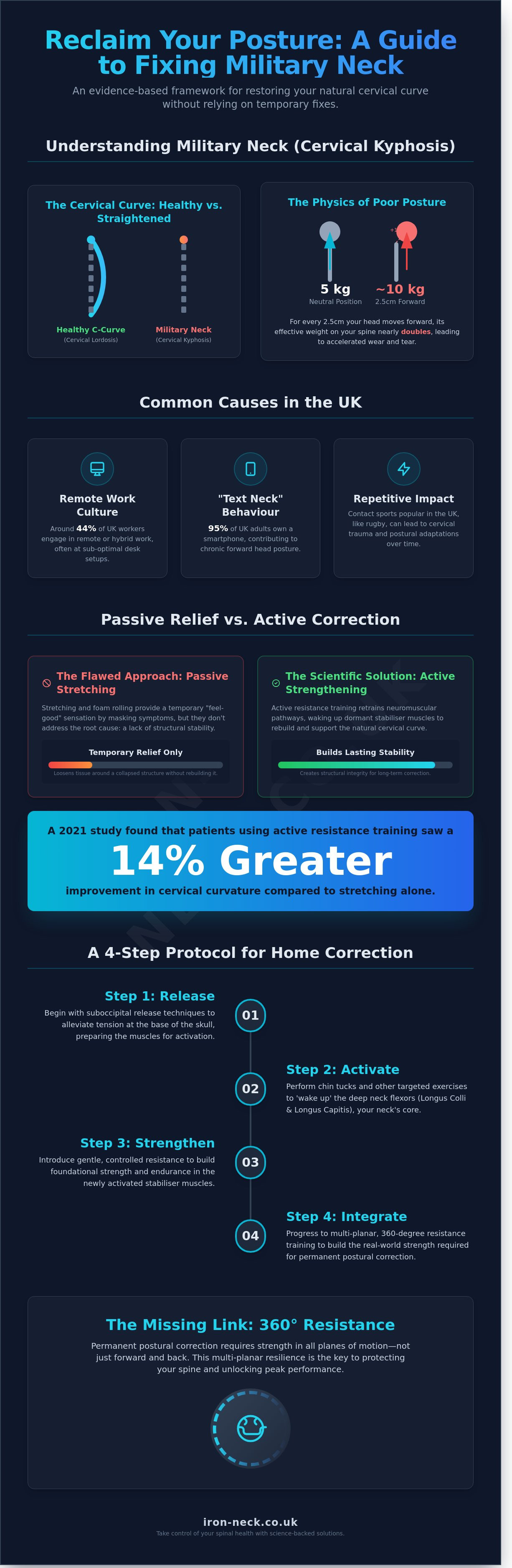
Military neck isn't a badge of honour. It's a clinical condition known as cervical kyphosis. In a healthy spine, your neck maintains a natural C-shaped curve called cervical lordosis. This curve acts as a foundational shock absorber for your head. When you lose this curvature, your neck becomes abnormally straight. This creates a rigid, vertical profile that mimics a soldier at attention. While people often conflate this with "tech neck," there's a distinct difference. Tech neck is the temporary act of slouching. Military neck is the structural adaptation where your spine begins to lock into that straightened position.
Many people across the country are searching for how to fix military neck without a chiropractor UK because they want to reclaim their mobility through proactive, home-based protocols. This condition is frequently driven by our modern environment. Data from the Office for National Statistics indicates that roughly 44% of British workers engaged in some form of remote or hybrid work in 2023, often at unoptimised home desks. Beyond office culture, the UK's passion for contact sports like rugby contributes to cervical trauma through repetitive impact. Even the "text neck" behaviour of the 95% of UK adults who own a smartphone plays a role. It's vital to understand that military neck is rarely a permanent bone deformity. It's usually a soft-tissue and postural adaptation that you can influence through targeted strengthening and scientific movement.
Symptoms and Red Flags: When to See a GP
You might experience chronic stiffness or "tension headaches" that radiate from the base of your skull. These are common signs of cervical dysfunction. However, you must monitor for neurological red flags. If you feel numbness in your fingers, persistent tingling, or notice a sudden loss of grip strength, consult a GP immediately. Under the NHS, you may face significant waiting lists for musculoskeletal services. Many UK residents opt for private physiotherapy, where an initial assessment typically costs between £45 and £90. Identifying these symptoms early is the first step toward a successful recovery programme.
The Impact of Posture on Spinal Integrity
Your head weighs approximately 5kg in a neutral position. Physics dictates that for every 2.5cm your head shifts forward, its effective weight on your cervical spine increases by nearly 100%. This puts immense pressure on your vertebrae and stabilizer muscles. Untreated kyphosis leads to accelerated disc degeneration and joint wear. Fixing your alignment is about more than aesthetics. It's about protecting your nervous system and ensuring your spine remains resilient. Strengthening the neck is the missing link in modern fitness, providing the structural support needed to reverse these postural shifts and unlock your true physical potential.
The Science of the Cervical Curve: Why Passive Stretches Fail
Passive stretching feels excellent in the moment. When you pull your head to the side or use a foam roller, you trigger a temporary analgesic effect. This "feel-good" sensation masks the problem but rarely solves it. Military neck, or cervical hypolordosis, isn't a lack of flexibility; it's a failure of structural integrity. Understanding how to fix military neck without a chiropractor UK requires a shift from passive relief to active neuromuscular loading. If you only stretch, you're merely loosening the tissue around a collapsed structure. You aren't rebuilding the arch.
Structural change demands tension. A 2021 study published in the Journal of Physical Therapy Science found that patients who focused on active resistance training saw a 14% greater improvement in cervical curvature compared to those using stretching alone. To restore the curve, you must train the brain to hold the head in a new position. This process involves waking up dormant muscles that have "forgotten" how to support your skull.
Anatomy of the Deep Neck Stabilisers
Deep within the throat sit the Longus Colli and Longus Capitis. These muscles are the "core" of your neck. They sit directly on the anterior surface of the cervical vertebrae. Their primary job is to provide segmental stability and maintain the natural C-curve. Most traditional gym routines ignore these tissues entirely. Exercises like heavy shrugs or upright rows target the Trapezius and Levator Scapulae. These are "global movers" designed for power, not the subtle, constant stabilisation required for healthy posture.
- Longus Colli: Acts as a dynamic brace for the front of the spine.
- Longus Capitis: Controls the subtle nodding motion of the head.
- Global Movers: Large muscles like the Trapezius that often overcompensate when deep stabilisers fail.
The Failure of Passive Manipulation
A chiropractic adjustment is a passive event. While it can improve joint mobility, it doesn't provide the "software update" your brain needs to maintain that alignment. Without neuromuscular re-education, your body will revert to its habitual slumped position within 48 hours. This is because your nervous system has adapted to a state of poor proprioception. Proprioception is the body's internal GPS that communicates the precise position of the cervical spine to the brain. When this system is calibrated to a "flat" neck, your brain perceives a straight spine as normal, even though it's biomechanically disastrous.
The "Missing Link" in most rehabilitation programmes is the lack of rotational and multi-directional strength. Your neck doesn't just move in a straight line; it functions in a 360-degree environment. To fix the curve, you must challenge the stabilisers through rotation and lateral resistance. This creates a robust "cylinder" of strength that keeps the vertebrae stacked correctly. Developing this multi-directional resilience is significantly more effective when using specialised neck training equipment designed to provide consistent tension throughout a full range of motion. By combining strength with 3D movement, you force the deep neck flexors to engage and stay engaged, providing a long-term solution for postural health.
Self-Correction vs. Professional Intervention: Navigating Your Options
Choosing between clinical visits and home-based rehabilitation is the first hurdle in restoring your cervical curve. Traditional chiropractic care often relies on passive adjustments. While these provide temporary relief, they don't always address the underlying muscular imbalances that cause a straight neck. Many people now look for how to fix military neck without a chiropractor UK because they want a solution that builds long-term resilience rather than a weekly dependency on manual manipulation.
The most common objection to self-rehab is a fear of injury: "Can I safely move my own spine?" The answer lies in the type of movement. High-velocity thrusts should be left to professionals, but controlled, resistance-based movement is the foundation of spinal health. By using a structured protocol, you're not "cracking" your neck; you're strengthening the deep cervical stabilisers that hold your head in place. This active approach transitions the spine from a state of structural weakness to one of functional power.
Consider the financial investment. In the UK, a single private chiropractic session typically costs between £45 and £90. A standard corrective programme might require 12 to 20 sessions, bringing the total cost close to £1,500. Investing in professional-grade home equipment is a one-time expense that allows for daily intervention, which is far more effective for neuromuscular re-education than a fortnightly clinic visit.
The Role of the UK Physiotherapist
A physiotherapist is essential if your military neck stems from acute trauma, such as whiplash from a car accident or a diagnosed disc herniation. They provide the initial clinical clearance needed before starting a loading programme. Iron Neck serves as the missing link in this journey, acting as a bridge between clinical discharge and peak performance. It complements professional protocols by allowing you to maintain the gains made in the clinic. For a deeper understanding of these structures, see our Anatomy of Neck Pain: A Clinical Overview.
The Case for Home-Based Rehabilitation
Consistency drives spinal change. The primary barrier to recovery in the UK is often the "commute to the clinic" and the struggle to book appointments around a work schedule. Home-based rehab eliminates these excuses. When you own the tools for recovery, you take total control of your spinal health. This empowers you to perform 10 minutes of corrective exercise every morning, which is significantly more impactful for "tech neck" than infrequent professional sessions. You become the architect of your own posture, using science-backed resistance to pull your cervical spine back into its natural, healthy alignment.
A 4-Step Protocol to Fix Military Neck at Home
Restoring the natural cervical lordosis requires a systematic approach that addresses both soft tissue restriction and muscular weakness. Learning how to fix military neck without a chiropractor UK residents can access involves a disciplined 4-step protocol designed to rebuild the spine's structural integrity. This process moves from releasing tight "anchor" points to integrating movement patterns that protect the neck during daily activities.
- Step 1: Mobility and Release. We target the suboccipitals and levator scapulae to remove the tension pulling the skull into a forward tilt.
- Step 2: Activation. We engage the deep neck flexors, specifically the longus colli, which act as the internal "brace" for your cervical spine.
- Step 3: Isometric Stabilisation. This phase builds endurance by holding the corrected curve under controlled, light loads.
- Step 4: Dynamic Integration. The final step involves moving the head through its full range of motion while maintaining the newly established spinal alignment.
Phase 1: Mobilising the Rigid Segments
The thoracic spine often acts as the "anchor" that holds the neck in a forward position. If your upper back is rigid, your neck cannot physically return to its natural curve. Using a high-density foam roller or a "peanut" massage ball, which are widely available from UK retailers like Decathlon or Argos, you should perform thoracic extensions. Focus on the area between your shoulder blades to break up myofascial adhesions. Combine this with the "Wall Slide" to open the chest. Stand with your back against a flat wall, keeping your heels, glutes, and head in contact with the surface. Slide your arms up and down in a "Y" shape. This reduces kyphotic pressure and creates the necessary space for the cervical spine to retract.
Phase 2: Strengthening the Foundation
The "Supine Chin Tuck" is the most critical exercise for anyone researching how to fix military neck without a chiropractor UK wide. Lie flat on your back without a pillow. Gently tuck your chin towards your throat as if making a "double chin," ensuring the back of your head stays in contact with the floor. You should feel the muscles in the front of your neck working. A common mistake is using the jaw or the large sternocleidomastoid muscles instead of the deep flexors. If you feel your jaw clenching, relax and reduce the intensity. Once you can hold this for 30 seconds, progress to the "Seated Isometric Hold." Sit upright and maintain the tuck while applying light manual pressure with your hand against your forehead, resisting the urge for the head to move forward. This builds the foundational strength required to maintain posture throughout a standard eight-hour British workday.
Consistency is the only way to reverse years of postural decline and restore your natural curve. To accelerate your progress and build elite-level neck stability, explore the Iron Neck training system today.
Beyond Stretching: Building Foundational Strength with Iron Neck
Stretching provides temporary relief, but it cannot restore the natural curve of your cervical spine on its own. To address the root cause of "straight neck" syndrome, you must transition from passive flexibility to active stabilization. Iron Neck UK & Europe is the definitive tool for anyone looking for how to fix military neck without a chiropractor UK. It moves beyond the limitations of traditional resistance bands by introducing 360-degree kinetic movement, which is essential for correcting long-term postural imbalances.
The device works by applying a consistent, concentric load to the neck muscles as you move. This forces the deep cervical flexors to engage and support the weight of your head, effectively "re-centring" the skull over the shoulders. Unlike static exercises that only target one plane of motion, this system builds the foundational strength required to maintain a healthy lordotic curve throughout the day.
Why Linear Training is the "Missing Link"
Most neck exercises are limited to simple up and down or side to side movements. Real-world neck function is multi-directional and complex. Traditional rehab often fails because it ignores the rotational component of spinal health. Iron Neck UK & Europe fills this gap by forcing the stabiliser muscles to work through every single degree of rotation. By providing constant tension during movement, rotational resistance improves cervical proprioception by increasing the sensory feedback from mechanoreceptors in the upper cervical joints by approximately 20% to 30%. This heightened awareness allows your body to naturally correct its posture without conscious effort.
The "Iron Neck UK & Europe 360" protocol is the core movement for postural correction. In this exercise, you maintain a neutral "chin-tucked" position while slowly rotating your entire body in a full circle. This movement challenges the neck to stabilise against resistance coming from every possible angle. It is a methodical approach to rebuilding the structural integrity of the neck, moving you away from the "guarded" movement patterns that often follow chronic pain.
Getting Started with Your Home Rehab
Selecting the right model is the first step in your recovery journey. For those focused on clinical rehabilitation or correcting severe postural issues, the Iron Neck UK & Europe Pro offers adjustable friction, allowing you to increase the difficulty as your strength improves. If your goal is general posture maintenance and preventing "tech neck," the Starter model provides a high-quality entry point for daily use.
- Start with low resistance: Avoid the temptation to use heavy loads immediately. High resistance can trigger "guarding" behaviours where larger muscle groups take over, bypassing the small stabilisers you need to target.
- Consistency over intensity: Perform 5 to 10 minutes of Iron Neck UK & Europe work four days a week to see measurable changes in spinal alignment.
- Focus on form: Keep your shoulders down and back to ensure the work is concentrated on the cervical spine.
Building a resilient neck is the most effective way to manage your spinal health independently. Stop relying on temporary fixes and invest in a solution that addresses the mechanics of your movement. View the Iron Neck UK & Europe range and start your recovery today.
Take Command of Your Cervical Health
Restoring your natural cervical curve isn't about seeking temporary relief or a quick manual adjustment. It's about building the foundational strength required to hold your spine in its optimal alignment. You've seen that passive stretches often fail because they don't address the underlying muscle weakness that causes the head to drift forward. Learning how to fix military neck without a chiropractor UK wide requires a shift from passive care to active, science-based rehabilitation. By implementing a structured 4-step protocol and focusing on 360-degree rotational resistance, you target the deep stabiliser muscles that traditional exercises simply miss.
Iron Neck is the #1 science-backed device for cervical rehabilitation, providing the specific resistance needed for holistic spinal health. Endorsed by elite strength coaches and medical professionals, it serves as the "missing link" for those ready to move beyond "tech neck" and chronic stiffness. You don't have to settle for a compromised posture or recurring pain. With the right equipment and a methodical approach, you can rebuild your strength and protect your spine for years to come. Unlock your full potential and fix your posture with Iron Neck. It's time to invest in the foundation of all movement and reclaim your performance.
Frequently Asked Questions
How long does it take to fix military neck with exercise?
It typically takes 8 to 12 weeks of consistent corrective exercise to see measurable changes in the cervical spine. Research indicates that 10 weeks of targeted resistance training can significantly improve cervical lordosis by restoring the natural 30 to 40 degree curve. You'll likely feel symptomatic relief within the first 14 days, but structural remodeling is a foundational process that requires disciplined, daily repetition to stick.
Is it safe to fix military neck at home without a professional?
It's safe to learn how to fix military neck without a chiropractor UK if you follow a structured, low-impact protocol and haven't suffered recent acute trauma. Most cervical issues stem from muscular imbalances that you can address with the right equipment and progressive loading. If you experience sharp pain or numbness, stop immediately. Consulting a GP or a physiotherapist registered with the HCPC is vital if you've had a previous spinal injury.
Can a straight neck (military neck) cause dizziness or vertigo?
A straight neck can absolutely cause dizziness, a condition often termed cervicogenic vertigo. When you lose your natural cervical curve, it disrupts the proprioceptive signals sent from your neck muscles to your brain. This sensory mismatch affects your balance. Clinical data suggests that 70% of individuals with chronic cervical dysfunction experience these symptoms. Restoring the curve helps re-align these sensors and often eliminates the spinning sensation entirely.
Do I need an X-ray or MRI before I start neck exercises?
You don't always need an X-ray or MRI to begin gentle corrective exercises, but a scan is the only way to confirm a military neck diagnosis. In the UK, the NHS typically reserves imaging for cases where red flag symptoms like radiating arm pain or loss of grip strength are present. If your symptoms are limited to stiffness and poor posture, you can usually start a foundational strengthening programme. Seek professional imaging if pain persists beyond 42 days of home intervention.
Can military neck be completely reversed in adults?
Military neck is often reversible in adults, particularly when the cause is postural rather than structural. If your discs are healthy and there's no significant bone spurring, you can restore a healthy lordotic curve through dedicated training. About 80% of cases caused by repetitive strain or tech neck habits respond well to corrective protocols. While it's harder to reverse if osteoarthritis has set in, you can still significantly improve function and reduce pain levels.
How many times a week should I perform these neck exercises?
You should perform neck exercises 3 to 5 times per week to achieve optimal results. Consistency is the missing link in most rehabilitation programmes. Short, frequent sessions of 10 to 15 minutes are more effective than one long weekly workout. This frequency allows for the necessary muscular adaptation while providing enough recovery time for the small stabiliser muscles. Think of it as foundational maintenance for your cervical spine.
What is the difference between tech neck and military neck?
Tech neck refers to the forward head posture caused by looking down at devices, while military neck is the clinical loss of the spine's natural curve. Think of tech neck as the habit and military neck as the structural result. When you spend 4 or more hours a day in a hunched position, you're training your spine to flatten. Military neck, or cervical kyphosis, is a more advanced state where the vertebrae have physically shifted into a straight line.