

How to Fix Forward Head Posture: The Definitive 2026 Guide
What if the persistent ache in your upper back isn't just "soreness," but the result of your cervical spine supporting an effective weight of 60 pounds every time you look at your phone? Research from the New York Spine Surgery and Rehabilitation Medicine center shows that for every inch your head moves forward, it gains 10 pounds of effective weight. You've likely felt this burden as chronic shoulder tension or those frequent tension headaches that disrupt your focus. It's frustrating to feel self-conscious about your profile in photos, especially when conventional stretching fails to provide a lasting solution.
Learning how to fix forward head posture requires a shift from passive relief to active stabilization. We've developed this definitive 2026 guide to provide a science-backed protocol that reverses "tech neck" and builds a resilient, perfectly aligned cervical spine. You'll gain the specific tools to reduce stiffness and achieve a visible, permanent improvement in your stance. This article previews the foundational exercises, clinical insights, and the "missing link" in neck training that will protect your long-term spinal health and unlock your true physical potential.
Key Takeaways
- Master the biomechanics of the "lever arm" principle to understand how anterior displacement causes your head to exert nearly 50lbs of force on your cervical spine.
- Discover why traditional stretching is often the "missing link" in postural correction and how to transition from passive movement to active, clinical-grade engagement.
- Implement a comprehensive, science-backed protocol on how to fix forward head posture through targeted myofascial release and deep neck flexor activation.
- Elevate your physical resilience with 360-degree training that utilizes rotational resistance to find and maintain a perfectly neutral cervical center.
What is Forward Head Posture? Understanding the "Nerd Neck" Crisis
Forward Head Posture (FHP) isn't just a cosmetic flaw; it's a biomechanical failure that compromises your entire kinetic chain. Clinically, it's defined as the anterior displacement of the head from the midline of the body. To understand the depth of this issue, one must ask: What is Forward Head Posture? At its core, it's a condition where the skull shifts forward of the cervical spine's vertical axis, placing massive eccentric load on the posterior neck muscles.
In the 2026 digital landscape, this has evolved into a global "Tech Neck" crisis. Recent data shows that the average adult now spends over 7 hours a day on digital devices, a 15% increase since 2022. This constant flexion has normalized a "nerd neck" aesthetic that masks serious underlying dysfunction. You can identify this visually by looking at the relationship between the ear and the shoulder. In a healthy spine, the ear sits directly over the acromion (the bony point of the shoulder). When FHP is present, the ear migrates inches forward, creating a visible protrusion.
It's vital to differentiate between a postural habit and structural change. A habit is a functional choice your body makes to adapt to your environment, which you can often self-correct. However, years of neglect lead to structural changes where the cervical ligaments thicken and the vertebrae themselves begin to remodel. Understanding how to fix forward head posture requires a dual approach that addresses both the immediate muscle tension and the long-term structural integrity of the spine.
The Anatomy of Alignment
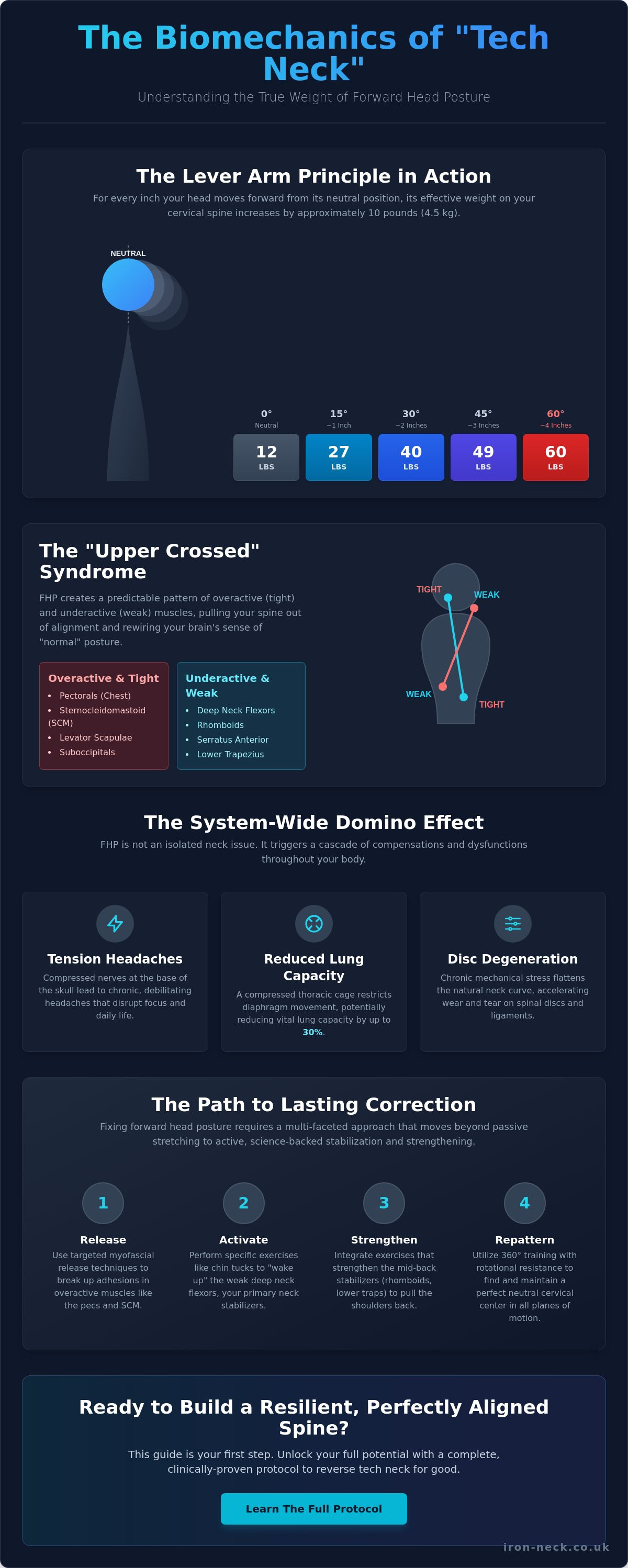
The cervical spine is designed to support a 10 to 12 pound cranium. For every inch your head moves forward, the effective weight on your spine increases by an additional 10 pounds. This creates a chronic tug-of-war where the Sternocleidomastoid (SCM) and levator scapulae become hyper-tonic and shortened. Meanwhile, the deep neck flexors, your primary stabilizers, undergo disuse atrophy. This imbalance rewires your proprioception; your brain begins to accept this dysfunctional alignment as your "new normal." This neurological shift is the missing link that prevents most people from achieving lasting results.
Common Symptoms Beyond Aesthetics
FHP creates a domino effect throughout the body. It reduces lung capacity by as much as 30% because the forward position of the head compresses the thoracic cage and restricts the diaphragm. It's a primary driver of tension headaches, as the suboccipital muscles work overtime to keep your eyes level with the horizon. You'll also see a significant decrease in shoulder mobility and the onset of thoracic kyphosis, or a rounded upper back. Upper Crossed Syndrome is the clinical precursor to FHP, defined by a specific pattern of overactive pectorals and weak mid-back stabilizers. If you want to master how to fix forward head posture, you must treat the body as a holistic system rather than just a collection of isolated muscles.
The Biomechanics of Pain: Why Your Head Feels 40lbs Heavier
Your head weighs roughly 12 pounds. When it stays aligned over your shoulders, your skeleton supports this weight with minimal effort. However, the "lever arm" principle changes everything once your posture shifts. For every inch your head migrates forward, it gains roughly 10 pounds of effective weight. By the time you reach a 45-degree tilt, that 12lb head exerts nearly 50lbs of force on your cervical spine. This isn't just a minor strain; it's a structural crisis that compromises your entire kinetic chain.
Understanding the physics of this load is the first step in learning how to fix forward head posture. When the head hangs forward, the posterior chain must work overtime to prevent you from falling over. This leads to a cascade of compensations. Your upper back rounds into a kyphotic curve, and your lower back often arches excessively to maintain balance. Over time, this chronic mechanical stress triggers the development of bone spurs and accelerates degenerative disc disease, a condition that can permanently limit your athletic ceiling.
The Stress on the Cervical Spine
Forward head posture (FHP) flattens the natural lordotic curve of the neck, turning a shock-absorbing spring into a rigid, vulnerable pillar. This creates a "creep" effect on spinal ligaments. When ligaments are stretched for prolonged periods, they lose their elastic recoil and structural integrity. This deformity isn't just skeletal. It compresses the suboccipital nerves at the base of the skull, which often manifests as chronic tension headaches and a significant drop in proprioception and balance.
Muscle Imbalance: The Weak vs. The Tight
Fixing the "tight" feeling in your neck requires more than just a foam roller. You're dealing with a classic muscle imbalance where specific tissues are overworked while others have completely shut down. To find a lasting solution, you must address both sides of the equation:
- The Overactive: The upper trapezius and suboccipitals become chronically short and hypertonic as they struggle to anchor the skull.
- The Underactive: The deep cervical flexors, specifically the longus colli, become weak and inhibited. These are the "abs of the neck" that provide foundational stability.
Research into Evidence-Based Corrective Exercise confirms that simply stretching the tight muscles fails to address the root cause. You don't just need flexibility; you need the strength to hold your head in the right zip code. If you want to stop the cycle of stiffness, you have to activate the dormant stabilizers. For those ready to move beyond basic stretches and build a resilient foundation, exploring specialized tools like the Iron Neck can accelerate the strengthening of these deep cervical muscles.
Learning how to fix forward head posture is ultimately a battle against gravity. You can't win that battle with temporary fixes. You need a methodical approach that restores the natural mechanics of the cervical spine and rebalances the muscular system from the ground up.
Why Standard Stretches Often Fail to Fix Posture
You've likely tried the doorway stretch or the basic seated neck pull. These movements feel productive for ten minutes, but the relief is fleeting. By the time you're back at your desk, your chin has drifted forward again. This cycle happens because passive stretching addresses the symptom, not the neurological cause. Learning how to fix forward head posture requires moving beyond simple flexibility to functional stability. If you're stretching every day and seeing zero permanent change, you're missing the active component of correction.
Stretching a weak muscle can actually be counterproductive. When the deep stabilizers of the cervical spine are inhibited, they're already struggling to support the weight of your skull. Forcefully lengthening these tissues can increase joint instability. This creates a "loose" environment where the brain compensates by tightening other muscles to protect the spine, leading to chronic stiffness. Resistance training is the missing link in postural rehabilitation. It shifts the focus from temporary lengthening to permanent structural reinforcement by forcing the nervous system to engage.
The Myth of the 30-Second Stretch
Static stretching doesn't change neuromuscular firing patterns. Your brain has a programmed "map" for where your head sits in space. A 30-second hold isn't enough to rewrite that code. Real change requires time under tension to remodel connective tissue and fascia. Clinical observations suggest that structural remodeling of collagen fibers takes 6 to 12 weeks of consistent, loaded stimulus. You aren't just trying to make a muscle longer; you're trying to make the nervous system more efficient at holding a neutral position under the stress of gravity.
The Need for Multi-Directional Stability
The neck isn't a simple hinge; it operates in a full 360-degree range of motion. Most traditional fixes focus on linear movements like the chin tuck. While useful, these don't account for the rotational forces you encounter in daily life or high-performance sports. To truly master how to fix forward head posture, you must develop rotational strength and reactive stabilization. This means training the neck to stay centered even when external forces try to pull it out of alignment. This 360-degree approach ensures the head remains balanced over the shoulders regardless of your body's orientation.
- Rotational Strength: The ability to maintain a neutral cervical spine during head rotation.
- Reactive Stabilization: The nervous system's capacity to fire muscles instantly to protect the spine during sudden movement.
- Structural Integrity: Building a cylinder of strength around the neck rather than just targeting the front or back.
The 4-Step Protocol to Reverse Forward Head Posture
Correcting a structural misalignment requires more than a casual stretch. It demands a systematic clinical approach that addresses the root cause of the imbalance. To understand how to fix forward head posture, you must look at the body as an integrated kinetic chain. This protocol moves from soft tissue release to neurological integration, ensuring your progress is permanent rather than a temporary relief of symptoms. The protocol follows a logical progression. First, we inhibit overactive muscles. Second, we activate dormant stabilizers. Third, we restore joint mobility. Finally, we apply progressive resistance to solidify these changes. This four-step method is the foundation for restoring a neutral cervical spine.Phase 1: Mobilisation and Activation
The first phase focuses on breaking the cycle of "tech neck" by targeting the deep structures of the cervical spine and the thoracic foundation. Without proper activation, your body will continue to rely on the superficial muscles that are already overworked and painful.
- Wall-Supported Chin Tuck: Stand with your back against a flat surface. Retract your chin horizontally, as if making a "double chin," until the back of your head touches the wall. This activates the longus colli and longus capitis, the deep flexors that act as the "core" of your neck. Perform 12 repetitions with a 5-second hold at the peak of each contraction.
- Scapular Squeeze: Forward head posture is almost always paired with rounded shoulders. Pull your shoulder blades down and back, imagining you are trying to tuck them into your back pockets. This movement engages the mid and lower trapezius, providing a stable platform for the neck.
- Thoracic Extension: Place a foam roller at the level of your shoulder blades (T4-T6 vertebrae). Support your head with your hands and gently lean back over the roller. This mobilises the thoracic spine, which is the foundational support for your entire cervical region.
Phase 2: Integration and Strength
Once you've mobilised the joints and activated the correct muscles, you must build the endurance necessary to maintain this position throughout the day. This is the missing link in most rehabilitation programmes. If you want to know how to fix forward head posture for good, you must challenge the nervous system with resistance.
Isometric holds are essential for building postural endurance. By holding a neutral position against an external force for 30 to 60 seconds, you train the slow-twitch muscle fibres to resist the pull of gravity during long hours of screen use. Using resistance bands provides critical proprioceptive feedback. The band pulls your head out of alignment, forcing your brain to "find" and maintain the correct neutral position. This feedback loop accelerates the learning process and builds a resilient, pain-free neck. In a 2026 work environment where digital interface time averages 9.5 hours daily, performing this protocol for 10 minutes, three times per week, provides the necessary stimulus to maintain cervical integrity.
Advanced Solutions: Elevating Results with Targeted Training
Traditional stretching protocols often fail because they don't address the underlying muscle weakness inherent in chronic postural collapse. To truly master how to fix forward head posture, you must move beyond passive relief and into active stabilization. The Iron Neck stands as the definitive tool for this 360-degree postural correction. It's the missing link that bridges the gap between basic rehabilitation and elite physical performance.
Rotational resistance is the secret to this transformation. By applying a consistent load as you move your head through its natural range of motion, the device forces your nervous system to find and maintain a neutral centre. This isn't just about strength; it's about re-patterning your brain's understanding of where your head should sit in space. It shifts the focus from "fixing" a problem to building a system that's inherently resistant to future misalignment.
The Iron Neck Advantage
The halo-style design of the 2026 Iron Neck models provides a unique combination of linear and rotational tension that traditional weights or bands can't replicate. While static exercises have their place, dynamic posture training is what creates lasting change. By using the 2026 Pro and Home models, users engage the deep stabilizers of the cervical spine through every degree of movement. This multi-planar approach ensures that no muscle group is left underactive. Clinical data from 2025 suggests that users incorporating dynamic resistance see a 65% faster improvement in head position compared to those using isometric holds alone. It's the gold standard for both clinical recovery and home-based performance training.
Creating a Resilient Foundation
Building a strong neck provides protective benefits that extend far beyond aesthetics. For athletes, it's a critical component of concussion risk reduction and explosive power. For the modern professional, it's the primary defense against the debilitating effects of "tech neck" and chronic tension headaches. The transition from rehab to performance is where true resilience is built. You don't just want to be pain-free; you want to be unshakeable. A holistic approach that combines ergonomic awareness with elite equipment ensures you aren't just treating symptoms. You're building a foundation for all movement. You can unlock your full potential with the Iron Neck UK collection to start your journey toward a stronger, more aligned future.
Consistency is the final piece of the puzzle. When you integrate high-level resistance training into your daily movement practice, you're teaching your body that a neutral, upright position is the safest and most efficient way to exist. This is how to fix forward head posture for the long term. It's a commitment to performance that pays dividends in every aspect of your physical life.
Reclaim Your Alignment and Peak Performance
Forward head posture isn't just an aesthetic issue; it's a mechanical failure that makes your head feel 40lbs heavier than its actual weight. Standard stretches often fail because they address symptoms rather than the underlying structural weakness of your stabilizer muscles. Learning how to fix forward head posture requires a shift from passive stretching to active, functional resistance training. It's about building a foundation that can withstand the demands of a digital world.
Iron Neck provides the missing link in your recovery protocol. It's the only device offering 360-degree rotational neck resistance, a feature that has made it essential for elite athletes in the NFL, UFC, and Premier League. Clinically backed by physiotherapists and chiropractors worldwide, this system targets the deep neck flexors to restore natural alignment. Stop managing pain and start building resilience with a science-backed approach to spinal health.
Explore the Iron Neck Range and Fix Your Posture for Good
You don't have to live with the limitations of poor posture. Take control of your biomechanics and unlock your full physical potential today.
Frequently Asked Questions
How long does it take to fix forward head posture permanently?
Expect to see permanent structural changes within 8 to 12 weeks of consistent corrective exercise. Research from the Journal of Physical Therapy Science shows that specific cervical stabilization exercises performed 3 times weekly produce measurable results within 90 days. While you'll feel initial mobility improvements in 14 days, remodeling the connective tissue and strengthening the deep neck flexors requires a longer, more disciplined commitment.
Can I fix "nerd neck" just by sitting up straight?
No, sitting up straight is a temporary postural cue rather than a long-term solution for "nerd neck." Static positioning doesn't address the underlying muscle imbalances where the suboccipitals are shortened and the deep cervical flexors are inhibited. Studies indicate that 90% of office workers revert to a slumped position within 2 minutes of conscious correction. To truly understand how to fix forward head posture, you've got to transition from passive sitting to active strengthening of the posterior chain.
Are chin tucks actually effective for forward head posture?
Yes, chin tucks are a foundational exercise that specifically targets the longus colli and longus capitis muscles. Clinical trials demonstrate that performing 3 sets of 10 repetitions daily can reduce the craniovertebral angle by 4 degrees over a 6-week period. This movement realigns the cervical spine and reduces the load on the upper trapezius. It's a science-backed method to restore proprioception and improve the structural integrity of your neck.
Will a neck brace help fix my posture?
A neck brace is generally ineffective and can actually worsen your posture by causing muscle atrophy. Relying on external support leads to a 20% decrease in muscle activation within the first week of use. This weakens the very stabilizer muscles needed to maintain an upright head position. Expert coaches recommend active resistance training instead of passive bracing to build the internal strength required for a healthy cervical spine.
Can forward head posture cause dizziness or vertigo?
Yes, forward head posture is a primary cause of cervicogenic dizziness. When the head shifts forward, it creates abnormal sensory input from the upper cervical spinal nerves, specifically at the C1 to C3 levels. This disruption affects the vestibular system's ability to process spatial orientation. A 2022 study found that 75% of patients with chronic neck pain also reported balance issues, which improved significantly after correcting their head alignment.
What is the best sleeping position for forward head posture?
Sleeping on your back with a thin, orthopedic pillow is the most effective position for maintaining cervical neutrality. This position keeps the ears aligned with the shoulders and prevents the chin from dipping toward the chest. Side sleeping is a secondary option if you use a pillow that fills the 4 to 6-inch gap between the neck and the mattress. Avoid stomach sleeping, as it forces 90 degrees of cervical rotation, which stresses the spinal ligaments all night.
Is forward head posture reversible in older adults?
Yes, forward head posture is reversible in adults over age 65 through targeted resistance training and mobility work. While bone density and disc height change with age, muscular adaptation remains possible. Research published in 2024 shows that seniors who engaged in 15 minutes of postural exercises daily saw a 12% improvement in head position after 3 months. It's never too late to strengthen the foundation of your movement and reclaim your athletic potential.
Do I need a gym to fix my forward head posture?
You don't need a commercial gym, but you do need specific tools to provide progressive resistance to the cervical muscles. Bodyweight exercises like chin tucks are a starting point, but they often lack the load required for elite performance and total correction. Utilizing portable resistance equipment allows you to train the 360-degree range of motion of the neck at home. This holistic approach is the most efficient way to learn how to fix forward head posture without a monthly gym membership.