

DIY Neck Harness Alternatives: Safe Training vs. Cervical Risk
What if your attempt to save £40 on training gear resulted in a permanent injury to your cervical spine? Many athletes recognize that neck strength is the foundational missing link for concussion resistance and postural health, but the £150 price tag of elite equipment can be a significant hurdle. It's understandable why you'd search for a DIY neck harness alternative to bridge the gap. You shouldn't have to compromise your long-term health for the sake of your monthly budget.
This article provides a methodical approach to strengthening your stabilizer muscles without the risk of crude equipment failures. You'll discover a clear list of safe, low-cost training methods and understand the specific biomechanical risks associated with home-made builds. We'll also map out a progression path that moves you from basic isometric work to professional-grade performance gear. You're about to unlock your full athletic potential while keeping your cervical health a top priority.
Key Takeaways
- Understand why your cervical spine (C1-C7) is too delicate for hardware-store rigs and how uneven weight distribution in homemade setups leads to disc compression.
- Discover the most effective DIY neck harness alternative methods, such as manual resistance and band training, to build foundational strength without the risk.
- Learn why a £40 investment in professional-grade equipment offers superior durability and safety compared to DIY rigs that often fail within months.
- Identify how to bridge "the missing link" in your performance by progressing from isometric holds to advanced rotational power.
- Explore why the Iron Neck 3.0 Pro remains the science-backed gold standard for elite injury prevention and unlocking your full athletic potential.
Understanding the DIY Neck Harness: Why Athletes Seek Alternatives
A DIY neck harness is typically a homemade rig constructed from hardware store lashing straps, galvanised chains, or heavy-duty towels looped over the head. Athletes across the UK often view neck training as the "missing link" in their physical development, yet the perceived entry cost of professional equipment leads many to the local DIY shop. While Strength training for the legs and torso has become highly sophisticated, neck training often remains stuck in a primitive era of improvised resistance. The evolution of this discipline has shifted from crude weight-lifting to a modern understanding of cervical biomechanics, where we prioritise the health of the joints as much as the size of the muscles.
The cervical spine is a high-mobility, high-risk area of the skeletal system that requires precise, multi-planar loading to build resilience without compromising structural integrity.
The Appeal of the "Homemade" Solution
For a student or an amateur MMA fighter on a budget, spending £5 at a hardware store for a length of chain and some foam padding is a tempting proposition. This cost-effectiveness is the primary driver behind the DIY movement. There is also the factor of accessibility; you can assemble a rig and start training in your garage tonight without waiting for international shipping or courier deliveries. Much of this DIY culture stems from "Old School" gym traditions. Legends of the 1970s and 80s often used simple tools to build "bull necks," creating a legacy that suggests grit and improvised gear are all you need to reach an elite level of performance.
Why Traditional DIY Fails Modern Safety Standards
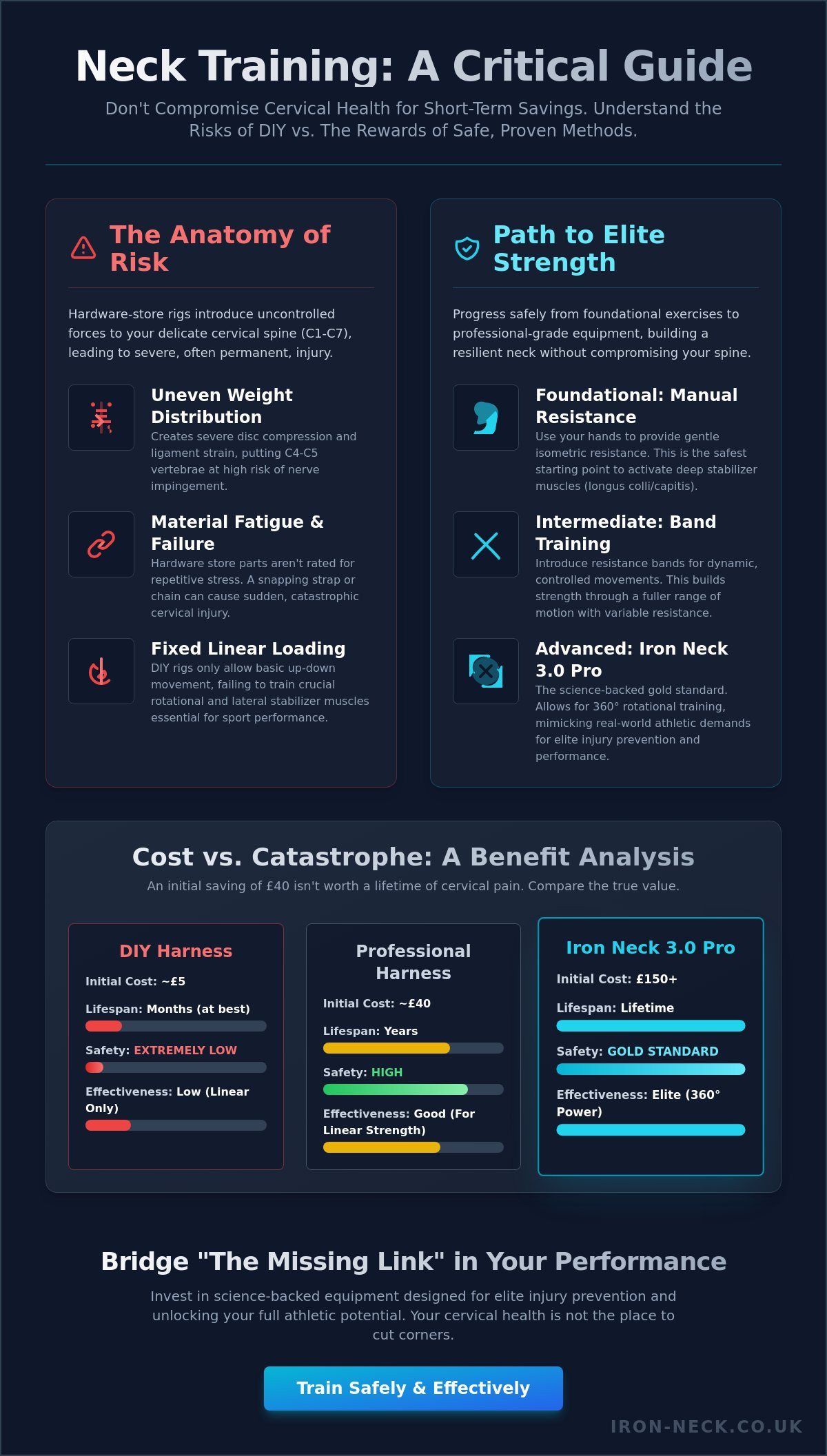
While the low price point is attractive, improvised rigs rarely meet the demands of modern cervical health. The most significant issue is linear loading. A DIY rig usually only allows for basic up-and-down movement, which ignores the rotational and lateral stabilisation the neck actually performs in sport. This lack of versatility makes finding a legitimate DIY neck harness alternative essential for those who want to avoid long-term injury.
- Lack of proprioceptive feedback: Crude equipment often masks poor form. If the harness slips or the weight swings unevenly, you lose the ability to feel how your stabilizer muscles are engaging.
- Material fatigue: Hardware store chains and lashing straps aren't rated for the repetitive shearing forces of neck training. A strap snapping under tension can lead to sudden, uncontrolled cervical flexion.
- Fixed resistance: Homemade solutions often rely on static weights that don't account for the varying strength curves of the neck muscles, increasing the risk of strain at the end-range of motion.
Building a thick neck shouldn't come at the expense of your spinal health. Understanding these risks is the first step in moving toward a more scientific, professional approach to training the most vulnerable part of your body.
The Anatomy of Risk: Why Your Cervical Spine Deserves Better Than DIY
Your cervical spine is a masterpiece of biological engineering. Seven delicate vertebrae, C1 through C7, form a structural column that protects the spinal cord while supporting the weight of your head. When you opt for a DIY neck harness alternative, you are experimenting with the most mobile and vulnerable segment of your skeletal system. Unlike the lumbar spine, which is built for heavy load-bearing, the cervical region prioritises range of motion. This makes it highly susceptible to injury when subjected to the erratic loading patterns common in homemade rigs.
The primary danger of improvised equipment is uneven weight distribution. A standard weight plate hanging from a hardware store chain does not account for the natural curvature of the neck. This misalignment creates significant disc compression and ligamentous strain. Even worse, these rigs often introduce shear force. Shear force occurs when pressure is applied parallel to the surface of the vertebrae, effectively trying to slide one bone over another. Professional equipment is designed to keep forces axial and controlled. Homemade setups lack this precision, often forcing the C4 and C5 vertebrae into compromised positions that can lead to long-term nerve impingement.
Training with crude tools also overlooks the deep stabiliser muscles. While you might feel a "burn" in your upper traps, you are likely failing to activate the longus colli and longus capitis. These muscles are the foundation of cervical integrity. To truly reduce neck pain and build functional strength, you need equipment that facilitates proper proprioception and muscle recruitment rather than just raw resistance.
The Danger of Non-Adjustable Rigs
Most DIY setups rely on a "one size fits all" loop. This creates dangerous leverage points on the base of the skull. If the harness is not perfectly fitted to your cranium, the centre of gravity shifts during the movement. This shift can cause the harness to slip mid-set. An unexpected slip during a heavy extension can lead to acute cervical trauma or a "stinger" that impacts nerve function down your arm. Furthermore, a loose fit prevents the isometric tension required to engage the deep neck flexors, leaving the most critical support structures of your spine completely dormant.
Rotational Instability and Concussion Risk
In contact sports like rugby or MMA, neck strength is your primary defence against concussion. Research from the Journal of Primary Prevention indicates that for every 1lb increase in neck strength, concussion risk decreases by 5%. However, this protection depends on 360-degree stability. DIY rigs are almost exclusively linear. They train the neck to move forward and backward but offer zero resistance against rotational forces. A tackle or a strike rarely hits you in a straight line. Without training for rotational stability, a DIY neck harness alternative leaves you unprepared for the high-velocity "whiplash" forces that cause traumatic brain injuries. True resilience requires a comprehensive training system that addresses every degree of motion safely.
Top 3 Safe DIY Alternatives to a Neck Harness
Building elite neck strength doesn't require a heavy leather harness or iron plates. Many athletes look for a DIY neck harness alternative to avoid the axial loading risks associated with traditional weighted setups. The most effective alternatives focus on controlled tension and stability rather than sheer weight. Resistance bands are the most versatile and safest low-cost option available today. Resistance bands provide variable resistance which is safer for joints; the tension increases as the muscle reaches its peak contraction, matching the natural strength curve of your cervical spine.
Zero-cost exercises like isometric wall holds build foundational stability without any equipment. These movements are essential for anyone starting their journey toward a pain-free life. By using your environment or your own body, you can create a high-performance training environment in any room. These methods prioritise the health of your stabilizer muscles, ensuring you don't compromise safety for the sake of progress.
The Resistance Band Loop Hack
To create a functional training station, you'll need a high-quality loop band and a sturdy anchor point. Secure the band to a power rack or a dedicated door frame attachment at head height. Using a towel as a buffer between the band and your forehead is a critical step for both comfort and grip. It prevents the rubber from pulling on your skin and keeps the band from slipping during lateral movements.
- Anchor: Ensure the attachment point is immovable to prevent accidents.
- Buffer: Use a folded gym towel to distribute pressure across the frontal or occipital bone.
- Progression: Implement progressive overload by stepping further away from the anchor point. This increases tension without the need for dangerous weight plates swinging near your face.
Manual Resistance Protocols
Manual resistance training involves using your own hands, or a partner's, to provide controlled tension. This is the preferred starting point for physiotherapy and rehabilitation because it offers immediate tactile feedback. You can feel the muscle engage through your own hands, allowing for micro-adjustments in real-time. This helps prevent overexertion in sensitive areas of the cervical spine.
For a structured approach to recovery and strength, many professionals recommend following the AAOS Spine Conditioning Program. This provides a medically reviewed framework for flexion, extension, and lateral bending. To perform these safely, apply steady pressure with your palm against your head while resisting the movement. It's a methodical way to build strength that doesn't require a DIY neck harness alternative or expensive machinery. You control the intensity, making it nearly impossible to overstrain the muscles if you listen to your body's signals.
Professional Harnesses vs. DIY: A Cost-Benefit Analysis
Choosing a DIY neck harness alternative usually stems from a desire to save money. However, a professional harness is a long term investment in your cervical health and athletic longevity. A £40 investment in high quality gear typically lasts five years or more. Conversely, makeshift rigs built from hardware store chains or tow straps often fail within 3 to 6 months of heavy use. Professional equipment like the Alpha Harness uses high strength nylon and reinforced stitching designed to withstand the shear force of explosive movements. When you're loading the cervical spine, the margin for error is zero.
- Industrial Durability: Professional grade materials prevent the fraying and degradation common in home builds.
- Advanced Padding: Integrated neoprene protects the forehead and prevents skin abrasions during high volume sets.
- Moisture Management: Breathable, moisture wicking fabrics manage sweat; this ensures the harness doesn't slip or cause skin irritation.
- Secure Hardware: Heavy duty D-rings provide secure attachment points that won't bend or snap under the tension of heavy plates or high tension bands.
The "Cheap" Harness Trap
Budget harnesses found on global marketplaces are often more dangerous than a well made DIY rig. These products frequently use thin nylon and weak, single stitched seams that can snap without warning during a lift. You can spot a harness that's likely to fail by looking for plastic buckles and lightweight metal rings. Saving £20 on a budget purchase is a poor trade if it leads to a £500 physiotherapy bill for a strained ligament or a disc injury. Reliable gear provides the peace of mind required to focus on your stabilizer muscles rather than equipment failure. Professional equipment is built to handle the rigours of elite training environments.
Why the Alpha Harness is the MOFU Choice
The Alpha Harness represents the missing link for athletes transitioning from basic hacks to professional grade training. It serves as the ideal middle ground for serious beginners who aren't ready for a full Iron Neck device but require total safety. This harness offers 4 point connectivity, making it compatible with both traditional plates and resistance bands. This versatility allows you to train proprioception and strength simultaneously. It's a foundational tool for anyone serious about concussion resistance and posture correction. By choosing professional gear, you ensure that every rep contributes to your performance rather than your risk profile.
Stop risking your safety with substandard equipment and start building a resilient foundation today. Upgrade to a professional Alpha Harness for a secure and effective training experience.
The Path to Elite Strength: From Harness to Iron Neck
Progressing from a beginner to an elite level of neck strength follows a logical, science-backed trajectory. You begin with isometrics to build foundational stability and proprioception. Once the cervical spine adapts to these static loads, you introduce linear resistance using bands or a professional harness. However, the Iron Neck 3.0 Pro represents the final evolution in this journey. It remains the gold standard for performance because it solves the "missing link" in human strength: rotational power. While a DIY neck harness alternative might handle basic vertical movements, it cannot replicate the 360-degree resistance required to truly bulletproof the head and neck against impact.
The Iron Neck philosophy views the neck as the foundation for all movement rather than an isolated muscle group. If your neck is weak, your body will naturally limit your power output to protect the brain. By investing in multi-directional resistance, you unlock your full athletic potential. Athletes must learn to value their foundation as much as their "engine." You wouldn't put a high-performance engine in a car with a fragile frame; don't build a powerful core and legs on top of a vulnerable neck.
Integrating Neck Training into Your Current Programme
Consistency beats intensity when you're starting out. Add neck work to your routine two or three times per week. High-volume sessions aren't necessary for results. Focus on three sets of 12 to 15 controlled repetitions to stimulate muscle growth without overtraining the central nervous system. Recovery is vital for maintaining cervical health. Use foam rollers on the upper traps and perform active stretching to ensure you don't lose mobility as you gain strength. For specific protocols, you can follow these 5 Iron Neck Workouts for Rotational Power to see how professionals structure their sessions.
Final Recommendation: Safety Over Savings
Your neck houses the most critical neurological pathways in your body. It's the one area where "good enough" equipment is never acceptable. Using a DIY neck harness alternative made from hardware store chains or luggage straps introduces unnecessary risks like uneven loading or sudden mechanical failure. These experiments aren't worth the potential for a cervical disc injury.
- Prioritise Engineering: Professional equipment is load-tested for human use.
- Think Long-Term: A single physio session for a neck strain costs more than a high-quality harness.
- Consult Experts: Always speak with a physio or sports doctor before starting high-intensity neck protocols.
If you aren't ready to invest in the Iron Neck 3.0 Pro, you should still choose professional-grade gear. You can explore the Alpha Harness for a professional, affordable start to your training. It provides a secure, industrial-strength platform for linear work without the risks of a homemade setup. Protect your most valuable asset by choosing gear designed for the job.
Secure Your Foundation for Elite Performance
Your cervical spine is the foundation for all movement and the primary line of defence against impact. While searching for a DIY neck harness alternative might seem like a budget-friendly shortcut, the structural integrity of your neck isn't the place to cut costs. Elite BJJ and Rugby athletes across the UK prioritise a scientific approach to concussion resistance because they understand that a single failure in a homemade rig can lead to permanent injury. Training with repurposed household items lacks the precision needed to target stabilizer muscles effectively and safely.
You deserve equipment that matches your ambition. By choosing heavy-duty materials designed for longevity, you move away from the anatomy of risk and toward a clinical standard of strength. Stop gambling with your spinal health and start investing in a proven system that supports your path to peak physical condition. Build the resilience your sport demands with gear that's built to last and backed by professional standards. It's the most important investment you'll make for your long-term athletic career.
Upgrade your training with the Alpha Head Harness – Professional safety for under £50
Take the first step toward a stronger, more resilient version of yourself today.
Frequently Asked Questions
Is a DIY neck harness safe for beginners?
No, a DIY neck harness isn't recommended for beginners because it lacks the structural stability required to protect the cervical spine. Beginners often haven't developed the proprioception needed to manage shifting, homemade loads. Research indicates that improper loading patterns can lead to disc herniation or ligament strain. For those seeking a DIY neck harness alternative, professional equipment provides the controlled environment necessary to isolate stabilizer muscles without risking injury.
Can I use a weight plate and a towel instead of a harness?
You can use a weight plate and towel, but it's an inefficient method that significantly limits your range of motion. This rudimentary technique primarily targets the posterior chain while failing to address vital rotational strength or lateral flexion. It's difficult to maintain the consistent tension required for hypertrophy. Without a secure attachment, you risk dropping the weight or causing uneven pressure on the 7 vertebrae of your neck.
What are the best neck exercises I can do with just a resistance band?
The most effective band exercises are 4-way isometric holds and slow-tempo rotations. Resistance bands are excellent for developing 360-degree strength and fixing poor posture by engaging the deep cervical stabilizers. These movements provide a safer entry point than heavy weights for athletes in high-contact sports like rugby. Bands allow for precise progressive overload, which is the foundation for building long-term concussion resistance and explosive performance.
How much does a professional neck harness cost in the UK?
A standard professional neck harness in the UK typically costs between £20 and £60 at major fitness retailers. High-end systems that offer multi-planar resistance can exceed £150. Investing in certified equipment ensures the nylon webbing and steel D-rings are rated for loads up to 50kg. It's a small price to pay for a tool that serves as the missing link in your injury prevention and strength routine.
Will a DIY harness help prevent concussions in rugby or MMA?
A DIY harness is unlikely to provide the specific, multi-directional resistance needed to effectively mitigate concussion risk. A 2014 study published in the American Journal of Sports Medicine found that for every 1lb increase in neck strength, concussion risk decreases by 5%. Homemade setups often fail to train rotational stability. Professional athletes rely on science-backed gear to ensure the neck functions as a high-performance shock absorber during impact.
Can I build a thick neck using only bodyweight exercises?
You can build muscle mass using bodyweight movements like wrestler's bridges and isometric self-resistance, but these methods eventually plateau. You can't easily quantify the load with bodyweight alone, making it hard to track progress. To achieve an elite, powerful look, you'll eventually need a DIY neck harness alternative or a professional system. Consistent, measurable tension is required to properly stimulate the sternocleidomastoid and trapezius muscles for growth.
What should I look for when buying a budget-friendly neck harness?
Look for a harness that features heavy-duty nylon, reinforced cross-stitching, and a padded neoprene lining. The padding is essential to prevent skin abrasion and ensure comfort during high-repetition sets. Check that the hardware includes steel D-rings and a secure chain or strap system. Don't compromise on the quality of the fastening straps, as these keep the load centered over your cervical spine during movement.
How often should I train my neck if I am using an alternative method?
You should train your neck 2 to 3 times per week to allow for full recovery of the stabilizer muscles. Like any other muscle group, the neck needs a stimulus-recovery cycle to grow stronger and more resilient. Start with 2 sets of 15 repetitions for each direction of movement. Over-training with an unverified alternative method increases the risk of chronic strain or stiffness rather than delivering the performance benefits you're after.