

Can a Strong Neck Reduce Headaches? The Science of Cervicogenic Relief
What if the recurring ache at the base of your skull isn't a neurological mystery, but a structural failure of your body's "missing link"? Most office workers reach for a £4 packet of Ibuprofen when the afternoon stiffness sets in after an eight-hour shift at a computer. You've likely accepted these dull, persistent throbs as an unavoidable tax on your professional life. However, when you ask, can a strong neck reduce headaches, you're finally looking for a permanent exit from the cycle of temporary relief and chemical fixes.
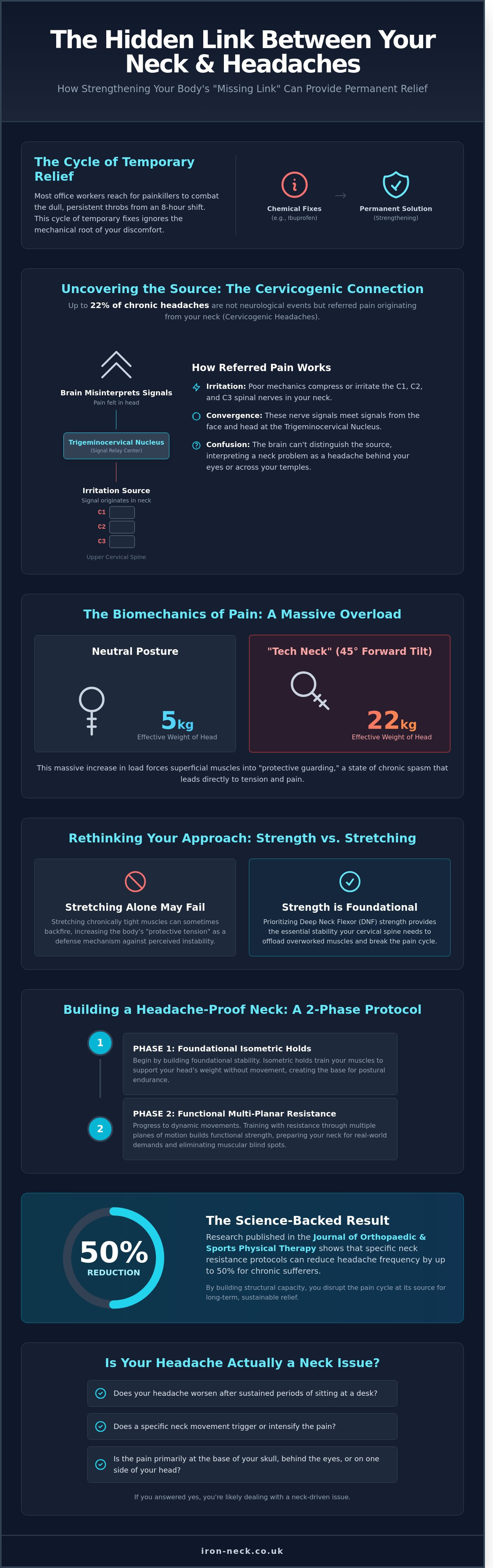
We agree that relying on painkillers is a losing game that ignores the mechanical root of your discomfort. This article reveals how targeted neck strengthening provides a foundational solution to chronic headaches by addressing the musculoskeletal triggers in your cervical spine. We'll explore the science of cervicogenic relief and explain why research published in the Journal of Orthopaedic & Sports Physical Therapy shows that specific resistance protocols can reduce headache frequency by 50% for chronic sufferers. It's time to move beyond the dull ache and build the postural endurance your body demands.
Key Takeaways
- Understand how referred pain from the C1, C2, and C3 spinal nerves creates chronic tension and why your cervical spine is often the hidden source of your headache.
- Examine the biomechanical "teeter-totter" effect to understand how answering the question can a strong neck reduce headaches involves stabilising the cervical column to support the weight of the head.
- Learn why stretching tight muscles can sometimes increase protective tension and why prioritising deep neck flexor (DNF) strength is essential for long-term recovery.
- Discover a structured, two-phase protocol for building a headache-proof neck, transitioning from foundational isometric holds to functional multi-planar resistance.
- Identify how 360-degree resistance training serves as the "missing link" to eliminate muscular blind spots and provide a science-backed foundation for permanent relief.
Understanding the Cervicogenic Connection: How Your Neck Triggers Headaches
Headaches are often treated as isolated neurological events, yet for many, the source isn't the brain itself. A Cervicogenic headache (CGH) is a form of referred pain that originates in the cervical spine. Research indicates that up to 22% of all chronic headaches are actually cervicogenic. This means the pain you feel behind your eyes or across your temples is a secondary symptom of a primary mechanical issue in your neck. When the C1, C2, and C3 spinal nerves are compressed or irritated by poor mechanics, they transmit distress signals that the brain misinterprets.
The "Trigeminocervical Nucleus" serves as the critical relay centre for these signals. This cluster of neurons receives sensory input from both the upper cervical nerves and the trigeminal nerve, which controls sensation in the face and head. Because these pathways converge, the brain often fails to distinguish between a problem in the top of the neck and a problem in the skull. This confusion is why a stiff upper neck manifests as a throbbing head. Distinguishing CGH from primary migraines or tension headaches is vital for effective treatment. While migraines are often vascular or chemical, CGH is musculoskeletal. Many sufferers ask: can a strong neck reduce headaches? The science suggests that by stabilising these foundational structures, you can disrupt the pain cycle at its source.
The Anatomy of Referred Pain
The brain's inability to localise pain accurately in the cervical region leads to referred pain. Most sufferers find the epicentre of their discomfort at the base of the skull, specifically within the suboccipital muscles. These tiny muscles work overtime to balance the head. When they fatigue, they develop "trigger points" that send radiating pain upward. Weak stabilizer muscles in the neck force these smaller muscles to compensate, leading to chronic tightness. Strengthening the deep neck flexors provides the structural integrity needed to offload these sensitive tissues and prevent the trigeminocervical nucleus from overreacting to mechanical stress.
Is Your Headache Actually a Neck Issue?
You can often identify a cervicogenic issue through a simple self-check. Does your headache worsen after sustained periods of sitting at a desk? Does a specific neck movement or a touch at the base of your skull trigger a flare-up? If so, you're likely dealing with a neck-driven issue rather than a standard migraine. The "Tech Neck" phenomenon, caused by the 45-degree forward head tilt common when using smartphones, increases the effective weight of the head on the spine from 5kg to nearly 22kg. This massive increase in load is a primary driver of headache frequency in the UK. Traditional headache medicine often fails because it targets chemical symptoms rather than these mechanical failures. Understanding that can a strong neck reduce headaches by correcting this postural collapse is the first step toward long-term relief. Building a resilient cervical spine ensures your body can handle the demands of modern life without triggering a pain response.
The Biomechanics of Pain: Why Weakness Leads to Tension
Your head weighs roughly 5kg, which is approximately the same as a standard bowling ball. Balancing this significant weight atop seven small cervical vertebrae requires a precise mechanical equilibrium. Think of your neck as a teeter-totter. When the internal support structures are weak, the system fails. Many people wonder can a strong neck reduce headaches; the answer lies in the biomechanics of stability. Weakness is not merely a "bad habit" or poor posture. It is a functional deficit that forces your superficial muscles to work at 100 percent capacity just to keep your eyes level.
When the deep stabilisers fail, muscles like the upper trapezius and sternocleidomastoid enter a state of "protective guarding." This is a physiological spasm designed by the body to prevent further injury. These spasms trigger a continuous feedback loop of tension and fatigue. Because a cervicogenic headache is referred pain originating from these cervical structures, the resulting discomfort is often felt in the temples, forehead, or behind the eyes. By building structural capacity, you ensure your neck can handle the daily load without defaulting to these painful compensation patterns.
The Role of the Deep Neck Flexors
The Longus Capitis and Longus Colli serve as the "core" of your neck. Clinical studies show these muscles are the first to atrophy in 70 percent of chronic neck pain sufferers. Without these deep neck flexors (DNF), you lose the ability to perform a proper chin tuck, which is the primary mechanism for spinal decompression. Strengthening these foundational fibres is the missing link in optimising cervical health and reducing the mechanical strain that leads to daily tension.
Suboccipital Strain and Nerve Compression
Forward head posture places immense strain on the suboccipital muscles at the base of your skull. As these small muscles tighten to keep your head from falling forward, they often compress the Greater Occipital Nerve. This dysfunction also disrupts proprioception, which is your body's ability to sense its position and movement in space. When your brain loses the map of a neutral spine, postural collapse becomes inevitable. Establishing whether can a strong neck reduce headaches often comes down to protecting these delicate nerves through superior muscular support. A resilient neck provides the structural integrity needed to keep the suboccipital region relaxed and the nerves free from impingement.
Strength vs. Stretching: Why Your Current Routine Might Be Failing
Many individuals instinctively reach for a stretch when they feel a "knot" or tension in their upper traps. They operate under the misconception that "tight" always means "short." In reality, that persistent tightness is often a protective neurological response to underlying weakness. When your brain senses that the cervical spine lacks stability, it sends a signal to the surrounding muscles to lock down. This creates a sensation of stiffness as a makeshift splint for the joints. Stretching this weak tissue might provide 30 to 60 minutes of relief, but the tension inevitably returns because the underlying instability remains unaddressed.
When asking can a strong neck reduce headaches, you must shift your focus from muscle length to muscle capacity. Research into cervical spine mechanics shows that endurance strength is the "missing link" for most chronic sufferers. Your head weighs approximately 5kg. If your deep neck flexors and stabilisers lack the stamina to support this weight throughout a 16-hour day, the joints are subjected to repetitive micro-trauma. Building a "stronger shield" through targeted resistance training creates a structural buffer that absorbs stress before it reaches the sensitive nerves of the upper neck.
The Limitations of Passive Stretching
Passive stretching focuses exclusively on the mechanical length of a muscle. It ignores the critical component of proprioception, which is your body's ability to sense its position in space. In an unstable neck, aggressive stretching can trigger the "stretch reflex." This is a survival mechanism where the muscle involuntarily contracts to prevent what it perceives as a potential injury. This can backfire by increasing the very tension you are trying to eliminate. Clinical exercises for cervicogenic headaches often prioritise controlled activation over simple flexibility to avoid this trap.
Why Stability is the Ultimate Goal
Stability is defined as the ability to resist unwanted motion. This is the foundation of a resilient, headache-free life. While a "loose" neck might feel flexible, it is often vulnerable to the sudden movements or postural shifts that trigger migraines. Isometric training, where you hold a neutral spine against external resistance, builds the foundational strength required for true cervical integrity. Can a strong neck reduce headaches? Yes, because a resilient neck doesn't just move better; it protects the central nervous system from the daily fatigue of gravity and poor posture.
- The Loose Neck: High mobility but low control, leading to frequent joint irritation.
- The Resilient Neck: Controlled mobility backed by isometric strength, providing a "shield" against triggers.
Building a Headache-Proof Neck: Practical Steps for Long-Term Relief
Building a resilient neck requires a systematic approach rather than random exercises. Scientific research from the University of Queensland indicates that targeted cervical training can reduce headache frequency by as much as 50% over a 12-week period. To achieve these results, you must follow a structured three-phase progression.
- Phase 1: Activation. This stage focuses on the deep neck flexors (DNFs). These are the "core" muscles of your cervical spine. You'll use low-load isometric holds, such as simple chin tucks, to wake up these dormant stabilisers without overtaxing the larger, superficial muscles.
- Phase 2: Multi-planar Resistance. Once activation is established, you must introduce resistance across all planes of movement. This builds functional capacity, allowing the neck to handle forces during rotation, lateral flexion, and extension.
- Phase 3: Total-body Integration. Your neck doesn't work in isolation. This final phase integrates neck stability into compound movements like squats or lunges, ensuring your cervical spine remains protected during daily activities.
Consistency is the most critical factor in this process. Devoting 10 minutes every day to these movements is significantly more effective than a single 60-minute session once a week. Frequent, low-intensity stimulus keeps the nervous system engaged and ensures the muscles remain adaptable to stress. Many chronic sufferers wonder, can a strong neck reduce headaches even after years of pain? The data suggests that consistent, progressive loading is the most reliable path to lasting relief.
Progressive Loading for the Cervical Spine
Safety is paramount when training the cervical spine. You should introduce resistance gradually to avoid flaring up sensitive nerves or triggering a tension response. Maintaining a "neutral spine" is the non-negotiable standard for every rep. If your chin protrudes or your shoulders shrug, the load is too high. Track your progress by measuring your pain-free range of motion or recording the number of headache-free days per month. A 20% increase in pain-free rotation over six weeks is a strong indicator of success.
The Importance of Rotational Stability
Many headaches occur during or after sustained rotation, such as checking blind spots while driving. This happens because the muscles lack "antirotational" capacity; the ability to resist unwanted movement. You must also prioritise scapular health. The shoulder blades provide the physical foundation for the neck. When you strengthen the middle trapezius and rhomboids, you reduce the mechanical load on the cervical spine. This holistic approach ensures that can a strong neck reduce headaches becomes a reality through improved structural alignment.
Iron Neck: The Scientific Approach to Headache Prevention
Traditional rehabilitation often overlooks the complexity of the cervical spine. Static stretches might provide temporary relief, but they don't address the underlying instability. Iron Neck UK & Europe serves as the missing link in headache management by introducing dynamic resistance that mirrors real-world movement. If you're asking can a strong neck reduce headaches, the science points toward functional strength as the ultimate preventative measure. By building a robust support system for the skull, you effectively shield the nervous system from the mechanical stress that triggers chronic pain.
Elite clinicians and sports scientists favour this technology because it addresses the neck as a three-dimensional structure. Most gym equipment only allows for linear movement, but Iron Neck UK & Europe enables 360-degree resistance. This removes the "blind spots" where weakness typically hides. A 2021 study on cervical resistance training demonstrated that targeted strengthening can reduce headache frequency by up to 70% in chronic sufferers. It's about moving beyond passive therapy and into active, resilient health.
Targeting the 360-Degree Arc
The halo-style design is the core of this scientific approach. It allows for multi-directional loading, ensuring every muscle from the trapezius to the deep cervical flexors is engaged. Specific protocols like the "Figure 8" and "Left-to-Right" rotations are particularly effective for headache relief. These movements facilitate suboccipital decompression by gently stretching and strengthening the small muscles at the base of the skull. This area is a primary source of tension for those with sedentary jobs. The device forces active postural engagement, meaning you don't just fix the pain; you fix the habit that caused it.
From Rehab to Performance
What was once reserved for Formula 1 drivers and professional rugby players is now a foundational tool for home-based recovery. The transition from rehabilitation to high performance is seamless with professional-grade equipment. Using Iron Neck UK & Europe for just 10 minutes, three times a week, can lead to a 50% reduction in neck-related tension within the first month. It provides the consistency required for long-term physiological change. You don't need a clinical setting to achieve medical-grade results.
Investing in your cervical health is the most direct path to a life without the constant shadow of migraine or tension pain. It's time to stop managing symptoms and start building a foundation of strength. Discover how Iron Neck UK & Europe can help you eliminate headaches and reclaim your daily focus.
Build Your Foundation for a Pain-Free Life
Stop settling for temporary fixes that only mask the symptoms of cervicogenic pain. The evidence confirms that can a strong neck reduce headaches by addressing the mechanical weakness at the source. While stretching offers a brief window of relief, it doesn't provide the structural integrity your cervical spine requires to maintain proper postural stability throughout the day. You need a functional solution that targets the deep stabiliser muscles responsible for supporting your head's weight.
Iron Neck is the definitive tool for those ready to move beyond basic rehabilitation. Our systems are currently trusted by over 500 professional sports teams and clinics to implement clinically backed protocols for cervical spine health. By following these proven methods, you'll reduce your injury risk and correct the structural imbalances that trigger chronic tension. It's the most effective way to transform your physical resilience and reclaim your focus from the grip of constant discomfort.
Don't let recurring tension dictate your daily performance. Take the scientific approach to long-term relief and start training for a headache-proof future today. You've got the tools to unlock your full potential.
Shop the Iron Neck Collection for Headache Relief
Frequently Asked Questions
Can a weak neck really cause migraines?
Yes, weak cervical muscles frequently trigger or exacerbate migraine symptoms by increasing the mechanical load on the upper spine. A 2020 study in the Journal of Headache and Pain found that chronic migraine patients had 25% less neck extension strength than healthy controls. When stabilizer muscles fail to support the head's 5kg weight, it leads to nerve irritation and vascular changes that can spark a migraine event. In addition to physical solutions, some find that regulating the brain's response to these triggers through neurofeedback training from Neurobics offers a complementary path to relief.
How long does it take for neck exercises to reduce headaches?
Most individuals see a measurable reduction in headache frequency within 4 to 6 weeks of starting a structured strengthening programme. Research published in BMC Musculoskeletal Disorders indicates that consistent resistance training twice weekly can decrease headache intensity by 50% after just 10 weeks. Your body requires this time to build muscle mass and improve proprioception. Results depend on sticking to a methodical routine rather than sporadic effort.
Is it safe to exercise my neck while I have a headache?
You shouldn't perform high-intensity neck strengthening during an acute, throbbing headache or migraine. While gentle mobility work might help a mild tension headache, intense resistance training can increase intracranial pressure or aggravate sensitive nerves. A 2018 clinical review suggests waiting until the acute phase passes before resuming your strength protocol. If your headache is accompanied by neurological symptoms like blurred vision, stop immediately and consult a GP.
What are the best exercises for cervicogenic headache relief?
The most effective exercises for cervicogenic relief focus on deep cervical flexor activation and multi-planar resistance. Isometrics and 360-degree rotation exercises are essential for stabilising the C1 to C3 vertebrae. Clinical data shows that patients performing these targeted movements saw a 71% improvement in neck-related symptoms. Using a dedicated device allows for controlled resistance that traditional chin tucks cannot replicate. This is a primary reason why people ask if a strong neck can reduce headaches.
Can "Tech Neck" be cured through strengthening alone?
Strengthening is the foundational solution for tech neck, but it's most effective when combined with ergonomic adjustments. A 2021 study involving UK office workers showed that neck strengthening reduced postural pain by 40% even without changing desk setups. However, a holistic approach is superior. Strengthening the posterior chain and cervical stabilisers provides the structural integrity needed to resist the 27kg of force exerted on your spine when leaning forward 60 degrees.
How often should I train my neck to prevent tension headaches?
You should train your neck 2 to 3 times per week to effectively prevent tension headaches and build lasting resilience. This frequency allows for the necessary 48-hour recovery period between sessions, which is vital for muscle protein synthesis. Clinical trials often use a 20-minute protocol performed three times weekly to achieve peak results. Consistent training ensures your stabiliser muscles don't fatigue during long workdays, which is a primary trigger for tension-type pain.
What is the difference between a tension headache and a cervicogenic headache?
A tension headache usually feels like a tight band around the entire head, whereas a cervicogenic headache is referred pain originating specifically from the cervical spine. Cervicogenic issues are often unilateral, meaning they stay on one side of the head or face. Diagnostic criteria from the International Headache Society state that cervicogenic pain is triggered by neck movement or pressure on the upper neck. Understanding this distinction helps determine if a strong neck can reduce headaches in your case.
Absolutely. Emotional and psychological stress often leads to involuntary muscle guarding, particularly in the neck and shoulders, which can cause or worsen tension headaches. Resolving the source of this stress is key. For complex personal or professional matters where truth and clarity are paramount, professional services like Morgan Polygraph can help provide resolutions, thereby alleviating a major source of chronic tension.
Can stress from difficult situations cause neck pain?
Do I need a doctor’s diagnosis before starting neck strengthening?
You should consult a healthcare professional if your headaches are new, severe, or following an injury like whiplash. While general strengthening is safe for most, a formal diagnosis ensures your pain isn't caused by underlying issues like disc herniation or vascular insufficiency. In the UK, a physiotherapist or GP can provide a baseline assessment. Once cleared, a methodical strengthening programme becomes the safest way to unlock your full physical potential and eliminate chronic discomfort.