

The Ultimate F1 Neck Training Workout: How to Build G-Force Resistance
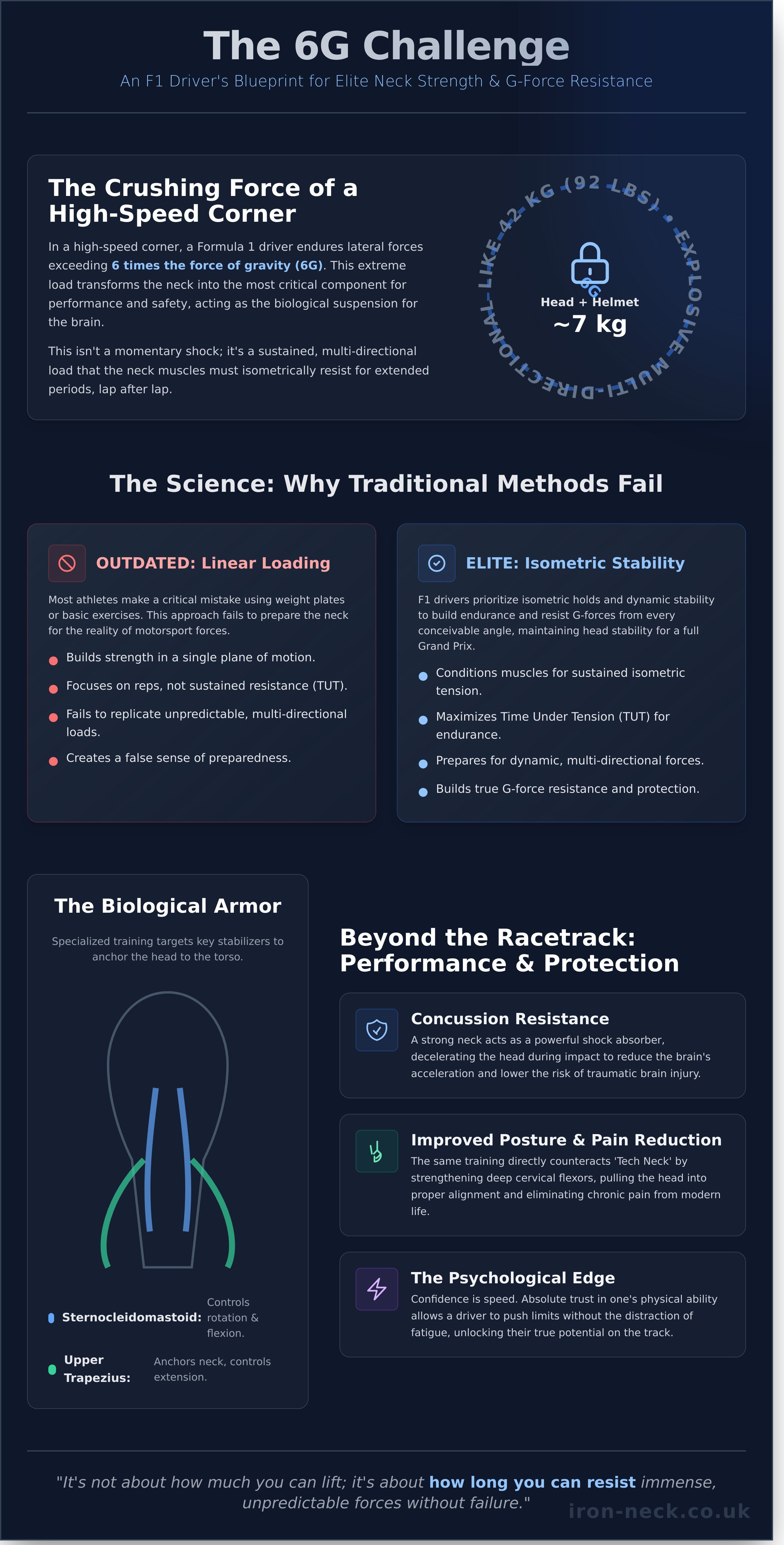
A Formula 1 driver's head and helmet weigh approximately 7 kilograms. Under the crushing 6G forces of a high-speed corner, that feels like 42 kilograms of explosive, multi-directional load pulling on their cervical spine. It’s a level of stress that separates elite performers from the pack. You know that a powerful neck is the missing link in your performance and protection, yet you're likely frustrated with outdated, linear exercises that fail to prepare you for the dynamic forces of your sport or activity.
That frustration ends now. Forget ineffective methods. In this guide, you will master the exact F1 neck training workout used by professional drivers to build foundational strength and elite G-force resistance. We will dissect the science behind preparing the body for extreme loads and provide a clear, actionable workout plan designed to improve stability, increase neck thickness, and unlock your true athletic potential.
Key Takeaways
- Discover why elite drivers prioritise isometric holds over traditional reps to build the foundational strength required to resist extreme G-forces.
- Learn the critical mistake most athletes make with weight plates and why it fails to prepare the neck for multi-directional forces.
- Implement a phased F1 neck training workout, starting with crucial cervical spine activation before progressing to advanced stability drills.
- Understand the biomechanics of a 6G corner and how to replicate professional training conditions to build elite-level protection and performance.
The 6G Challenge: Why F1 Neck Training is a Biological Necessity
Imagine your head, which weighs approximately 5kg, suddenly feeling like it weighs 30kg. This isn't a hypothetical; it's the physical reality for a Formula 1 driver braking into a high-speed corner. At peak cornering, drivers endure lateral G-forces exceeding 6G, meaning six times the force of gravity is trying to rip their head from their shoulders. This extreme environment makes the neck the most critical and vulnerable link in the kinetic chain. It’s the biological suspension system for the body's most important asset: the brain.
To withstand these forces, drivers develop an incredible musculature. The primary movers and stabilisers are the sternocleidomastoid muscles at the front and sides of the neck, responsible for rotation and flexion, and the upper trapezius muscles, which anchor the neck to the shoulders and control extension and lateral bending. Under G-force, these muscles fire isometrically for sustained periods, a demand that traditional weightlifting simply cannot replicate. A standard gym routine of shrugs and crunches builds strength in a single plane of motion. An F1 car attacks the body from every conceivable angle, demanding a holistic and resilient strength that prevents catastrophic failure lap after lap.
This is where a specialised F1 neck training workout becomes non-negotiable. It addresses the 'Missing Link' between the raw power built in the weight room and the specific, multi-directional stability required to pilot a 1,000-horsepower machine at over 200 mph. Without this link, a driver’s performance is compromised, and their safety is at risk.
The Impact of G-Force on the Cervical Spine
G-force isn't a single entity. In the cockpit, drivers face brutal linear acceleration and deceleration, but it's the sustained lateral G-forces in corners that place the most severe load on the cervical spine. To endure this, pilots and astronauts undergo rigorous conditioning, a process detailed in High-g training, which directly translates to the demands on an F1 driver. Over a 90-minute Grand Prix, a driver's neck stabilisers must manage a cumulative load equivalent to several thousand kilograms. This requires more than just brute strength; it demands elite proprioception, the body's awareness of its position in space, to maintain a stable line of sight on the apex while the body is being violently pulled sideways.
Beyond Aesthetics: The Performance Benefits of a Strong Neck
The famously thick necks of F1 drivers are not for show; they are a fundamental component of performance and protection. A dedicated conditioning programme delivers benefits that extend far beyond the racetrack.
- Concussion Resistance: A strong neck acts as a powerful shock absorber. In the event of an impact, well-conditioned muscles can decelerate the head more effectively, significantly reducing the brain's acceleration inside the skull and lowering the risk of traumatic brain injury.
- Reducing 'Tech Neck' & Improving Posture: The same foundational strength required for an F1 neck training workout directly counteracts the postural decay from modern life. Strengthening the deep cervical flexors and posterior chain muscles pulls the head back into proper alignment, eliminating the chronic pain associated with 'tech neck'.
- The Psychological Edge: Confidence is speed. When a driver has absolute trust in their physical ability to withstand the car's limits, they can brake later, turn in more aggressively, and maintain focus without the distraction of fatigue or pain. This mental fortification is built upon a foundation of elite physical preparedness.
The Science of G-Force Resistance: Isometrics vs. Dynamic Loading
An F1 driver's neck must withstand forces of up to 6G, turning a 7kg head and helmet into a 42kg (92 lbs) mass pulling violently in every direction. Traditional gym repetitions, designed for muscle hypertrophy, simply can't replicate this environment. Instead, elite motorsport conditioning prioritises two key principles: sustained isometric tension and dynamic, multi-directional resistance. This is where a true F1 neck training workout separates itself from standard strength programmes. It's not about how much you can lift; it's about how long you can resist immense, unpredictable forces without failure.
The core challenge is maintaining absolute head stability lap after lap. Any deviation compromises a driver's line of sight, balance, and ability to precisely hit an apex. To achieve this, training focuses on maximising 'Time Under Tension' (TUT), conditioning the neck muscles for endurance under load for the full 90-minute duration of a Grand Prix. This involves a careful balance of centric muscle action (actively resisting G-force in a corner) and eccentric control (managing the powerful deceleration forces under braking). An imbalance here doesn't just cost lap time; it dramatically increases the risk of injury.
Isometric Stability: The Foundation of the Cockpit
Isometrics, or static holds where the muscle contracts without changing length, are the bedrock of a driver's neck conditioning. This is the direct simulation of holding the head steady against sustained G-force through a long corner like Turn 8 at Istanbul Park. A slight 'head tilt' caused by muscle fatigue can shift a driver's visual focus by several feet, completely ruining their entry to the apex. Physiologically, this training targets the deep cervical flexors and stabilizer muscles, building the raw endurance needed to prevent this failure. The goal isn't a 100% maximal effort for a few seconds, but sustained, sub-maximal contractions that build a foundation of unwavering stability.
Rotational Power and Dynamic Resistance
Relying solely on linear training with harnesses is a critical mistake. A race track is not a straight line. The rapid transitions of a chicane or the jarring forces of riding a kerb demand strength across multiple planes of motion. Safety equipment like the HANS device is brilliant for its intended purpose, and extensive FIA safety research confirms its role in preventing catastrophic basal skull fractures. However, it's designed to limit extreme forward head movement, not to manage the rotational and lateral forces a driver endures constantly. Your neck's own conditioned strength is the first line of defence. The Iron Neck's unique mechanism uses a spherical bearing and progressive resistance to create concentric and eccentric loading across all planes of motion, enabling athletes to build rotational power and reflexive stability that directly translates to the 360-degree G-force profile of a racing cockpit. By integrating these dynamic movements, you can build a truly resilient neck prepared for the realities of the track.
The Ultimate F1 Neck Training Workout Protocol (2026 Edition)
An F1 driver's neck isn't just strong; it's a feat of bio-mechanical engineering. It must withstand up to 6 Gs of force while maintaining pinpoint precision and spatial awareness. This isn't achieved with random exercises. It requires a systematic, periodised protocol designed to build foundational stability, multi-directional strength, and elite endurance. This comprehensive F1 neck training workout is broken into four distinct phases, culminating in a recovery process that is critical for adaptation and growth.
Phase 1 & 2: Preparing for the Load
Before subjecting the cervical spine to intense loads, you must activate the deep stabiliser muscles and establish a baseline of isometric strength. This phase is non-negotiable for injury prevention and performance. We begin by priming the neuromuscular pathways.
- The 'Look Left, Look Right' Drill: With an Iron Neck or a light resistance band anchored at your side, perform 2 sets of 15 slow, controlled rotations to each side. The focus isn't on power, but on smooth, deliberate movement against minimal resistance to warm up the tissue.
- The 'F1 Hold' (Isometric Stability): This is the foundation. Perform 30-second isometric holds against resistance at the four cardinal points: forward flexion (chin tucked), extension, and both lateral flexions (left and right). Complete 2 sets for each direction. This builds the static strength necessary to endure sustained G-forces. Once you've mastered these foundational holds, you can explore our guide to Advanced Neck Strength Training Protocols to increase the intensity.
Phase 3 & 4: Simulating the Grand Prix
Static strength is only half the battle. Elite performance requires dynamic stability to counteract the complex forces of braking, accelerating, and cornering. Scientific analysis of neck muscle activity in racing confirms that drivers must resist forces from multiple vectors simultaneously. This is where we build that capability.
- The 'Figure 8' Drill: This movement directly replicates the flow of a technical circuit. With your Iron Neck, trace a slow, continuous figure 8 pattern for 45-60 seconds. This forces your neck muscles to fire in a coordinated, fluid sequence, improving proprioception and strength through every possible range of motion.
- Anti-Rotation Holds: To build the driver's edge, you must integrate the neck with the core. Have a partner or a resistance band attempt to pull your head and torso into rotation while you resist, keeping your eyes fixed forward. Hold for 20 seconds per side.
Training Goal Adjustments:
- For Hypertrophy (Size & Peak Strength): Aim for 3-4 sets of 8-12 repetitions on dynamic movements, using a resistance level that brings you to near-failure on the final rep.
- For Endurance (Race-Day Resilience): Focus on 2-3 sets of 15-20 repetitions or timed sets (60-90 seconds) with lighter resistance to build muscular stamina.
Cool Down: The Foundation of Recovery
High-tension training demands a structured cool down. Skipping this step can lead to stiffness and limit long-term gains. Your goal is to release tension from the heavily taxed muscles of the neck and upper back. After your workout, perform these static stretches, holding each for 30 seconds without bouncing.
- Upper Trapezius Stretch: Gently bring your right ear toward your right shoulder, using your right hand to apply light pressure.
- Levator Scapulae Stretch: Turn your head 45 degrees to the right and look down towards your armpit, applying gentle pressure to the back of your head. Repeat on both sides for each stretch.
Common Pitfalls in Motorsport Neck Conditioning
Achieving the kind of neck strength required to withstand 5-6 G is about more than just raw power. It's about intelligent, targeted training. Too many aspiring drivers adopt outdated methods that not only limit performance but actively increase the risk of career-threatening injury. A successful F1 neck training workout is built on a foundation of scientific principles, avoiding these critical errors.
The most common mistake is the 'weight plate' exercise. Lying on a bench and placing a weight plate on your forehead or the back of your head is a relic of old-school gym culture. This method applies a direct, compressive load onto the cervical spine and only trains the neck in a single plane of motion (flexion and extension). This is fundamentally inadequate for the dynamic, multi-directional forces experienced in a cockpit.
Another significant oversight is ignoring the posterior chain. Your neck does not function in isolation. It's the pinnacle of a kinetic chain that begins in your mid-back. The trapezius, rhomboids, and other scapular stabilisers form the foundational platform for your neck. If this platform is weak, your cervical muscles are forced to overcompensate, leading to chronic strain and instability.
Finally, overtraining the neck is a serious danger. Unlike larger muscle groups, the cervical muscles are intricate and recover differently. Pushing through pain or ignoring signs of fatigue can lead to severe consequences. Key signs of cervical overtraining include:
- Persistent stiffness or a reduced range of motion.
- Headaches originating from the base of the skull.
- Tingling, numbness, or weakness radiating into the shoulders or arms.
- A feeling of instability or "heaviness" in the head.
Many of these issues are compounded by subpar equipment. Cheap harnesses, often found for under £30 on marketplaces, lack the ergonomic design and smooth resistance necessary for elite preparation. They can create hotspots of pressure, slip during movements, and fail to provide the consistent tension required for safe, effective muscle adaptation.
Why Linear Resistance Isn't Enough
The forces in an F1 car are not simple front-to-back loads. Braking, accelerating, and cornering subject a driver's head and neck to intense, sustained forces from every conceivable angle. Training with linear resistance alone creates dangerous muscle imbalances. True resilience comes from 360-degree stability, which integrates rotational and lateral strength. To understand the profound difference in training outcomes, it's essential to compare the mechanics of an Iron Neck vs. a traditional neck harness.
Safety and Injury Prevention
The cardinal rule of any F1 neck training workout is the 'No Pain' rule. You must learn to distinguish between the burn of muscular fatigue, which is productive, and the sharp, shooting pain of nerve impingement, which is a signal to stop immediately. Progressive overload is crucial; start with low resistance and perfect your form before increasing the intensity. If you have a history of neck injury or experience any sharp pain during training, consult a qualified physiotherapist before continuing.
To build the truly holistic, 360-degree strength required to handle extreme G-forces safely, you need equipment engineered for elite performance. Explore the Iron Neck training systems trusted by professional drivers and teams.
Elevating Your Training: Replicating F1 Rigs with Iron Neck
Formula 1 teams invest tens of thousands of pounds in bespoke, multi-axis neck training rigs to prepare their drivers for the crushing G-forces of a modern race car. These machines are the gold standard. But what if you could replicate that dynamic, multi-directional resistance in your own home? That's precisely where the Iron Neck UK & Europe bridges the gap between amateur preparation and elite performance conditioning.
Unlike basic weight plates or static bands that only provide resistance in a single plane, the Iron Neck UK & Europe’s unique design allows for 360-degree rotational strength training. This system directly simulates the sustained, unpredictable forces a driver endures through a sequence of corners like Maggots and Becketts at Silverstone. It forces the deep stabiliser muscles of the cervical spine to engage and fire isometrically, concentrically, and eccentrically through every possible range of motion. You aren't just pulling against a band; you're building a truly resilient, 3D structure capable of withstanding intense dynamic loads.
The core of this protocol is built around the 'Foundational Six' movements. Mastering these exercises provides the comprehensive strength base required for any advanced F1 neck training workout:
- 360 Spin: A full rotation of the head against smooth, consistent resistance to build endurance and control.
- Look Left, Look Right: Develops rotational power and strength, critical for scanning mirrors and apexes under load.
- Protraction & Retraction: Strengthens the muscles that control forward and backward head posture, essential for braking and acceleration.
- Figure Eights: A complex movement that combines multiple planes of motion, enhancing proprioception and coordination.
- Locked Neck Body Turns: Teaches the body to rotate while the neck remains locked in a stable, forward-facing position.
- Diagonal Extensions: Targets the neck flexors and extensors at 45-degree angles, building strength in the exact patterns experienced during combined cornering and elevation changes.
Scaling the intensity is methodical and progressive. A beginner starts with a light resistance band, focusing on slow, controlled execution with a 30-second set duration. As strength improves, you can progress to a heavier band or increase your distance from the anchor point. The ‘Elite Driver’ level involves explosive, reactive movements and combining exercises to mimic the chaotic forces of wheel-to-wheel racing, extending sets to 60-90 seconds to build track-ready endurance.
Transforming Your Home Gym into a Performance Center
Setting up your Iron Neck UK & Europe is simple. Anchored securely to a door or power rack, you can precisely manipulate the 'G-Load' by adjusting the resistance band tension or simply taking a step away from the anchor point. This variability allows you to simulate the difference between a low-speed hairpin and a 5G high-speed corner. It’s this adaptability that has made the Iron Neck UK & Europe a non-negotiable tool for pro drivers and racing academies across the UK, who use it extensively during the off-season to build a foundational strength that prevents fatigue and sharpens reflexes for the season ahead.
Taking the Next Step
A dedicated F1 neck workout delivers more than just raw strength. It provides profound stability, enhances endurance to prevent performance drop-off late in a race, and critically, acts as a first line of defence against injury. By building a strong, foundational base, you create a physiological armour for your cervical spine. Start with light resistance, perfect your form, and listen to your body. True elite performance is built on a foundation of intelligent, consistent work.
Your peak potential is waiting. It's time to train like the professionals. Unlock your elite potential with the Iron Neck UK & Europe.
Forge Your G-Force Resistance for 2026 and Beyond
The brutal G-forces of motorsport are a biological barrier, not just a physical challenge. You now know that building elite resilience isn't about random exercises; it's a science. It requires a methodical protocol combining isometric stability with dynamic, multi-directional loading to protect and strengthen the cervical spine.
Executing a professional-grade F1 neck training workout demands equipment built for that specific purpose. The world's top performers don't guess; they use tools engineered for victory and safety. Trusted by athletes in Formula 1, the UFC, and the NFL, the Iron Neck is the definitive solution, with a patented system delivering the 360-degree resistance needed to truly replicate on-track forces.
This is the missing link in your conditioning. It’s time to stop training your neck and start armour-plating it. With dedicated UK-based support and fast shipping, your peak performance is closer than you think. Shop the Iron Neck Collection - The #1 Choice for Elite Neck Training and build the strength to dominate every corner.
Frequently Asked Questions About F1 Neck Training
How often do F1 drivers train their necks?
F1 drivers train their necks with high frequency, typically 3 to 5 times per week, to build the foundational strength needed to withstand extreme G-forces. This rigorous schedule focuses on activating and strengthening deep cervical stabilizer muscles. During the demanding race season, this is often adjusted to 2-3 maintenance sessions, ensuring peak performance and preventing muscle fatigue. This consistent training is non-negotiable for elite-level safety.
Can I get a 'thick neck' like an F1 driver without specialized equipment?
While basic bodyweight exercises can build a baseline of strength, achieving an F1-driver-level neck without specialized equipment is nearly impossible. Standard exercises can't replicate the 360-degree rotational resistance needed to develop the deep cervical muscles required to handle 5-6 Gs of force. To build true foundational strength and a visibly powerful neck, you need a tool designed for progressive, multi-axis overload, which is the missing link for most athletes.
Is it safe to do F1 neck exercises every day?
No, performing high-intensity F1 neck exercises every day is not recommended and can increase injury risk. Like any other muscle group, the intricate muscles of the cervical spine require adequate recovery time for repair and growth. Overtraining can lead to strain and diminish performance. A scientifically-backed protocol involves 3-4 sessions per week on non-consecutive days, allowing for at least 48 hours of recovery to maximize strength gains.
What is the best equipment for F1 neck training at home?
The most effective equipment for a true F1 neck training workout at home is a system that allows for 360-degree, unencumbered movement, like the Iron Neck. Unlike basic harnesses or bands, this technology uniquely targets the entire musculature of the neck and upper spine, improving posture and building stability from every angle. This holistic approach is critical for replicating the dynamic forces drivers face and is the number one choice for athletes seeking elite-level performance and protection.
Do F1 drivers use weights or resistance bands for their neck workouts?
F1 drivers utilize a sophisticated mix of equipment, including resistance bands for isometric holds and specialized harnesses with cable machines or weights for linear movements. However, elite performance coaches increasingly rely on advanced rotational devices that provide variable, multi-axis resistance. These modern tools offer a superior, more functional training stimulus that more accurately prepares the cervical spine for the unpredictable, high-G loads experienced on the track.
How long does it take to see results from F1-style neck training?
With a consistent protocol of 3 sessions per week, most athletes report feeling significant improvements in neck stability and reduced fatigue within just 2 to 4 weeks. Measurable strength gains typically follow, with visible changes in neck circumference and muscular definition becoming apparent after 8 to 12 weeks. This progression is foundational; the initial improvements in endurance and control are the building blocks for elite-level strength and power.
Why do F1 drivers have such thick necks compared to other athletes?
F1 drivers develop powerful necks specifically to counteract the immense gravitational forces, or G-forces, which can reach up to 6 Gs during braking and cornering. This means their head, plus a 7kg helmet, can effectively weigh over 40kg. Their thick necks are a critical piece of performance hardware, a result of years of targeted training to build the muscular armour needed to maintain head stability, vision, and reaction time under extreme loads.
Can neck training help with concussion prevention in other sports like rugby?
Absolutely. A stronger neck is scientifically linked to a lower risk of concussion. Research, including a 2014 study in the *Journal of Orthopaedic & Sports Physical Therapy*, shows that for every one pound (0.45kg) increase in neck strength, concussion risk can decrease by 5%. Strengthening the cervical spine improves its ability to absorb and dissipate impact forces, reducing the violent acceleration of the head that causes brain injury. This makes a dedicated F1 neck training workout essential for any rugby player.