

Neck Training Frequency for Best Results: The Definitive 2026 Guide
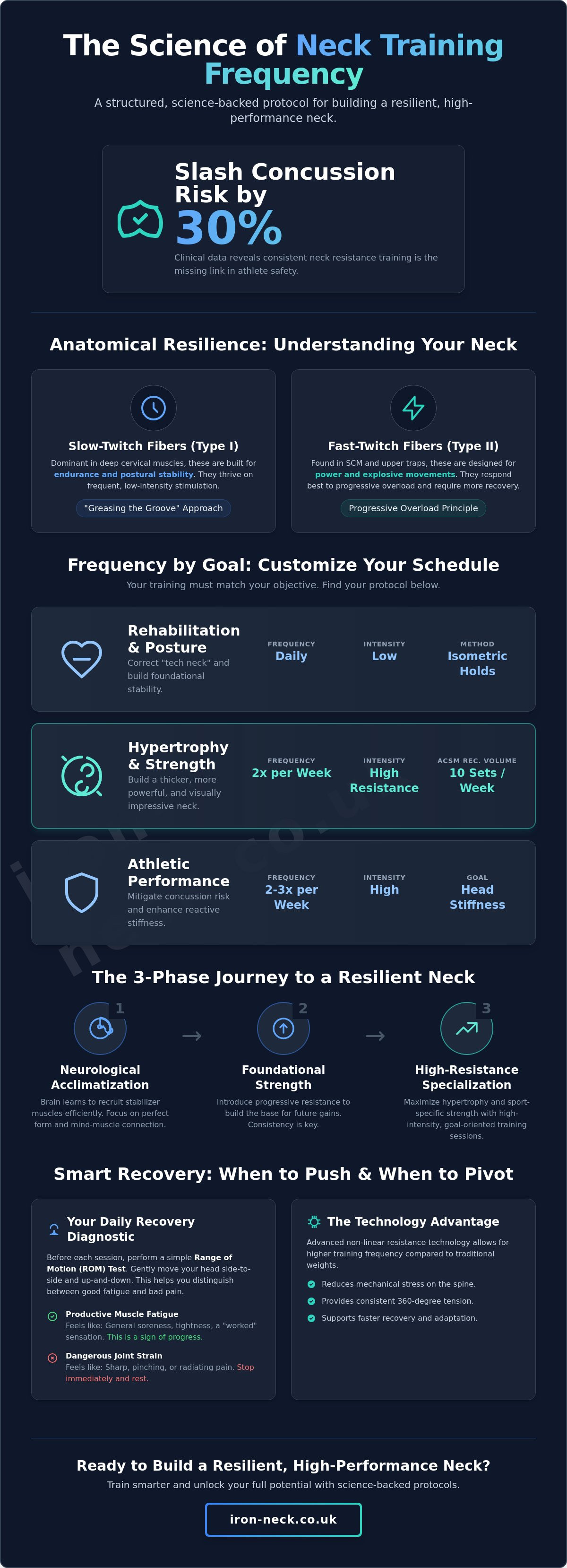
Clinical data from 2025 reveals that consistent neck resistance training can slash concussion risk by 30% in contact situations, yet many athletes still treat this missing link as an afterthought. You likely recognize that a strong cervical spine is the foundation for elite performance and posture, but the fear of injuring such a delicate area often leads to either debilitating stiffness or complete avoidance. Finding the optimal neck training frequency for best results shouldn't feel like a guessing game that puts your health at risk.
We'll master the science of recovery and scheduling to help you build a resilient, high-performance neck without the pitfalls of overtraining. This guide integrates the March 2026 ACSM update, which recommends training major muscle groups at least twice a week for strength gains. You'll gain a clear weekly schedule, learn to identify the signs of optimal recovery, and understand how to hit the recommended 10 sets per week for maximum hypertrophy. Let's transform your approach from hesitant movements to a structured, science-backed protocol.
Key Takeaways
- Understand why the cervical spine's slow-twitch fiber composition requires a "greasing the groove" approach to build long-term postural stability.
- Determine the optimal neck training frequency for best results by aligning your schedule with specific goals, such as daily isometric holds for rehabilitation or high-intensity sessions for concussion resistance.
- Master the transition from foundational neurological acclimatization to high-resistance specialization using our structured 3-phase training protocol.
- Learn to distinguish between productive muscle fatigue and dangerous joint strain by using the daily Range of Motion test as a recovery diagnostic.
- Discover how advanced non-linear resistance technology allows for higher training frequency compared to traditional weighted harnesses by reducing mechanical stress on the spine.
The Science of Neck Recovery: Why Frequency is the Missing Link
The cervical spine is a masterpiece of biological engineering, designed to support the head while facilitating complex, multi-planar movement. Unlike the large, explosive muscle groups of the lower body, the neck is predominantly composed of slow-twitch, Type I fibres. These muscles are built for endurance and postural maintenance rather than raw power. Understanding this cellular makeup is vital for determining The Science of Neck Recovery and setting a neck training frequency for best results. Because these muscles are active 16 hours a day just to keep your eyes level, they possess a unique capacity for frequent, low-intensity stimulation, a concept often called "greasing the groove."
However, a common mistake is treating neck training like a casual stretching routine. When you shift from simple mobility to high-intensity resistance training, the rules change. Structural adaptation requires a strict 48-hour recovery window between intense sessions. This allows the central nervous system (CNS) to recover and the muscle tissues to repair. In the early stages of a programme, your strength gains aren't actually coming from larger muscles. They come from neurological adaptation and improved proprioception. Your brain is learning how to recruit the stabiliser muscles more efficiently, which provides an immediate boost in stability before any visible growth occurs.
Anatomical Resilience: Postural vs. Explosive Muscles
The deep cervical flexors act as the internal girdle for your spine. They require consistent, low-load volume to maintain stability and prevent the dreaded forward head posture. In contrast, the sternocleidomastoid (SCM) and upper trapezius contain a higher mix of fast-twitch fibres. These respond better to progressive overload and lower frequency. The neck's high vascularity is a significant advantage; rich blood flow delivers nutrients faster than in poorly vascularised areas like the lower back. This high rate of nutrient delivery supports a slightly higher frequency for athletes using specialised equipment from Iron Neck UK & Europe.
The Frequency Paradox: Daily Mobility vs. Weekly Strength
You should move your neck every single day, but you must only train it 2 to 4 times per week. This is the frequency paradox. Daily mobility involves active recovery; it flushes the tissue and maintains range of motion without causing microscopic tears. Structural training, however, demands a metabolic cost. The 2026 ACSM guidelines emphasise that for true hypertrophy and concussion resistance, total weekly volume is the priority. Aim for 10 sets per week spread across 2 or 3 focused sessions. This balance ensures you maximise the neck training frequency for best results without overtaxing the CNS or inducing chronic stiffness.
Frequency by Goal: Customising Your Schedule for Results
Your training frequency must reflect your specific objectives. A rugby player bracing for a 100kg impact requires a vastly different stimulus than an office worker correcting a decade of "tech neck." Finding the right Frequency by Goal: Customising Your Schedule starts with identifying whether you need neurological stability, structural thickness, or reactive stiffness. While the 2026 ACSM guidelines provide a baseline of twice-weekly training for general strength, your individual needs might demand more frequent "micro-doses" or less frequent, high-intensity sessions.
For those seeking a thicker, more powerful neck, mass follows volume. To trigger hypertrophy, the latest clinical data suggests you must hit approximately 10 sets per week. This volume is best achieved by training the neck twice weekly with 5 sets per session. Balancing this volume with high-intensity resistance is the key neck training frequency for best results. If you're serious about adding functional mass, consider how professional-grade resistance tools from Iron Neck UK & Europe can accelerate your progress by providing 360-degree tension that traditional weights simply cannot match.
The Athlete's Protocol: Concussion Mitigation
For contact sports like MMA, Rugby, and Motorsports, the primary goal is building "stiffness" to resist head acceleration. Clinical evidence from 2025 suggests that a 30% reduction in concussion risk is achievable through targeted resistance. Athletes should perform 2 to 3 high-intensity sessions per week, integrated into their existing strength splits. A Tuesday and Friday schedule, for example, allows for maximum CNS recovery. Short "pre-hab" sessions involving low-intensity isometrics can also be performed daily as part of a warm-up to prime the stabiliser muscles before high-impact practice.
Rehab and Posture: The Path to Pain-Free Movement
If you're battling chronic tension, the approach shifts to high-frequency, ultra-low intensity. We recommend 5-minute daily micro-doses of isometric flexion to build the neurological foundation for stability. This method doesn't induce the muscle damage associated with growth; it simply retrains the brain to hold the cervical spine in a neutral position. As pain thresholds improve, usually over a 4 to 6-week period, you can safely transition to 2 or 3 resistance sessions per week. Consistency beats intensity when reversing postural imbalances; the goal is to eliminate the source of pain through steady, daily movement and the engagement of deep stabiliser fibres.
The Iron Neck 3-Phase Frequency Protocol
Moving from the theory of recovery to the reality of the gym requires a structured roadmap. You cannot jump into elite level volume without first preparing the underlying architecture of your cervical spine. This protocol provides a methodical progression that respects tissue tolerance while maximising adaptation. Following an evidence-based neck training frequency of three sessions per week has been shown to reduce chronic pain significantly; our protocol builds upon this foundation to drive both safety and performance. Adhering to this phased approach is the only way to ensure you hit the neck training frequency for best results without risking the setbacks of overtraining.
Phase 1: The Foundation of Stability (Weeks 1 to 4)
The first four weeks are dedicated to neurological acclimatisation. During this period, you aren't training for size; you're training your brain to control the 20-plus muscles that stabilise the head. You should perform 2 to 3 sessions per week using only light resistance. The priority is mastering the 360-degree movement pattern, ensuring you can resist tension from every angle. Maintain a neutral spine by tucking the chin slightly and aligning the ears directly over the shoulders; this ensures the cervical vertebrae remain stacked without excessive extension or flexion. This phase is successful when you can complete your sets with zero post-workout stiffness.
Phase 2: Driving Adaptation and Power (Weeks 5 to 12)
Once you've built the neurological foundation, you can safely increase the neck training frequency for best results to 3 or 4 sessions per week. This phase introduces varied intensity and dynamic rotational movements. You'll begin applying the principle of progressive overload by increasing the resistance or the complexity of the movements. For example, if you've mastered isometric holds, you'll transition to "Figures-of-8" or rotational movements under tension. This increased frequency forces the muscles to adapt to higher metabolic demands, building the structural thickness required for elite athletic performance.
Phase 3: Maintenance and Performance
Phase 3 is about sustaining the elite levels of strength you've built. Transition to this phase only when you've hit objective performance markers, such as a 20% increase in resistance or achieving a full, pain-free range of motion under load. In this stage, frequency can fluctuate based on your competitive season or training cycle. Most athletes find that 2 high-intensity sessions per week are sufficient to maintain their gains. This phase focuses on reactive stiffness, training the neck to respond instantly to external forces. By following this methodical transition using equipment from Iron Neck UK & Europe, you turn the "missing link" of your training into a permanent pillar of your physical resilience.
Monitoring Fatigue: When to Push and When to Pivot
Adjusting your neck training frequency for best results requires a keen eye for biofeedback. While the 2026 ACSM guidelines emphasize consistency, the delicate nature of the cervical spine means that "more" is rarely "better." You must learn to distinguish between productive muscle fatigue, which feels like a dull ache in the muscle belly, and dangerous joint strain, which presents as sharp or localized pain near the vertebrae. Pushing through joint pain doesn't build resilience; it builds pathology.
The "Range of Motion" (ROM) test is your most reliable daily diagnostic tool. Before every session, perform a slow, controlled rotation to both sides. If your range is restricted by more than 10% compared to your baseline, your tissues haven't fully recovered from previous stress. In this scenario, pivot away from resistance and focus on low-intensity mobility. Ignoring these subtle signals often leads to a 45% increase in training-related stiffness, stalling your progress before it truly begins. Managing the "soreness" factor is particularly critical in the first two weeks of a new programme as your nervous system adapts to new loading patterns.
Red Flags: Signs of Cervical Overtraining
Stop your session immediately if you experience headaches, dizziness, or radiating tingling down the arms. These are not signs of a "good workout"; they are neurological red flags indicating excessive pressure on the cervical nerves or blood vessels. Persistent morning stiffness that lasts longer than 30 minutes is another clear indicator that your current neck training frequency for best results has crossed the line into overtraining. Factors like poor sleep, which can reduce protein synthesis by up to 20%, drastically narrow your recovery window. If you're experiencing these symptoms, it's time to invest in training equipment that allows for more precise, non-linear resistance control.
Benchmarking Your Progress
Methodical tracking turns guesswork into science. Every 4 weeks, perform a sub-maximal isometric test to benchmark your strength levels without hitting absolute failure. Rather than focusing solely on the resistance setting, track your "Time Under Tension" (TUT). A 15% increase in TUT over a month is a far safer and more accurate metric for success than simply adding weight. Re-testing allows you to adjust your frequency based on objective data rather than ego. If your strength has plateaued or dipped, it's a physiological signal to reduce your session frequency and prioritize restorative protocols.
Optimising Results with Advanced Training Technology
Traditional equipment often limits how often you can train. Linear devices, like the Alpha Head Harness, are excellent for building raw sagittal plane strength, but they place high shear forces on the cervical discs. This mechanical stress usually requires a longer recovery window. In contrast, the Iron Neck 3.0 utilizes non-linear resistance. This allows you to modulate the neck training frequency for best results by distributing tension across a 360-degree range; this significantly reduces the risk of overuse injuries common with repetitive linear loading.
The Alpha Head Harness is a specialized tool for vertical loading, making it ideal for the "growth and specialization" phase discussed earlier. However, because it lacks rotational freedom, it's best utilized once or twice a week. The Iron Neck allows for higher frequency because it targets the stabilizer muscles through a full range of motion. Integrating resistance bands into these sessions provides an added layer of intensity modulation. You can start with heavy mechanical resistance and transition to band-driven speed work to refine your proprioception without adding excessive joint load.
The Iron Neck Advantage: 360-Degree Resistance
By engaging the cervical spine through rotation and lateral flexion, you eliminate the "missing link" of traditional strength programs. Multi-directional training prevents the development of compensation patterns that lead to chronic stiffness. You're not just moving weight; you're building a holistic shield. Learn How to Use The Iron Neck for Maximum Results to understand how to leverage these rotational mechanics. This technology allows athletes to maintain a higher neck training frequency for best results because it avoids the localized tissue fatigue associated with one-dimensional harnesses.
Sample Weekly Schedules for the Modern Athlete
Your schedule must fit your lifestyle and your recovery capacity. For the busy professional dealing with postural issues, a minimalist 2-day schedule is often the most sustainable path. This involves two 15-minute sessions per week, focusing on postural correction and isometric stability. For the elite contact athlete, a 4-day split is the gold standard. This split might look like:
- Monday: High-intensity rotational resistance for power.
- Tuesday: Low-intensity mobility and active recovery.
- Thursday: Dynamic resistance for concussion mitigation.
- Friday: Isometric "stiffness" training for structural integrity.
Integrating this work into your existing gymnasium set-up is seamless. By following the 2026 ACSM guidelines of 10 total sets per week, you'll ensure that your neck strength becomes a foundational asset rather than a performance bottleneck. Consistency in your schedule, paired with the right technology, is the only way to unlock your full athletic potential while protecting your most vital anatomical structure.
Build a Foundation of Unbreakable Strength
Mastering your neck training frequency for best results is no longer a matter of guesswork; it's a precise application of sports science. By implementing the 3-Phase Protocol and adhering to the 2026 ACSM standard of 10 weekly sets, you've turned the "missing link" of your program into a pillar of resilience. You've learned to distinguish between productive fatigue and joint strain while using the daily Range of Motion test to guide your recovery. This methodical approach ensures you build functional mass and concussion resistance without the setbacks of overtraining.
Elite performance is reserved for those who prioritize foundational stability. This is why the Iron Neck is the trusted choice for NFL, UFC, and F1 athletes who cannot afford to leave their safety to chance. Our technology is clinically backed by doctors and physical therapists to ensure every session moves you closer to your peak. It's time to stop neglecting the most vital area of your anatomy and start training with the precision your body deserves.
Unlock your full potential with the world's #1 neck trainer. With our 30-day money-back guarantee on all devices, you can begin your journey toward a pain-free, high-performance life with total confidence. Your strongest self starts from the neck up.
Frequently Asked Questions
Can I train my neck every day?
You shouldn't perform high-intensity resistance training every day, but daily low-load mobility is highly recommended. The cervical spine's slow-twitch fibers benefit from daily movement to maintain range of motion and blood flow. However, structural adaptation requires a 48-hour recovery window. Training with resistance daily often leads to chronic inflammation and neurological fatigue rather than the strength gains you're after.
How long does it take to see results from neck training?
You'll typically experience neurological improvements and better posture within 2 to 4 weeks of consistent training. These early gains are driven by increased proprioception and motor unit recruitment. Significant muscle hypertrophy and structural changes usually require 8 to 12 weeks of adherence to a progressive program. Tracking your "Time Under Tension" is the most effective way to measure these incremental successes over time.
Is it normal for my neck to be sore after the first session?
Mild muscle soreness is a normal response to new stimulus, especially during the first 14 days of a new program. This delayed onset muscle soreness (DOMS) should feel like a dull ache in the muscle belly. If the pain is sharp, localized near the vertebrae, or accompanied by radiating tingling, you've likely overtaxed the joints. Always prioritize the Range of Motion test before starting your next session.
Should I train my neck before or after my main workout?
We recommend training your neck at the end of your session or as a standalone workout to avoid pre-fatiguing the stabilizer muscles before heavy compound lifts. If your primary goal is "pre-hab" or activation, 2 to 3 minutes of light isometric work can be integrated into your warm-up. For hypertrophy, saving the high-intensity sets for the end ensures you don't compromise your performance in the squat or deadlift.
What happens if I miss a week of neck training?
Missing seven days of training won't cause a significant loss in muscle mass, but you may notice a slight decrease in neurological "stiffness." Detraining of the cervical muscles typically begins after 14 to 21 days of total inactivity. If you miss a week, simply resume your previous phase in the protocol rather than trying to double the volume to make up for lost time.
Can neck training help with existing chronic neck pain?
Targeted resistance training is a clinically proven method for reducing chronic neck pain by strengthening the deep cervical flexors. These muscles act as an internal brace for the spine. When these stabilizers are weak, the larger superficial muscles overwork, leading to tension. Consistently applying the correct neck training frequency for best results helps restore balance and eliminates the root cause of postural discomfort.
Is frequency more important than weight/resistance for the neck?
For the neck, total weekly volume and frequency are often more critical than maximal resistance. Because the cervical muscles are designed for endurance, they respond best to a higher number of repetitions and consistent stimulation. The 2026 ACSM guidelines suggest that hitting 10 sets per week is the most important factor for growth. Pushing for ego weights often compromises form and increases the risk of joint shear.
How do I know if I'm overtraining my neck?
You're likely overtraining if you experience persistent morning stiffness, chronic headaches, or a 10% reduction in your baseline range of motion. These symptoms indicate that your current neck training frequency for best results has exceeded your body's ability to repair tissue and recover neurologically. If these red flags appear, reduce your training frequency for at least 72 hours and focus on restorative mobility until your ROM returns to normal.