

Neck Strengthening for Brazilian Jiu-Jitsu Chokes: The 2026 Grappler’s Guide
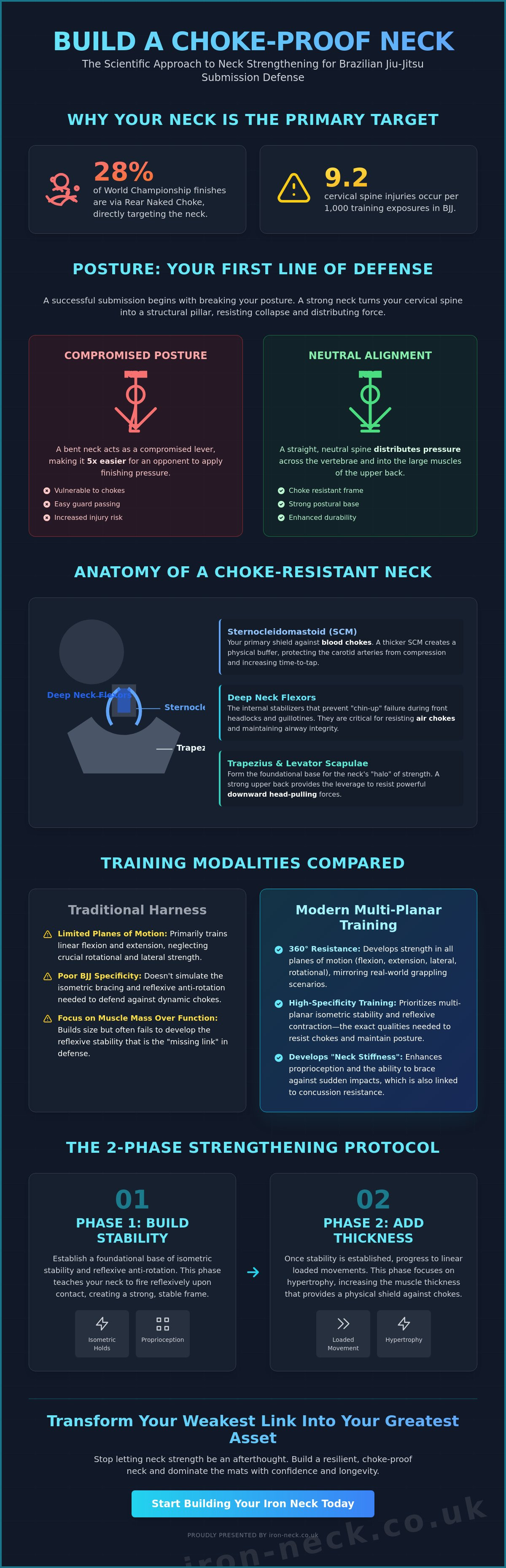
With the Rear Naked Choke accounting for a 28% finish rate at the World Championships, your neck is more than just a part of your anatomy; it's a primary target. If you aren't prioritizing neck strengthening for Brazilian Jiu-Jitsu chokes, you're leaving your cervical spine vulnerable to the 9.2 injuries that occur every 1,000 training exposures. You've likely felt that deep, lingering soreness after a hard night of rolling or felt your posture collapse the moment a training partner secured a front headlock. It's frustrating to feel your defense fail because your neck lacks the isometric stability to maintain a strong frame.
We understand that you want to stay on the mats for decades, not just until your next cervical flare-up. This guide provides the scientific protocols and targeted drills needed to build a resilient, "thick" neck that resists compression and protects your longevity. We'll examine the multi-planar mechanics of choke resistance and show you how to integrate reflexive anti-rotation into your strength routine. You'll learn to transform your neck from the missing link in your game into a foundational pillar of your submission defense.
Key Takeaways
- Understand how neck strength functions as a structural pillar to prevent posture breaking, the primary mechanical failure that leads to successful submissions.
- Identify the critical roles of deep neck flexors and the trapezius in stabilizing the cervical spine against downward head-pulling and compression.
- Evaluate the limitations of traditional harnesses compared to modern neck strengthening for Brazilian Jiu-Jitsu chokes that prioritizes multi-planar isometric stability.
- Master a two-phase training protocol that builds a foundational base of stability before progressing to linear loaded movements for increased muscle thickness.
- Discover the science of neck stiffness and how it serves as the missing link for concussion resistance and long-term durability during high-intensity rolling.
The Bio-Mechanics of Choke Resistance in BJJ
In grappling, every successful submission begins with a loss of position. When an opponent secures a front headlock or a guillotine, they aren't just attacking your throat; they're attacking your posture. Posture breaking is the primary mechanical failure that allows a choke to finish. It occurs when the cervical spine deviates from its neutral alignment, allowing an opponent to apply downward force that collapses your entire kinetic chain. Effective neck strengthening for Brazilian Jiu-Jitsu chokes focuses on turning the cervical spine into a structural pillar that resists this mechanical collapse.
Understanding the target is essential for elite performance. The Bio-Mechanics of Choke Resistance involves differentiating between blood chokes, which target the carotid arteries, and air chokes, which compress the trachea. Blood chokes require lateral stability to prevent the collapse of the neck's sides, while air chokes demand massive anterior strength to keep the airway open. Proprioception serves as your early warning system. It's the sensory feedback that allows a grappler to feel the exact moment a grip tightens, triggering a reflexive muscular contraction before the submission is fully locked.
Why Your Posture is Your First Line of Defence
The physics of the mat are unforgiving. A bent neck acts as a compromised lever, making it five times easier for an opponent to apply finishing pressure compared to a straight, neutral spine. When you maintain alignment, the cervical spine distributes pressure across the vertebrae and into the larger muscle groups of the upper back. Cervical alignment is the foundation of BJJ posture. Without it, your guard is easily passed and your neck is constantly exposed to high-velocity transitions.
Anatomy of a Choke-Resistant Neck
Building a resilient neck requires targeting specific muscle groups that traditional weightlifting often ignores. The Sternocleidomastoid (SCM) is your primary defender against lateral compression, acting as a shield for the carotid arteries. Meanwhile, the deep neck flexors are the internal stabilizers that prevent the "chin-up" failure during front headlock attacks. We often call the traps and neck the "Missing Link" because they must function as a single, cohesive unit. When your trapezius and levator scapulae provide a stable base, your neck gains a "halo" of strength that protects against both strangulation and sudden impact.
Key Muscle Groups for BJJ Neck Stability
Building a choke-resistant neck requires more than just high-volume shrugs. It demands a scientific approach to the specific muscles that safeguard your cervical spine and airway. In the high-pressure environment of 2026 grappling, elite athletes focus on neck strengthening for Brazilian Jiu-Jitsu chokes by targeting the stabilizer muscles that maintain structural integrity under load. When an opponent applies a heavy cross-face or attempts a guillotine, these stabilizers must engage instantly to prevent the cervical spine from buckling.
The deep neck flexors are your primary internal stabilizers. They prevent the "chin-up" failure, a common mechanical error where the head tilts back and exposes the throat to air chokes. Surrounding these are the trapezius and levator scapulae; they provide the foundational base for the neck's "halo" of strength. Without a strong upper back, the neck lacks the leverage to resist downward head-pulling. Additionally, the scalenes and sternocleidomastoid (SCM) act as the side walls of your defense. They protect the carotid arteries through active muscular tension, buying you time to work an escape. Bracing is the "Missing Link" here. Your neck must fire reflexively upon contact. Many physical therapy exercises for neck strength emphasize this reflexive recruitment to build a neck that is both strong and responsive.
The SCM and Blood Choke Defence
Blood chokes win by compressing the carotid arteries. Increasing the thickness of the SCM and surrounding musculature creates a physical buffer against this arterial compression. Data from professional grappling circuits indicates that increased neck girth correlates with a longer time-to-tap. This extra mass doesn't just look impressive; it provides a mechanical shield. Exercises that specifically target the lateral columns of the neck are essential for creating this protective layer. By developing these muscles, you reduce the immediate impact of a squeeze, allowing for more composed defensive transitions.
The Posterior Chain Connection
The neck doesn't work in isolation. A weak upper back leads to a vulnerable neck in the clinch, making you an easy target for snap downs. The splenius capitis plays a critical role here; it's the muscle responsible for resisting the forward flexion of the head. To build holistic grappling strength, you must integrate neck training with your deadlifts and rows. This creates a unified posterior chain that resists manipulation. For grapplers who want to bridge the gap between static strength and dynamic rolling, using a professional neck training device helps develop the functional power required for elite competition.
Comparing Training Modalities: Harness vs. Iron Neck
Selecting the correct tool for neck strengthening for Brazilian Jiu-Jitsu chokes determines whether you're building superficial muscle or functional armor. Many grapplers rely on outdated methods that treat the cervical spine as a simple hinge. In a sport defined by multi-directional chaos, your training must reflect the complexity of the mats. While traditional tools have their place, they often leave critical gaps in a grappler's defensive structure. Elite performance requires moving beyond basic linear movements to embrace dynamic stability.
- Traditional Neck Harness: These are effective for developing linear strength in flexion and extension. They're excellent for building the "thick" look, but they lack rotational utility. A harness won't prepare you for the twisting force of a Japanese necktie.
- Isometric Drills: These offer a low equipment cost and are useful for early-stage rehabilitation. However, it's difficult to quantify progress or apply resistance from varied angles. Without measurable data, you can't ensure you're actually getting stronger.
- The Iron Neck: This is the only system providing 360-degree resistance combined with anti-rotation. It forces your stabilizer muscles to fire constantly as you move through a full range of motion.
BJJ requires dynamic stability rather than just static strength. In a live roll, your head isn't just pushed back; it's pulled, twisted, and compressed simultaneously. Static isometrics don't prepare the neuromuscular system for these sudden, high-velocity changes in direction.
The Limitation of Linear Training
Performing only neck curls and extensions is a common mistake. These movements won't help you escape a Guillotine because they don't address the diagonal leverage an opponent uses to finish. Over-training extension while neglecting rotation leaves the "corners" of your neck vulnerable. This imbalance creates a false sense of security. If your training doesn't include lateral and rotational loads, your posture will still collapse the moment an opponent applies pressure off-center.
Why Rotational Resistance is the 'Secret Sauce'
Escaping submissions like the D'Arce or the Anaconda choke often requires clearing your arm and shoulder through a rotational shrug. This is where anti-rotation becomes your greatest asset. By training your neck to resist being turned against its will, you develop the "neck-awareness" needed to find pockets of air in tight spots. This specialized strength allows you to maintain a neutral spine even when an opponent is trying to spiral your head toward the mat. To upgrade your team's defensive capabilities, you can compare Iron Neck models for your BJJ academy to find the right fit for your training environment.
The BJJ Neck Strengthening Programme: A Step-by-Step Guide
A systematic approach is what separates a casual hobbyist from an elite grappler. To achieve effective neck strengthening for Brazilian Jiu-Jitsu chokes, you must progress through specific physiological stages. We don't jump into heavy loads. We build the foundation first. This methodical progression ensures that your cervical spine remains protected while you develop the explosive power needed to shrug off deep submission attempts. In the 2026 training landscape, the focus has shifted from simple "neck bridges" to sophisticated, multi-phase protocols.
- Phase 1: Foundational Isometrics. You're building the base without rolling the spine. This phase teaches the stabilizer muscles to fire as a unified unit to resist static pressure.
- Phase 2: Linear Loaded Movement. Here, we increase the "thickening" effect of the muscles. Controlled flexion and extension under load build the physical mass that buffers the carotid arteries.
- Phase 3: 360-Degree Rotational Training. This phase prepares you for the chaos of the mats. It challenges the neck's ability to resist twisting forces, which is the primary mechanism of the D'Arce and Anaconda chokes.
- Phase 4: Grappling-Specific Drills. We simulate posture breaks. You learn to maintain a neutral spine while an external force attempts to snap your head down or pull it out of alignment.
The 'Figure 8' and 'Look Left, Look Right' Drills
Using the Iron Neck allows you to build reflexive stability across all 360 degrees. The "Look Left, Look Right" drill is foundational for grapplers. It teaches the cervical spine to maintain alignment while the head rotates under constant tension. Setting the correct resistance is vital. Heavy isn't always better. For the neck, high-quality movement beats high-weight ego every time. The Figure 8 drill enhances cervical proprioception by forcing the stabilizer muscles to maintain control through a continuous, multi-planar loop of resistance.
Anti-Rotation and Posture Maintenance
The "Locked-In" drill is your secret weapon against the Guillotine. You maintain a neutral spine while resisting an external lateral force trying to pull your head out of alignment. This anti-rotation strength is the missing link in submission defense. For frequency, aim for two to three sessions per week. This volume provides enough stimulus for hypertrophy without stealing energy from your mat time. Recovery is equally important. Use the Iron Neck at low tension for mobility work after a heavy session to reduce soreness and improve blood flow. To start building your own choke-resistant structure, explore the full range of Iron Neck training systems.
The Iron Neck Advantage for Grapplers and MMA
Developing a high level of neck strengthening for Brazilian Jiu-Jitsu chokes does more than just prevent submissions. It provides a comprehensive layer of protection that extends to the very center of your performance: the brain. In combat sports, the risk of concussion often stems from rapid head acceleration upon impact. By increasing neck stiffness, you significantly reduce the G-force transmitted to the skull during a hard takedown or an unexpected sweep. This isn't just about resisting a squeeze; it's about safeguarding your cognitive health and athletic longevity for the long term.
Beyond the physical shielding, there's a profound psychological edge that comes with a bulletproof neck. When you know your cervical spine is resilient, you roll with a different level of confidence. You aren't afraid to engage in the clinch or fight out of a front headlock because you trust your posture to hold. This mental resilience allows you to focus on your offensive game rather than constantly worrying about protecting a vulnerable neck. Durability on the mats is the ultimate currency for the modern grappler, especially during long competition seasons where injury downtime can derail a year of progress.
Reducing the Risk of Concussion and Whiplash
A stronger neck slows down head acceleration during impact. When your stabilizer muscles are conditioned to fire reflexively, they act as a braking system for the skull. Research in contact sports indicates that for every one pound of neck strength gained, the risk of concussion decreases by 5%. As one expert quote states, "A strong neck is your brain's best shock absorber." This relationship between neck strength and longevity is why elite MMA camps have moved away from traditional training toward specialized rotational resistance. It's a scientific approach to a high-risk environment.
Integrating Iron Neck into Your Academy
Forward-thinking BJJ schools are now using the Iron Neck to reduce student injury rates and improve retention. By implementing a standardized protocol, coaches ensure their athletes have the structural integrity to survive high-intensity rolling without the frequent neck soreness that plagues many hobbyists. For beginners, the Alpha Head Harness serves as a budget-friendly entry point. It allows new students to begin building foundational tension before they progress to more advanced rotational devices. You can invest in your longevity—Shop the Iron Neck UK collection to bring this level of professional preparation to your own training environment.
Neck training remains "The Missing Link" in modern BJJ conditioning. While most grapplers focus exclusively on their gas tank or their grip strength, the cervical spine is often the first point of failure in a match. Integrating neck strengthening for Brazilian Jiu-Jitsu chokes into your weekly routine provides the foundational stability needed to survive the chaos of the mats. Master the science of neck stability to ensure your time in the sport is measured in decades, not months.
Future-Proof Your Performance on the Mats
Mastering the mechanics of the cervical spine is no longer optional for the serious grappler. By prioritizing neck strengthening for Brazilian Jiu-Jitsu chokes, you transform a common vulnerability into a foundational pillar of your game. You've learned that true resistance requires more than linear strength; it demands the multi-planar stability and reflexive anti-rotation that only professional-grade protocols can provide. This scientific approach ensures your posture remains unbroken even under the most aggressive head-pulling and compression attacks.
Iron Neck is recognized as the #1 piece of neck training equipment worldwide, trusted by elite UFC and BJJ athletes to maintain peak condition. Our science-backed protocols are specifically designed for injury prevention, helping you reduce the risk of concussion and long-term cervical damage. It's time to stop neglecting the most critical link in your kinetic chain and start training with the same intensity as your technical drills.
Build a choke-resistant neck with the Iron Neck UK & Europe collection and secure your longevity in the sport. Your future self will thank you for the resilience you build today. Stay strong, stay protected, and keep rolling with absolute confidence.
Frequently Asked Questions
Can neck strengthening actually help me escape a fully locked-in choke?
Neck strength buys you critical seconds to execute a technical escape by resisting immediate arterial or airway collapse. It creates a muscular buffer that prevents the instant "lights out" effect of a blood choke. While no amount of muscle can stop a perfectly applied submission indefinitely, a resilient neck allows you to maintain composure and find the necessary space to work your hands inside the grip.
Is it dangerous to train my neck if I already have a bulging disc?
You must consult a medical professional before starting any program with a pre-existing cervical injury. However, controlled isometric training is a standard clinical protocol for stabilizing the cervical spine and supporting the vertebrae. The key is to avoid high-risk movements like traditional neck bridges and instead focus on low-impact, multi-planar stability to protect the damaged area from further strain during rolling.
How many times per week should a BJJ practitioner train their neck?
Aim for two to three dedicated sessions per week to see optimal results without overtraining. This frequency allows for muscle protein synthesis and recovery between heavy sparring sessions. Each session only requires 10 to 15 minutes of focused work to build a solid foundation for neck strengthening for Brazilian Jiu-Jitsu chokes without interfering with your mat time.
Will a thicker neck make it harder for opponents to find my neck for a choke?
Increased neck girth makes it mechanically more difficult for an opponent to slide their forearm under your chin and clear the jawline. A thicker neck fills the "void" space attackers look for in submissions like the Rear Naked Choke or the Guillotine. This physical mass acts as a first layer of defense by forcing the opponent to work significantly harder just to secure a deep grip.
What is the difference between an Iron Neck and a traditional head harness?
The primary difference is the Iron Neck's ability to provide 360-degree rotational resistance and anti-rotation. Traditional harnesses only allow for linear movement like flexion and extension. Because grappling involves chaotic, multi-directional forces, training only in a straight line leaves your stabilizer muscles unprepared for the twisting leverage used in modern submission grappling.
How long does it take to see results in neck strength and thickness?
You'll typically notice improved stability and reduced post-rolling soreness within the first 14 to 21 days of consistent training. Significant muscular hypertrophy and increased neck thickness generally take 8 to 12 weeks of progressive loading. Consistency in your neck strengthening for Brazilian Jiu-Jitsu chokes protocol is the most important factor in achieving these long-term structural changes.
Can neck training help reduce the 'stiff neck' feeling after BJJ training?
Strengthening your neck reduces post-training stiffness by increasing the fatigue threshold of your stabilizer muscles. Most "stiff neck" issues in BJJ occur because muscles are overstretched or strained when they lack the strength to maintain posture. A stronger neck handles the stress of a heavy cross-face or snap down without reaching the point of clinical strain or inflammation.
Is the Iron Neck suitable for white belts or just advanced grapplers?
The Iron Neck is highly suitable for white belts because they are statistically the most likely to suffer from neck strain during their first year of training. Building foundational strength early reduces the injury rate of 9.2 per 1,000 exposures common in the sport. It's an essential tool for any grappler, regardless of rank, who is focused on long-term safety and athletic performance.