

Long-Term Relief for Stiff Neck: Why Strengthening Trumps Stretching
Your daily stretching routine might be the very thing keeping your neck locked in a cycle of tension. While most people reach for a yoga strap or a foam roller to find comfort, clinical evidence indicates that chronic stiffness is rarely a flexibility problem; it's a stability problem. When the muscles supporting your cervical spine are too weak to handle the load of "tech neck" or athletic impact, your body compensates by tightening up to protect itself. If you want genuine, long term relief for stiff neck issues, you must stop trying to bypass your body's natural defense mechanisms and start addressing the underlying weakness.
It's exhausting to rely on temporary fixes that fail to deliver results beyond a few hours. You shouldn't have to live in fear that persistent tightness will lead to permanent disc issues or a reduced range of motion that sidelines you from your training. This article reveals why chronic stiffness is actually a survival mechanism for a weak neck and provides a science-backed protocol for structural relief. We'll explore the missing link between stabilizer strength and postural correction, giving you a clear roadmap to rebuild the foundational integrity of your cervical spine for good.
Key Takeaways
- Understand why your brain uses "protective tension" to lock the neck and how this functional limitation signals a need for stability rather than just a stretch.
- Discover why the "stretching trap" can actually increase muscle guarding and how to achieve long term relief for stiff neck through targeted isometric loading.
- Learn the science-backed 4-step protocol to restore thoracic mobility and activate the deep neck flexors, the foundational stabilisers of the cervical spine.
- Identify the "missing link" in your recovery by distinguishing between mover and stabiliser muscles to finally eliminate chronic tension and structural weakness.
- Explore how the Iron Neck’s 360-degree resistance technology addresses the "stability gap" to engineer a high-performance, resilient, and pain-free spine.
Understanding Chronic Stiffness: Why Your Neck Feels "Locked"
Chronic neck stiffness isn't just a temporary annoyance from sleeping poorly. It's a functional limitation that signals a breakdown in your body's mechanical integrity. When you're searching for long term relief for stiff neck, you must look past the surface-level ache. Most people treat stiffness like a tight rubber band that needs stretching. In reality, your neck feels "locked" because your brain has decided your cervical spine is unstable. This isn't a muscle problem; it's a neurological one.
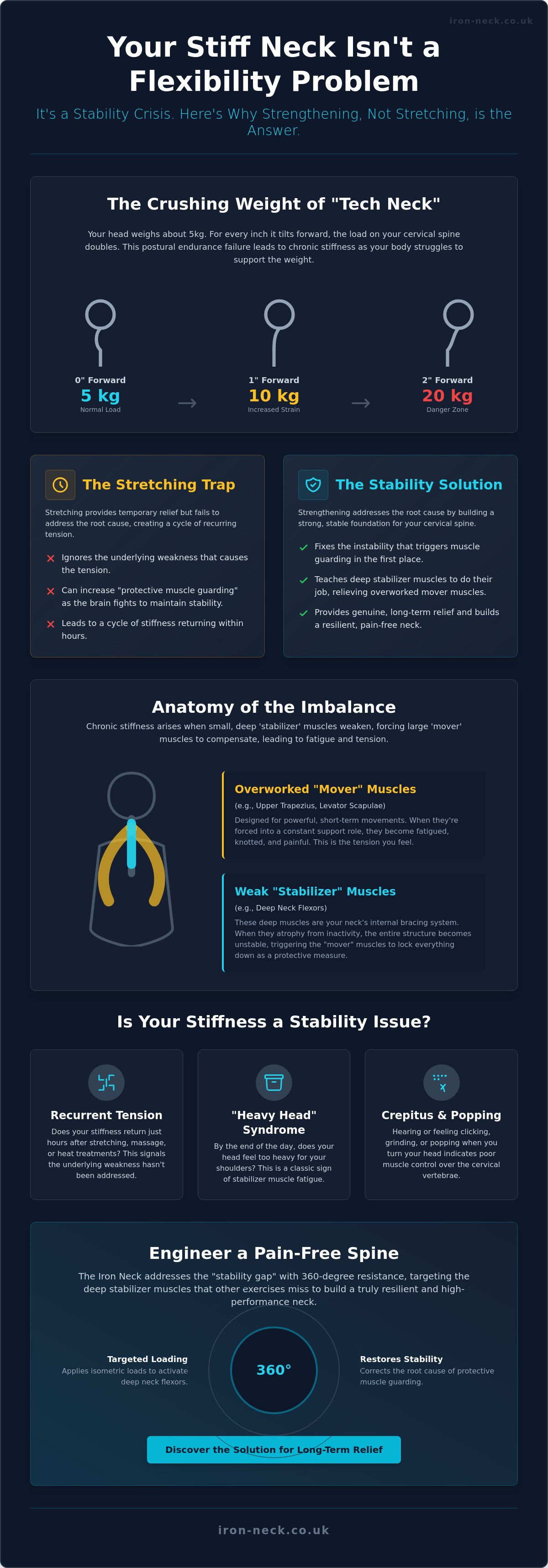
Modern "tech neck" is a postural endurance failure. Your head weighs approximately 5kg, and for every inch it tilts forward, the effective weight on your spine doubles. By the end of an eight-hour shift, your muscles aren't just tired. They've reached a point of exhaustion where they can no longer support the skeletal structure. This leads to cumulative micro-trauma. Unlike an acute injury like whiplash, which occurs in milliseconds, this damage happens over years of sedentary habits, slowly eroding your ability to move without pain.
The Science of Protective Muscle Guarding
Your nervous system is your body's chief of security. If it senses weakness in the deep neck flexors, it uses the larger, superficial muscles as a "splint" to protect the spine. This is known as protective muscle guarding. It's a biological response to a perceived medical condition or structural vulnerability. Massaging the area might provide relief for two or three hours, but the tension always returns. Why? Because you haven't fixed the instability that triggered the guarding in the first place. Without the deep neck flexors maintaining structural integrity, your upper trapezius and levator scapulae are forced to do a job they weren't designed for.
Signs Your Stiffness is a Stability Issue
Identifying whether your pain is a flexibility issue or a stability deficit is the first step toward long term relief for stiff neck. You aren't dealing with simple "tightness" if you experience the following:
- Recurrent Tension: You stretch or use heat treatments daily, but the "knots" return within the same afternoon.
- The "Heavy Head" Syndrome: By 4:00 PM, your head feels like it's too heavy for your shoulders to support.
- Crepitus: You hear clicking, popping, or grinding sounds when turning your head, often followed by a wave of tightness.
These symptoms indicate that your muscles are failing to control the movement of your cervical vertebrae. When the muscles lack the strength to stabilize the joints, the brain creates stiffness as a last-ditch effort to prevent injury. To unlock the neck, you don't need more flexibility; you need more power.
The Anatomy of Long-Term Relief for Stiff Neck
Achieving long term relief for stiff neck requires more than a temporary stretch; it demands an understanding of how your cervical spine functions under load. The neck isn't a single unit. It's a complex system of seven vertebrae supported by over 20 muscles that must coordinate perfectly. When we look at common causes of neck pain, we often find a breakdown in the relationship between "stabiliser" muscles and "mover" muscles. If this balance isn't restored, the cycle of stiffness will continue regardless of how often you massage the area.
The Deep Neck Flexors: Your Internal Bracing System
The Longus Colli and Longus Capitis act as your neck's internal scaffolding. These deep neck flexors sit close to the spine, providing the essential stability needed to maintain an upright posture. When you spend hours at a desk, these muscles often "turn off" or atrophy because they aren't being challenged. This leads to a loss of structural integrity and a degradation of your body's internal map. Proprioception is the sensory input that allows the brain to trust neck movement. When this map becomes blurred through inactivity, the brain limits your range of motion to prevent what it perceives as potential injury.
The Role of the Trapezius and Levator Scapulae
When the deep stabilisers fail, your global "movers" like the upper trapezius and levator scapulae are forced to take over. These muscles are designed for explosive movement and power, not constant postural support. This forced compensation creates a relentless cycle of overwork, fatigue, and trigger point formation. It's why your shoulders feel like concrete after a long day. The suboccipital muscles at the base of the skull also tighten in response, often leading to debilitating tension headaches. Data suggests that nearly 70% of chronic neck pain cases involve this specific muscle imbalance.
Strengthening these "overworked" muscles is often safer and more effective than just stretching them. While stretching provides a fleeting sense of release, it doesn't address the underlying weakness that caused the tension. You must also consider the thoracic spine. A stiff upper back forces the cervical spine to over-rotate to compensate for the lack of mid-back mobility. By implementing a structured neck strengthening programme, you provide the foundational support your body needs to stop the "guarding" response. This shift from passive stretching to active loading is the missing link for anyone seeking a permanent solution to chronic stiffness.
Stretching vs. Strengthening: Why You Can’t Stretch Away Weakness
Many people fall into the "Stretching Trap." When you feel a knot in your upper trapezius or levator scapulae, your first instinct is to pull your head to the side. While this provides temporary sensory relief, it often makes the problem worse. Your brain creates stiffness as a protective mechanism. If the cervical spine lacks stability, the nervous system "guards" the area by tightening the surrounding muscles. Over-stretching an unstable joint simply triggers more guarding; it's a cycle of diminishing returns that fails to provide long term relief for stiff neck issues.
Static stretching focuses on tissue length, but it doesn't address the neurological demand for stability. Isometric loading, on the other hand, forces the muscles to produce force without changing length. This builds "neurological trust." When you apply resistance, you're telling your brain that the joint is safe and supported. Clinical data indicates that isometric training can reduce pain sensitivity significantly after a single session. This is why 360-degree resistance training is the missing link in traditional rehab protocols.
There's a common misconception that strong muscles are inherently tight. The opposite is usually true. A weak muscle must work at its maximum capacity just to maintain your posture during the day. This constant state of high-level exertion leads to the sensation of "tightness." Strengthening these muscles increases their capacity, allowing them to handle daily loads without reaching a state of fatigue-induced tension.
When Stretching Actually Helps
Stretching is effective only when there's "true" muscle shortening, which is less common than neural tension. You can use active mobility to check your range of motion. If you stretch and the relief lasts less than 120 seconds, your muscles aren't short; they're unstable. Use the 2-minute rule to stop wasting time on ineffective protocols. If the stiffness returns before you've even finished your coffee, stretching isn't your solution.
The Power of Isometric Stability
Isometrics are the safest entry point for chronic pain because they eliminate the shearing forces associated with movement. These static holds "reboot" the nervous system, allowing it to relax the guarding response. Once stability is established through 360-degree holds, you can transition to dynamic rotational strength. This progression is vital for achieving long term relief for stiff neck pain, as it prepares the cervical spine for the unpredictable forces of daily life and high-performance athletics.
A 4-Step Protocol for Permanent Neck Resilience
Achieving long term relief for stiff neck issues requires a shift from passive therapy to active loading. This protocol targets the underlying structural weaknesses that allow stiffness to return. By following a methodical progression, you transform the neck from a point of vulnerability into a pillar of strength. It's about moving beyond the "stretch and hope" method and adopting a scientific approach to cervical health.
- Step 1: Restore Thoracic Mobility. A stiff mid-back forces the cervical spine to overcompensate. Improving extension in the T-spine takes immediate pressure off the neck, allowing it to move through its natural range without restriction.
- Step 2: Activate Deep Neck Flexors. Use chin tuck variations to wake up the internal stabilisers. These muscles act like the "core" of your neck, keeping the spine aligned under load and preventing the superficial muscles from overworking.
- Step 3: Multi-Directional Isometrics. Build foundational stability by resisting force from all angles without moving the head. This prepares the tendons and ligaments for more complex, dynamic movements.
- Step 4: Progress to Rotational Resistance. This is the final stage. Training the neck to move against resistance in rotation mimics real-world demands, providing the ultimate shield against sudden movements or impacts.
Phase 1: Regaining Neutral Alignment
Poor posture isn't just an aesthetic issue; it's a mechanical failure. Forward Head Posture (FHP) creates a massive cantilever effect on the cervical spine. You can recalibrate your brain’s sense of vertical using the Wall Drill. Stand with your heels, glutes, and shoulders against a flat surface, then gently tuck your chin to touch the back of your head to the wall. Neutral alignment reduces the effective weight of the head by up to 30lbs, which immediately lowers the baseline stress on your upper trapezius and levator scapulae.
Phase 2: Building 360-Degree Strength
True resilience isn't linear. The neck must be trained in rotation because that's where most functional movements and athletic impacts occur. A standard 15-minute home gymnasium set should include these movements to ensure no muscle group is neglected. Applying a linear progression protocol, where you incrementally increase resistance every 2nd or 3rd session, allows for safe tissue adaptation. This methodical approach ensures the 20+ muscles surrounding the spine develop the capacity for long term relief for stiff neck pain. You'll move from basic stability to multi-planar strength that protects the central nervous system.
Stop managing pain and start building power. Explore the Iron Neck training systems to standardise your recovery protocol.
The Iron Neck Advantage: Engineering a Pain-Free Spine
Traditional rehabilitation often fails because it misses the "stability gap." This is the disconnect between passive flexibility and active functional control. While stretching might temporarily soothe a tight muscle, it doesn't prepare the cervical spine for the unpredictable forces of daily life or high-impact sports. The Iron Neck serves as the missing link in modern physical therapy. It transforms the neck from a point of vulnerability into a pillar of structural integrity. This proactive approach is the only way to achieve long term relief for stiff neck symptoms that persist despite regular massage or yoga. It's about moving beyond temporary fixes and engineering a spine that can withstand the demands of your lifestyle.
Why 360-Degree Resistance Changes Everything
Standard neck harnesses are limited to linear movements like extensions and curls. These antiquated methods often leave "dead zones" where the stabilizer muscles aren't fully engaged. The Iron Neck utilizes a patented 360-degree slider to provide constant, concentric resistance during rotation. This allows you to strengthen the neck through its entire natural range of motion. UK-based sports physiotherapists and elite athletes, including professional rugby players, use this technology to mitigate injury risks and correct postural imbalances. By adding rotational resistance, you force the deep stabilizers to fire. This creates a protective "internal brace" for your cervical spine, ensuring every degree of movement is supported by functional strength.
Getting Started with Iron Neck UK
Selecting the right tool depends on your specific path to recovery or performance. The Iron Neck Pro is the gold standard for clinical rehabilitation and elite training, featuring an adjustable friction dial for fine-tuned resistance control. For those focusing on postural correction and general fitness, the Iron Neck 3.0 offers a streamlined, highly effective experience. Both systems utilize interchangeable resistance bands to scale your progress. This ensures you can start at a safe level and increase the load as your capacity grows. It's a professional-grade investment in your physical longevity. Whether you're a desk worker battling the effects of "tech neck" or a combat athlete seeking a competitive edge, building foundational strength is the only way to secure long term relief for stiff neck pain.
Don't settle for temporary relief when you can build a stronger foundation. Unlock your full potential and eliminate stiffness with the Iron Neck to experience the difference that professional-grade engineering makes for your health and performance.
Build a Resilient Spine for Life
Stretching might offer a moment of ease, but it won't fix the underlying weakness that keeps your cervical spine locked in a cycle of pain. Achieving long term relief for stiff neck requires a fundamental shift from passive mobility to active stability. By implementing a methodical strengthening protocol, you address the root cause of chronic tension rather than just masking the symptoms. True resilience is built through resistance, not just flexibility.
The Iron Neck represents the missing link in modern rehabilitation. It's the only 360-degree rotational neck trainer on the market, providing the precise resistance needed to engineer a pain-free spine. This science-backed design is currently trusted by over 500 UK clinics and relied upon by elite athletes in the Premiership and UFC to maintain peak physical condition. You don't have to settle for a "locked" neck or limited range of motion. It's time to invest in the foundational strength that protects your performance and your daily health.
Explore the Iron Neck range for long-term pain relief
Take the first step toward a stronger, more mobile future today.
Frequently Asked Questions
Is it safe to strengthen my neck if it currently feels stiff and painful?
Yes, isometric strengthening is often safer and more effective than aggressive stretching when your neck is painful. Static holds stabilise the cervical spine without aggravating sensitive joints or inflamed tissues. A 2020 study published in the Journal of Orthopaedic & Sports Physical Therapy showed that isometric training reduced acute pain scores by 33% within the first session. Start with low intensity to re-educate the stabilizer muscles. It's the missing link to shifting from temporary relief to a functional recovery.
How long does it take to see long term relief for a stiff neck using resistance training?
You'll typically experience initial improvements in mobility within 2 to 3 weeks, but achieving long term relief for a stiff neck requires a consistent 8 to 12 week programme. Clinical research indicates that structural changes in muscle density and neuromuscular control take approximately 60 days of progressive overload to solidify. This timeframe ensures the deep cervical flexors are strong enough to support the head's weight during 8 hour workdays. Consistency is the foundation of lasting physiological change.
Can neck strengthening help with chronic tension headaches?
Yes, strengthening the neck is a proven method for reducing the frequency and intensity of tension-type headaches. According to a 2016 clinical trial, patients who performed specific neck resistance exercises reported a 50% decrease in headache frequency over 10 weeks. By correcting postural imbalances like "tech neck," you reduce the strain on the suboccipital muscles. This stops the referral pain patterns that often cause debilitating head pressure and discomfort throughout the day.
Do I need a doctor’s diagnosis before starting a neck training programme?
It's advisable to consult a healthcare professional if you've experienced recent trauma or have neurological symptoms like numbness in your hands. For general stiffness, most users can safely begin foundational movements. The NHS recommends seeking a GP's advice if pain persists for more than 4 weeks without improvement. Establishing a clinical baseline ensures your training protocol addresses your specific anatomical needs. This methodical approach builds a strong foundation of trust in your recovery process.
What is the difference between a neck harness and the Iron Neck for rehab?
A traditional neck harness only allows for linear, up-and-down movement, whereas the Iron Neck provides 360 degree resistance and 4-in-1 rehabilitation. This distinction is critical because the cervical spine is designed for rotation and lateral flexion. The Iron Neck's patented slider system enables dynamic movements that a static harness cannot replicate. It targets the small stabilizer muscles that are often the missing link in standard rehabilitation protocols used by elite athletes.
Can I use the Iron Neck at home without a professional trainer?
Yes, the system is designed for independent use with guided digital protocols that mirror a professional sports science environment. Over 500 professional teams and 1,000 clinics globally use this technology, and the home versions include the same safety features. You can follow structured video tutorials to ensure your form is perfect. This allows you to maintain a consistent routine without the £60 to £100 per hour cost of a private therapist or trainer.
How often should I perform neck stability exercises for the best results?
For optimal results, perform stability exercises 3 to 4 times per week to allow for 48 hours of muscle recovery between sessions. This frequency is the foundation for achieving long term relief for a stiff neck and improving proprioception. Each session should last roughly 10 to 15 minutes. Over-training can lead to fatigue-induced poor posture, so quality of movement always outweighs the quantity of repetitions performed. Follow a methodical schedule for peak performance.
Will strengthening my neck make it look bulky or "thick"?
Strengthening your neck will improve muscle tone and posture rather than creating excessive bulk unless you're following a specific bodybuilding protocol. Most users see a more defined jawline and a more upright, athletic stance. Research shows that hypertrophy requires high-volume, high-intensity training that far exceeds standard rehabilitation or stability work. You'll likely find your neck looks leaner as your posture improves and forward head carriage disappears. It's about performance and protection, not just size.