

How to Recover From a Neck Sprain Faster: The Science-Backed Guide to Active Rehab
Passive rest is the enemy of a high-performance recovery. While the instinct is to protect your injury through total immobilisation, modern sports science proves that "waiting it out" often sabotages your return to peak performance. Learning how to recover from a neck sprain faster requires a fundamental shift from passive protection to active, multi-directional loading. With over 206 million cases of neck pain reported globally in 2021, the data suggests that a proactive approach is no longer optional for those who value their physical longevity.
It's frustrating to deal with persistent stiffness that limits your daily movement or the lingering anxiety that a single wrong turn will reset your progress. You need a clear path back to the field that replaces confusion with clinical certainty. This guide provides the master protocols and active recovery strategies required to slash your recovery time while building a more resilient cervical spine. We'll explore the transition from initial mobility work to the advanced strengthening frameworks that restore full range of motion and prevent the injury from ever recurring.
Key Takeaways
- Shift from passive rest to active loading to catalyze tissue repair and prevent the formation of disorganized, restrictive scar tissue.
- Follow a structured three-phase protocol that transitions safely from acute pain management to full physiological restoration.
- Discover how to recover from a neck sprain faster by integrating multi-directional resistance and retraining the vital eye-neck vestibular connection.
- Identify the hidden costs of prolonged immobilization and why cervical collars often delay your return to peak performance.
- Bulletproof your cervical spine against future injury by moving beyond simple recovery toward 360-degree stability and elite neck resilience.
Understanding Neck Sprains and the Science of Accelerated Recovery
Recovery begins with a precise understanding of the injury. A cervical sprain occurs when the ligaments, the fibrous tissues connecting your vertebrae, are overstretched or torn. This differs fundamentally from a strain, which involves damage to muscles or tendons. For a foundational perspective on the symptoms and diagnosis associated with these injuries, Understanding Neck Sprains is essential to differentiate between simple discomfort and structural damage. The traditional "wait and see" approach is a relic of outdated sports medicine. It often results in chronic stiffness and neural inhibition because it ignores mechanotransduction, the physiological process where mechanical loading triggers cellular responses to repair tissue. If you want to know how to recover from a neck sprain faster, you must understand that movement is the primary signal your body needs to initiate high-quality repair.
The Physiology of Soft Tissue Repair
The healing cascade follows a strict biological timeline that you can optimize through specific protocols.
- Phase 1: The Inflammatory Response (Days 1-3): This is your body's survival mechanism. Inflammation delivers white blood cells to clear damaged debris. While uncomfortable, this phase is a necessary precursor to rebuilding tissue.
- Phase 2: Proliferation and Collagen Synthesis (Days 4-21): Your body begins laying down new collagen fibers. This tissue is initially disorganized and weak. Controlled movement during this window ensures fibers align along the lines of stress rather than forming a chaotic knot.
- Phase 3: Tissue Remodelling and Strengthening (Week 3+): The focus shifts to maturation. The new tissue becomes denser and more resilient. This is the stage where high-level performance and structural integrity are restored.
Why 'Faster' Recovery Requires Active Participation
Speeding up the clock isn't about rushing; it's about optimizing the environment for healing. Fear-avoidance, the psychological tendency to avoid movement due to pain, is a leading cause of delayed recovery. It creates a cycle of muscle guarding and restricted blood flow that starves the injury site. Early, pain-free movement acts as a biological pump. It delivers oxygen and nutrients to the damaged ligaments while flushing out metabolic waste. Active Recovery is the purposeful use of low-intensity movement to stimulate healing. By engaging in controlled protocols, you prevent the formation of rigid scar tissue and maintain the neural pathways required for complex movement. This proactive engagement is the definitive strategy for how to recover from a neck sprain faster and returning to training with a more resilient cervical spine.
The Three Phases of Neck Sprain Rehabilitation
Successful rehabilitation isn't a linear timeline; it's a series of physiological gates. To understand how to recover from a neck sprain faster, you must respect biological healing windows while aggressively pursuing the next level of function. We utilize a "Pain Traffic Light" system to guide this progression. Green indicates movement is safe and pain-free. Yellow suggests proceeding with caution; some discomfort is acceptable if it does not increase during or after the session. Red is a definitive stop signal, indicating the need to regress the load. This methodical approach ensures you are constantly challenging the tissue without triggering secondary inflammation.
Phase 1: Calming the System (Days 1-5)
The primary objective in the acute phase is protection without total immobilization. Optimizing sleep posture is a critical first step. You must use a pillow that maintains neutral cervical alignment to prevent nocturnal muscle guarding and overnight stress. While traditional advice often suggests total rest, we advocate for "relative rest." This involves avoiding provocative activities while maintaining gentle, non-aggressive mobility drills within your green light zone. Referencing the science of accelerated recovery confirms that early, controlled movement is vastly superior to the prolonged use of cervical collars, which can lead to muscle atrophy and joint stiffness.
Phase 2: Regaining Your Range (Days 5-14)
Once the initial inflammatory surge subsides, the focus shifts to restoring controlled range of motion. We implement Controlled Articular Rotations (CARs) for the cervical spine. These are not simple stretches; they are active, mindful rotations designed to retrain the nervous system and map the boundaries of your joint space. During this phase, it's vital to address the thoracic spine. A stiff mid-back often forces the neck to overcompensate, creating a bottleneck for recovery. Correcting these compensatory movement patterns ensures the cervical spine isn't bearing an unfair share of the load during daily tasks or training.
Phase 3: Building Resilience (Day 14+)
The final phase is where true injury-proofing occurs. We introduce isometric holds to restore muscle firing and neural confidence. These static contractions allow you to apply force without the risks associated with high-velocity movement. As you progress, you must transition from unloaded movements to purposeful loading. This is the only way to prepare the neck for the unpredictable demands of contact sports or high-intensity training. Utilizing specialized rehab and recovery equipment during this phase allows for the 360-degree resistance required to restore total cervical stability. This transition from "repaired" to "resilient" is the definitive answer for how to recover from a neck sprain faster and stay back in the game.
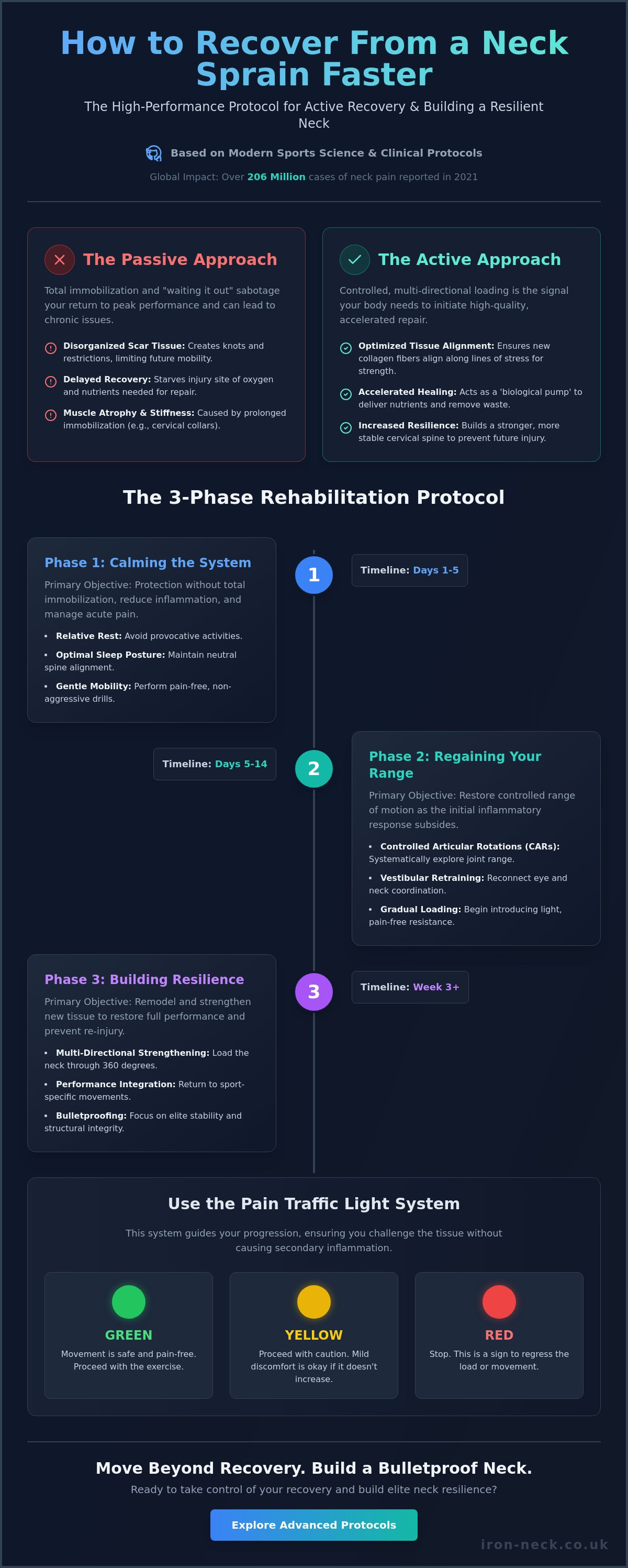
Passive vs. Active Recovery: Why 'Wait and See' Is Slowing You Down
Passive recovery is often a misnomer for physiological stagnation. While traditional protocols frequently rely on heavy painkillers and complete immobilization, these methods prioritize short-term comfort over long-term structural integrity. If you want to know how to recover from a neck sprain faster, you must recognize that your body requires mechanical signals to heal efficiently. Prolonged use of neck collars is rarely the answer. These devices act as a physical crutch that leads to muscle inhibition, effectively telling your nervous system that your neck is incapable of supporting its own weight. This shuts down the deep stabilizers and delays the return of neural confidence.
Movement is the catalyst for organized tissue repair. When you engage in active loading, you influence the way collagen fibers are deposited during the proliferation phase. Without this controlled stress, your body produces disorganized scar tissue. This "biological glue" is rigid and restrictive, often becoming the primary source of chronic stiffness long after the initial injury has healed. Retraining the brain to trust the neck is equally critical. Pain often persists because the brain maintains a protective "buffer zone" of perceived threat. By introducing safe, controlled movement, you recalibrate this neuroplastic response and dismantle the fear-avoidance cycle that keeps athletes sidelined.
The Downside of Prolonged Rest
Total rest triggers a rapid decline in the strength of the deep cervical flexors. These muscles are the "core" of your neck; they provide the fine-tuned stability required for every movement you make. Muscle inhibition occurs almost immediately when movement is restricted, leading to a feedback loop of stiffness and weakness. You begin to feel "fragile," which creates a psychological barrier to recovery. This perceived fragility is often more debilitating than the physiological sprain itself, as it prevents the very movement required to flush out inflammation and restore blood flow to the damaged ligaments.
The Power of Isometrics
Isometrics are the definitive entry point for loaded rehabilitation because they provide the safest way to introduce tension. A static contraction allows you to activate the muscle without the shear force or unpredictable range associated with dynamic movement. Scientific research identifies an "analgesic effect" from isometric training; these holds can actually reduce pain sensitivity by triggering exercise-induced hypoalgesia. To begin, perform basic wall-based isometrics. Stand with your head against a wall and apply gentle pressure in four directions: forward, backward, and to each side. Hold each contraction for 10 seconds. This simple protocol initiates the strengthening process without risking further injury, providing a clear path for how to recover from a neck sprain faster through evidence-based loading.
Advanced Strategies for Restoring Mobility and Stability
True recovery extends beyond the absence of pain. Once you've restored basic movement, the focus must shift to the neurological "software" that governs cervical control. The cervical spine contains a higher density of muscle spindles than almost any other part of the body, acting as a sophisticated GPS for your head's position in space. Damage to these ligaments disrupts this feedback loop, leading to the "clumsy" or unstable feeling many experience post-injury. If you're serious about how to recover from a neck sprain faster, you must retrain these proprioceptive pathways to ensure your brain accurately perceives where your head is during high-velocity movements.
Proprioceptive Retraining
Elite athletes prioritize "neck-eye" coordination because the vestibular-ocular reflex (VOR) is the foundation of athletic performance. This reflex allows you to maintain a stable gaze while your head is moving. Post-sprain, this connection is often compromised. We utilize laser-guided targets to restore this spatial awareness. By attaching a small laser to the head and following specific patterns on a wall, you force the deep cervical stabilizers to execute micro-adjustments. Balance-based drills, such as standing on a single leg while performing slow cervical rotations, further challenge these stabilizers. These exercises bridge the gap between clinical rehab and the unpredictable demands of the field.
Addressing the Kinetic Chain
The neck doesn't function in isolation. It's the top of a kinetic chain that includes the thoracic spine and shoulder girdle. Upper Cross Syndrome, characterized by a forward head posture and weak mid-back muscles, creates a mechanical environment that invites re-injury. You must strengthen the trapezius and serratus anterior to provide a stable base for the cervical spine. Breathing mechanics also play a significant role; shallow chest breathing overworks the scalenes and sternocleidomastoid, keeping the neck in a state of constant tension. Integrating 5 Essential Stretches for Shoulder Blade Muscles helps release the tension that pulls the cervical spine out of alignment.
Tissue synthesis requires more than just movement; it requires the right biological building blocks. Accelerating ligament repair involves optimizing your intake of collagen-forming nutrients like Vitamin C, zinc, and high-quality protein. Hydration is equally critical for maintaining the viscosity of the intervertebral discs and ensuring smooth articulation of the facet joints. When you combine these lifestyle factors with advanced loading protocols, you create a physiological environment where recovery isn't just faster, it's more complete. This comprehensive approach is the only way to ensure you don't just return to your previous level, but surpass it.
Ready to move from basic rehab to elite resilience? Discover the professional standard in cervical training and explore our full range of testing, rehab and recovery equipment to bulletproof your neck today.
Beyond Recovery: Building a Resilient Neck to Prevent Future Sprains
Pain-free does not mean injury-proof. Achieving a full range of motion is a significant milestone, but returning to high-impact environments without structural reinforcement is a calculated risk. To truly master how to recover from a neck sprain faster, you must view the final stage of rehab not as an exit point, but as the beginning of a high-performance prehab protocol. True resilience requires the ability to withstand force from any angle, a requirement that traditional gym routines often overlook. By shifting your focus from "repaired" to "fortified," you eliminate the physiological vulnerability that leads to recurring sprains and chronic instability.
The Gold Standard in Neck Training
Linear training has inherent limitations that can leave you exposed. While traditional head harnesses provide resistance in basic planes of motion, they fail to address the complex rotational demands of real-world sports and daily life. The Iron Neck Device represents a paradigm shift by offering 360-degree resistance. This multi-directional loading is the essential component for developing total cervical stability. It allows you to train rotational strength and isometric stability simultaneously, closing the gaps that linear training leaves behind. This is why the technology has clinical backing in the highest echelons of professional rugby and MMA, where cervical integrity is a non-negotiable requirement for career longevity and athlete safety.
Your Long-Term Performance Protocol
Consistency is the foundation of a "neck armour" routine. You don't need hours in the gym to maintain these gains; a 10-minute weekly session integrated into your existing training set is sufficient to maintain elite-level stability. Use your neck's range of motion as a lead indicator for your overall readiness. Any sudden restriction in movement often precedes a new injury. Monitoring these physiological markers allows you to adjust your training volume before a minor stiffness becomes a major setback. This proactive mindset is the ultimate secret to how to recover from a neck sprain faster and ensuring your cervical spine remains a pillar of strength rather than a point of failure.
Don't wait for the next injury to start training your most vital connection. Discover the Iron Neck range for elite rehabilitation and take command of your physical resilience today.
Take Command of Your Cervical Resilience
Recovery is a choice, not a waiting game. By moving beyond the outdated "rest and ice" mentality, you've established the foundation for a more resilient cervical spine. You now understand that active loading and neurological retraining are the essential components of a high-performance return to sport. Mastering how to recover from a neck sprain faster requires a commitment to clinical protocols that prioritize 360-degree stability over passive protection. You've seen the data; now it's time to implement the solution.
Don't leave your physical longevity to chance. The Iron Neck Pro is endorsed by elite strength coaches and physiotherapists globally, providing the 360-degree resistance technology required for superior cervical stability. It's a trusted tool used by over 100 professional sports teams to bridge the gap between rehab and elite performance. Upgrade your recovery with the Iron Neck Pro and turn your current limitation into a future competitive advantage. Your path to a pain-free, high-performance life starts with the first controlled rotation. Stay focused, stay resilient, and reclaim your strength.
Frequently Asked Questions
How long does it typically take to recover from a neck sprain?
Recovery typically takes four to six weeks for a grade I or II sprain. However, your specific timeline depends heavily on the severity of the ligamentous damage and your adherence to an active rehab protocol. While minor stiffness might resolve in a few days, structural repair of the tissue requires a methodical approach to restore full integrity and neural confidence.
Is it better to use heat or ice for a neck sprain?
Use ice during the first 48 to 72 hours to manage acute inflammation and provide a natural analgesic effect. Once the initial inflammatory surge subsides, transition to heat to promote vasodilation and relax guarded musculature. This shift supports the proliferation phase of healing by increasing blood flow and delivering the essential nutrients required for collagen synthesis at the injury site.
Can I exercise with a sprained neck?
Yes, you can and should engage in controlled, pain-free movement to learn how to recover from a neck sprain faster. Avoid high-impact or ballistic movements that risk secondary injury. Focus on isometric holds and low-intensity mobility drills that stay within your "green light" pain zone. This stimulates mechanotransduction and prevents the muscle inhibition that occurs with total rest.
When should I see a doctor or specialist for my neck pain?
Seek a professional medical evaluation immediately if you experience neurological symptoms like numbness, tingling, or radiating pain into the arms. You should also consult a specialist if your pain results from a high-velocity impact or if your range of motion does not improve after 72 hours of relative rest. A clinical diagnosis is vital to rule out fractures or underlying disc issues.
What are the best sleeping positions for a neck injury?
Sleeping on your back or side with a supportive pillow is the optimal strategy for maintaining neutral cervical alignment. Avoid sleeping on your stomach; this position forces the neck into extreme rotation for extended periods, which increases mechanical stress on the injured ligaments. Proper positioning reduces nocturnal muscle guarding and helps you avoid the common setback of intense morning stiffness.
How can I tell the difference between a minor sprain and whiplash?
Whiplash is a specific mechanism of injury involving rapid acceleration and deceleration, often resulting in more complex symptoms than a simple sprain. While both involve ligamentous damage, whiplash frequently includes secondary symptoms like headaches, dizziness, and cognitive fatigue. A minor sprain is typically localized to the site of overstretching without the broader systemic or neurological involvement often seen in whiplash cases.
Will a neck brace help me recover faster?
Prolonged use of a neck brace usually delays recovery by causing muscle atrophy and joint stiffness. While a collar might provide temporary comfort in the first 24 hours, early mobilization is the clinical standard for how to recover from a neck sprain faster. Relying on external support prevents your deep stabilizers from engaging and slows the vital restoration of neural control and proprioception.
How do I know when I'm ready to return to contact sports?
Readiness is determined by the restoration of full, pain-free range of motion and the ability to withstand multi-directional loading. You must demonstrate that your neck strength and spatial awareness have returned to pre-injury levels. Testing your stability with specialized rehab and recovery equipment provides the objective data needed to ensure your cervical spine can handle the unpredictable forces of high-impact activity.