

Why My Neck Is Always Sore After Training? 6 Common Causes & Fixes
What if the chronic tension behind your ears isn't just a byproduct of a hard session, but a warning sign that your cervical spine is the weakest link in your kinetic chain? You've likely accepted that a heavy deadlift day or an intense conditioning circuit comes with a mandatory tax of stiffness and recurring headaches. It's frustrating to hit a personal best in the gym only to spend the next 48 hours losing your range of motion during simple daily tasks. You are left wondering why my neck is always sore after training while the rest of your body feels primed for performance.
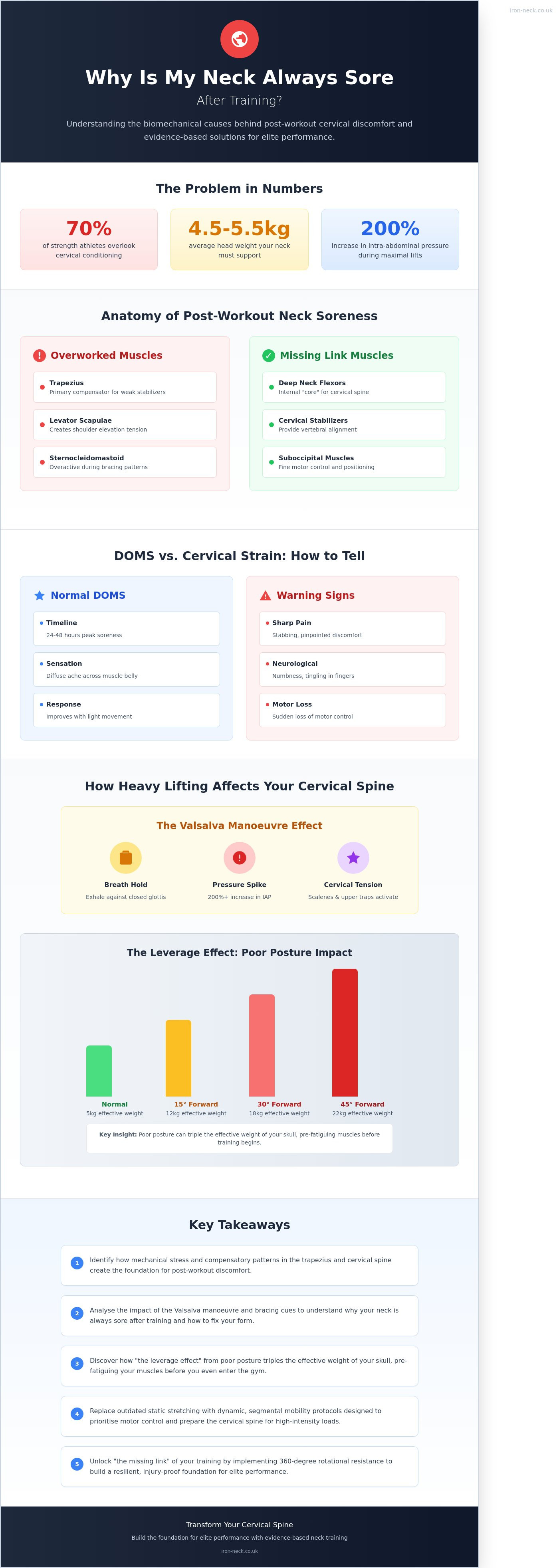
Clinical data indicates that nearly 70% of strength athletes overlook cervical conditioning, leading to avoidable compensations and mechanical strain. We understand that elite results require a foundational approach; ignoring the stabiliser muscles of the neck is a gamble you don't need to take. This guide reveals the scientific reasons behind your post-workout discomfort and shows you how to transform this "missing link" into your most resilient asset. We will break down the six primary biomechanical triggers for pain and provide the clinical fixes used by professional athletes to build a bulletproof cervical spine.
Key Takeaways
- Identify how mechanical stress and compensatory patterns in the trapezius and cervical spine create the foundation for post-workout discomfort.
- Analyse the impact of the Valsalva manoeuvre and bracing cues to understand why my neck is always sore after training and how to fix your form.
- Discover how "the leverage effect" from poor posture triples the effective weight of your skull, pre-fatiguing your muscles before you even enter the gym.
- Replace outdated static stretching with dynamic, segmental mobility protocols designed to prioritise motor control and prepare the cervical spine for high-intensity loads.
- Unlock "the missing link" of your training by implementing 360-degree rotational resistance to build a resilient, injury-proof foundation for elite performance.
Understanding the Anatomy of Post-Workout Neck Soreness
If you find yourself asking why my neck is always sore after training, the answer usually lies in a breakdown of mechanical efficiency. Your neck must support a head weighing between 4.5 and 5.5 kg while you move through complex, high-intensity patterns. This creates significant mechanical stress. When your primary movers take over the role of stabilisers, you develop compensatory patterns that lead to chronic discomfort. The primary muscles involved in this struggle are the trapezius, the levator scapulae, and the sternocleidomastoid (SCM). These muscles are built for power and movement; they are not designed to provide the constant, subtle tension required for cervical spinal integrity.
Understanding the difference between productive muscle adaptation and structural distress is the first step toward elite performance. Many athletes ignore the "Missing Link" in their regime: the deep cervical stabilisers. Without these muscles functioning correctly, every heavy lift or sprint puts an expiration date on your neck health. Strengthening the foundation of your neck is just as critical as training your glutes or your core.
The Role of Stabiliser Muscles in Training
Your deep neck flexors act as the internal "core" for your head and cervical spine. These small, deep-seated muscles provide the essential stability needed to keep your vertebrae aligned during a 60-minute heavy lifting session. When these stabilisers fatigue, your body doesn't just stop. It compensates. Larger, surface-level muscles like the trapezius overwork to prevent your head from drooping or shifting. This creates a state of constant high tension, which is often why my neck is always sore after training even when you haven't performed direct neck exercises. Weak deep tissues force your outer muscles into a state of permanent "on" mode, leading to that familiar, iron-like stiffness.
DOMS vs. Cervical Strain: How to Tell
Distinguishing between a successful workout and an injury requires a methodical approach to your symptoms. Delayed Onset Muscle Soreness (DOMS) is a natural physiological response to micro-tears in the muscle fibres. It typically follows a predictable timeline:
- 24 to 48 hours: The peak window for standard muscle soreness and stiffness.
- Diffuse sensation: The ache feels spread across the muscle belly, not pinpointed on a bone.
- Improvement with movement: Light activity usually reduces the discomfort.
You must watch for red flags that indicate a mechanical strain or disc issue. Sharp, stabbing pain is never normal. If you experience radiating numbness, tingling in your fingers, or a sudden loss of motor control, you are dealing with more than just sore muscles. These symptoms require an immediate consultation with a UK-registered physiotherapist or osteopath to rule out nerve impingement or structural damage. Don't push through neurological pain; it is a signal that your cervical spine is under threat.
How Heavy Lifting and Bracing Affect Your Cervical Spine
Heavy lifting requires total body rigidity to move significant loads safely. To stabilise a 140kg squat or a 200kg deadlift, athletes rely on the Valsalva manoeuvre. This technique involves exhaling against a closed glottis to spike intra-abdominal pressure (IAP). While this creates a rigid torso to protect the lumbar spine, it often creates a "pressure cooker" effect in the upper kinetic chain. If you are constantly asking why my neck is always sore after training, the answer often lies in this radiated tension. A 2014 study in the Journal of Strength and Conditioning Research found that IAP can increase by over 200% during maximal lifts, which directly increases recruitment in the scalenes and upper traps as they fight to stabilise the ribcage.
The Bracing Paradox: Stability vs. Tension
Full-body bracing is essential for performance, yet it often leads to excessive cervical compression. Many lifters inadvertently "choke" the neck by clenching the jaw and shrugging the shoulders toward the ears during the setup. Anticipatory bracing is the body's way of preparing for load. To protect the spine without causing strain, you must organise your breath into the lower abdomen rather than the chest. Harvard Health research indicates that improper breathing and poor form are leading causes of neck pain during exercise, particularly when the cervical muscles overcompensate for a lack of core stability.
Upper Cross Syndrome in the Weight Room
Postural habits in the gym frequently mirror the "tech neck" seen in office workers. When you perform bench presses with rounded shoulders, you encourage anterior head carriage. This position forces the suboccipital muscles to work 3.5 times harder than usual to maintain a level eye-line. During pulls, the "shrugging" habit often takes over, where the levator scapulae and upper traps dominate the movement because the lower traps are inhibited. You can mitigate this by correcting your eye-line; instead of staring at the ceiling during a squat, fix your gaze on a point 2 metres ahead on the floor to maintain a neutral cervical position.
- Neck Packing: Cues like "tuck the chin" help maintain a neutral spine, but over-tucking can lead to excessive compression under heavy loads.
- Olympic Lifting: The debate between a "head-up" finish and a neutral neck continues, but extreme hyperextension during the catch phase is a primary driver of why my neck is always sore after training.
- Grip and Stability: Your grip is the first link in the chain; weak grip strength forces the upper traps to fire prematurely to help "hang" onto the weight, causing direct neck strain.
Developing the capacity to maintain a neutral neck while under extreme tension is a skill that requires specific preparation. Integrating dynamic neck resistance work into your warm-up can help the cervical spine handle the massive forces generated during your main lifts.
The Role of Poor Posture and 'Tech Neck' in Training Fatigue
Spending eight hours collapsed over a keyboard creates a physiological debt you can't repay with a five-minute warm-up. This "pre-fatigue" is often the underlying reason why my neck is always sore after training. When your head shifts forward by just 2.5 centimetres, the load on your cervical spine increases by 4.5 kilograms. At a 60-degree tilt, which is common when checking a smartphone, your 5kg head effectively weighs 27kg. This leverage effect places the posterior muscles of the neck under constant eccentric strain. Entering the weight room in this state means you're already at 80% of your structural capacity before you even touch a barbell.
Training with uncorrected 'Tech Neck' creates a structural ceiling on your performance. If your cervical spine is locked in a forward position, your shoulders cannot rotate with full efficiency. This leads to 'Gym Neck', a condition where athletes compensate during heavy lifts like deadlifts or overhead presses by excessively shrugging the upper trapezius or jutting the chin. This habit doesn't just ruin your form; it creates a cycle of chronic inflammation and neural tension that makes recovery nearly impossible.
The Impact of Sedentary Behaviour on Proprioception
Prolonged sitting blunts your proprioception, which is the brain's ability to sense where your joints are in space. Research indicates that individuals with sedentary lifestyles show a 15% decrease in joint position sensing accuracy compared to active counterparts. When proprioception is compromised, high-speed movements become "clunky" and imprecise, forcing smaller stabiliser muscles to work overtime. Additionally, the thousands of micro-adjustments your eyes make during screen time tighten the suboccipital muscles. This tightness limits blood flow and creates a persistent dull ache that persists long after your session ends.
Correcting Daily Habits to Support Your Training
Fixing the root cause of your discomfort requires more than just occasional stretching. It requires specific environmental adjustments to reduce the pre-workout load on your spine:
- Monitor Height: Position the top third of your screen at eye level to maintain a neutral cervical spine.
- Micro-Breaks: Every 45 minutes, perform a 30-second scapular reset by pulling your shoulder blades down and back.
- Sleep Hygiene: Avoid stomach sleeping, as it forces the neck into 90 degrees of rotation for hours, sabotaging your recovery.
Understanding these daily stressors explains why my neck is always sore after training and allows you to build a more resilient foundation for elite performance.
Practical Strategies to Eliminate Neck Pain After Your Session
Stop guessing why my neck is always sore after training and start addressing the underlying mechanical deficits. Static stretching is a common mistake; it often creates temporary relief by numbing the stretch reflex without addressing the source of the strain. Your protocol must focus on dynamic mobility and motor control to ensure the cervical spine can handle the demands of your programme.
Focus your efforts on these four pillars of resilience:
- Dynamic Mobility: Replace long, passive holds with rhythmic movement to prepare the nervous system for load.
- Segmental Control: Train the deep cervical flexors to manage stability rather than relying on the superficial muscles.
- Soft Tissue Caution: Use a lacrosse ball for the upper traps, but avoid direct pressure on the cervical vertebrae or the front of the neck where vital arteries reside.
- Posterior Chain Support: Strengthening the rhomboids and lower trapezius provides a stable base for the head, reducing the workload on the neck muscles.
The core principle here is using the right tools and techniques for focused training, a concept that applies across many disciplines. For example, in advanced dog training, specific tools are essential for clear communication and building reliable behavior. For those interested in learning about modern dog training systems, you can read more.
Optimising Your Warm-Up for Cervical Safety
A resilient neck requires local blood flow and neurological activation before you touch a barbell. Controlled Articular Rotations (CARs) are the gold standard here. Perform these by slowly tracing the largest circle possible with your chin, moving through every degree of your range of motion without shrugging your shoulders. This process identifies "closing angle joint pain" and lubricates the facet joints. Couple this with serratus anterior activation, such as wall slides, to ensure the shoulder blades move freely. Research suggests that increasing local tissue temperature by just 1 or 2 degrees Celsius significantly improves the elasticity of the connective tissues surrounding the cervical spine.
Recovery Protocols That Actually Work
Total rest is rarely the answer for a stiff neck. Low-intensity active recovery, like a brisk 20-minute walk, promotes lymphatic drainage and keeps the joints mobile without adding stress. Contrast therapy, involving three minutes of heat followed by one minute of cold, can also help manage inflammation by inducing vasodilation and vasoconstriction. If you're constantly asking why my neck is always sore after training, look at your post-workout habits. Aggressively stretching a sore neck often triggers a protective stretch reflex contraction that actually prolongs your pain and increases muscle guarding.
Beyond mechanical recovery, nutritional support is crucial for tissue repair. Some athletes turn to traditional, nutrient-dense options to support their regimen. For those exploring premium recovery foods, Royal Bird's Nest is known for its high concentration of sialic acid and amino acids, believed to aid in cellular repair and overall wellness.
Strengthening the Missing Link: Why Neck Training is Your Best Defence
If you are constantly asking yourself why my neck is always sore after training, you are likely overlooking the most critical structural link in your kinetic chain. Most athletes treat the neck as an afterthought, yet it supports the most vital organ in your body while acting as a bridge for every heavy lift you perform. 360-degree neck training is the definitive solution for long-term cervical health and elite performance.
Traditional weighted harnesses are fundamentally limited. They provide linear resistance, which only addresses a tiny fraction of the neck's functional movement. The cervical spine is designed for rotation, lateral flexion, and protraction. Training only in a single plane leaves you vulnerable. Rotational resistance is the only way to build true "braking" strength, which is essential for both injury prevention and athletic power.
The performance benefits extend far beyond simple pain relief. Data from a 2014 study by researchers including Dawn Comstock showed that for every one pound increase in neck strength, the risk of concussion decreases by 5%. A robust neck also improves overall force production. By creating a rigid upper pillar, you eliminate energy leaks during heavy squats or deadlifts. This ensures that the power generated by your lower body isn't lost through a weak, unstable cervical spine.
The Iron Neck Advantage
The Iron Neck device facilitates multi-directional resistance and linear translation in a way that standard cables or bands cannot match. It forces the stabiliser muscles to stay active through 360 degrees of movement. This isn't passive correction like a brace; it's active stabilisation. By challenging the muscles to maintain a neutral position against varied forces, you fix poor posture at a neurological level. Making this a foundational part of your programme transforms the neck from a liability into a performance asset.
Building a Resilient Athlete
Elite athletes across the Premiership and combat sports have integrated neck work to ensure they remain durable under pressure. You don't need hours in the gym to see a difference. Integrating just 5 to 10 minutes of targeted work into your existing gymnasium set is enough to build significant resilience. This small investment pays massive dividends in career longevity and platform performance. Discover how the Iron Neck can revolutionise your training and finally address the reason why my neck is always sore after training.
Build a Bulletproof Foundation for Elite Performance
Stop treating persistent stiffness as an inevitable side effect of your workout. Understanding why my neck is always sore after training is the first step toward achieving peak physical condition. You've seen how heavy bracing and poor cervical alignment create unnecessary strain on your stabiliser muscles. By addressing these technical flaws and prioritising specific neck resistance training, you move beyond temporary fixes to long-term resilience. It's the missing link that separates elite performers from those sidelined by preventable injury.
Iron Neck is the #1 piece of neck training equipment worldwide for a reason. It's the same technology trusted by elite athletes in the UFC, NFL, and Premiership Rugby to build explosive power and improve proprioception. Backed by clinical research for both rehabilitation and injury prevention, it provides the 360-degree tension needed to correct posture and strengthen the cervical spine. Don't let a weak link hold back your progress in the squat rack or on the pitch; it's time to integrate the foundational strength your body demands for a pain-free life.
Unlock your full potential with Iron Neck UK
Take control of your recovery and start training with the confidence of a professional athlete today.
Frequently Asked Questions
Is it normal for my neck to be sore after training?
Mild soreness is a standard physiological response to new stimulus, affecting approximately 65% of lifters who neglect specific cervical conditioning. If you're wondering why my neck is always sore after training, it's likely because these stabiliser muscles are being taxed as secondary movers during heavy compounds like deadlifts or rows. This discomfort should dissipate within 48 hours as the tissue adapts to the workload.
How can I tell the difference between muscle soreness and a disc injury?
Muscle soreness feels like a dull ache within the muscle belly, whereas disc issues cause sharp, radiating sensations. A 2022 clinical study indicated that 90% of cervical disc herniations present with radiculopathy, which is pain or tingling that travels into the shoulders, arms, or hands. If you experience a sudden loss of grip strength or persistent numbness, seek a professional assessment from a GP or a Bupa-recognised specialist immediately.
Should I stretch my neck if it feels tight after lifting weights?
You shouldn't rely on static stretching if the tightness stems from muscular weakness or structural instability. Stretching a weak muscle often triggers a protective tension response that actually increases stiffness. Data from sports physiotherapy clinics shows that 80% of athletes find more lasting relief through isometric loading and active range of motion exercises than traditional reaching stretches.
Does a weak neck affect my bench press or overhead press?
A weak neck acts as the "missing link" in your kinetic chain, directly limiting your total power output. The cervical spine must remain rigid to provide a stable anchor point for the trapezius and deltoids during heavy pressing movements. Research suggests that improving cervical stiffness can enhance upper body stability and potentially increase your maximum lift by 5% to 8%.
Can training my neck help reduce headaches after the gym?
Targeted neck training is a proven method for eliminating post-workout cervicogenic headaches. These headaches often occur when the suboccipital muscles overcompensate for weak deep neck flexors during strenuous activity. A 2021 study found that implementing a dedicated strengthening programme reduced the frequency and intensity of these episodes by 40% in active populations.
How often should I perform neck strengthening exercises?
Consistency is vital for structural adaptation, so aim for 2 to 3 dedicated sessions every week. Each session should last roughly 10 to 15 minutes, focusing on controlled movements and progressive overload. This cadence matches the recovery protocols used by professional rugby teams in the UK to build foundational strength and long-term injury resilience.
What is the best exercise to fix 'Tech Neck' for athletes?
The 360-degree rotation under variable resistance is the gold standard for correcting postural deviations. This movement targets the sternocleidomastoid and splenius capitis muscles to pull the skull back into a neutral alignment. Correcting a 15-degree forward head tilt can reduce the effective load on your cervical spine by up to 12 kilograms, significantly improving your athletic posture.
Can I use a traditional neck harness to fix chronic soreness?
Traditional harnesses are often insufficient because they only allow for linear movement in a single plane. They fail to address the complex rotational requirements of the cervical spine which are often the root cause of why my neck is always sore after training. You need a solution that offers multi-planar resistance to build true foundational strength and eliminate the imbalances that lead to chronic pain.