

What Is the Best Neck Exercise? The Definitive Guide to Strength and Stability
The stretching routine you've been doing for years might actually be the reason your neck still feels fragile. While many people ask what is the best neck exercise to fix a stiff neck, they often mistake temporary flexibility for long-term health. You've likely felt that nagging ache after hours at a desk or felt a flicker of fear about a potential impact injury during a game. It's frustrating to cycle through passive movements that provide minutes of relief but fail to build any lasting resilience or structural integrity.
This guide moves beyond basic mobility to reveal the science of multi-directional resistance. You'll discover why true stability requires more than just tilting your head and how specific, load-bearing movements can eliminate chronic pain while dramatically improving your posture. We will preview the exact protocols used by elite athletes to protect against whiplash and enhance performance. This methodical approach provides you with a definitive roadmap to building a stronger, more capable cervical spine that is ready for the demands of both the office and the field.
Key Takeaways
- Learn why active mobility and load-bearing capacity are superior to passive stretching for long-term cervical health and injury prevention.
- Understand the mechanics of progressive overload and how training across the sagittal, frontal, and transverse planes builds a truly resilient neck.
- Discover what is the best neck exercise by evaluating movements that prioritize multi-directional resistance over simple flexibility.
- Explore how the Iron Neck provides unique 360-degree rotational resistance to correct postural imbalances and mitigate risks like whiplash.
- Identify the five most effective exercises for 2026 that transition you from chronic desk-work stiffness to peak athletic performance.
Understanding Neck Health: Why Mobility is Only Half the Battle
Most people searching for what is the best neck exercise are looking for a quick fix for stiffness. They usually find a list of static stretches. While these movements might provide temporary relief, they fail to address the root cause of chronic pain. True neck health isn't just about how far you can tilt your head; it's about your load-bearing capacity. The best neck exercise is one that simultaneously improves your range of motion and your ability to stabilize against external force.
We must distinguish between flexibility and mobility. Flexibility is a passive attribute, representing how far a muscle can be stretched by an outside force. Mobility is active control. It's the ability to move through a full range of motion while maintaining structural integrity under tension. When we discuss Understanding Neck Health, we are talking about building a neck that is both supple and strong enough to protect the spinal cord and support the skull.
The modern neck crisis is a direct result of our sedentary environment. Hours spent hunched over screens cause the deep cervical flexors to atrophy. These small muscles are responsible for stabilizing the vertebrae. When they weaken, the larger muscles like the trapezius and levator scapulae have to work overtime just to keep your head upright. This leads to the tightness people feel, which is actually muscle fatigue from overcompensation. The goal of any serious training program is to build a neck that can absorb impact and maintain alignment throughout the day.
The Role of the Cervical Spine in Daily Life
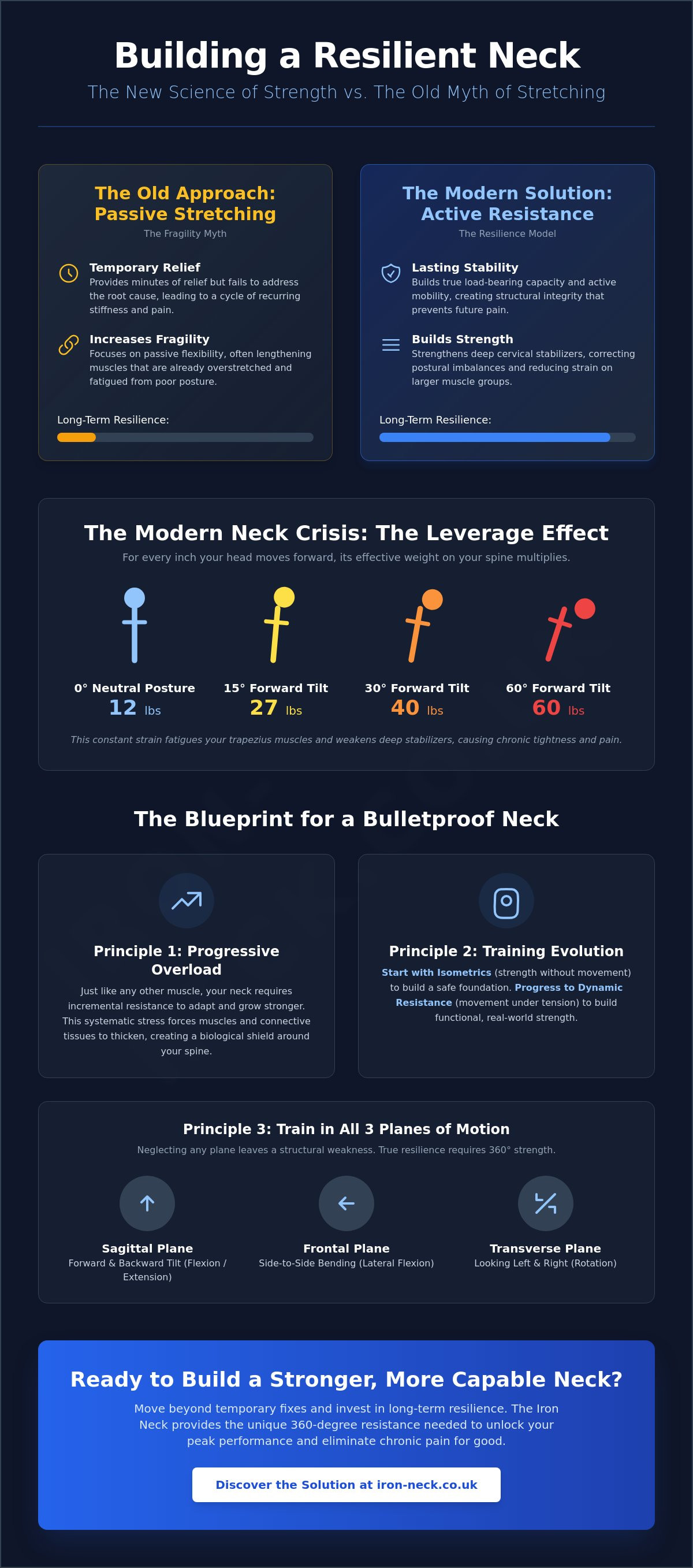
The average human head weighs between 10 and 12 pounds. This weight is manageable when perfectly balanced over the shoulders. However, for every inch your head moves forward, the effective weight on your spine increases significantly. This creates leverage pain in the upper trapezius. If you try to stretch this tightness away, you're often lengthening a muscle that is already overstretched and exhausted. Strengthening the stabilizers is the only way to reduce this mechanical stress.
From Rehabilitation to Resilience
Waiting for pain to arrive before you act is a reactive strategy that leads to long-term decline. We need to shift toward a resilience-based model. Proactive strengthening isn't just for contact sports; it's for anyone who wants to maintain a high quality of life as they age. Cervical stability is the fundamental anchor for all upper body mechanics, ensuring that your shoulders and arms have a solid base to pull and push from.
The Science of Resistance: How to Build a Resilient Cervical Spine
Building a neck that can withstand the rigors of high-impact sports or the slow attrition of office work requires more than just movement. It requires load. When people ask what is the best neck exercise, the answer lies in the principle of progressive overload. Just as you wouldn't expect your legs to get stronger without adding weight to a squat, your cervical spine won't adapt unless it's challenged with incremental resistance. This systematic stress forces the muscles and connective tissues to thicken and harden, creating a biological shield around your spine.
To achieve total resilience, you must train across all three planes of motion. The sagittal plane handles forward and backward tilting. The frontal plane manages side-to-side bending. Finally, the transverse plane governs rotation. Neglecting any of these leaves a structural gap that can be exploited by sudden forces or repetitive strain. A comprehensive program ensures that every muscle group, from the deep flexors to the large superficial muscles, is capable of generating and absorbing force.
Isometric vs. Dynamic Neck Training
Beginners should always start with isometrics. These are "strength without movement" exercises where you exert force against an immovable object or a resistance band without changing the joint angle. Isometrics are the safest entry point because they allow you to recruit maximum muscle fibers with minimal risk of joint irritation. Once you've established a baseline of stability, you must transition to dynamic, or isotonic, resistance. This involves moving through a range of motion under tension. Training the sternocleidomastoid and splenius muscles through resisted rotation is what separates a truly functional neck from one that is merely "not in pain."
The Kinetic Chain: How Neck Strength Impacts the Shoulders
Your neck doesn't exist in a vacuum. It's the top of a complex kinetic chain that includes your shoulders and upper back. If the neck is weak, the body compensates by tightening the muscles around the shoulder blades to provide stability. This often leads to scapular dysfunction and "energy leaks" during compound movements like overhead presses or heavy carries. By Mapping your back and neck muscles, you can see how deep the connections run between cervical strength and overall upper body power.
A stable neck provides the solid anchor necessary for the shoulders to move efficiently. If you're serious about your physical longevity, you should consider integrating professional-grade tools like those found at Iron Neck to ensure your training is precise and effective. Strengthening this area doesn't just stop pain; it unlocks your body's full athletic potential and protects your most vital structures.
Static Stretching vs. Dynamic Resistance: Debunking the Fragility Myth
A common misconception persists that the cervical spine is too delicate for rigorous training. This "fragility myth" leads many to rely solely on passive stretching, fearing that any significant load will cause injury. However, the neck is a robust structure designed to support, move, and protect. Avoiding resistance doesn't safeguard the neck; it leaves it vulnerable to the very injuries you fear. When you ask what is the best neck exercise, you must look for movements that challenge the musculature with weights or bands. Static stretching provides a brief neurological reset, but dynamic resistance creates the permanent physiological changes needed for true stability.
Safety is the primary concern for those with previous injuries or chronic conditions. Ironically, a weak neck is more prone to re-injury than a strong one. While you should always follow professional guidance after a trauma, progressive resistance training is the most effective way to restore function and confidence. For individuals with hypermobile joints, over-stretching is actually counterproductive. It increases instability in a system that already lacks structural tension. Strengthening the surrounding muscles is the only way to secure these joints and prevent the micro-trauma associated with excessive range of motion.
Why Stretching Alone Fails for Chronic Pain
Chronic tightness is often a "protective tension" reflex. Your brain senses instability in the cervical spine and commands the muscles to shorten and tighten to prevent dangerous movement. This is why your neck feels stiff again just minutes after a stretch. You aren't dealing with a "tight" muscle; you're dealing with a weak one that is exhausted from trying to stabilize your head. Strengthening the deep stabilizers signals to the brain that the area is secure. Once stability is established, the brain naturally "turns off" the pain signal and allows the superficial muscles to relax.
Concussion and Whiplash Prevention
The physics of impact are undeniable. A stronger neck acts as a shock absorber for the brain. Sports science research consistently shows that athletes with greater neck strength and girth experience lower head acceleration during collisions. By tethering the head more securely to the torso, the neck prevents the violent "whiplash" effect that causes the brain to strike the inside of the skull. You can learn more about the mechanics of protection by exploring Can neck strength reduce whiplash severity?. Building neck girth and force-absorption capacity isn't just about aesthetics; it's a critical safety measure for anyone in high-risk environments.
The 5 Best Neck Exercises for Pain Relief and Performance in 2026
Most traditional protocols treat the neck as a simple hinge, focusing only on basic flexion and extension. This 2D approach is why many people never achieve lasting relief. To build a truly resilient cervical spine, you must adopt a 360-degree training philosophy. When determining what is the best neck exercise, we must prioritize movements that challenge the stabilizers through rotation and lateral resistance. The following exercises are ranked by their ability to provide immediate structural support while building long-term force-absorption capacity.
Foundational Movements for Beginners
1. The Resisted Chin Tuck: This is the gold standard for correcting "forward head posture." Unlike a standard tuck, performing this against a light resistance band engages the deep cervical flexors. Cue: Imagine a string pulling the crown of your head toward the ceiling while you pull your ears back over your shoulders. Don't simply look down; move the entire skull backward.
2. 4-Way Isometric Holds: These builds essential stability in the front, back, and sides of the neck. Use your hand or a band to apply pressure while keeping your head perfectly still. Cue: Keep your jaw relaxed and your gaze forward. The goal is to resist movement entirely, creating a rigid column of support.
3. Shoulder Blade Retraction with Neck Neutrality: This exercise bridges the gap between the neck and the upper back. Pull your shoulder blades down and back while maintaining a packed neck position. This prevents the upper trapezius from "taking over" the movement, ensuring the load stays on the intended stabilizers.
Advanced Protocols for Maximum Strength
4. The Rotational 'Look-Around' under Resistance: This addresses the critical SERP gap in most training programs. By using Iron Neck Resistance Bands, you can apply tension while rotating your head from left to right. This strengthens the sternocleidomastoid and splenius muscles in the transverse plane, which is vital for preventing whiplash during sudden impacts.
5. Figure-8 Patterns: This is the ultimate test of cervical control. Trace a small, controlled infinity symbol with your nose while under constant resistance. The Figure-8 exercise requires the neck to navigate all three planes of motion simultaneously, building unparalleled motor control. Cue: Keep the movement small and precise. If your shoulders start to shrug, reduce the resistance.
Transitioning from basic tilts to these resisted protocols is the only way to stop the cycle of chronic stiffness. If you want to see what is the best neck exercise in action, you must move into resisted rotation. This methodical progression ensures that your neck is prepared for the high-velocity demands of sports and the static demands of modern life.
Iron Neck: The Ultimate Solution for 360-Degree Neck Strengthening
Traditional training tools often fall short because they treat the cervical spine as a one-dimensional hinge. While the Alpha Head Harness is an excellent tool for building linear strength in the sagittal plane, it cannot replicate the complex rotational demands of real-world movement. When elite athletes and medical professionals evaluate what is the best neck exercise, the focus shifts from simple movements to the equipment that enables them. The Iron Neck Device stands alone as the only system providing both linear and rotational resistance, allowing you to train every degree of your neck's natural range of motion.
This technology facilitates active rehabilitation that mirrors the chaotic demands of the field or the ring. Elite strength coaches and physiotherapists rely on this system because it bridges the gap between static stability and dynamic performance. By applying a consistent load during rotation, the device forces the deep stabilizers to remain engaged throughout the entire movement. This methodical approach builds a level of structural integrity that bodyweight exercises or traditional harnesses simply cannot match. It transforms the neck from a vulnerable point into a resilient anchor for the rest of the body.
Why Linear Resistance Isn't Enough
Most traumatic neck injuries don't occur during perfectly aligned forward or backward movements; they happen during sudden, resisted rotation. If your training only involves up-and-down motions, you're leaving your spine exposed to dangerous shear forces. The Iron Neck creates a "Halo" effect, maintaining constant tension as you move through all three planes of motion. This specific type of resistance helps neutralize shear force by ensuring the muscles are strong enough to keep the vertebrae aligned even under high-velocity rotational stress. It's the difference between having a neck that looks strong and one that is actually protected.
Getting Started with the Iron Neck
Choosing the right equipment depends on your specific performance goals. The Pro model offers adjustable rotational resistance for high-level athletes, while the Varsity and Starter models provide foundational tension for those focused on general health and posture. Even if you don't have an athletic background, a simple 5-minute everyday routine can reverse the damage caused by years of desk work. Consistency is the key to longevity. By integrating resisted rotations and isometric holds into your morning, you build a protective shield that lasts a lifetime.
Explore the Iron Neck range and take control of your neck health today.
Secure Your Foundation and Unlock Peak Performance
Building a resilient cervical spine requires a fundamental shift from passive stretching to active resistance. You now understand that what is the best neck exercise isn't a simple tilt or stretch; it's a methodical approach to multi-directional load. By addressing the deep stabilizers through rotational tension, you eliminate the protective tension reflex and finally break the cycle of chronic stiffness. This transition from rehabilitation to true resilience is the only way to safeguard your long-term health and athletic longevity.
This systematic training is exactly why our technology is endorsed by elite UFC and NFL athletes who demand maximum protection against high-impact forces. Our equipment is clinically backed by physiotherapists to ensure every movement is safe, effective, and scientifically sound. You can begin your journey toward a pain-free life with total confidence, supported by our 30-day money-back guarantee. It's time to stop merely managing discomfort and start building a biological shield around your spine.
Build a stronger, safer neck with the Iron Neck 360° system. Your strongest, most capable self begins with a stable foundation.
Frequently Asked Questions
Is it safe to do neck exercises every day?
It's safe to perform low-intensity mobility and isometric exercises daily, but high-resistance training requires 48 hours of recovery. Just like any other muscle group, the cervical stabilizers need time to repair and adapt after a heavy workload. Beginners should start with three sessions per week to establish a baseline of structural integrity before increasing frequency. Listen to your body's feedback to ensure you aren't bypassing the recovery phase.
How long does it take to see results from neck strengthening?
Neurological adaptations often occur within the first 7 to 10 days, resulting in reduced stiffness and improved motor control. Significant gains in muscle thickness and structural stability typically take four to eight weeks of consistent training. Tracking your progress through increased resistance or improved range of motion is essential for maintaining a methodical progression toward your performance goals. Resilience is built through consistency rather than intensity alone.
Can neck exercises help with tension headaches?
Neck exercises are highly effective at mitigating tension headaches by strengthening the deep cervical flexors. These headaches often stem from the larger superficial muscles overworking to compensate for weak stabilizers. By restoring balance to the kinetic chain, you eliminate the mechanical stress that triggers referred pain in the skull and temples. Strengthening the foundation of your neck provides a permanent solution to a chronic problem.
What is the difference between a neck harness and the Iron Neck?
A traditional head harness provides only linear resistance, while the Iron Neck offers 360-degree rotational tension. While a harness is useful for basic flexion and extension, it cannot address the transverse plane where most injuries occur. When people ask what is the best neck exercise for total protection, it involves the rotational resistance that only a specialized device can provide. This multi-directional load is the key to true resilience.
Should I stretch my neck if it feels tight and painful?
You shouldn't automatically stretch a tight neck, as the stiffness is often a "protective tension" reflex caused by underlying weakness. Stretching an unstable joint can exacerbate the problem by increasing hypermobility. Instead, focus on gentle isometrics to signal stability to the brain. This allows the tight muscles to relax naturally without risking further injury. Strengthening the area is usually the most effective way to "turn off" the pain signal.
Can neck strengthening prevent concussions in sports like rugby?
Strengthening the neck is a critical strategy for reducing concussion risk in high-impact sports like rugby. A stronger neck increases the "coupling" between the head and the torso, which significantly reduces the peak acceleration of the brain during an impact. Data indicates that for every one-pound increase in neck strength, the risk of concussion decreases by approximately 5%. This makes cervical training an essential component of any modern athletic safety protocol.
Do I need special equipment to start training my neck?
You don't need special equipment to begin, as bodyweight isometrics are an effective starting point for any beginner. However, to achieve maximum resilience and answer what is the best neck exercise for long-term health, you will eventually need resistance bands or a specialized device. These tools allow for the progressive overload necessary to build functional muscle girth and 360-degree stability. Moving beyond bodyweight is required to reach peak physical condition.
What are the signs that I'm overtraining my neck muscles?
Signs of overtraining include lingering muscle soreness that lasts more than 48 hours or an increase in tension headaches. You may also notice a temporary reduction in your active range of motion or a "heavy" feeling in the head. If these symptoms occur, reduce your training volume and focus on recovery protocols. Professional training is about precision and methodical growth, not simply pushing until failure.