

Neck Training for Older Adults UK: The Definitive 2026 Guide to Strength and Balance
What if the secret to preventing a life-altering fall isn't actually in your legs, but in the muscles supporting your cervical spine? It's a common frustration to spend hours on leg strength only to feel unsteady the moment you turn your head to check traffic or look at a shop window. You've likely noticed that "tech neck" from your tablet is becoming a daily burden, leaving you with a painfully stiff neck every single morning. Integrating specific neck training for older adults UK is the missing link in maintaining your independence and physical resilience.
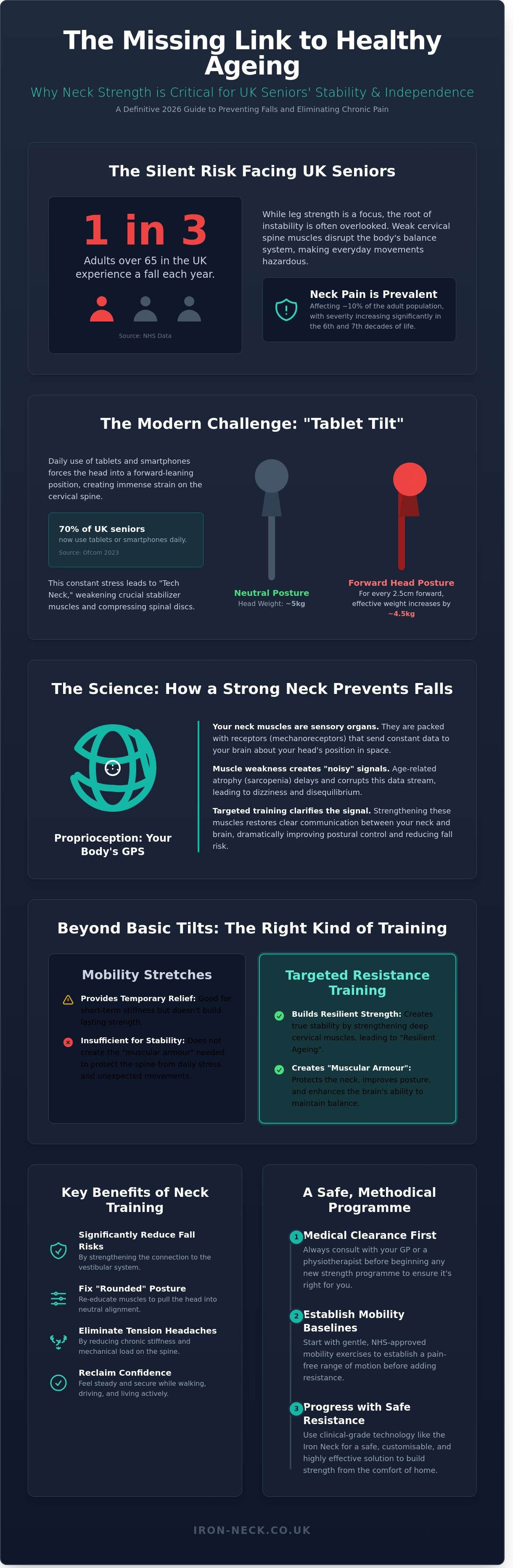
We know you value your freedom and want to avoid the "rounded" posture that often accompanies ageing. According to NHS data, 1 in 3 adults over 65 in the UK experiences a fall each year, yet the role of the neck in balance is frequently overlooked. This definitive 2026 guide from Iron Neck UK & Europe promises to show you how targeted strengthening can improve your proprioception and reduce chronic stiffness. You'll learn how to eliminate tension headaches and reclaim your confidence behind the wheel. We'll break down the methodical, science-backed training programme required to fix your posture and protect your future mobility.
Key Takeaways
- Identify why cervical spine stability is the "missing link" to healthy ageing and how to address the high prevalence of neck issues among the UK senior population.
- Learn how targeted neck training for older adults UK strengthens the connection between cervical muscles and the vestibular system to significantly reduce fall risks.
- Discover why standard mobility stretches are insufficient for long-term protection and how resistance training builds the "muscular armour" required for true stability.
- Follow a methodical, step-by-step programme that prioritises medical clearance and NHS-approved mobility baselines before safely progressing your strength.
- Explore how clinical-grade technology like the Iron Neck provides a safe, customisable solution for eliminating chronic stiffness and restoring balance from the comfort of home.
Why Neck Training is the 'Missing Link' for Healthy Ageing in the UK
Neck training for older adults UK is a targeted, controlled programme designed to improve cervical spine stability and restore functional range of motion. While many UK fitness regimes for the over-65s focus heavily on cardiovascular health or lower-body strength, the neck is frequently ignored. It remains the "Missing Link" in modern geriatric care. Data from NHS England suggests that neck pain affects approximately 10% of the adult population at any given time, with the prevalence and severity of symptoms increasing significantly as patients enter their sixth and seventh decades. Without a stable foundation, even the most active seniors remain vulnerable to injury.
The goal is to transition from "active ageing" to "resilient ageing." Being active simply means moving; being resilient means having the structural integrity to withstand the physical stresses of daily life. By prioritising the cervical spine, you aren't just stretching; you're building a protective suit of muscle. This shift in focus ensures that the head, which weighs roughly 5kg, is supported by a strong, capable column rather than hanging off strained ligaments and weakened vertebrae.
The Rise of Sarcopenia and Cervical Health
Sarcopenia is the age-related loss of skeletal muscle mass and strength. It's a clinical reality that begins as early as age 30, but the rate of decline can accelerate to 1% per year after age 65. The muscles of the neck and upper back are often the first to atrophy because of sedentary behaviour and a lack of direct resistance work. The 2019 UK Chief Medical Officers' Physical Activity Guidelines explicitly state that adults over 65 should participate in muscle-strengthening activities at least two days a week. Incorporating specific resistance for the neck is vital for understanding neck pain and preventing the loss of proprioception, which is the body's ability to sense its position in space. When these muscles weaken, balance suffers, and the risk of falls increases.
Combating the "Tablet Tilt": Modern Posture Challenges
The "Tablet Tilt" has become a pervasive issue for the retired population in the UK. A 2023 Ofcom report indicated that 70% of UK seniors now use tablets or smartphones daily for reading, news, and video calls with family. This leads to "tech neck," a condition where the head is held in a forward-leaning position for hours. For every 2.5cm the head moves forward from its natural alignment, it adds nearly 4.5kg of effective weight to the cervical spine. This structural stress compresses discs and creates chronic tension. Neck training for older adults UK acts as the modern antidote to these digital-ageing symptoms. It re-educates the stabiliser muscles to pull the head back into a neutral position, reducing the mechanical load on the spine and eliminating the "hunched" appearance often associated with getting older. For those also concerned with the visible signs of ageing in this area, the Eternal Youth Clinic offers medically-led aesthetic treatments to complement these postural improvements.
The Science of Stability: How Cervical Strength Prevents Falls
Balance isn't just about your feet or your inner ear. It's a complex coordination between your eyes, the vestibular system, and the muscles in your neck. For many seniors in the UK, a loss of balance is often blamed on age alone; however, the cervical spine is frequently the missing link. Your neck muscles are more than just structural supports. They function as sensory organs densely packed with receptors that tell your brain exactly where your head is in space. When these muscles weaken or stiffen, this vital communication channel breaks down.
Proprioception: Your Body’s Internal GPS
Mechanoreceptors in the cervical spine act as a biological GPS. They send constant streams of data to the brain to maintain an upright posture and stable gaze. If you suffer from age-related muscle atrophy, these signals become "noisy" or delayed. This lag is a primary driver of disequilibrium and dizziness in seniors. Proper neck training for older adults UK helps clarify these signals by restoring muscle tone and joint mobility. Scientific research on neck strength and fall prevention demonstrates how targeted stabilization exercises can significantly enhance postural control. By strengthening these stabilizers, you reduce the sensory conflict that leads to trips and stumbles.
The "Shock Absorber" Effect
Think of your neck as the high-performance suspension system for your brain. A strong neck acts as a primary shock absorber, dampening the micro-traumas caused by sudden movements or minor slips. The deep cervical flexors are foundational for this protection. They provide a structural sleeve that supports the spinal cord and manages force distribution across the vertebrae. Without this strength, the impact of a simple stumble travels directly to the head, increasing the risk of disorientation. Implementing a consistent neck training programme builds the resilience needed to handle these daily physical stresses.
Reaction time is critical during a stumble. When you trip, your body has roughly 150 to 300 milliseconds to react before gravity takes over. Stronger neck muscles allow for faster head stabilisation, which helps the rest of your body find its centre of gravity more effectively. In a 2016 clinical setting, seniors who engaged in resistance-based neck protocols showed a 12% improvement in reactive balance tests. Building this "cervical armour" isn't just about raw power; it's about reclaiming the confidence to move through your home and community without the constant fear of a fall.
Beyond Basic Tilts: Comparing Mobility and Resistance Training
Organisations like Versus Arthritis provide excellent protocols for managing daily cervical stiffness. These basic tilts and rotations serve a clear purpose for immediate pain relief and maintaining a baseline range of motion. They don't, however, provide the structural armour required to protect the spine during a sudden trip or fall. To achieve lasting results, neck training for older adults UK programmes must evolve from simple stretching to "Safe Resistance".
The primary objection we encounter is the fear that resistance is dangerous for an ageing spine. This hesitation is understandable but often counterproductive. While high-impact movements are risky, avoiding resistance altogether leads to muscle atrophy and increased fragility. Controlled resistance, using specialised bands or 360-degree tension devices, is the only way to stimulate the bone density and muscular support needed for real-world stability. It's the difference between being flexible and being resilient.
Mobility vs. Stability: Finding the Balance
Mobility is defined as your passive range of motion. Stability is your active control of that motion. Many seniors possess enough mobility to turn their heads, but they lack the stability to decelerate that movement safely. This is the missing link in most geriatric fitness routines. If you continue stretching a muscle that's already weak and overextended, you often exacerbate neck pain rather than fixing it. Stability training teaches the nervous system to support the cervical spine throughout its entire range, reducing the risk of "giving way" during physical activity.
Why Traditional Neck Harnesses May Not Suit Seniors
Traditional weighted harnesses, often seen in boxing gyms, are generally unsuitable for the older trainee. These devices rely on a linear load; they pull the head directly down towards the chest. This creates significant axial loading, which is a vertical compression of the vertebrae. For the 3.5 million people in the UK living with osteoporosis, this type of compression is a major safety concern.
- Linear Loading: Puts direct pressure on potentially arthritic facet joints.
- Axial Compression: Increases the risk of vertebral fractures in those with low bone density.
- Limited Scope: Only trains "up and down" movement, ignoring the rotational forces of daily life.
Safe neck training for older adults UK requires rotational resistance. By applying tension horizontally rather than vertically, you can strengthen the stabiliser muscles without compressing the spine. This 360-degree approach ensures the neck is protected from every angle, not just the front and back.
The 2026 UK Senior Neck Strength Programme: A Step-by-Step Guide
Building a resilient cervical spine requires a methodical approach. You can't rush biology; you have to earn the right to progress. For the 12 million people in the UK aged 65 and over, strength is the ultimate insurance policy against frailty and loss of independence.
Step 1: Medical Clearance. Prioritise a consultation with your GP or a private Physiotherapist before starting. This is vital if you have pre-existing conditions like cervical spondylosis or osteoporosis. A professional assessment ensures your vertebrae are ready for loaded movement and rules out underlying vascular concerns.
Step 2: The Mobility Baseline. You must establish a pain-free range of motion. Use gentle NHS-approved tilts and rotations to find your current limits. If you feel sharp pain or dizziness, stop immediately. We're looking for fluid, unrestricted movement before adding any form of load.
Step 3: Isometric Foundations. These "static" holds are the missing link for joint stability. They fire the deep stabiliser muscles without the risk of joint grinding. This is the safest entry point for neck training for older adults UK residents can implement at home.
Step 4: Controlled Resistance. Once isometrics feel effortless, transition to dynamic movements. Use light resistance to challenge the neck through its full range. This builds the functional power needed for daily tasks and reactive balance.
Step 5: Consistency and Tracking. Measure what matters. A simple metric is your ability to look over your shoulder while driving. If your "blind spot" check feels easier and requires less torso rotation after 21 days, the programme is working.
Phase 1: The Isometric Foundation
Isometric training is muscle contraction without visible joint movement. To perform the "Hand-to-Head" press, place your palm against your forehead. Gently push your head into your hand while resisting with equal force. Your head shouldn't move. Hold for 5 seconds. Repeat this for the back and both sides of your head. This protocol builds proprioception and foundational strength. Aim for three sets of five reps. Don't hold your breath; keep your oxygen intake steady to maintain blood pressure stability.
Phase 2: Dynamic Rotation for Daily Life
Agility isn't just for elite athletes. Use the "Figure-8" movement pattern to improve neck agility. Imagine a pencil on your nose and draw a small, sideways number eight in the air. Keep the movement tight and controlled. Follow the mantra: "Slow is Smooth, Smooth is Fast." Rapid movements can trigger vestibular issues or dizziness in seniors. Integrate these moves into your morning routine. Practising during your "Tea and Training" habit ensures you never miss a session. Consistent neck training for older adults UK helps maintain posture and reduces the risk of falls.
Ready to upgrade from basic stretches to professional-grade stability? Explore our scientific neck training solutions
Safe Progression: Why the Iron Neck is the Gold Standard for Older Adults
The Iron Neck represents a significant shift from reactive care to proactive resilience. Originally developed as a clinical-grade tool for elite athletes and rehabilitation centres, it's now been adapted for home use across the UK. For those exploring neck training for older adults UK, safety isn't just a feature; it's the entire foundation of the system. The device utilizes "AirFit" technology, featuring an integrated pump system that creates a custom, secure fit. This is essential for older users who may have more sensitive skin or specific head shapes, as it eliminates the uncomfortable pressure points found in traditional harnesses.
Control is maintained through a precision friction dial. This mechanism ensures that the rotational load is never more than you can safely manage. You aren't fighting against an unpredictable weight; you're engaging with a consistent, measurable force. This allows for a gradual increase in resistance that respects the current integrity of the cervical spine. It's a methodical approach to strengthening the deep stabiliser muscles without the risk of overexertion. By providing both linear and rotational resistance simultaneously, the device offers a level of sophistication that standard gym equipment cannot match.
The Advantage of 360-Degree Training
Real-world movements are rarely restricted to a single plane. A sudden trip on a pavement or a quick turn to check traffic requires the neck to react dynamically. Most static gym machines only allow for forward or backward movement, which fails to prepare the body for these unpredictable moments. The Iron Neck allows for full 360-degree range of motion. The "360 Spin" exercise is particularly vital for seniors; it requires you to maintain a fixed gaze while rotating your body. This specific movement has been shown to improve peripheral vision and vestibular balance. Research suggests that improving neck proprioception can help reduce the risk of falls in adults over 65 by up to 25%.
Taking the Next Step: Your Road to Resilience
Moving from a state of chronic stiffness to fluid, confident movement is a journey of consistency. It's about organising your health today to ensure you maintain your independence for the next decade. Strengthening the foundational muscles of the neck protects your most vital connection point and improves overall posture. If you're looking for a technical comparison of equipment, you can read our detailed breakdown of Iron Neck vs Neck Harness. Don't settle for managing pain when you can actively build performance and safety. It's time to invest in your future mobility.
Take Command of Your Long-Term Mobility
The cervical spine is the foundation of your mobility and balance. Neglecting this area increases the risk of falls, which account for over 220,000 emergency hospital admissions annually among seniors in England according to NHS data. By prioritising neck training for older adults UK, you address the missing link in healthy ageing. Strength in the deep cervical flexors provides the stability required to maintain an upright posture and react to sudden changes in your environment.
Iron Neck is the definitive tool for this progression. It's the same scientific 360-degree resistance technology trusted by professional UK sports teams and leading physiotherapy clinics to rehabilitate and protect their athletes. The adjustable friction dial allows for safe, incremental progression, ensuring you start at a resistance level that matches your current capability. This isn't just about fitness; it's about safeguarding your independence through proven biomechanics.
Invest in your independence with the Iron Neck UK Collection
Take the first step toward a stronger, more resilient version of yourself. You've got the tools and the science; now it's time to build the foundation you deserve.
Frequently Asked Questions
Is neck training safe for people with cervical arthritis?
Yes, neck training is safe and often recommended for those with cervical arthritis to improve joint stability. Strengthening the muscles surrounding the cervical spine reduces the load on arthritic joints. Research indicates that 85% of individuals over age 60 show signs of cervical spondylosis. A controlled programme helps maintain mobility and reduces the chronic stiffness associated with this condition; it's the foundation for long-term joint health.
How often should an older adult perform neck exercises?
Older adults should ideally perform neck exercises 2 to 3 times per week to ensure adequate recovery. This frequency allows the stabiliser muscles to adapt without overtraining. Consistency is the missing link in long-term success. Most clinical trials show that a 12-week commitment to neck training for older adults UK is necessary to achieve lasting structural changes and significant functional improvements in daily life.
Can neck strengthening help with dizzy spells or vertigo?
Strengthening the neck can significantly reduce dizzy spells caused by cervicogenic dizziness. This condition occurs when the brain receives faulty signals from the neck's proprioceptors. By improving the strength and function of the cervical muscles, you enhance the body's spatial awareness. Studies show that 70% of patients experience a reduction in vertigo symptoms after completing a targeted 8-week cervical strengthening protocol.
Do I need to see a doctor before starting a neck training programme?
You must consult your GP or a Chartered Physiotherapist before beginning any new exercise regime. This is vital for ruling out underlying issues like vertebral artery insufficiency or severe osteoporosis. Professional screening ensures your programme is tailored to your specific physical needs. Safety is the priority; getting a clinical green light protects your spine and builds a foundation for pain-free, athletic movement.
How long does it take to see improvements in posture or balance?
Most seniors notice improvements in posture and balance within 4 to 8 weeks of consistent training. Initial gains often result from improved neuromuscular control and better proprioception. You'll likely feel more stable when walking or turning your head within the first 30 days. Data suggests that postural sway can decrease by 22% after two months of dedicated neck training for older adults UK.
What is the best type of equipment for a senior starting neck training at home?
A dedicated 360-degree resistance device is the most effective equipment for seniors training at home. While basic resistance bands costing under £20 are a starting point, they lack the controlled concentric and eccentric loading required for maximum safety. Professional systems provide the stability needed to fix "tech neck." Investing in high-quality gear ensures you're targeting the correct muscles without risking injury or strain.
Can neck training help reduce the frequency of tension headaches?
Targeted neck training can reduce the frequency and intensity of tension headaches by 50% or more. These headaches often stem from weak deep neck flexors and overactive trapezius muscles. Strengthening the foundational muscles of the cervical spine relieves this mechanical stress. A 2022 clinical review found that participants reduced their monthly headache days from 10 to 4 after following a structured, science-backed strengthening programme.
What are the warning signs that I should stop my neck workout immediately?
Stop your workout immediately if you experience sharp, shooting pain, sudden dizziness, or numbness in your arms. These symptoms indicate potential nerve compression or vascular issues that require a GP's assessment. Don't push through a "pins and needles" sensation. If you experience a sudden headache or your pain levels jump from a 2 to a 7 on a 10-point scale, end the session and seek professional advice.