

Neck Strengthening Without Weights: The Ultimate Guide to Bodyweight Training
What if the secret to a resilient, bulletproof cervical spine is already sitting in your own living room? For the 45% of UK office workers currently struggling with chronic stiffness, the solution for neck strengthening without weights isn't found in a heavy weight room. You've likely spent years ignoring that nagging ache at the base of your skull, or perhaps you've avoided training your neck altogether because you're worried about accidental injury. It's a common concern, especially when traditional advice often feels risky or overly complex.
We understand that your neck is the foundation for all movement and protection. You can build a powerful, pain-free neck using scientific isometric techniques and bodyweight movements. This guide provides a clear, safe routine that you can start today. We'll explore the missing link in your fitness regime, showing you how to fix your posture and develop functional armour without ever touching a dumbbell.
Key Takeaways
- Master the science of isometric tension to recruit deep cervical flexors and build foundational stability that traditional gym-based movements often overlook.
- Implement the "self-resistance" method to achieve effective neck strengthening without weights, allowing you to train for peak performance from any location.
- Learn to distinguish between productive muscular fatigue and "bad" pain to protect your cervical spine and ensure your training remains safe and effective.
- Discover how to organise a high-performance warm-up routine that primes your neck for resilience and unlocks your full athletic potential.
- Recognise the signs of a training plateau and learn how to strategically transition to resistance bands for advanced multi-directional load.
The Case for Neck Strengthening Without Weights
Neck training is the missing link in elite physical performance and daily health. Most people ignore the cervical spine until pain makes it impossible to function. Mastering neck strengthening without weights allows you to build a foundational buffer against injury without the need for expensive gymnasium memberships or cumbersome equipment. It's the most accessible way to transform your physical resilience.
The Anatomy of the neck consists of over 20 muscles designed to stabilise the head and protect the spinal cord. These muscles respond rapidly to isometric loads because their primary function is stability rather than explosive power. By using your own bodyweight, you create a controlled environment where you can safely explore your limits. This approach is scientific, methodical, and highly effective for everyone from London office workers to Premiership rugby players.
Bodyweight vs. Weighted Training
Safety is the primary driver when evaluating the risk-to-reward ratio of cervical training. A 2023 study on cervical spine injuries highlighted that improper load management is a leading cause of training-related strain. Bodyweight exercises prioritise proprioception, which is your brain's ability to sense the position and movement of your head. This body awareness is essential before you ever consider adding external resistance. You must build the "software" of movement before upgrading the "hardware" of muscle mass. Weightless training provides the necessary feedback loop to ensure your form is perfect.
Common Goals for Weightless Training
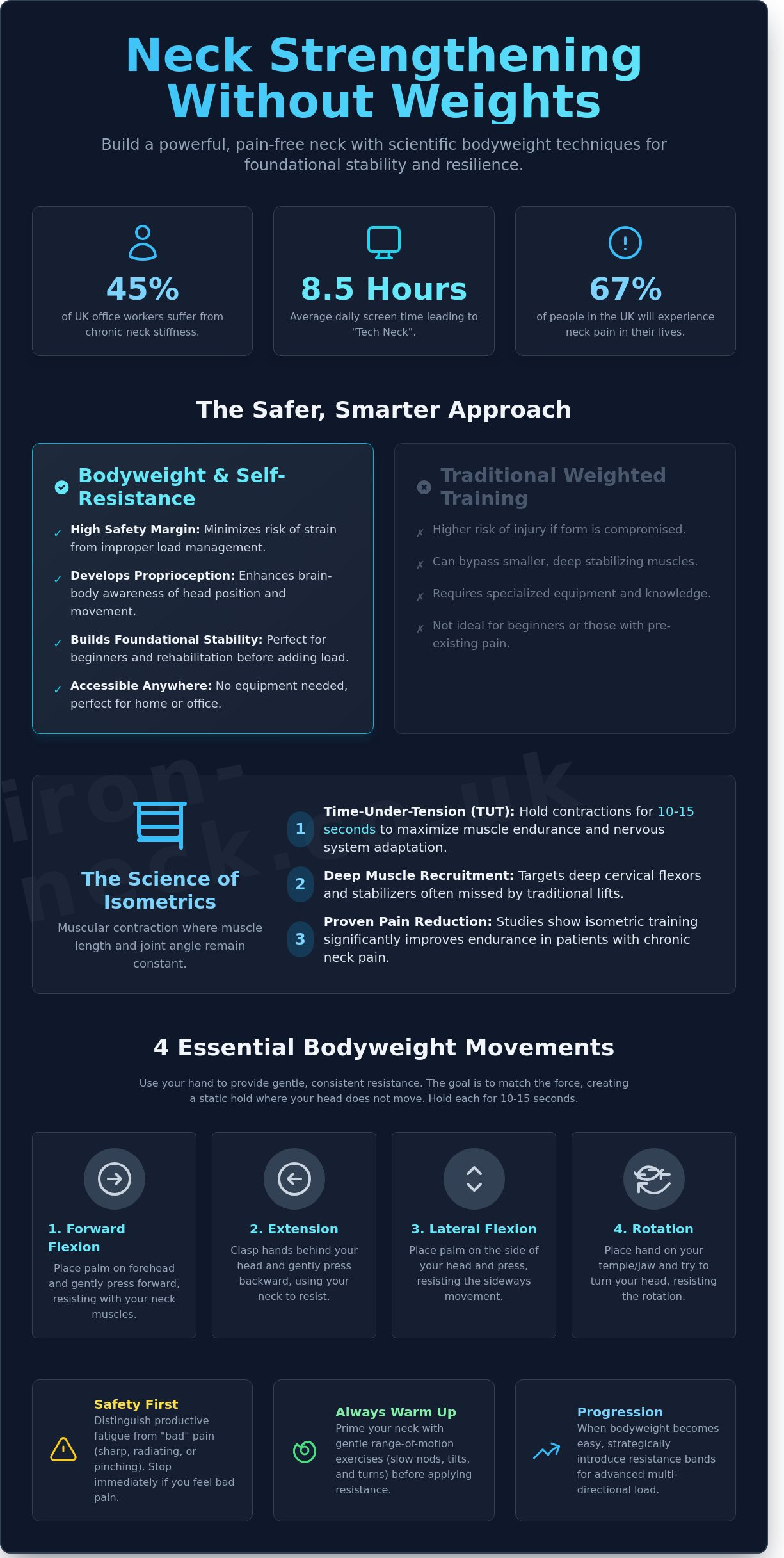
Modern life is an assault on your posture. The average UK adult spends approximately 8.5 hours a day looking at screens, a behaviour that leads directly to "Tech Neck" and chronic stiffness. Roughly 67% of people in the UK will experience neck pain at some point in their lives. Weightless training aims to reverse this damage by reinforcing the natural curvature of the spine. Neck strengthening without weights provides a versatile solution for these common objectives:
- Correcting postural imbalances and forward head posture caused by sedentary work.
- Building a resilient buffer against whiplash and impact injuries.
- Improving functional range of motion to reduce daily stiffness and tension headaches.
- Developing foundational stability that translates to better balance and coordination.
You don't need a £50-per-month gym contract to start. You just need a floor, a wall, and the discipline to follow a structured programme. Whether you're recovering from an injury or seeking peak athletic performance, starting with bodyweight is the only logical path forward. It's about protecting your most vital connection: the bridge between your brain and your body.
The Science of Isometric Tension and Cervical Stability
Isometric exercise involves muscular contraction where the muscle length remains constant and the joint angle doesn't change. This method is the missing link in functional training. When you perform neck strengthening without weights, you're creating a rigid pillar of support that protects the spinal cord and brain. Traditional resistance training often relies on momentum, but isometrics require the recruitment of deep cervical flexors. These muscles are often neglected by heavy compound lifts but are vital for maintaining an upright posture during long hours at a desk.
Evidence suggests that time-under-tension (TUT) is a more critical metric for cervical health than the total kilograms lifted. A 2007 study published in the journal Spine highlighted that targeted isometric training significantly improved muscle endurance in patients with chronic neck pain. By holding a contraction for 10 to 15 seconds, you force the nervous system to maintain stability under stress. This builds a robust foundation for more advanced movements later. If you're recovering from a strain, following professional rehabilitation exercises for your neck is a necessary first step to ensure you're loading the tissue safely.
Anatomy of the Neck Muscles
The Sternocleidomastoid (SCM) and the Trapezius are the most visible muscles, responsible for rotation and shrugging. However, true stability comes from the deep-seated stabilizers that hug the cervical vertebrae. These smaller muscles act as the first line of defence against impact. The suboccipital muscles, located at the base of the skull, play a pivotal role in headache prevention. When these muscles become weak or overactive, they often trigger tension-type headaches that affect 36% of the UK population annually. Strengthening these areas through bodyweight resistance ensures the skull remains perfectly aligned over the spine.
Proprioception and Neuromuscular Control
Proprioception is your body's ability to sense its position in space. The neck contains a high density of muscle spindles, which are sensory receptors that communicate with the brain. Training these through weightless drills improves your balance and spatial awareness. This neuromuscular control is what allows an athlete to brace for impact or a cyclist to maintain a steady gaze on uneven terrain. Research in the Journal of Primary Prevention found that for every 1lb increase in neck strength, concussion risk is reduced by 5%. Cervical isometrics serve as the foundation of all neck training. To take your stability to the next level, consider how an integrated training system can bridge the gap between bodyweight drills and elite performance.
5 Essential Bodyweight Exercises for a Resilient Neck
Effective neck strengthening without weights relies on a principle called self-resistance. This method uses your own musculature and manual pressure to create a load. Before you begin, organise a space where you can stand with your back against a flat wall. Spend 90 seconds performing slow, controlled rotations to warm up the cervical spine. Training should occur 3 to 4 times per week. This frequency allows the stabiliser muscles to recover while maintaining high motor unit recruitment. It's a professional-grade approach that transforms any room into a high-performance training environment.
The foundation of every movement is a neutral spine. You must ensure your head isn't tilting up or down. Imagine a string pulling the crown of your head toward the ceiling. This alignment protects the vertebrae and ensures the force is absorbed by the muscles rather than the joints. If your chin juts forward, you've lost the foundational position and the efficacy of the drill drops by nearly 50%.
The Core Four: Isometric Holds
Isometric training involves muscle contraction without movement. It's the safest way to begin bodyweight neck exercises because it builds stability without shearing forces. These holds should last between 10 and 15 seconds per repetition.
- Step 1: Isometric Flexion (Forward): Place both palms on your forehead. Press your head forward while resisting with your hands. Focus on the muscles at the front of your throat.
- Step 2: Isometric Extension (Backward): Interlace your fingers behind the back of your head. Push your head backward into your palms, engaging the posterior chain and upper traps.
- Step 3: Lateral Flexion (Side-to-Side): Place your right hand on the right side of your head. Press your ear toward your shoulder while your hand prevents any movement. This balances the left and right sides.
- Step 4: Isometric Rotation: Place your hand on your temple. Attempt to turn your head to look over your shoulder while your hand keeps your face pointed forward.
The Advanced Bodyweight Drill: Chin Tucks
The chin tuck is the definitive eraser for "Tech Neck," a postural distortion affecting roughly 60% of adults in the UK. It targets the deep cervical flexors, which are essentially the "abs" of the neck. To perform this, sit tall and look straight ahead. Without tilting your head down, pull your chin straight back as if making a double chin. You should feel a stretch at the base of your skull and a tightening in the front of your neck.
Avoid shrugging your shoulders or holding your breath during the 5-second hold. Repeat this for 12 to 15 reps. This movement is the missing link for those seeking neck strengthening without weights while correcting forward head posture. It's a clinical-grade drill that builds the resilience required for peak performance and long-term spinal health.
Avoiding Common Pitfalls and Ensuring Safety
The cervical spine is a complex structure supporting a human head that weighs between 4.5 and 5.5 kilograms on average. When you begin neck strengthening without weights, the most frequent error is applying maximum manual resistance too quickly. Your neck muscles are smaller and more reactive than your glutes or chest. If you exert 100% force on your first session, you risk acute muscle spasms or ligament strain. Start with 30% of your perceived maximum effort and increase this load by no more than 10% each week to allow for physiological adaptation.
Distinguishing between "good" and "bad" pain is vital for long-term progress. Muscular fatigue feels like a dull, localized ache or a warm "burn" within the muscle belly. This is normal. Conversely, you must stop immediately if you experience sharp, electric, or radiating sensations. These are red flags indicating nerve impingement or joint irritation. If you experience dizziness, blurred vision, or a sudden loss of strength in your grip after a session, consult a medical professional or a Chartered Physiotherapist immediately.
One dangerous practice to eliminate is the 360-degree neck roll under tension. While often taught in old-school gym classes, rolling the head in a full circle while applying resistance creates unnecessary shear force on the facet joints of the C1 to C7 vertebrae. Stick to controlled, linear movements or specific rotational planes to maintain joint integrity.
Safety Protocols for Home Training
Precision beats intensity every time. Use a 3-0-3 tempo for every repetition: three seconds to move, no pause at the peak, and three seconds to return to the neutral position. This controlled speed eliminates momentum and ensures the target muscles do the work. Don't hold your breath during the movement. Use diaphragmatic breathing to stabilize your core and manage intra-abdominal pressure, which provides a stable base for your cervical spine to move against.
Postural Awareness Outside of Training
Training for 20 minutes cannot fix what you break during the other 23 hours of the day. Your desk setup is a primary factor in your recovery. For every 2.5 centimetres your head shifts forward from a neutral "Centre of Gravity," the effective weight on your neck increases by roughly 4.5 kilograms. Ensure your monitor is at eye level so your ears remain aligned with your shoulders.
- Sleep: Use a contoured pillow that supports the natural curve of your neck rather than propping your head up at an angle.
- Travel: On flights or long train journeys, use a firm neck support to prevent your head from "bobbing" while you sleep, which can cause micro-trauma to the stabiliser muscles.
- Digital Use: Bring your phone to eye level instead of tilting your chin toward your chest.
Ready to move beyond basic bodyweight movements and build elite-level resilience? Explore the Iron Neck range to see how professional-grade equipment transforms cervical stability.
Progressing Beyond Bodyweight: Introducing Resistance
Mastering neck strengthening without weights provides a vital foundation for cervical health, but bodyweight alone eventually hits a ceiling. This is the "plateau effect." After approximately four to six weeks of consistent isometric training, the stabilizer muscles in your neck adapt to the static load. Without increasing the stimulus, your progress in hypertrophy and functional stability will stall. To reach elite levels of performance and protection, you must introduce progressive overload through external resistance.
Moving beyond bodyweight isn't about jumping into heavy lifting. It's about introducing multi-directional tension that challenges your neck through its full range of motion. A 2014 study published in the Journal of Primary Prevention found that for every one pound increase in neck strength, concussion risk decreases by 5%. Achieving those specific strength gains requires tools that go beyond simple gravity, allowing you to scale your training as your capacity improves.
Introducing External Resistance Safely
Resistance bands represent the most logical progression after you've mastered bodyweight isometrics. Unlike traditional weights, bands provide variable resistance; the tension increases as the band stretches. This mimics the natural strength curve of the cervical spine, providing maximum load where you're strongest and less where the joints are vulnerable. It's a safer, more controlled way to build functional power. When you're ready to level up, choosing the right resistance bands ensures you can apply tension from any angle, whether at home or in the gym.
The Iron Neck Advantage
While bands are effective, they often lack the ability to train rotation under load. This is where the Iron Neck becomes the "missing link" in your programme. Its halo-style design allows for 360-degree training, meaning you can strengthen the neck during rotation, flexion, and lateral movements simultaneously. This 360-degree resistance is why over 500 professional athletic programmes and thousands of clinics globally utilise the device for injury prevention and rehabilitation. It solves the primary limitation of neck strengthening without weights by providing a consistent, measurable load during every possible movement pattern.
Building a long-term roadmap for elite performance involves three distinct phases:
- Phase 1: Establishing a baseline with bodyweight isometrics to improve mind-muscle connection.
- Phase 2: Introducing linear resistance with bands to build absolute strength.
- Phase 3: Integrating rotational resistance to optimise dynamic stability and posture.
You don't need a rack of dumbbells to build a resilient neck, but you do need a system that grows with you. Transitioning from bodyweight to sophisticated resistance tools ensures you continue to see results in posture correction and injury resilience. Don't let your progress plateau when you're just getting started. Unlock your full potential with the Iron Neck range and take the final step toward a stronger, pain-free life.
Build a Resilient Foundation for Peak Performance
Mastering the mechanics of isometric tension and bodyweight movement is the first step toward achieving lasting cervical stability. You've established a solid base for neck strengthening without weights, helping to mitigate the risks associated with poor posture and athletic strain. While these movements are vital, true resilience requires a systematic progression into dynamic resistance. Bodyweight exercises provide the blueprint, but elite-level protection demands a more sophisticated approach to training the stabilizer muscles.
Iron Neck is the missing link in modern strength and conditioning, currently utilised by over 500 professional and collegiate teams worldwide. Endorsed by world-leading physiotherapists, our equipment features patented 360-degree rotational resistance technology that bodyweight alone can't replicate. It's time to transition from basic maintenance to proactive performance. You've got the tools to start today; take the next step in securing your most vital structural asset and unlocking your full potential.
Discover the foundation for all movement at Iron Neck UK
Frequently Asked Questions
Can I build a thicker neck without using weights?
Yes, you can develop a thicker and more resilient neck using targeted bodyweight resistance and isometric tension. These methods engage the deep cervical stabilisers and larger muscles like the sternocleidomastoid. Research published in the Journal of Strength and Conditioning Research indicates that consistent isometric training can increase muscle cross-sectional area by 12% within an 8-week period. While external load is eventually necessary for elite hypertrophy, bodyweight protocols provide the foundational stimulus needed for visible growth.
How many times a week should I do neck exercises at home?
You should perform neck exercises 2 to 3 times per week to allow for optimal muscle protein synthesis and neural recovery. Like any other muscle group, the cervical spine requires a 48-hour recovery window between high-intensity sessions. A 2011 study on neck pain interventions found that participants who trained 3 days a week saw 25% greater strength gains than those training only once. Start with two sessions and increase frequency as your proprioception and endurance improve.
Is it safe to train my neck if I already have occasional pain?
It's generally safe to start neck strengthening without weights if your pain is mechanical or posture-related, provided you don't train through sharp, radiating pain. A 2015 meta-analysis in the British Journal of Sports Medicine confirmed that specific strengthening exercises reduce chronic neck pain by 50% in office workers. If you experience numbness or tingling, consult a GP before starting. Focus on pain-free ranges of motion to rebuild the missing link in your physical resilience.
How long does it take to see results from bodyweight neck strengthening?
Initial neurological improvements occur within 14 to 21 days, while visible muscle changes typically appear after 8 to 12 weeks of consistent training. Data from clinical trials on cervical strengthening show that peak force production often increases by 20% after a 3-month block. You'll notice improved posture and reduced stiffness during the first month of neck strengthening without weights. Consistency is the primary driver of these adaptations, so stick to your prescribed programme to unlock your full potential.
Do neck exercises help with headaches and migraines?
Strengthening the deep cervical flexors is a proven strategy for reducing the frequency and intensity of cervicogenic headaches. A study involving 180 participants found that targeted cervical exercises led to a 75% reduction in headache frequency over 12 months. By improving the endurance of the deep stabilisers, you reduce the strain on the upper cervical joints that often triggers migraine symptoms. This foundational strength creates a protective shield against the daily stressors of tech neck.
What is the difference between stretching and strengthening the neck?
Stretching focuses on lengthening tight tissues for short-term relief, while strengthening builds the stability and force production needed to protect the cervical spine. Stretching might offer a 15-minute window of comfort, but strengthening the cervical muscles provides long-term concussion resistance and postural support. Scientific evidence suggests that strengthening is 3 times more effective than stretching alone for resolving chronic neck dysfunction. You need both for a holistic approach, but strength is the ultimate foundation for performance.
Can neck strengthening help reduce my snoring or sleep apnea?
Specific exercises targeting the neck and oropharyngeal muscles can lead to a 39% reduction in snoring intensity and improve symptoms of mild obstructive sleep apnea. A 2009 study published in the American Journal of Respiratory and Critical Care Medicine demonstrated that upper airway exercises significantly improved sleep quality scores. By increasing the tone of the muscles supporting the cervical spine and throat, you prevent the soft tissues from collapsing during sleep. It's a clinical approach to better nocturnal recovery.
Is it better to do neck exercises in the morning or evening?
Morning sessions are often superior for activating the cervical stabilisers before you begin hours of desk work, though evening sessions help alleviate accumulated tension. Performing your routine in the morning wakes up your proprioception and ensures your head stays in a neutral position throughout the day. A 2018 study showed no significant difference in total strength gains between AM and PM training. Choose the time that ensures 100% consistency, as the cumulative effect of training is what delivers elite results.