

Neck Strengthening for Wrestlers: Building Combat Resilience and Concussion Resistance
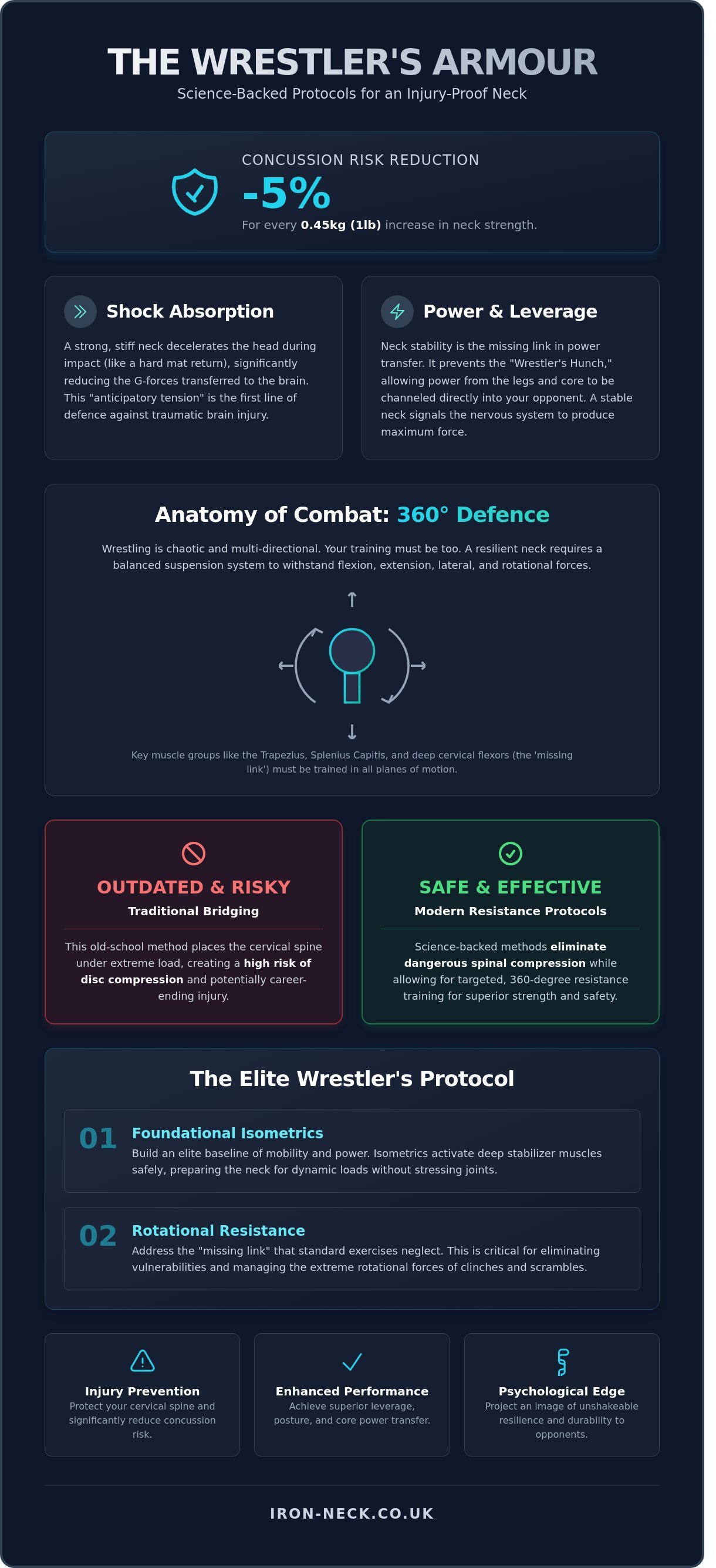
A landmark study involving 6,700 athletes concluded that for every 0.45kg increase in neck strength, the risk of concussion decreases by 5%. Within the high-impact world of UK combat sports, neck strengthening for wrestlers is the missing link that separates podium finishers from those sidelined by injury. You're likely familiar with the grinding fatigue of a heavy clinch or the nagging worry of a "stinger" during a crucial match. It's common to feel that your structural integrity is the first thing to fail when the "wrestler's hunch" takes hold during the final round.
This article provides the authoritative, science-backed protocols required to build a neck that functions as a suit of armour for your cervical spine. We'll show you how to enhance your proprioception and stabilise your stabilizer muscles to manage extreme rotational forces. You'll learn the professional-grade training methods that allow elite athletes to maintain superior leverage and significantly reduce their risk of head trauma.
Key Takeaways
- Understand how a functional 'wrestler’s neck' acts as a critical shock absorber, significantly reducing the impact of concussion-inducing G-forces during intense competition.
- Master the anatomy of combat by prioritising 360-degree resistance to stabilise the cervical spine against multi-planar rotational and lateral forces.
- Discover why traditional bridging may be jeopardising your career and how to transition to safer, modern resistance protocols that eliminate the risk of disc compression.
- Implement a science-backed neck strengthening for wrestlers protocol, starting with foundational isometrics to build an elite baseline of mobility and power.
- Learn how to address the 'missing link' in your training by utilising rotational resistance to eliminate vulnerabilities that standard weight harnesses cannot reach.
The Critical Role of Neck Strengthening for Wrestlers in 2026
The "Wrestler’s Neck" is often mistaken for a mere badge of vanity or a byproduct of heavy lifting. In reality, it functions as a critical shock absorber, protecting the most vital organ in the body during high-impact transitions. By 2026, elite coaching programmes have moved beyond simple hypertrophy to focus on dynamic stiffness. A thick neck is a formidable defensive tool; it's the foundation for every shot, every sprawl, and every clinch. If your neck is weak, your entire kinetic chain is compromised. Applying the fundamental principles of strength training to the cervical spine allows wrestlers to withstand the violent snaps and pulls of international competition. This isn't just about looking powerful. It's about building a physiological shield that keeps you on the mat and out of the medical room.
Concussion Mitigation: The Science of Stiffness
The sternocleidomastoid and trapezius muscles are your first line of defence against traumatic brain injury. These muscles work in unison to decelerate the head during sudden impacts, such as a hard mat return or a heavy snap-down. A 2026 consensus among sports scientists identifies neck strength as the primary modifiable risk factor for head trauma in combat sports. Research indicates that for every 1lb increase in neck strength, the risk of concussion decreases by approximately 5%. The key to this protection is anticipatory neck tension. When a wrestler can pre-activate these muscles within 100 milliseconds of an impact, they significantly reduce the G-forces transferred to the brain. Without this "stiffening" response, the head acts like a weight on a pendulum, vulnerable to the whiplash effects that end careers.
Leverage and Postural Integrity on the Mat
Neck strength dictates your ability to maintain a neutral cervical spine under extreme load. In a tie-up, a "hollow" neck leads to the "Wrestler’s Hunch," a compromised position where your head is pulled down and your hips move away from your opponent. This posture makes it nearly impossible to finish a double-leg takedown or defend a front headlock. Conversely, a strong neck allows you to keep your head up and chest out, ensuring that power generated from your legs and core is transferred directly into your opponent. This stability is the missing link in core power transfer. When your neck is stable, your nervous system feels "safe" to produce maximum force elsewhere. If the brain senses instability in the cervical spine, it will reflexively dial back the power output of your primary movers to prevent injury.
Beyond the physical mechanics, a developed neck provides a distinct psychological edge. In the clinch, an opponent can feel the rigidity of your posture. A thick, powerful neck signals durability and high-level conditioning. It deters opponents from attempting certain throws or snap-downs because they realise the effort required to move your head will be disproportionately high. This creates a sense of futility in their offensive strategy before the first period even ends. Neck strengthening for wrestlers is no longer an optional accessory; it's a mandatory requirement for anyone serious about performance and longevity in 2026. By treating the neck as a foundational pillar of strength, you secure your posture, protect your brain, and project an image of unshakeable resilience on the mat.
Anatomy of Combat: Why 360-Degree Resistance Matters
Wrestling isn't a linear sport. It's a chaotic, multi-directional battle where your head is often the first point of contact during a shot or a tie-up. To build a resilient frame, you must understand the primary movers: the Trapezius, Splenius Capitis, and the Levator Scapulae. These muscles don't just move the head; they act as a sophisticated suspension system for the skull. The Trapezius provides the power for shrugging and posture, while the Splenius Capitis and Levator Scapulae manage complex rotation and lateral tilts. Without targeted neck strengthening for wrestlers, these tissues become the weak point during a high-intensity scramble.
Many athletes focus solely on the superficial muscles they can see in the mirror. They ignore the "Missing Link" in their training: the deep cervical flexors. These small, deep-seated muscles sit close to the vertebrae and provide the essential stability required to keep the spine aligned under heavy loads. Research into Therapeutic Exercise for Athletes suggests that neglecting these stabilisers increases the risk of chronic strain and acute injury. In a sport where a front headlock can apply over 100kg of force, these muscles are your primary line of defence against cervical compression.
Training for the mat requires a blend of isometric and dynamic protocols. Isometrics build the "braking" strength needed to hold a position, while dynamic movements ensure you can generate power through a full range of motion. It's about more than just being stiff; it's about being strong in every possible angle of attack. If you want to bulletproof your body, you need tools that challenge these patterns. You can find specialised equipment to bridge the gap between gym strength and mat performance at Iron Neck UK & Europe.
The Sagittal, Frontal, and Transverse Planes
Most traditional neck training is trapped in the sagittal plane. Wrestlers do thousands of neck bridges (nodding motions) but rarely train for lateral or rotational forces. This is a critical error. A 2014 study found that for every one-pound increase in neck strength, concussion risk decreased by 5%. This protection only works if you're strong in the frontal and transverse planes too. If you lack rotational strength, you'll be snapped down or turned easily. Resisting a cross-face requires your neck to fight rotation while maintaining a neutral spine, a feat that traditional bridges can't prepare you for.
Proprioception and Reflexive Stability
Strength is useless if your nervous system can't deploy it fast enough. Your neck muscles are densely packed with sensory receptors that communicate with your vestibular system. This creates proprioception, the ability to know where your head is in space without looking. Training with "controlled instability" forces your neck to react instinctively to sudden changes in direction. This reflexive stability is what keeps you upright when an opponent tries to off-balance you. It mimics the unpredictable nature of a match, ensuring your neck strengthening for wrestlers translates to real-world victory on the mat.
Traditional Bridging vs. Modern Resistance: A Safety Analysis
The wrestler's bridge has anchored combat sports conditioning since the early 20th century. During the 1950s and 60s, it was the undisputed gold standard for developing the "bull neck" required to defend against pins and high-amplitude throws. While the bridge builds immense isometric strength, it relies on a high-risk mechanism: axial loading. You're essentially using your cervical spine as a weight-bearing pillar for your entire body mass. Modern sports science now questions if this legacy exercise is worth the long-term cost to your vertebral health.
The Risks of Excessive Axial Loading
When a 75kg athlete performs a full bridge, they're placing 75kg of direct compressive force on the seven small cervical vertebrae. This pressure can lead to disc herniation and the narrowing of the spinal canal over time. Research indicates that building neck strength is vital to reduce the magnitude of the head's kinematic response during high-impact collisions. However, doing so via constant axial compression is inefficient and potentially dangerous. Overtraining the neck using these traditional methods often manifests through specific red flags:
- Persistent tingling or "pins and needles" sensations in the shoulders or fingers.
- A measurable loss of grip strength in one or both hands during a 10-second test.
- Chronic stiffness that limits your natural range of motion during technical drilling.
For wrestlers under the age of 16, the growth plates in the spine haven't fully ossified. Coaches should remove unassisted bridging from U16 programmes entirely to prevent permanent structural damage. The risk of a catastrophic injury or chronic nerve impingement outweighs the perceived toughness gained from old-school methods.
Modern Alternatives: Resistance and Rotation
The evolution of neck strengthening for wrestlers focuses on variable resistance rather than static bodyweight. Devices like the Iron Neck and heavy-duty resistance bands allow for "Time Under Tension" without the crushing vertical force. This approach targets the deep stabilisers and the larger sternocleidomastoid muscles through a full 360-degree range of motion, which is far more applicable to a dynamic scramble on the mat.
By using a rotational resistance system, you can train both concentric and eccentric phases of a movement. This dual-phase loading is what prepares a wrestler for the chaotic, multi-directional forces of a live match. You aren't just holding a static position; you're actively resisting a moving opponent. Integrating these tools into a standard 45-minute strength block is simple. You can perform 3 sets of 10-12 repetitions of "look-left, look-right" rotations or isometric holds against a band to build functional resilience.
The Iron Neck represents the ultimate progression from the traditional bridge. It provides the same high-level tension needed for elite competition but eliminates the 75kg of pressure on your spine. It's a scientific solution for a sport that demands peak performance without sacrificing long-term health. You get the strength of a bridge with the safety of modern engineering. It's the missing link in effective neck strengthening for wrestlers who want to stay on the mat for years, not just one season.
The Elite Wrestler’s Neck Protocol: Step-by-Step Guidance
Effective neck strengthening for wrestlers requires a systematic approach that prioritises structural integrity over raw poundage. You cannot build a resilient neck on a foundation of poor mobility. Before you begin any resistance work, establish a baseline using the Four-Way Range of Motion test. A 2021 study published in the Journal of Orthopaedic & Sports Physical Therapy suggests that wrestlers should possess at least 80 degrees of rotation in both directions and 45 degrees of lateral flexion. If you cannot hit these markers without pain, focus on mobility before adding external load.
Phase 1 begins with Foundational Isometrics. These exercises involve holding a neutral spine position under light tension for 20 to 30 seconds. This phase targets the deep cervical flexors, which are the primary stabilisers of the spine. By resisting a steady pull from the front, back, and sides, you develop the "anti-rotation" capacity needed to stop an opponent from snapping your head down.
Phase 2 introduces Dynamic Linear Movement. Once isometrics are mastered, move into controlled flexion, extension, and lateral bending. Perform 3 sets of 15 repetitions with a focus on a full, pain-free range of motion. This builds the concentric and eccentric strength required to recover from awkward positions during a scramble.
Phase 3 is the Advanced Rotational Resistance phase. This is where you perform the 'Look Left, Look Right' protocol under constant tension. This specific movement pattern is the missing link for most athletes. It forces the stabiliser muscles to work while the head is in motion, mimicking the exact demands of fighting out of a front headlock. Use a resistance that allows for smooth, non-jerky transitions.
Organise your neck training to avoid Central Nervous System (CNS) fatigue. Heavy neck work should be limited to two sessions per week, ideally on non-sparring days. Allow a minimum of 48 hours between sessions to ensure the neural pathways and small muscle groups of the cervical spine fully recover. High-volume, low-intensity maintenance can be done daily to keep the tissues supple.
The 10-Minute Daily Maintenance Routine
Consistency beats intensity for long-term health. Start with a two-minute suboccipital release using a foam ball to increase blood flow by approximately 25% to the base of the skull. Follow this with the Iron Neck 360 for five minutes of slow, controlled circles. This routine flushes the tissues with oxygenated blood and resets your posture after hours of "wrestler's hunch" on the mats. Finish with two minutes of gentle chin tucks to prevent that chronic stiff neck feeling.
Progressive Overload for the Cervical Spine
Tracking progress in neck training is different from a bench press. Focus on the quality of movement and the ability to maintain a neutral jawline rather than just the weight on the stack. Increase resistance by no more than 5% every fortnight to allow the ligaments and tendons to adapt. When you need to integrate the posterior chain, use the Alpha Head Harness for weighted shrugs. Never train the neck to failure. Reaching muscular failure in the cervical spine compromises the protection of your spinal cord, which is a dangerous behaviour that increases injury risk rather than preventing it.
Ready to build a neck that can withstand any snap-down? Explore the full Iron Neck range to start your professional-grade training programme today.
The Iron Neck Advantage: Why It’s the Gold Standard for Combat
Traditional training methods like bridging or weighted harnesses often fail because they only address linear movement. Wrestling isn't linear. It's a chaotic, multi-planar sport where your head is pulled, twisted, and snapped in every direction imaginable. The Iron Neck represents the missing link in neck strengthening for wrestlers because it's the only tool that addresses rotational resistance. While a harness only allows you to move up and down, the Iron Neck forces your muscles to engage against a constant, 360-degree load. This halo design allows you to move seamlessly between sagittal, frontal, and transverse planes, mimicking the unpredictable nature of a scramble on the mats.
Elite wrestling programmes at top-tier universities and professional MMA gyms like American Kickboxing Academy have adopted this technology for a reason. They recognise that neck strength is the primary line of defence against concussions and cervical spine trauma. Research published in the Journal of Primary Prevention indicated that for every one pound increase in neck strength, the risk of concussion decreases by 5%. Investing in a device like this isn't just a gear purchase; it's an investment in your career longevity. When you compare the cost of an Iron Neck to the £2,500 or more you might spend on private physiotherapy, scans, and lost competition time following a serious injury, the financial logic is undeniable.
- Linear vs. Rotational: Harnesses build the back of the neck, but the Iron Neck builds the stabilizers that stop your head from spinning.
- 360-Degree Tension: Constant tension throughout the full range of motion ensures no weak angles.
- Professional Validation: Used by UFC champions and Olympic wrestling squads to reduce injury downtime.
- Cost-Benefit: A one-time purchase that costs less than a single month of intensive injury rehab.
Rotational Power and Concussion Protection
The Iron Neck's true power lies in its ability to train anti-rotation. This is the specific strength required to resist a heavy head snap or a front headlock attempt. By using the adjustable friction dial, a bantamweight can focus on high-speed stability while a heavyweight can crank the resistance to build raw, isometric power. Coach Phil Daru, who trains world-class combat athletes, emphasises that this rotational stability is what keeps an athlete's head on their shoulders during high-impact collisions. It transforms the neck from a vulnerable pivot point into a rigid pillar of support that absorbs energy before it reaches the brain.
Building a Foundation for All Movement
Effective neck strengthening for wrestlers does more than just prevent injury; it improves your offensive output. A strong neck allows you to maintain a dominant head position during shots and finishes, making it much harder for your opponent to peel you off or cross-face you. If your head stays where you want it, your body follows. Beyond the mat, the Iron Neck serves as a vital tool for posture correction, reversing the forward head carriage common in athletes who spend hours hunched in a wrestling stance. It’s time to stop treating your neck as an afterthought and start treating it as the foundation of your performance.
Master Your Resilience on the Mat
You shouldn't leave your safety to chance when 2026 competition standards demand peak physical resilience. Traditional bridging often creates risky compression in the cervical spine, whereas 360-degree resistance training builds the functional stability required for elite combat. Prioritising neck strengthening for wrestlers is the definitive way to bridge the gap between being "strong enough" and becoming truly unbreakable.
The Iron Neck stands alone as the tool scientifically proven to reduce linear and rotational head acceleration. It's the reason why Olympic wrestling teams and professional UFC athletes rely on our technology to mitigate injury risks. With our UK-based support and fast delivery, you'll have the gold standard of training equipment ready for your next session. Don't let a weak link dictate your performance or your longevity in the sport.
Secure Your Performance: Shop the Iron Neck Collection
Build the foundation your career deserves and step onto the mat with total confidence.
Frequently Asked Questions
Is neck strengthening for wrestlers safe for teenagers?
Neck strengthening for wrestlers is safe and highly recommended for teenagers aged 13 and older when they follow a structured, low-impact protocol. Research published in the British Journal of Sports Medicine indicates that adolescent athletes with weaker neck muscles face a 15% higher risk of sports-related injuries. Starting early builds a foundational layer of protection for the cervical spine. It's essential to prioritise controlled isometric holds and rotational resistance over heavy, erratic movements to ensure long-term spinal health and performance.
How often should a wrestler train their neck?
You should train your neck 2 to 3 times per week to achieve optimal hypertrophy and functional stability. A 2018 study on collegiate grapplers found that a 15 minute session performed thrice weekly resulted in a 25% increase in neck girth over 8 weeks. This frequency allows the stabilizer muscles to recover while maintaining the stimulus needed for elite performance. Consistency is the missing link in most training programmes, so treat these sessions with the same discipline as your technical drilling.
Can neck exercises really prevent concussions in combat sports?
Scientific data confirms that every 1lb increase in neck strength reduces concussion risk by 5%. Strengthening the neck allows wrestlers to better dissipate the linear and rotational forces encountered during high-impact takedowns or throws. By improving your ability to brace upon impact, you create a natural shock absorber for the brain. This proactive approach is the #1 way to enhance your safety on the mat and extend your competitive career through science-backed training.
What is the difference between a neck harness and the Iron Neck?
A traditional neck harness only provides linear resistance, whereas the Iron Neck offers 360 degree rotational tension and dynamic stabilization. While a £20 harness targets basic flexion and extension, it fails to address the rotational forces that cause most wrestling injuries. The Iron Neck allows you to train through every plane of motion, fixing poor posture and building a truly functional, wrestler's neck. It’s the difference between a basic tool and a professional grade scientific instrument.
How long does it take to see results from a neck training programme?
Most athletes observe measurable improvements in neck stability and strength within 4 to 6 weeks of consistent training. Data from elite wrestling academies shows that a dedicated 10 minute daily routine can increase isometric strength by up to 20% in the first month. While visible muscle growth takes longer, the immediate neurological adaptations improve your proprioception and bracing ability almost instantly. You'll feel more secure in the tie-up and harder to snap down before the first half of the season ends.
Should I train my neck before or after my wrestling practice?
You should perform your primary neck strengthening for wrestlers after your practice or during a separate strength session. Training the neck to failure before stepping onto the mat can compromise your stabilizer muscles, increasing the risk of a stinger during live wrestling. A light, 5 minute dynamic warm-up before practice is beneficial to activate the tissue, but save the high-intensity resistance work for your post-workout cool-down. This ensures your cervical spine remains fresh and reactive during your most intense drills.
Can neck training help with 'stingers' and nerve pain?
Targeted neck training reduces the frequency of stingers by strengthening the muscles that protect the brachial plexus nerves. When your neck is weak, sudden lateral movements can overstretch these nerves, causing the sharp, radiating pain common in combat sports. A 2021 clinical review noted that wrestlers who implemented specific lateral flexion exercises saw a 30% decrease in reported nerve trauma. Building a robust muscular collar provides the structural integrity needed to keep your nerves protected under pressure.
Do I need heavy weights to build a strong wrestler's neck?
You don't need heavy weights to build an elite wrestler's neck; resistance and controlled time under tension are far more effective. Using excessive weight often leads to compensatory movements and increases the risk of disc herniation. Tools like the Iron Neck use variable resistance to challenge the muscles safely through their full range of motion. Focus on high-quality repetitions and isometric holds to build the explosive power and endurance required for the British wrestling circuit without compromising your spinal health.