

Neck Strengthening for Concussion Rehab: Building Resilience and Recovery in 2026
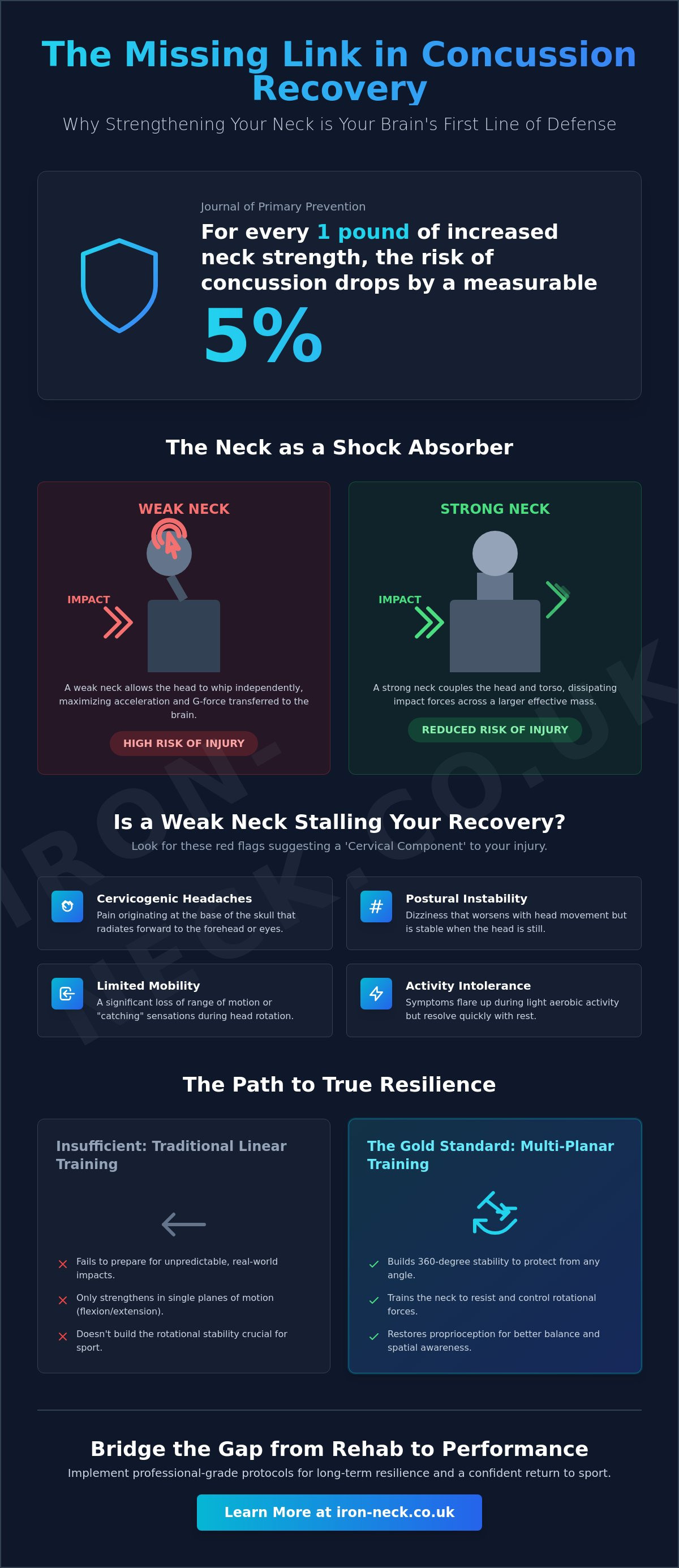
Did you know that for every single pound of strength you add to your neck, your risk of concussion drops by a measurable 5%? This statistic from the Journal of Primary Prevention highlights a critical reality: your cervical spine is your first line of defense against traumatic brain injury. If you're currently battling the persistent fog of headaches, dizziness, or neck pain, you already know that rest alone isn't enough. It's frustrating to feel like your recovery has plateaued, especially when you're anxious about the risk of re-injury upon your return to the field.
We understand that the transition from clinical rest to active training is often filled with uncertainty and fear. This article will bridge that gap by detailing the essential role of neck strengthening for concussion rehab in building long-term resilience. You'll discover the clinical link between cervical strength and brain health, and learn how to move beyond simple mobility drills into sophisticated, multi-planar resistance training. We'll provide a clear recovery timeline, explain the scientific justification for using dedicated resistance devices, and show you exactly how to transition from basic movements to high-level impact protection.
Key Takeaways
- Understand the whiplash-concussion overlap and why restoring cervical stability is essential for resolving lingering vestibular and ocular symptoms.
- Discover the biomechanics of energy attenuation and how a stronger neck acts as a shock absorber to dissipate kinetic forces before they reach the cranium.
- Follow a phased recovery timeline for neck strengthening for concussion rehab, moving safely from pain-free range of motion to high-level isometric holds.
- Learn why traditional linear movements are insufficient for sport and why multi-planar, rotational training is the key to true resilience.
- Explore how the Iron Neck bridges the gap between clinical rehabilitation and elite performance by training the neck in 360 degrees of motion.
The Critical Link Between Neck Strength and Concussion Recovery
Every impact that causes a concussion involves a cervical acceleration-deceleration event. It's a physiological certainty. The forces required to disrupt neural function often exceed the threshold for soft tissue damage in the neck. This means that while the brain is the focus, the cervical spine is frequently the silent partner in your injury. For a comprehensive overview of concussions, it's clear that symptoms like fatigue, headache, and neck pain are deeply intertwined. If you ignore the neck, you're only treating half the injury.
Modern protocols in 2026 have shifted away from the outdated "dark room" approach. We now know that prolonged passive rest can actually delay recovery by allowing the cervical musculature to atrophy. Instead, active cervical stabilization is the new gold standard. By initiating neck strengthening for concussion rehab early in the sub-acute phase, athletes can address Cervicogenic Post-Concussion Syndrome (CPCS). This condition occurs when neck dysfunction mimics or exacerbates brain-based symptoms, leading to a cycle of chronic pain and vestibular issues. Targeted resistance training doesn't just build muscle; it restores the neurological communication between the head and the torso.
Why the Neck is the Brain's First Line of Defence
The suboccipital muscles are densely packed with proprioceptors. These sensors provide the brain with constant feedback about head position and spatial orientation. When these muscles are weakened or traumatized, the feedback loop breaks. This disruption often manifests as "visual fog" or a sense of being "off" even when ocular tests appear normal. Neck strengthening for concussion rehab restores this proprioceptive clarity, acting as a functional anchor for the vestibular system. Cervical stiffness is a primary contributor to prolonged concussion symptoms.
Identifying the 'Cervical Component' of Your Injury
Distinguishing between a primary brain injury and referred pain from the neck is critical for a fast recovery. While a concussion is a metabolic crisis in the brain, the neck often drives the physical symptoms that keep you on the sidelines. Early screening for cervical spine dysfunction by a healthcare professional is essential. Look for these red flags that suggest your recovery is being stalled by neck weakness:
- Cervicogenic Headaches: Pain that originates at the base of the skull and radiates forward to the forehead or eyes.
- Postural Instability: Dizziness that worsens with head movement but remains stable when the head is still.
- Limited Mobility: Significant loss of range of motion or "catching" sensations during rotation.
- Activity Intolerance: Symptoms that flare up during light aerobic activity but resolve with rest.
Addressing these issues requires more than just stretching. It requires the systematic application of resistance to rebuild the neck's ability to manage load and dissipate energy. This is where professional-grade rehab equipment becomes the definitive solution for returning to peak performance.
The Biomechanics of Energy Dissipation: Building the 'Shock Absorber'
The human head weighs roughly 10 to 12 pounds. When an impact occurs, the brain's safety depends entirely on how much of that kinetic force is transferred to the cranium. Think of your neck as a shock absorber. A weak neck allows the head to whip independently of the body, maximizing acceleration and brain displacement. Conversely, a robust cervical spine increases the "effective mass" of the head, neck, and torso unit. By coupling the head more securely to the body, the force of an impact is distributed across a much larger mass, significantly reducing the G-force experienced by the brain tissue.
The data supporting this is definitive. Research indicates that every one-pound increase in neck strength correlates with a 5% decrease in the odds of sustaining a concussion. This conclusion is reinforced by a systematic review of neck strengthening studies, which highlights that building this muscular "cylinder" is a primary modifiable risk factor for athletes. However, absolute strength is only part of the equation. Recruitment speed, often referred to as "neck stiffness," determines how quickly your muscles can react to an unexpected blow. If the muscles don't fire fast enough, the strength they possess becomes irrelevant at the moment of impact.
Anticipatory Muscle Activation (Pre-Tensing)
In high-velocity environments like rugby or MMA, the most dangerous hits are those the athlete doesn't see coming. Your nervous system must be trained to engage the deep neck flexors, such as the longus colli, almost instantly. These muscles act as internal stabilizers, maintaining spinal alignment and preventing the rapid deceleration that causes neural trauma. Effective neck strengthening for concussion rehab focuses on neural drive, teaching the brain to pre-tense the musculature before the energy of an impact can reach the brain's axonal structures.
Rotational vs. Linear Energy
Traditional gym exercises like shrugs or simple nods only address linear forces. This is a dangerous oversight. Rotational acceleration is the primary driver of traumatic brain injury because it causes shearing of the brain's white matter. To build true resilience, you must move beyond one-dimensional training. The neck is designed for 360-degree movement, and your recovery protocols should reflect that complexity. By utilizing the Iron Neck Device, you can develop the specific rotational stability required to dissipate energy from any angle. This multi-planar approach to neck strengthening for concussion rehab ensures that you aren't just strong in a straight line, but protected in the chaotic, multi-directional environment of competitive sports.
Transitioning from Mobility to Resistance: The Rehab Timeline
Transitioning from total rest to active loading is the most precarious stage of recovery. Many athletes fail here because they mistake a lack of pain for true performance readiness. Effective neck strengthening for concussion rehab follows a methodical, three-phase ladder that respects the brain's metabolic limits while demanding muscular adaptation. This timeline ensures that by the time you return to the field, your cervical spine has been transformed from a liability into a protective asset.
Phase 1: Restoring the Foundation
Restoring pain-free range of motion (ROM) is the immediate priority during the acute phase. We start with guided chin tucks and gentle rotations to "wake up" deep cervical stabilizers that often become inhibited after trauma. Integrating these movements with ocular tracking exercises helps the brain recalibrate spatial awareness and proprioception. Success in this phase is defined by staying below your "symptom threshold." If a specific movement triggers visual fog or dizziness, you must back off immediately.
Phase 2: The Power of Isometrics
Isometrics are the safest entry point for resistance training because they build tension without changing muscle length. By performing multi-angle holds, you develop endurance and stability at every degree of rotation. This phase bridges the gap between basic mobility and the rigors of dynamic loading. Isometric contractions facilitate localized blood flow and nutrient delivery to the cervical tissues without the shear stress associated with high-velocity movement. You're building the capacity to hold your ground before you attempt to move through it.
Once isometrics are mastered without symptom provocation, you move into Phase 3: Strengthening. This involves dynamic resistance that mimics the chaotic forces of sport. You're no longer just holding a position; you're controlling movement against an external load. This is where you utilize tools like the Iron Neck Device or Iron Neck Resistance Bands to challenge the cervical spine through its full 360-degree range. Research supports this progression, including an NIH study on neck strengthening for TBI reduction, which emphasizes that structured programs are vital for mitigating injury risk in high-impact environments. A structured approach to neck strengthening for concussion rehab is what separates a temporary recovery from permanent resilience.
How do you know when it's safe to move from bodyweight to external load? The 24-hour rule is the definitive metric. If symptoms like headaches or dizziness increase by more than two points on a ten-point scale during or after exercise, you aren't ready for more weight. You must demonstrate perfect form and symptom stability before introducing testing, rehab and recovery equipment into your daily protocol. Consistency in these phases prevents the setbacks that commonly plague unguided recoveries.
Multi-Planar Training: Why Linear Strengthening Isn't Enough
Linear training is a necessary starting point, but it isn't the finish line. If your recovery stops at simple front-to-back nods, you're leaving your brain vulnerable to the most dangerous forces in sport. Most traditional equipment, including the Alpha Head Harness, is gravity-dependent. While these tools are excellent for building specific posterior chain strength, they primarily address linear movement. In a real-world impact, forces are chaotic and multi-directional. To achieve true resilience, neck strengthening for concussion rehab must move into the third dimension.
The goal of advanced rehab is "Centration." This is the ability to keep the head neutral and stable while the body moves, rotates, or absorbs impact around it. It requires more than just strong muscles; it requires a coordinated kinetic chain. Your neck doesn't work in isolation. It relies on the shoulders and core to provide a stable base of support. By training the neck in 360 degrees, you ensure that the deep cervical stabilizers can maintain alignment regardless of the angle of impact. This "cylinder of strength" is what ultimately protects the brain's axonal structures from the shearing forces caused by rotational acceleration.
Training for the 'Chaotic' Environment
Static positions don't reflect the reality of the field or the ring. Once an athlete has established a baseline of strength, they must introduce dynamic stabilization drills. This involves adding footwork, lunges, or torso rotations while maintaining a fixed head position against resistance. It's a common mistake to assume that "bulky" trapezius muscles provide adequate protection. While large traps look impressive, they often mask underlying weakness in the deep neck flexors. True protection comes from the nervous system's ability to stabilize the head during unpredictable, high-velocity movements.
Resistance Bands vs. Rotational Devices
Simple resistance bands are a portable and effective entry point, but they have limitations. Bands often lose tension at the end of a range of motion or encourage "compensatory patterns" where the shoulders shrug to help the neck move the load. Dedicated 360-degree trainers resolve this by providing constant, adjustable tension throughout the entire movement. This eliminates "dead zones" in your strength profile and forces the cervical musculature to do the work without assistance from the upper back. To bridge the gap between clinical rehab and elite performance, you need a tool that can challenge your rotation, flexion, and extension simultaneously.
If you're ready to move beyond basic mobility and build a professional-grade shock absorber for your brain, it's time to upgrade your equipment. Explore the Iron Neck Device to see how multi-planar resistance can accelerate your recovery and provide the impact protection you need for a safe return to play.
Implementing Iron Neck Protocols for Long-Term Resilience
The gap between clinical rehabilitation and elite performance is where most recoveries fail. While standard physical therapy restores basic function, it rarely prepares the cervical spine for the high-velocity, multi-directional forces of competitive sport. Iron Neck UK & Europe bridges this gap by providing a 360-degree advantage. Unlike traditional weights that rely on gravity, this technology allows you to train rotation, flexion, and extension within a single, fluid movement. It transforms neck strengthening for concussion rehab from a static chore into a dynamic performance protocol.
Precision is vital when managing a recovering nervous system. The Iron Neck 3.0 Pro features a variable friction dial that allows for meticulous control over resistance levels. In a rehab setting, this means you can progress in micro-increments, ensuring the musculature is challenged without triggering a symptomatic flare-up. You aren't just guessing with band tension; you're applying a quantifiable load that can be adjusted as your strength-to-bodyweight ratio improves. Iron Neck UK & Europe ensures that every session builds toward a foundation of permanent resilience.
The Iron Neck 360: Rotational Stability
The "Look-Left, Look-Right" drill is the cornerstone of rotational stability. By executing this movement under controlled resistance, you force the deep stabilizers to manage tension while the head is in motion. This specifically targets the muscles responsible for preventing the head snapping that occurs during unexpected impacts. It's why professional UK rugby and football clubs have integrated this technology into their daily training environments. They recognize that a neck capable of resisting rotational acceleration is the most effective tool for brain protection available in 2026.
Consistency and Long-Term Prevention
Resilience isn't built in a single session. To maintain the protective benefits of neck strengthening for concussion rehab, you should integrate these protocols into a standard strength programme 2 to 3 times per week. Monitoring your progress is essential for long-term safety. By 2026 standards, athletes should aim for specific strength-to-bodyweight benchmarks to ensure they're adequately protected. Elite standards require reaching 10% of bodyweight for flexion and 15% for extension.
Tracking these metrics allows you to see objective gains in your capacity to dissipate energy. Iron Neck UK & Europe provides the testing, rehab and recovery equipment necessary to track these metrics objectively. By treating neck training as a non-negotiable component of your athletic kit, you ensure that your first injury is also your last. Explore the Iron Neck range for your rehab journey and start building a neck that is as resilient as it is strong.
Transform Your Recovery into Lasting Performance Resilience
Recovery shouldn't be a passive wait for symptoms to fade. It's a proactive build toward a stronger, more resilient version of yourself. We've established that the cervical spine acts as the brain's primary shock absorber and that multi-planar training is essential for dissipating dangerous rotational forces. By following a structured timeline and hitting objective strength benchmarks, you remove the guesswork from your return to sport.
Implementing neck strengthening for concussion rehab is the definitive way to bridge the gap between clinical healing and elite-level impact protection. The Iron Neck is currently used by over 500 professional sports teams globally because it's scientifically backed to reduce both linear and rotational head acceleration. With UK-based support and fast delivery for rehab clinics, you can start rebuilding your foundation today. Secure your recovery with the Iron Neck 360 and reclaim your confidence on the field. Your brain deserves a professional-grade defense.
Frequently Asked Questions
Is it safe to strengthen my neck immediately after a concussion?
No, you should not begin resistance training immediately following a head injury. Current clinical guidelines recommend a brief period of total cognitive and physical rest for the first 24 to 48 hours. Once this acute window passes and your symptoms begin to stabilize, you can gradually transition into active recovery. Always ensure you have professional clearance before moving from rest to active loading.
How do I know if my neck pain is causing my headaches after a head injury?
Headaches originating from the cervical spine, often called Cervicogenic Post-Concussion Syndrome, typically radiate from the base of the skull toward the forehead or eyes. If your pain is triggered by certain head positions, prolonged sitting, or neck stiffness, the neck is likely a primary driver. Addressing this through neck strengthening for concussion rehab can often resolve these persistent, referred symptoms when traditional rest fails.
Can neck strengthening actually prevent a future concussion?
Yes, building a robust "shock absorber" is one of the few modifiable risk factors for brain injury. By increasing the effective mass of the head-neck-torso unit, you reduce the peak acceleration the brain experiences during an impact. Strengthening the cervical musculature allows you to dissipate kinetic energy more efficiently, significantly lowering the odds of sustaining a concussion during contact sports or high-velocity activities.
What are the best exercises for the 'Deep Neck Flexors' during rehab?
The foundation of deep neck flexor training is the craniocervical flexion exercise, commonly known as a "chin tuck." This movement targets the longus colli and longus capitis, which act as internal stabilizers for the spine. During rehab, these are best performed as isometric holds. You can eventually progress these drills by adding light resistance with Iron Neck Resistance Bands to build the endurance necessary for postural stability.
How long does it take to see results from a neck strengthening programme?
Initial neurological adaptations, such as improved coordination and reduced "visual fog," often appear within the first 2 to 4 weeks of consistent training. However, significant structural changes and permanent gains in muscle density typically require a commitment of 8 to 12 weeks. A 2024 study in Cureus highlighted that a 12-week dedicated protocol was necessary to reach the lowest recorded injury values in athletic history.
Do I need a specialist to supervise my neck training after an injury?
You must consult a healthcare professional for an initial medical diagnosis and clearance to exercise. While our testing, rehab and recovery equipment is designed for self-directed use, a specialist can identify contraindications like ligamentous instability or fractures. Once cleared, following a methodical protocol allows you to safely transition from clinical rest back to the high-intensity demands of your specific sport or profession.
What is the difference between a neck harness and the Iron Neck for rehab?
A traditional neck harness is a gravity-dependent tool that primarily facilitates linear movements like flexion and extension. While useful for basic strength, it cannot address rotational forces. The Iron Neck provides a 360-degree resistance profile, allowing you to train rotation and multi-planar stability. This is essential for concussion rehab because most traumatic brain injuries are caused by rotational acceleration rather than simple linear impacts.
Can I use resistance bands for concussion rehab exercises at home?
Yes, resistance bands are an excellent and portable entry point for home-based recovery. Iron Neck Resistance Bands provide the constant tension required to challenge the muscles throughout their full range of motion without the "dead zones" found in free-weight training. They're ideal for performing the isometric holds and slow, controlled rotations that define the sub-acute phase of a successful neck strengthening for concussion rehab programme.