

Neck Mobility Exercises for Stiffness: The Science of Restoring Range of Motion
What if that 'crunch' you feel when turning your head isn't just a sign of getting older, but a direct signal that your cervical spine is unstable? That grinding sensation, the inability to comfortably check your blind spot, and the tension headaches that start at the base of your skull are not conditions you have to accept. They're symptoms of a critical weakness in the foundational muscles that support and protect your head.
Forget temporary relief from passive stretching. This guide provides a definitive, science-backed protocol to restore full range of motion. You'll master the most effective neck mobility exercises for stiffness and learn how to integrate active resistance techniques to build a resilient, powerful, and pain-free neck. We'll break down the biomechanics of your stiffness and deliver a repeatable routine designed to permanently transition you from chronic pain to fluid, confident movement.
Key Takeaways
- Understand why neck stiffness is a protective signal from your nervous system, not just a muscular issue, and how to address its root cause.
- Discover why static stretching provides only temporary relief and how active resistance techniques build permanent gains in mobility and strength.
- Implement a simple 3-minute morning protocol of neck mobility exercises for stiffness to reset your cervical spine and improve movement quality all day.
- Learn how to progress from foundational movements to 360-degree loaded mobility to build elite-level resilience against pain and injury.
The Science of Stiffness: Why Your Neck Feels Locked
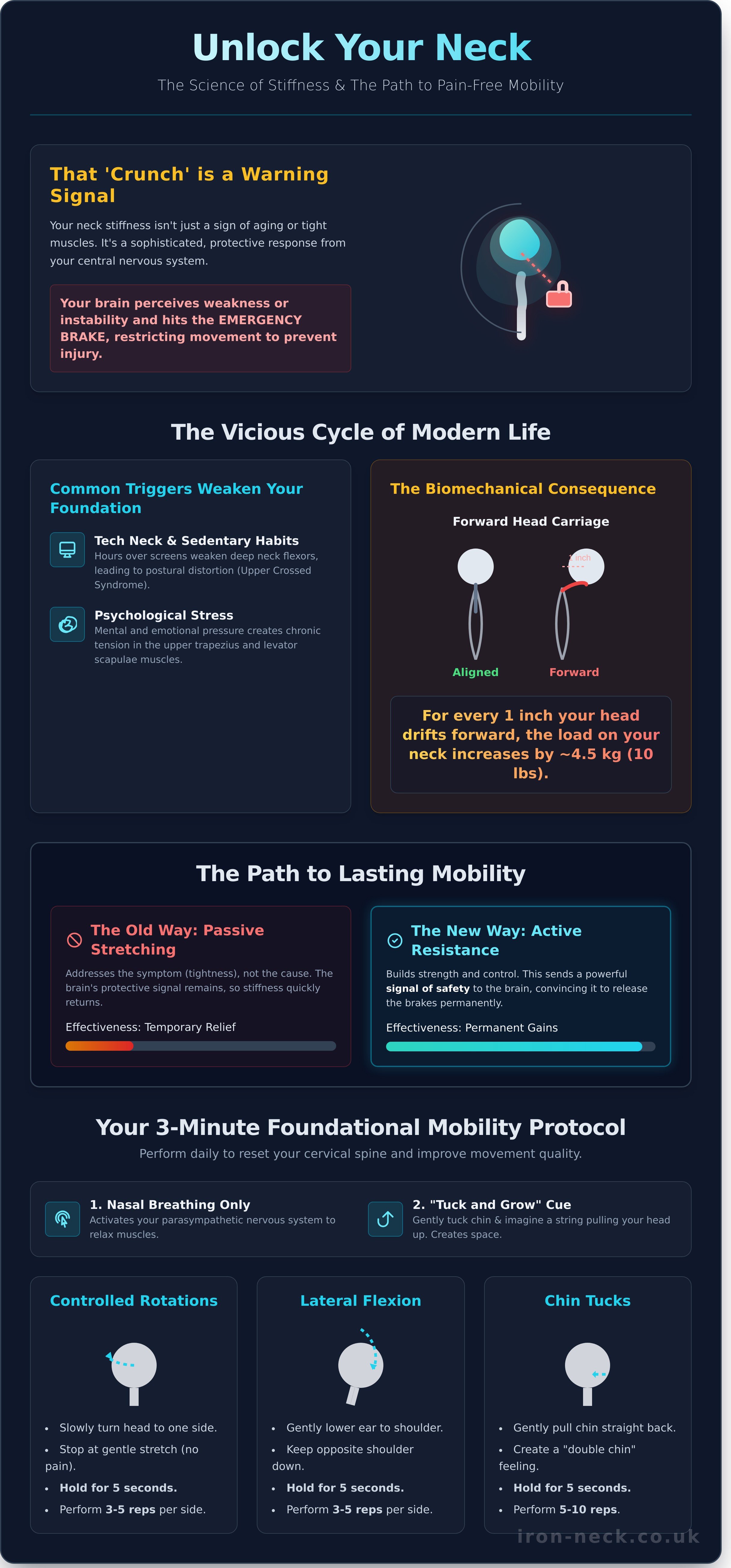
That locked, concrete feeling in your neck isn't just a sign of "tight muscles." It's a sophisticated, protective response from your central nervous system. Your brain perceives instability or weakness in your cervical spine and hits the emergency brake, restricting movement to prevent potential injury. This is a critical distinction: your stiffness is less about short, tight tissues and more about your brain actively limiting your range of motion. Understanding this is the first step to unlocking true, lasting relief.
Your cervical spine isn't just a column of bones; it's the foundation for all movement. It supports the weight of your head, houses the critical nerves that connect your brain to the rest of your body, and enables the sensory input from your eyes and ears to orient you in space. When this foundation is weak, your entire kinetic chain is compromised. Your brain, sensing this vulnerability, creates neural tension as a protective shield. This is why many people find that stretching alone provides only temporary relief. You are not addressing the root cause: the perceived lack of strength and control.
The Protective Braking Mechanism
Think of your nervous system as an intelligent control system. If it detects that the deep stabiliser muscles of your neck are not strong enough to control a specific range of motion, it won't allow you to go there. This neural lockdown is the difference between mechanical stiffness (actual tissue restriction) and the neural tension that causes most chronic pain. For too long, the focus has been on stretching, but the true "Missing Link" in most training and rehabilitation programmes is direct neck strengthening. Building strength sends a powerful signal of safety to the brain, convincing it to release the brakes.
Modern Triggers: Beyond Tech Neck
By 2026, our increasingly sedentary lifestyles have cemented a pattern of cervical deconditioning. Hours spent slouched over screens create a chronic postural distortion known as Upper Crossed Syndrome. This condition leads to the inhibition and weakening of crucial deep neck flexors and scapular stabilisers. Simultaneously, psychological stress directly impacts the upper trapezius and levator scapulae, muscles that often become rock-solid with tension during high-pressure periods. This combination of physical and mental stress creates a perfect storm for stiffness.
This postural collapse results in "forward head carriage," a condition with severe biomechanical consequences. For every inch your head drifts forward from its optimal alignment over your shoulders, the load on your cervical spine increases by approximately 4.5 kilograms. This constant strain degrades proprioception, your body's awareness of its position. Without clear signals, the brain defaults to its protective mode, further limiting movement and reinforcing the cycle of stiffness. This is why effective neck mobility exercises for stiffness must do more than just stretch; they must retrain posture, rebuild strength, and restore the brain's confidence in your neck's capabilities. A deeper look into The Science of Neck Pain reveals that this multi-faceted approach is essential for long-term resolution.
Foundational Neck Mobility Exercises for Immediate Relief
To effectively combat stiffness, you must first re-establish control. These initial movements are not about aggressive stretching; they are designed to wake up the deep cervical stabilizers that support your head. Think of this as neurological flossing for the nerves and gentle hydration for the vertebral discs. Before you begin any movement, implement two core principles. First, breathe exclusively through your nose. Nasal breathing activates the parasympathetic nervous system, lowering your overall neural tone and allowing muscles to relax. Second, use the "tuck and grow" cue: gently tuck your chin and imagine a string pulling the crown of your head towards the ceiling. This creates space in the cervical spine, decompressing the vertebrae before you initiate movement. This systematic approach is critical for effective neck mobility exercises for stiffness.
The Big Three: Rotation, Lateral Flexion, and Chin Tucks
This trio forms the bedrock of cervical spine health. Master them with slow, deliberate control to restore fundamental movement patterns. Each repetition should be intentional, focusing on the quality of the motion, not the quantity.
- Controlled Neck Rotations: Begin with the "tuck and grow" posture. Slowly turn your head to the right, as if looking over your shoulder, until you feel a gentle stretch. Stop before you feel any pain. Hold this end-range position for 5 seconds while maintaining your nasal breathing. Return to the centre with equal control and repeat on the left side. Perform 3-5 repetitions per side.
- Lateral Flexion (Ear to Shoulder): From your neutral, tall posture, gently lower your right ear towards your right shoulder. The key is to keep your left shoulder down and relaxed; do not allow it to shrug up towards your ear. This isolates the stretch in the scalene muscles on the side of your neck. Hold for 5 seconds, then return to the start. Repeat 3-5 times per side.
- Cervical Retraction (Chin Tuck): This is the single most powerful corrective for "tech neck." Sit or stand tall. Without tilting your head down, gently glide your chin and head straight back, creating a "double chin." You should feel the muscles at the front of your neck engage and a stretch at the base of your skull. This movement is so fundamental that similar techniques are included in official guidance, such as these Foundational Neck Exercises from NHS inform. Hold for 3-5 seconds and perform 10 repetitions.
Controlled Articular Rotations (CARs)
Controlled Articular Rotations, or CARs, are a systematic way to explore your joint's full range of motion. The goal is to move your neck through its largest, pain-free circle, improving joint health and proprioception (your brain's awareness of your body in space). This is one of the most productive neck mobility exercises for stiffness as it addresses the joint capsule directly.
To perform a neck CAR safely and effectively, follow this 4-point checklist:
- Create Tension: Lightly brace your core and keep your shoulders locked down. This isolates the movement to the cervical spine.
- Move Slowly: The entire rotation should take at least 30 seconds. Speed is the enemy of control.
- Explore the Outer Limits: Actively try to draw the biggest circle possible with your chin, moving through flexion, rotation, and extension.
- Breathe: Maintain steady nasal breathing throughout the entire movement.
Warning: It is critical to distinguish between a muscular stretch and a joint impingement. A stretching sensation feels broad and elastic. A pinching, sharp, or blocking sensation is a signal from your nervous system to stop. If you feel a pinch, do not push through it. Make your circle smaller to avoid that specific point. Once you have established this baseline control, the next step is to build the foundational strength that locks in your new mobility for good.
Active Resistance: The Key to Lasting Mobility
Passive stretching can feel good, but the relief is often fleeting. Why? Because you're only addressing the symptom, not the root cause. True, lasting freedom from neck pain comes not from temporarily lengthening a muscle, but from strengthening it. Your brain restricts movement when it senses instability. By introducing active resistance, you are proving to your nervous system that your neck is strong, stable, and capable of moving through a full range of motion without risk. This is the transition from feeling loose to being functionally strong.
This approach moves beyond simple neck mobility exercises for stiffness and into the realm of performance and protection. By actively loading the muscles of the cervical spine, you not only eliminate stiffness but also build foundational strength that improves posture, enhances athletic performance, and increases your body's resilience against impact. It's the missing link in most mobility programmes.
Isometrics for End-Range Stability
Isometrics involve contracting a muscle without changing its length. For a stiff neck, this is a game-changer. You can apply this principle to strengthen the exact positions where you feel tight, teaching your body that these ranges are safe. For example, to target side-bending (lateral flexion), place your right palm on the right side of your head. Gently press your head into your hand while your hand provides equal resistance. Hold for 5-10 seconds, then relax. You're not trying to win; you're activating the deep stabiliser muscles. For rotation, use the "Push-Pull" method to activate the powerful sternocleidomastoid (SCM) muscle. Place one hand on your chin and the other on the back of your head, then gently attempt to turn your head while resisting the movement. Stability is the permission the brain gives the body to move freely.
Eccentric Loading and Tissue Resilience
Eccentric movement is the "braking" phase of an exercise, where a muscle lengthens under tension. Think of slowly lowering a heavy weight. This type of contraction is scientifically proven to build stronger, more resilient muscle fibres and connective tissue. For the neck, eccentric strength is the foundation of force absorption and injury prevention. It’s why elite rugby players and combat athletes dedicate significant training time to it; a 2014 study found that for every one-pound increase in neck strength, the odds of sustaining a concussion decreased by 5%.
While manual isometrics are an excellent starting point, achieving controlled eccentric loading requires specialised tools. This is where equipment like Iron Neck Resistance Bands becomes essential. They allow for consistent, measurable tension through the entire range of motion, building the robust strength needed to protect your cervical spine from the demands of sport and life. This type of training, when combined with a consistent routine like the Daily Mobility Protocol outlined by the Oxford Health NHS Foundation Trust, creates a comprehensive system for lasting neck health and peak performance.
Creating Your 2026 Daily Mobility Protocol
Isolated exercises provide temporary relief. A structured protocol delivers lasting resilience. To eliminate chronic stiffness, you need a systematic approach that integrates movement into your daily life. This isn't about adding another hour to your schedule; it's about using precise, targeted drills to reclaim function and build a foundation for strength. True performance starts with a plan.
Begin each day with this 3-Minute Morning Flow to reset your cervical spine after sleep:
- Minute 1: Controlled Chin Tucks. Lying on your back without a pillow, gently nod your chin towards your chest, creating a "double chin." Feel the muscles at the front of your neck engage. Perform 2 sets of 15 repetitions, focusing on control, not speed.
- Minute 2: Supine Rotations. Remaining on your back, slowly rotate your head to the left, as if trying to touch your ear to the floor. Hold for 2 seconds, return to centre, and repeat on the right. Complete 10 total rotations.
- Minute 3: Cervical Glides. Sit up and imagine your head is on a track. Without tilting, gently glide your head forward, then retract it backward as far as possible. This isolates the upper cervical spine. Perform 15 repetitions.
Consistency is non-negotiable. The principle "motion is lotion" is clinically accurate; movement stimulates synovial fluid, which lubricates your spinal joints. Performing these drills for 3 minutes every day is neurologically and physiologically superior to one 21-minute session per week. Little and often wins.
To quantify your progress, use the "Blind Spot Test." Sit upright in a chair and fix your gaze on a point directly in front of you. Slowly rotate your head to the right until your peripheral vision just starts to blur. Note an object in that spot. This is your current active range of motion. Retest every 14 days, aiming to expand that field of vision.
The Office Reset: Combatting Sedentary Stiffness
Your desk is a primary battlefield for neck health. Implement the 50/5 rule: for every 50 minutes of seated work, stand up and move for 5 minutes. Use this micro-break for seated Cat-Cows or Ear-to-Shoulder tilts. These discrete neck mobility exercises for stiffness won't draw attention but will prevent neuromuscular patterns from setting in. Finally, adjust your monitor so the top third of the screen is at eye level, eliminating the "tech neck" posture that sabotages your progress.
Pre-Workout Activation
You would never squat heavy with cold hips. Why would you perform heavy lifting with a stiff, cold neck? A compromised cervical spine inhibits neural drive and destabilises the entire kinetic chain, increasing injury risk from the shoulders to the lower back. Before you touch a barbell, you must activate. Prioritise dynamic mobility work like Controlled Articular Rotations (CARs) to prepare the joints. Save static holds for your post-workout cool-down. For serious athletes, mobility is the starting line, not the finish. To build elite-level protection and performance, explore our Advanced Neck Strength Training Protocols.
Once your mobility is restored, the next step is to build strength. A strong neck is the missing link in total-body power and injury prevention. Explore the Iron Neck systems to build foundational strength and unlock your full potential.
The Iron Neck Advantage: 360-Degree Mobility Training
The previous bodyweight movements are foundational for alleviating immediate discomfort. But what if you could eliminate the root cause of that stiffness permanently? Standard stretching provides passive flexibility, but true, lasting mobility requires strength through a full range of motion. This is called Active Mobility, and it’s the principle that makes the Iron Neck, a leading product from Iron Neck UK & Europe, the most effective tool for building a strong, resilient, and pain-free neck.
Its unique design introduces two concepts that bodyweight exercises simply can't replicate: Linear Projection and Rotational Training under consistent, variable resistance. Unlike traditional stretches where it’s easy to compensate by shrugging your shoulders or twisting your torso, the Iron Neck’s halo design isolates the muscles of your neck and upper back. This forces them to perform the work without "cheating." It provides concentric and eccentric loading through every degree of movement, activating deep stabiliser muscles often missed by other methods. This is the missing link between basic relief and elite performance.
Redefining Rotation with the Iron Neck
The device’s 360-degree rotational track transforms standard movements into powerful strengthening protocols. Performing smooth “Figure 8s” or controlled “Left-Right” rotations against the band’s tension challenges your cervical spine in a way that builds both mobility and stability simultaneously. Athletes in professional rugby and motorsports report that this dynamic resistance unlocks restricted movement and enhances spatial awareness, a critical factor in preventing injury and improving performance.
From Rehab to Performance
It’s no surprise that leading physiotherapists across the UK integrate the Iron Neck into cervical spine recovery plans. The ability to apply precise, low-level resistance makes it an ideal tool for safely rebuilding strength post-injury. But its purpose extends far beyond rehabilitation. As you progress, the Iron Neck transitions from a tool for relief into a system for building a truly bulletproof neck. This is how you move beyond temporary fixes and develop foundational strength that protects you for life.
The best neck mobility exercises for stiffness are the ones that build strength to prevent it from returning. Ready to build a stronger foundation? Unlock your full potential with the Iron Neck.
From Stiffness to Strength: Your Next Move
Your journey from chronic neck stiffness to foundational strength starts with understanding the science. While foundational stretches offer immediate relief, the key to lasting change lies in progressive, active resistance. This is what builds true resilience in the cervical spine, transforming your daily neck mobility exercises for stiffness from a temporary fix into a permanent solution.
That's where the Iron Neck system becomes the missing link. It’s the only training device engineered with 360-degree rotational resistance technology, clinically backed for cervical spine rehabilitation. Trusted by elite organisations from the NFL and UFC to top-tier UK athletic programmes, it provides the systematic overload needed for profound, lasting results. Don't let stiffness dictate your performance.
It's time to take control. Shop the Iron Neck Collection to Fix Your Stiffness For Good and start building the strong, resilient neck you deserve. Your full potential is waiting.
Frequently Asked Questions
Is it safe to do neck mobility exercises if I have a pinched nerve?
No, you should not perform these exercises with a diagnosed pinched nerve without professional medical clearance. A pinched nerve, or cervical radiculopathy, requires a specific diagnosis and treatment plan. According to NHS guidelines, unsupervised movements can worsen nerve impingement and increase pain. Always consult your GP or a qualified physiotherapist to ensure any movement protocol is safe and appropriate for your specific condition before you begin.
How long does it take to fix a stiff neck with these exercises?
For mild stiffness caused by factors like poor sleep posture or "tech neck," you can feel significant relief within 24-48 hours of consistent practice. For more chronic issues, a dedicated routine of neck mobility exercises for stiffness performed daily for 1-2 weeks is required to restore function and reduce pain. A 2021 study in the British Journal of Sports Medicine showed that consistent mobility work improves cervical range of motion by over 20% in two weeks.
Why does my neck crack or pop when I do mobility drills?
That cracking sound, known as crepitus or cavitation, is usually harmless. It's caused by tiny gas bubbles in the synovial fluid of your facet joints being released as you move. As long as the sound isn't accompanied by sharp pain, swelling, or a significant loss of motion, it's considered normal. This phenomenon is common, occurring in up to 45% of adults during routine neck movements, and it is not an indicator of joint damage.
Can neck stiffness cause dizziness or vertigo?
Yes, significant stiffness and dysfunction in the cervical spine can lead to a condition called cervicogenic dizziness. The nerves in your upper neck are critical for proprioception, which helps your brain understand your body's position in space. When these pathways are disrupted by muscle tension or joint restriction, it can create a mismatch of sensory information, leading to feelings of dizziness or imbalance. This affects an estimated 7.8 million adults in the UK.
Should I use heat or ice before doing neck mobility exercises?
Use heat before performing mobility exercises for stiffness. Applying a warm compress for 10-15 minutes increases blood flow, which helps relax tight muscles and improves tissue elasticity. This preparation can enhance your range of motion during the drills. Ice is best reserved for treating acute injuries involving inflammation and swelling, not for preparing muscles for movement. Applying heat can make your routine more effective and comfortable.
What is the difference between neck stretching and neck mobility?
Neck mobility is an active process, while stretching is typically passive. Mobility drills, like controlled articular rotations, actively guide your joints through their entire range of motion, improving motor control and joint health. In contrast, a static stretch involves holding a position to lengthen a targeted muscle for a period, often 20-30 seconds. A complete neck health programme integrates both, using mobility to improve function and stretching to increase muscle length.
How often should I use the Iron Neck for mobility vs. strength?
For foundational mobility, use the Iron Neck daily with light or no resistance for 2-3 minutes. This frequency helps restore pain-free range of motion and improves posture. For building elite strength and resilience, training protocols should be more intense but less frequent. We recommend 2-3 strength sessions per week on non-consecutive days, using progressive resistance for specific sets and repetitions to allow for proper muscle recovery and adaptation.