

Neck Exercises for Office Workers UK: The 2026 Guide to Ending Tech Neck
According to the Health and Safety Executive (HSE) data published in November 2025, 41% of all work-related musculoskeletal disorders in the UK now target the neck and upper limbs. This impacts an estimated 211,000 workers who deal with chronic stiffness and tension headaches daily. You've likely tried the standard chin tucks or doorway stretches, only to find the dull ache returns by lunch. It's frustrating to feel your posture collapsing while you wait for a 6 to 12 week NHS appointment or face private physio fees that averaged £74 per session in early 2026.
You deserve a solution that actually sticks. This guide teaches you the science-backed protocols to move beyond temporary relief. You'll master specific neck exercises for office workers UK that don't just stretch tight tissue but build a resilient, high-performance cervical spine. We will analyze the mechanics of "tech neck," explain why multidirectional strengthening is the missing link in your recovery, and provide a systematic plan to eliminate desk-based pain forever.
Key Takeaways
- Learn why "tech neck" is a clinical postural syndrome and how to identify the specific mechanical failures caused by prolonged desk work.
- Master a 10-minute "Desk Athlete" protocol featuring essential neck exercises for office workers UK to build a resilient and stable cervical spine.
- Discover the role of deep neck flexors as the foundation of head control; strengthening these muscles is critical for permanent pain relief.
- Compare the efficacy of passive stretches against active resistance to understand which methods actually provide lasting structural change.
- Explore how rotational resistance technology fills the gaps left by standard training, offering 360-degree protection for your posture.
The UK Office Epidemic: Why 'Tech Neck' is More Than Just Stiffness
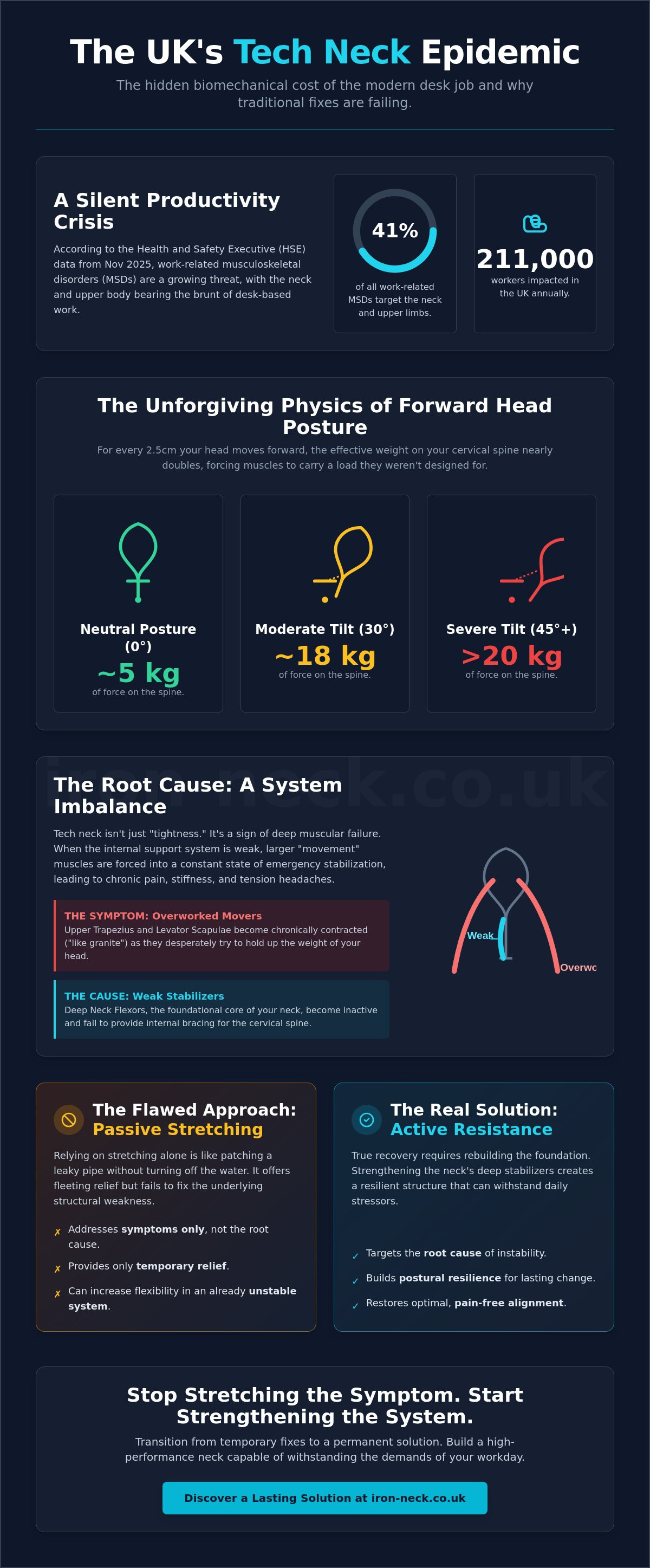
The UK is facing a silent productivity crisis. According to the Health and Safety Executive (HSE) report published in November 2025, an estimated 511,000 workers suffered from work-related musculoskeletal disorders (MSDs) over the last year. Of those cases, 41% specifically affected the neck and upper limbs, impacting 211,000 individuals across the country. This isn't just "soreness" from a long day; it's a clinical postural syndrome known as tech neck. It results from prolonged cervical flexion, where the head is tilted downward and forward to view screens, causing structural changes in the cervical spine.
We need to reframe how we view the modern professional. You aren't just an employee sitting at a desk; you're a "Desk Athlete." Just as a professional rugby player requires targeted conditioning to protect their spine during a scrum, office workers require professional-grade recovery and specific neck exercises for office workers UK to withstand the 1,800 hours they spend at a workstation annually. Without a foundational strengthening protocol, the repetitive strain of the 8-hour workday will eventually lead to chronic degenerative changes.
The Biomechanics of the 8-Hour Workday
The physics of the human head are unforgiving. In a neutral position, your head weighs approximately 5kg. However, as Forward head posture develops, the effective weight on your cervical vertebrae increases exponentially. For every 2.5cm your head moves forward from your center of gravity, the load on your spine effectively doubles. By the time you're leaning in to read a spreadsheet, your neck might be supporting upwards of 20kg of force.
Your body isn't designed to hold this weight through bone structure alone. When the deep stabilizer muscles of the neck fail, the upper trapezius and levator scapulae are forced to compensate. These muscles are designed for movement, not for holding static weight for hours on end. Your nervous system eventually "locks" these muscles into a state of chronic contraction as a protective mechanism to prevent further injury. This is why your shoulders feel like granite by 3:00 PM; it's a desperate attempt by your body to stabilize an imbalanced system.
Beyond the Stretch: Why Your Routine is Failing
Most UK office workers make the mistake of relying solely on passive stretching. While a quick side-to-side stretch might provide 15 minutes of relief, it does nothing to address the underlying structural instability. Stretching targets the symptoms by temporarily lengthening tight tissue, but it often ignores the "why" behind the tightness. In many cases, your muscles are tight because they are weak and overworked. Adding more flexibility to an unstable joint can actually worsen the problem.
True recovery requires building postural resilience. Postural resilience is the ability of the neck to maintain neutral alignment under stress. To achieve this, you must transition from passive muscle lengthening to active multi-directional strengthening. By implementing resisted neck exercises for office workers UK, you move beyond temporary fixes and start building the foundational strength required to keep your spine in its optimal, pain-free alignment.
The Science of Neck Strengthening for Postural Restoration
While many fitness programs focus on the core or glutes, the cervical spine remains the missing link in the kinetic chain. For a desk-based professional, the neck is the most overlooked part of your physical foundation. Strengthening this area isn't just about avoiding a "stiff neck." It's about restoring the structural integrity of your posture. To do this, we must look beyond the superficial muscles and target the deep neck flexors.
The deep neck flexors act as the internal bracing system for your head. When these muscles are weak, your body relies on larger, global muscles like the upper trapezius to do the work. This leads to the chronic tension many experience by mid-afternoon. Following the UK guidance on Display Screen Equipment is a vital starting point for ergonomics, but ergonomic chairs cannot fix a weak musculoskeletal system. You need active resistance to build a resilient spine and eliminate the root cause of pain.
Targeting the Stabilizer Muscles
Office-based tension headaches often originate in the suboccipital muscles. These four small muscles sit at the base of your skull. When you sit in a forward-head position, they become chronically shortened and hyperactive. This compression often triggers referred pain that feels like a tight band around the forehead. Targeted neck exercises for office workers UK use isometric training to reset these stabilizers. Isometrics involve holding a position against resistance, which builds foundational strength without the high-impact movements that can irritate sensitive cervical joints.
The sternocleidomastoid (SCM) also plays a critical role. It's one of the primary muscles responsible for maintaining an upright posture. When the SCM is balanced with the deep flexors, your head stays stacked over your shoulders. This reduces the mechanical load on your vertebrae and eliminates the "pulling" sensation in your upper back. Integrating advanced neck training tools into your weekly routine ensures these muscles are conditioned to handle the demands of a high-performance career.
Proprioception and Spatial Awareness
Proprioception is your body's ability to sense its position in space. The cervical spine is densely packed with proprioceptive sensors that send data to your brain. If your neck is weak, this data becomes noisy and unreliable. You lose the ability to sense when your posture is slipping until the pain actually starts. Strengthening the neck improves this neurological feedback loop. A strong neck allows you to subconsciously maintain neutral alignment, protecting your neurological health and cognitive performance throughout the workday. This increased spatial awareness is why athletes and high-performers prioritize neck strength as a foundational pillar of their health.
Comparing Recovery Methods: Passive Stretches vs. Active Resistance
Most UK office workers rely on basic rotations and shrugs to manage daily discomfort. These NHS-recomended neck exercises are excellent for maintaining basic mobility and providing immediate, short-term relief. However, they only address one half of the equation. While stretching temporarily lengthens tight muscles, it doesn't build the postural endurance needed to resist the constant pull of gravity during a ten-hour shift. To truly end tech neck, you must transition from passive movement to active resistance.
Active resistance is the foundation of structural protection. Think of your cervical spine as a suspension system. Stretches might grease the gears. Strength provides the shocks that absorb daily stress. By incorporating resisted neck exercises for office workers UK, you create a buffer against future injury. This protection is critical; a strong neck is far less likely to suffer from sudden strain or whiplash compared to one that is merely flexible. Strength is the missing link between temporary comfort and permanent postural health.
The Limits of Manual Resistance
Some traditional protocols suggest manual resistance, such as pushing your head against your own palm. While this is often touted as a sufficient entry point for rehabilitation, it's a flawed strategy for long-term growth. Manual resistance is highly inconsistent. It's impossible to track your progress or ensure you are applying the same load every session. Even worse, self-applying pressure often leads to poor form. You might inadvertently use your shoulder or torso to compensate for weak neck stabilizers. Professional equipment ensures 360-degree consistent tension, which is something manual pressure simply cannot replicate.
Linear Progression for the Neck
Effective physical training relies on the Overload Principle. This scientific law states that you must gradually increase the stress placed on the body during exercise to see structural results. You wouldn't expect your legs to get stronger by doing the same bodyweight squats for three years. The same logic applies to your neck. Office workers need to treat their cervical spine like any other major muscle group. By using variable resistance, you can move from "rehab"—the phase of getting out of pain—to "prehab," where you build the elite-level strength required to stay out of pain permanently. This methodical approach allows you to apply the right amount of load at the right time, ensuring your neck exercises for office workers UK lead to measurable, long-term postural restoration.
The 10-Minute 'Desk Athlete' Protocol: Essential Exercises
Most office workers spend 40 hours a week or more in a state of constant cervical flexion. To counteract this, you need a structured defensive strategy rather than random stretching. This 10-minute protocol is designed to be performed within the standard UK working day, ideally during a mid-morning or mid-afternoon break when postural fatigue begins to peak. Implementing these neck exercises for office workers UK ensures your stabilizer muscles remain engaged, preventing the "slump" that leads to chronic pain.
Start with Tucked Chins to activate the deep neck flexors. This isn't about pulling your head back; it's a precise pivot. Imagine a rod passing through your ears and rotate your skull around that axis to draw your chin toward your throat. You'll feel a deep activation in the front of your neck. Perform 3 sets of 12 repetitions, holding each for 2 seconds at the peak of contraction. This foundational movement resets your head position and reduces the load on your upper vertebrae.
Foundational Isometric Holds
Isometric holds build the capacity to resist external forces and maintain neutral alignment. For a Neutral Spine Hold, apply light resistance to the front, back, or side of your head. Your objective is to keep your head perfectly centered without moving an inch. Hold this position for 30 seconds per side for 3 total sets. Avoid the common mistake of shrugging your shoulders or clenching your jaw to compensate for weak neck stabilizers. Isometric flexion is the safest starting point for those with chronic stiffness.
Dynamic Rotational Drills
Once you've established stability, you must introduce movement under tension. The 'Look Left, Look Right' drill involves rotating your head slowly through its full range of motion while maintaining constant resistance. For advanced multi-planar mobility, integrate 'Figure 8s' by tracing a small infinity symbol with your nose while under load. Focus on slow, eccentric control when returning your head to the neutral position. This controlled return is where the most significant strength gains and structural protection occur.
Consistency is your greatest asset in the fight against tech neck. We recommend performing this protocol at least once daily to maintain postural resilience. For professionals in high-stress roles, a "micro-dosing" approach—performing one exercise every 90 minutes—can prevent the cumulative fatigue that leads to headaches. To maximize your results and ensure 360-degree resistance during every rep, shop the Iron Neck training system to upgrade your home or office setup.
Eliminating Tech Neck with Iron Neck Technology
Traditional recovery methods often fail because they don't provide the level of stimulus required to change the physical structure of the cervical spine. While basic stretches might temporarily soothe a sore muscle, they lack the multi-directional tension needed to rebuild your postural foundation. Iron Neck UK & Europe represents a paradigm shift in this area. By providing 360-degree resistance, it allows you to perform neck exercises for office workers UK that were previously impossible outside of a specialized sports science facility. It's the definitive tool for those who refuse to accept chronic stiffness as a byproduct of their career.
The patented "Halo" design is the core of this transformation. Unlike resistance bands or manual pressure, which only offer linear tension, Iron Neck UK & Europe introduces rotational resistance. This forces your stabilizer muscles to engage through every degree of movement. It doesn't just build strength; it builds postural intelligence. Your brain learns to subconsciously maintain a neutral position because your deep flexors are finally conditioned to handle the load. Integrating resisted neck exercises for office workers UK into your daily routine is no longer a luxury; it's a requirement for the modern professional seeking long-term resilience.
Why Iron Neck UK & Europe is the 'Gold Standard'
The unique mechanism of rotational tension mimics the complex, multi-planar movements your neck performs in the real world. Whether you're shifting between multiple monitors or looking down at a mobile device, your neck rarely moves in a perfectly straight line. This technology addresses the "Missing Link" by ensuring your neck is as resilient as the rest of your kinetic chain. The device is also engineered for the modern hybrid professional. It's portable enough to fit in a laptop bag, making it easy to transition between a London headquarters and a home office in the suburbs. It's the only solution that provides consistent, professional-grade training regardless of your location.
Getting Started with Iron Neck UK & Europe
Selecting the right equipment depends on your specific performance goals. The Iron Neck 3.0 Starter bundle is an excellent entry point for those beginning their recovery journey, providing foundational linear resistance. However, for those serious about ending tech neck for good, the 3.0 Pro model is essential. It features a patented friction dial that allows for adjustable rotational resistance, challenging your muscles in ways standard gym equipment cannot. Elite UK athletes and leading physiotherapists now recognize that neck strength is the foundation for both safety and performance. It's time to stop managing symptoms and start building a stronger, pain-free future.
Build a Resilient Spine for the Modern Workplace
Your cervical spine serves as the structural foundation for both physical movement and cognitive focus. As this guide has demonstrated, resolving tech neck requires a move beyond temporary flexibility toward permanent structural support. By conditioning the deep stabilizer muscles that facilitate neutral alignment, you effectively counteract the cumulative strain of sedentary work. Integrating consistent neck exercises for office workers UK into your professional routine is the most effective way to transition from daily discomfort to long-term postural health.
Iron Neck UK & Europe provides the 360-degree multi-directional resistance technology required to achieve these results. Used by every team in the NFL and elite UK athletes, our equipment is endorsed by world-leading sports scientists for its ability to build foundational strength and protection. You no longer have to accept neck pain as an inevitable part of your career. Take the definitive step toward a stronger, more resilient spine and unlock your full athletic and professional potential.
Shop the Iron Neck UK & Europe range and eliminate neck pain today
Frequently Asked Questions
Are neck exercises safe for someone with a history of cervical spine issues?
Yes, controlled neck exercises are generally safe and highly beneficial for individuals with a history of cervical issues. The key is starting with isometrics, which provide foundational strength without high-impact joint movement. By building resilient stabilizer muscles, you create a protective buffer for your spine. You should avoid training during acute flare-ups and focus on pain-free ranges of motion to ensure long-term safety and structural integrity.
How long does it take to see results from a neck strengthening programme?
Most users report a noticeable reduction in stiffness within the first 14 to 21 days of consistent training. These initial gains are largely neurological as your brain improves its proprioception and muscle recruitment. For measurable structural changes and permanent postural restoration, you should commit to a methodical 12-week protocol. This timeline allows for the hypertrophy of deep stabilizer muscles required to sustain an upright posture during long shifts.
Can neck exercises really reduce the frequency of tension headaches?
Absolutely. Tension headaches are often the result of overworked suboccipital muscles compensating for weak deep flexors. By implementing resisted neck exercises for office workers UK, you strengthen the muscles responsible for head control. This reduces the chronic contraction in your upper traps and the base of the skull. Data suggests that building a stronger neck is a primary solution for eliminating desk-based headaches permanently.
Is it better to do these exercises at the start or end of the workday?
Training at the start of your day or during a lunch break is the most effective strategy for office professionals. This approach primes your stabilizer muscles, preparing them to resist the postural fatigue that accumulates over an 8-hour shift. If you wait until the end of the day, you're training a system that's already exhausted. Morning sessions ensure you maintain neutral alignment from your first meeting to your last email.
What is the difference between a neck harness and the Iron Neck device?
The primary difference lies in the direction of resistance and the complexity of movement. A traditional Alpha Head Harness is designed for linear loading, which is useful for building general muscle mass. The Iron Neck device utilizes a patented 360-degree rotation system. This allows you to train rotational stability and multi-planar movement. It's the only tool that provides the variable resistance needed to fix complex postural issues like tech neck.
Can I fix 'Tech Neck' if I've had poor posture for years?
You can certainly improve your posture regardless of how many years you've spent at a desk. While structural changes take time, the human body is highly adaptable to new physical demands. By transitioning from passive stretches to active strengthening, you force your cervical spine to reorganize its support system. A dedicated 3-month programme can significantly reverse the forward head tilt associated with long-term computer use.
How much resistance should I start with for neck training?
Begin with the lightest possible resistance to prioritize form and neurological control. For most beginners, this means using a 2kg to 5kg resistance band or the lowest setting on the Iron Neck dial. Form is the foundation of safety. You should be able to complete 3 sets of 12 controlled repetitions before increasing the load. This methodical approach ensures you're strengthening the stabilizers rather than straining the sensitive cervical joints.
Do I need to see a doctor before starting these exercises?
You should consult a healthcare professional if you experience neurological symptoms like numbness or radiating pain in your arms. While neck exercises for office workers UK are foundational for recovery, it's vital to rule out serious underlying conditions like disc herniations. Once you're cleared for physical activity, a structured strengthening routine is the most effective way to prevent future injury. Always listen to your body and avoid any movement that causes sharp discomfort.