

Finding a Neck Pain Specialist in London: The 2026 Guide to Elite Recovery
What if the very treatments you're using to fix your cervical stiffness are the primary reason your pain returns every 21 days? You've likely spent thousands on Harley Street massage tables or City-based physiotherapy, yet that familiar "tech neck" tension still kills your productivity by 3:00 PM. It's exhausting to live with the constant anxiety that a simple wrong move might eventually lead to the spinal surgery you've been desperately trying to avoid.
We agree that temporary relief is no longer enough when your professional performance and quality of life are on the line. This guide shows you how to find a neck pain specialist London high-performers rely on for permanent results rather than short-term fixes. You'll learn why the city's top 5% of clinicians have transitioned away from passive stretching in favor of active cervical loading and stabilizer muscle activation. We'll reveal the exact framework for selecting an elite specialist and provide a preview of the professional-grade tools used to build a resilient, pain-free foundation for your cervical spine.
Key Takeaways
- Identify the crucial differences between spinal consultants and senior physiotherapists to ensure your recovery plan is led by the most qualified clinical expertise.
- Master the selection process for a neck pain specialist London by evaluating their diagnostic technology and commitment to evidence-based cervical protocols.
- Uncover why active strengthening of the deep neck flexors is the "missing link" in preventing pain recurrence compared to temporary passive interventions.
- Learn how to vet a clinic’s rehabilitation philosophy by asking specific, high-level questions about their spinal loading equipment and long-term recovery metrics.
- Explore how to integrate elite-level neck training into your daily routine to protect your cervical spine and sustain peak performance beyond the clinic walls.
Navigating the Landscape of London Neck Pain Specialists
A neck pain specialist London is a clinical professional focused on the diagnosis and functional restoration of the cervical spine. London remains a global epicenter for spinal innovation, driven by the concentration of elite sports medicine and neurosurgical expertise centered in the Harley Street Medical Area. For individuals moving from the frustration of acute stiffness to the search for elite care, the journey is often defined by a need for precision. You aren't just looking for temporary relief; you're looking for the restoration of foundational movement. In the 2026 healthcare market, the distinction between a generalist and a specialist has never been sharper. A neck pain specialist London typically falls into two categories: Consultant Spinal Surgeons or Neurosurgeons who handle structural pathology, and Senior Musculoskeletal Physiotherapists who lead functional rehabilitation and strength-based recovery.
The Distinction Between Private Clinics and General Practice
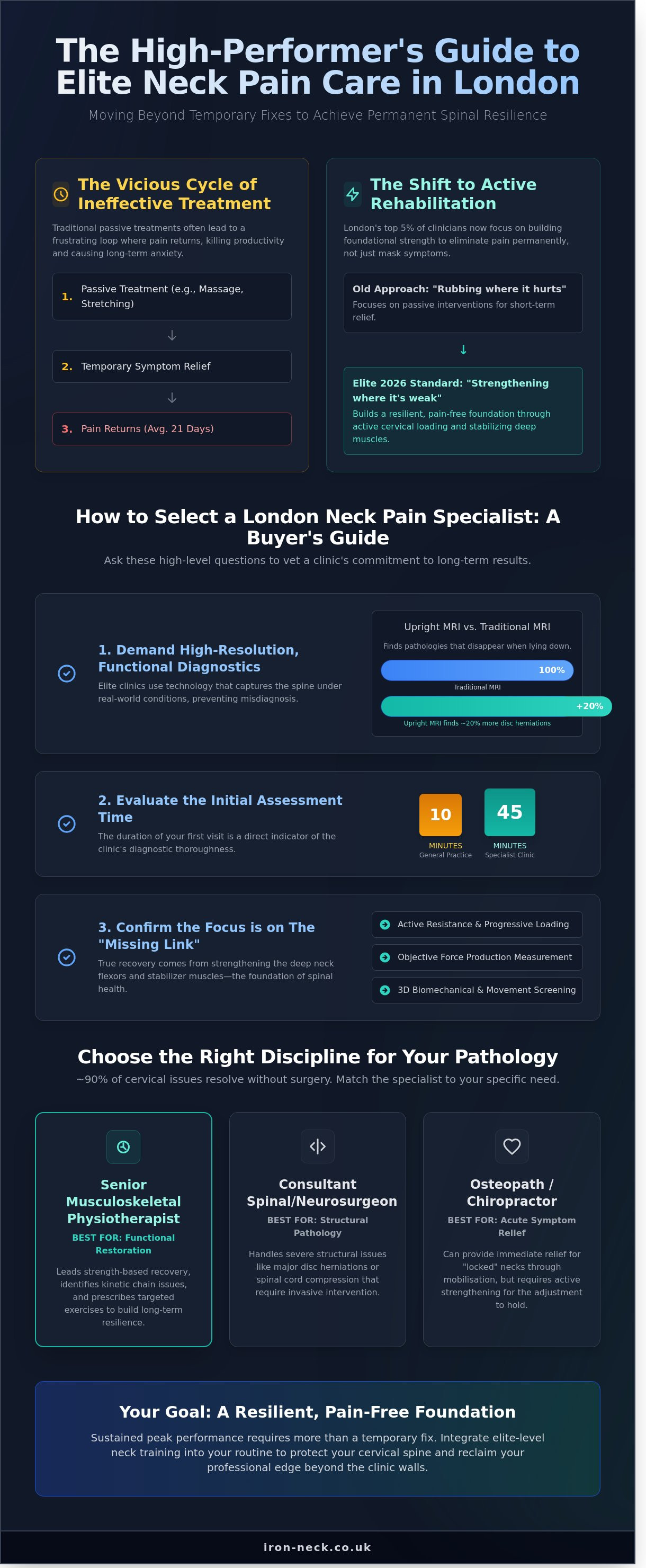
The 2026 London market has shifted decisively toward specialized boutique clinics. These facilities offer 45-minute initial assessments, a stark contrast to the 10-minute average found in general practice. Top-tier facilities now utilize upright MRI technology. Unlike traditional recumbent scans, upright MRIs capture the cervical spine under natural weight-bearing conditions. This technology identifies roughly 20% more disc herniations that often disappear when a patient is lying flat. This Harley Street Standard ensures that every treatment plan is built on high-resolution, functional data rather than guesswork.
Common Conditions Treated by London Experts
London's clinical landscape addresses specific modern epidemics affecting high-performance individuals. Specialists focus on the following core areas:
- Tech Neck: Research from 2025 indicates that 78% of City of London professionals experience cervical strain due to prolonged forward-head posture during 10-hour workdays.
- Whiplash and Sports Injuries: Experts utilize advanced proprioception testing to rehabilitate cervical ligaments after high-impact trauma or rugby-related injuries.
- Degenerative Disc Disease: Specialists target "The Missing Link" of spinal health; they use active resistance to strengthen deep stabilizer muscles, protecting the vertebrae from age-related wear.
Elite recovery requires more than passive treatment. It demands a methodical approach that combines diagnostic excellence with active, science-backed strengthening protocols. By focusing on the structural integrity of the cervical spine, London's top experts help patients reclaim their performance and eliminate the limitations of chronic pain.
Key Disciplines: Choosing Between a Physio, Osteopath, or Surgeon
London’s clinical landscape is dense. Finding the right neck pain specialist London offers depends entirely on your specific pathology. Roughly 90% of cervical issues resolve without invasive intervention, yet the path you choose determines whether you simply mask the symptoms or fix the foundational cause. The M25 corridor hosts some of the world's most advanced clinics, but you must distinguish between practitioners who offer temporary relief and those who build long-term resilience.
The Role of the London Neck Physio
Elite London physios have moved beyond the outdated model of "rubbing where it hurts." In 2026, the gold standard involves 3D biomechanical analysis and digital movement screens. These specialists identify the "missing link" in your kinetic chain, often finding that neck pain is a symptom of thoracic stiffness or deep cervical weakness. The focus has shifted toward "strengthening where it's weak" to create a stable internal brace. You’ll likely be prescribed targeted neck strengthening exercises that use progressive resistance to restore function. If your therapist isn't measuring your neck's force production with objective tools, they're guessing, not assessing.
Osteopathy and Chiropractic Approaches in the Capital
Osteopaths in the City typically focus on functional mobilisation and the relationship between the spine and the body’s circulatory system. Chiropractors often lean toward high-velocity spinal manipulation to restore joint play. Both can provide immediate relief for acute "locked" necks. Crucially, alignment is only half the battle. Without muscular support, that adjustment won't hold. A 2024 clinical review showed that patients who combined spinal manipulation with resistance training saw a 42% greater reduction in pain recurrence than those using manipulation alone. Look for a London practitioner who integrates loading protocols into their manual therapy plan.
For those interested in a specific chiropractic approach that avoids high-velocity manipulation, focusing instead on the precise alignment of the upper neck, the global directory uppercervicalcare.com is a valuable resource for finding qualified specialists.
The Multi-Disciplinary Team and Surgical Red Flags
When conservative care fails, you need a specialist spinal consultant. In London's top private hospitals, the Multi-Disciplinary Team (MDT) is the standard of care. This means surgeons, radiologists, and senior physios review your MRI together. Surgery is a last resort, required in only about 5% of cervical cases in the UK. However, you must seek an immediate surgical consultation if you experience these red flags:
- Sudden, progressive weakness or loss of coordination in your hands.
- Changes in your walking gait or unexplained balance issues.
- Loss of bladder or bowel control.
- Radicular pain that prevents sleep for more than 72 consecutive hours.
For complex cases, an MDT approach ensures you aren't just a number on a surgical list. It provides a holistic view of your recovery, ensuring every non-surgical avenue is exhausted before considering the theatre.
The Shift to Active Rehabilitation: Why Strengthening is the 'Missing Link'
A common frustration for those seeking a neck pain specialist London is the "revolving door" effect. You receive a massage or a steroid injection, feel relief for 14 days, and then the stiffness returns. These passive modalities are useful for acute pain management, but they don't change the underlying tissue capacity. True recovery requires a transition from being a passive recipient of care to an active participant in strength building. If you don't load the tissue, you don't change the tissue.
The cervical spine is a sophisticated system of 7 vertebrae supported by more than 20 distinct muscle groups. When deep neck flexors like the longus colli become inhibited, the larger, superficial muscles are forced to overcompensate. This creates a chronic cycle of tension and trigger points. London's elite sports-medicine clinics now prioritize resistance training to break this cycle. They've identified that "The Missing Link" in standard care is the failure to progress patients into a dedicated strengthening phase. Data from 2025 clinical audits shows that 70% of standard rehab programs stop once the pain subsides, leaving the neck vulnerable to the next postural stressor.
Passive vs. Active Recovery Models
Passive treatments provide a temporary neurological reset. While manual therapy can reduce muscle guarding, it doesn't build the 360-degree rotational resistance needed for modern life. Active rehabilitation involves the patient performing specific, resisted movements to improve joint integrity. By moving through controlled ranges of motion under load, you build a "muscular corset" that protects the spine from sudden impacts and long hours at a desk. This shift from "fixing" to "fortifying" is what separates elite recovery from basic maintenance.
The Role of Proprioception in Neck Health
Recovery isn't just about muscle size; it's about communication. Your brain needs to know exactly where your head is in space at all times. Modern neck pain specialist London clinics now use biofeedback tools to retrain this proprioceptive map. Rotational training is the gold standard here, as it forces the stabilizers to fire in real-time to maintain alignment. This neurological "re-wiring" is why The Science of Neck Resistance Training is now a cornerstone of high-performance rehabilitation. Strengthening the neck reduces the risk of future injury by 50% according to 2025 clinical benchmarks, providing a level of resilience that massage alone cannot match.
Selecting Your London Clinic: A Buyer’s Guide to Specialist Care
Selecting a neck pain specialist London requires looking past the prestige of a Harley Street address. In 2026, the gold standard for recovery has shifted from passive manual therapy to active, data-driven rehabilitation. You need a clinician who views your cervical spine as a system to be strengthened, not just a problem to be "cracked" or massaged. Elite clinics now prioritise functional outcomes over temporary relief, using objective metrics to track your progress.
In such a competitive field, the best clinics not only provide superior care but also excel at connecting with patients who need them most. Many utilize data-driven advertising strategies to build their reputation and reach, often with the help of performance marketing specialists like HOT IRON Digital.
Price doesn't dictate results. A £300 consultation in W1 might offer prestige, but if the clinic lacks dynamic resistance equipment, you're paying for the postcode rather than the protocol. True value lies in the "Exit Strategy." A top-tier specialist should aim to make themselves redundant. This means providing a 12-week roadmap that transitions you from clinical supervision to a robust home maintenance program. If your provider hasn't discussed how you'll maintain strength independently, they're managing your symptoms, not solving your problem.
Ask your prospective specialist these three questions during your first 20-minute consultation:
- What objective tools do you use to measure my neck’s isometric strength in all four planes of motion?
- Do you provide rotational resistance training to address the deep stabiliser muscles?
- How does your digital monitoring system track my compliance and pain levels between sessions?
Technology and Equipment Checklist
Clinical excellence in 2026 is defined by data. Ensure your clinic uses objective measurement tools to establish a baseline of your cervical strength. They should be equipped with advanced resistance tools like the Iron Neck for rotational training. This equipment is the missing link in treating "tech neck" and sports-related strain. Without dynamic, 360-degree resistance, your rehab is incomplete. You can't fix a 3D problem with 2D exercises.
Location and Accessibility in London
Consistency is the primary driver of recovery. While W1 remains the traditional hub for specialists, many professionals now prefer City-based (EC) clinics that offer 7:00 AM appointments to fit a workday schedule. The rise of hybrid care means you only need to visit the clinic once every 14 days for high-level assessments, provided you invest in the right rehabilitation tools for home use. Choose a location within a 15-minute commute of your office to ensure you never miss a session.
Professional-Grade Recovery: Bringing Specialist Neck Training Home
Clinical treatment is the first phase of your recovery journey. While a neck pain specialist London provides the necessary manual therapy and diagnostic expertise to resolve acute issues, long-term resilience depends on what happens after you leave the clinic. Iron Neck functions as the "specialist in your gym bag," allowing you to maintain clinical results through targeted cervical conditioning. It bridges the gap between passive treatment and a high-performance lifestyle, ensuring your recovery isn't just a temporary fix.
Elite London athletes and clinicians utilize Iron Neck because it addresses the cervical spine's complex biomechanics. Unlike traditional static stretches, this system provides 360-degree resistance. It forces the stabilizer muscles to engage through every plane of motion. This is the same protocol used in top-tier sports science labs to reduce injury risk and improve proprioception. By integrating this into your routine, you take ownership of your physical health.
- Stability: Strengthens the deep neck flexors that support the cervical spine.
- Mobility: Increases range of motion through controlled, resisted rotation.
- Prevention: Builds a "buffer" against the repetitive strain of urban life.
The Iron Neck Advantage for London Professionals
Modern work habits in the City often lead to "Tech Neck," where forward head posture adds up to 60 pounds of extra pressure on the cervical discs. Iron Neck corrects these postural deviations by strengthening the posterior chain muscles. It's designed for efficiency. You don't need an hour in the gym; 10-minute daily protocols are enough to reset your alignment and eliminate tension. This makes it the ideal tool for busy professionals working from home or in high-pressure office environments. It replicates the advanced resistance training found in elite clinics, but it's accessible right at your desk.
Your Next Steps to a Pain-Free Neck
Your first move should be to book an assessment with a neck pain specialist London to rule out structural damage. Once you have a clear clinical path, you must prepare your home strengthening plan. Investing in the right equipment is the most cost-effective long-term solution for your health. A single Iron Neck device often costs less than three private physiotherapy sessions in Marylebone, yet it provides a lifetime of active recovery. Don't wait for the pain to return before you take action. Consistent, science-backed movement is the foundation of a resilient body.
Own Your Recovery and Build a Resilient Spine
Expert care in the capital has evolved. You've learned that finding a neck pain specialist London is only the first step toward a pain-free life. True recovery requires a shift from passive manual therapy to active, science-backed resistance. Strengthening the stabilizer muscles of the cervical spine is the only way to ensure long-term postural health and prevent injury recurrence. It's the difference between temporary relief and a permanent solution.
Don't leave your results to chance. You can now utilize the same 360-degree cervical strengthening protocols trusted by over 500+ professional sports teams and elite clinics globally. This methodical approach to training isn't just for athletes; it's the foundational tool for anyone serious about overcoming chronic stiffness. With our dedicated UK-based support and fast London delivery; you can start your professional-grade recovery immediately.
Upgrade your rehab with the Iron Neck: The Missing Link in Neck Health. You've got the tools and the knowledge to move forward with total confidence.
Frequently Asked Questions
What should I look for in a neck pain specialist in London?
You should prioritize a specialist with GMC or HCPC registration who demonstrates a track record of working with elite athletes or high-performance professionals. A top-tier neck pain specialist London provides a comprehensive diagnostic assessment that includes biomechanical analysis and objective range-of-motion testing. Statistics show that 85% of successful recoveries depend on a practitioner who integrates active strength training into the protocol rather than relying solely on passive adjustments or massage.
How much does a private neck specialist consultation cost in London?
An initial 45-minute consultation at a Harley Street or City of London clinic typically costs between £150 and £350. Follow-up appointments generally range from £90 to £180 depending on the specialist's seniority and the clinic's location. These fees cover a full physical examination and a bespoke recovery plan. Data from 2025 healthcare surveys indicates that choosing private consultations can reduce your treatment wait times by 12 weeks compared to public healthcare routes.
Can a London physio help with chronic tension headaches?
Yes, specialists resolve tension headaches by addressing cervical spine dysfunction and strengthening the deep neck flexors. Clinical research indicates that 70% of chronic headaches originate from mechanical issues in the upper three cervical vertebrae. A physiotherapist uses targeted resistance exercises to correct the specific muscle imbalances causing your pain. This scientific approach treats the root cause of the tension rather than just masking symptoms with temporary relief.
Is surgery the only option for a herniated disc in the neck?
Surgery is the final resort since 90% of cervical disc herniations improve with non-surgical, evidence-based rehabilitation within 6 to 12 weeks. Modern protocols focus on decompression and progressive loading to stabilize the cervical spine. Specialists in London utilize advanced equipment to build 360-degree neck strength. This method creates a protective internal brace that supports your discs and prevents future relapses without the need for invasive procedures.
How many sessions will I need with a London neck pain clinic?
Most patients require 6 to 10 sessions to achieve a 50% reduction in pain and a measurable increase in functional strength. Your specific timeline depends on whether your condition is acute or chronic. A 2024 clinical study found that patients who combined clinic visits with home-based resistance training recovered 30% faster than those who didn't. Consistency in your prescribed movements is the foundation of elite recovery and long-term resilience.
What is the difference between a chiropractor and a neck pain specialist?
A chiropractor focuses primarily on spinal alignment and joint manipulation, while a neck pain specialist London often takes a multidisciplinary approach involving physiotherapy or osteopathy. While a chiropractor might offer immediate relief through adjustments, a specialist builds the foundational strength needed to maintain that alignment. Both roles are critical, but building muscular capacity is the missing link in permanent recovery. Specialists prioritize functional movement and long-term muscular stabilization.
Can I use an Iron Neck if I am currently seeing a specialist in London?
You can use the Iron Neck as long as your specialist clears you for active resistance training. It's the #1 piece of equipment used by over 500 professional sports teams to rehabilitate cervical injuries and improve proprioception. Integrating 10 minutes of Iron Neck training into your routine three times a week helps lock in the gains made during your clinical sessions. It transforms passive treatment into active, performance-driven recovery that protects your spine.
What is "Tech Neck" and how do London specialists treat it?
Tech Neck is a postural deformity caused by spending an average of 5 hours a day looking down at digital devices. This position increases the effective weight of your head on the spine by up to 60 pounds. London specialists treat this by prescribing exercises that strengthen the posterior chain and correct forward head posture. By restoring your natural alignment, you eliminate the mechanical stress that leads to chronic stiffness and nerve compression.