

Exercises to Prevent Whiplash Injury: A Proactive Guide to Cervical Resilience
What if the most critical safety feature in your vehicle isn't the airbag or a five-star Euro NCAP rating, but the "structural roll cage" you build within your own body? With a yearly incidence rate of whiplash reaching 78 per 100,000 people in recent studies, the risk of cervical trauma remains a significant concern for drivers across Great Britain. You likely share the common fear of long-term disability or that recurring "stiff neck" that follows even minor impacts. It's frustrating when you're told to just "stretch it out" when your real need is for structural stability and impact absorption.
By implementing targeted exercises to prevent whiplash injury, you can move from a state of vulnerability to one of high-performance resilience. This guide explores the science-backed strengthening protocols that build a protective buffer for your neck to mitigate impact forces. We'll preview a systematic approach to cervical stability, moving through the mechanics of impact absorption to a clear routine that provides total confidence in your physical resilience.
Key Takeaways
- Analyze the biomechanics of the "S-curve" impact phase to understand why structural strengthening is superior to traditional stretching for cervical protection.
- Discover specific exercises to prevent whiplash injury by increasing muscle cross-sectional area, which effectively minimizes vertebral shear during sudden acceleration.
- Master foundational isometric protocols that utilize maximal voluntary contraction to build deep neck stability without compromising joint integrity.
- Implement multi-directional training strategies to mitigate the complex torsional forces that often occur during off-axis vehicle collisions.
- Access a methodical 2026 training protocol designed to integrate seamlessly into your weekly routine for long-term cervical resilience and performance.
Understanding the Bio-mechanics of Whiplash Injury
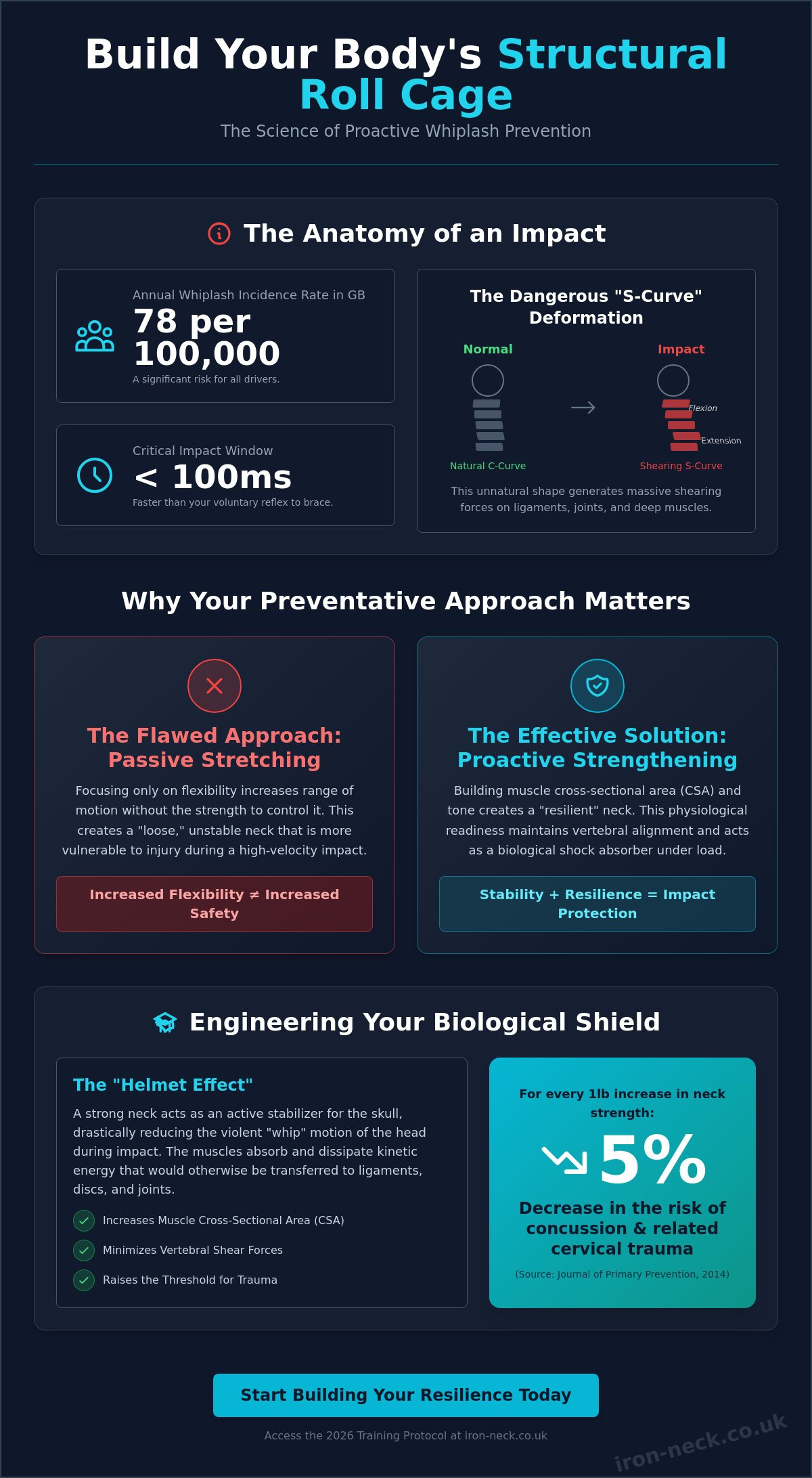
Whiplash is far more complex than a simple muscle strain. It's a high-velocity traumatic event characterized by a rapid sequence of hyper-flexion and hyper-extension of the cervical spine. While many associate the injury with a simple "snap" of the head, Understanding Whiplash requires a deeper look at the specific physiological deformation that occurs in the first 100 milliseconds of impact. This is the "S-curve" phase. During this critical window, the lower cervical vertebrae are forced into extreme extension while the upper vertebrae flex. This creates a literal S-shape in your neck, generating massive shearing forces that the body isn't naturally designed to handle.
The primary tissues at risk during this event are the anterior longitudinal ligaments, the facet joints, and the deep cervical flexors like the longus colli. In a low-velocity strain, the damage might be limited to superficial muscle fibers. However, in high-velocity traumatic impacts, the energy transfer is so great that it can lead to Grade 2 or Grade 3 whiplash-associated disorders, involving neurological signs or significant musculoskeletal damage. Understanding these mechanics is why performing specific exercises to prevent whiplash injury is a necessity for anyone concerned with long-term spinal health.
The Role of Kinetic Energy in Cervical Trauma
Physics dictates that your neck must dissipate a specific amount of kinetic energy during a sudden change in momentum. If your muscles lack the necessary cross-sectional area and tone, that energy is transferred directly into the non-contractile tissues like discs and ligaments. A common misconception is that you can simply "brace" for an impact. Research into muscle reaction times shows that the human nervous system is often too slow to respond. The S-curve phase happens faster than the voluntary reflex to tighten your muscles. This means your baseline "resting" strength and structural resilience are the only things standing between you and a debilitating injury. A stronger neck acts as a biological shock absorber, stretching the duration of the impact and reducing the peak force applied to the spine.
Why Passive Stretching Fails as a Preventative Measure
Many people mistakenly focus on flexibility when they should be prioritizing stability. Passive stretching increases your range of motion, but without corresponding strength, it actually increases the range of potential injury. A "loose" neck is a vulnerable neck in a high-velocity event. In contrast, a "resilient" neck possesses high levels of muscular stiffness, or "tone." This isn't the kind of stiffness that limits movement, but rather the physiological readiness to maintain vertebral alignment under load. When you integrate exercises to prevent whiplash injury into your routine, you aren't just trying to get flexible; you're building a structural roll cage. You need the ability to maintain joint integrity against multi-directional forces, ensuring that your vertebrae stay in a safe, neutral alignment even when subjected to extreme external pressure.
Proactive Strengthening: The Science of Pre-hab for the Neck
While traditional medicine often focuses on recovery, elite performance demands a shift toward Pre-habilitation. This proactive approach centers on building a physiological buffer before an accident happens. Increasing the muscle cross-sectional area (CSA) of the cervical spine is the most effective way to reduce vertebral shear. When your neck muscles are robust, they act as active stabilizers that keep the vertebrae aligned during sudden acceleration. This is a primary goal of specific exercises to prevent whiplash injury. According to the Mayo Clinic on whiplash, the injury often stems from forces that exceed the neck's natural tolerance. By increasing that tolerance through hypertrophic and neural loading, you effectively raise the threshold for trauma. You aren't just building muscle; you're engineering a biological shield.
Strength coaches often refer to this as the "Helmet Effect." A strong neck stabilizes the skull, reducing the violent motion of the head upon impact. If the neck is weak, the head acts like a weight on the end of a whip, accelerating through a dangerous arc. Research published in the Journal of Primary Prevention (2014) indicates that for every one-pound increase in neck strength, the risk of concussion and related cervical trauma decreases by approximately 5%. This data underscores why neck training isn't just for contact sports athletes. It's a critical safety protocol for anyone who operates a vehicle or engages in high-velocity activities.
The Importance of the Deep Cervical Flexors
The Longus Colli and Longus Capitis serve as the internal core of your neck. These deep cervical flexors are responsible for maintaining the natural lordotic curvature of the spine under stress. Unfortunately, modern "tech neck"—the result of prolonged forward-head posture—often leaves these muscles inhibited and weak. When these internal stabilizers fail, the superficial muscles like the SCM and upper trapezius take over. This leads to the chronic stiffness and "stiff neck" sensations many people feel after minor impacts. Re-activating these muscles through controlled, multi-planar resistance is essential for true cervical resilience.
Neural Adaptation and Reaction Speed
Strength is only half the equation. You also need speed. Consistent loading through exercises to prevent whiplash injury improves proprioception, which is your body's ability to sense its position in space. This leads to better Anticipatory Postural Adjustments (APA). When your nervous system is primed, it can trigger reflexive muscle activation much faster than a deconditioned system. This split-second reaction can be the difference between a minor strain and a life-altering injury. Utilizing professional-grade testing and rehab equipment ensures that your neural pathways remain sharp and your structural integrity stays intact.
Foundational Isometric Exercises for Cervical Stability
Isometrics represent the most controlled method for initiating neuromuscular recruitment in the cervical spine. Unlike standard range-of-motion drills, which often bypass the deep stabilizing musculature, isometrics require a maximal voluntary contraction against a static force. This approach ensures that you develop the necessary tension to maintain a neutral spine under load. It's the essential first step when performing exercises to prevent whiplash injury. According to Johns Hopkins Medicine on whiplash injury, the severity of the trauma is often linked to the suddenness of the head's displacement. By training your muscles to resist that displacement without movement, you build the foundation for true impact absorption.
The Four-Way Isometric Protocol
This protocol targets the primary planes of motion where whiplash forces occur. During these holds, your goal isn't just to push, but to maintain a perfectly vertical head position. Imagine a rod through your ears that must stay level. Execute the following sequence:
- Anterior Flexion (Front): Place your palm against your forehead. Attempt to push your head forward while using your neck muscles to resist any movement.
- Posterior Extension (Back): Cup the back of your head with your palm. Push backward into your hand, focusing on the muscles at the base of the skull.
- Lateral Flexion (Sides): Place your hand above your ear. Resist the urge to tilt your head toward your shoulder as you apply pressure.
For each position, aim for 3 sets of 10-second holds at 100% effort. Once you master hand-resistance, you can progress to using Iron Neck Resistance Bands to provide a more consistent and scalable load. This progression is vital for continuing to challenge the nervous system as your strength increases.
Chin Tucks and Deep Flexor Activation
The chin tuck is the gold standard for activating the deep cervical flexors, which act as the internal "core" of your neck. To perform this, stand with your back against a wall. Gently draw your chin straight back as if making a "double chin" without tilting your head up or down. You should feel a stretch at the base of your skull and activation in the front of your neck. Use the wall as proprioceptive feedback; your head should maintain contact throughout the movement. Avoid common mistakes like clenching your jaw or holding your breath. These compensatory patterns reduce the effectiveness of the movement and can lead to tension headaches. Mastery of this neutral alignment is what allows you to transition safely to more complex exercises to prevent whiplash injury.
Multi-Directional Training to Mitigate Impact Forces
Real-world impacts don't follow a predictable, linear path. While the S-curve mechanics describe the primary sagittal plane movement, most vehicle collisions involve off-axis forces that create severe torsional stress. If your training protocol only covers simple flexion and extension, you're leaving your cervical spine vulnerable to rotational trauma. This is why advanced exercises to prevent whiplash injury must evolve into multi-planar control. Your goal is to develop the ability to decelerate the head's mass regardless of the angle of impact.
The Sternocleidomastoid (SCM) and the upper trapezius act as the primary engines for rotation and lateral stability. In a torsional impact, these muscles must engage instantly to prevent the skull from spinning violently on the atlas and axis vertebrae. A common objection to this type of training is the fear of developing an excessively "bulky" neck. However, there's a significant difference between functional density and pure aesthetic hypertrophy. We are prioritizing "cervical armor"—increasing muscle tone and structural stiffness to protect the spine. This functional approach ensures your neck remains a resilient shock absorber without sacrificing your natural proportions.
Controlled Rotational Loading
To build comprehensive resilience, you must introduce rotation against resistance. This isn't about rapid, jerky movements; it's about slow-speed transitions that force the muscles to maintain eccentric control. By resisting a rotational load, you teach the nervous system to stabilize the spine throughout its entire range of motion. Traditional head harnesses often fail here because they only allow for linear loading. The Iron Neck Device is the premier choice for this protocol because its 360-degree system allows for seamless resistance in every plane. This ensures there are no "weak links" in your cervical defense, providing a level of protection that basic equipment cannot match.
Dynamic Stabilisation and Perturbation Training
Preparing for the "unexpected" is the final stage of proactive neck health. Dynamic stabilization involves counteracting rapid, unpredictable changes in resistance, often referred to as perturbations. By using Iron Neck Resistance Bands to create micro-instabilities, you force your neck muscles to fire reflexively. This bridges the gap between static strength and real-world performance. You move from simply holding a position to maintaining a neutral spine while your body is in motion. This type of training effectively prepares your neck to act as a high-performance shock absorber, neutralizing forces before they can reach the delicate structures of the spinal cord.
Building a Resilient Neck: Implementing a 2026 Training Protocol
Consistency is the catalyst that transforms anatomical knowledge into physical safety. To establish a lasting buffer against trauma, you should commit to a protocol of two to three sessions per week. These sessions don't need to be exhaustive; they simply need to provide a precise, progressive stimulus to the cervical tissues. Integrating these exercises to prevent whiplash injury into your existing gym routine or home schedule ensures that neck health becomes a non-negotiable component of your overall physical readiness. Using the Iron Neck Device allows you to automate this progression, removing the guesswork from your training and ensuring that every set moves you closer to peak resilience.
The Beginners 4-Week "Resilience" Programme
This initial phase focuses on re-establishing neuromuscular control and building a baseline of tension. It's about teaching the nervous system to "hold the line" before you introduce more complex variables. By focusing on quality over quantity, you ensure that the deep stabilizers are doing the heavy lifting rather than the superficial muscles compensating for weakness.
- Weeks 1-2: Focus on foundational isometrics and proprioception using hand resistance. Execute 3 sets of 10-second holds in all four planes (front, back, and sides) at maximal voluntary contraction.
- Weeks 3-4: Introduce light tension using Iron Neck Resistance Bands. Increase volume to 3 sets of 12-15 repetitions, focusing on the slow-speed transitions and maintaining a neutral spine throughout every movement.
Throughout this programme, you must distinguish between productive muscular fatigue and joint-related distress. "Good" soreness typically feels like a deep ache within the muscle belly, whereas "bad" soreness presents as sharp, stabbing, or radiating pain. If the latter occurs, prioritize recovery and reassess your loading parameters to ensure you aren't overtraining the delicate structures of the cervical spine.
Advanced Tools for Elite Prevention
Mastering the foundational holds is just the beginning of your journey toward total cervical resilience. To continue driving adaptation, you require specialized equipment that can provide consistent, measurable resistance. The Alpha Head Harness is the premier choice for heavy linear loading, specifically for those looking to build the posterior chain strength necessary to resist hyper-flexion. For the ultimate in multi-planar protection, the Iron Neck Pro offers variable friction and rotational resistance that mimics the complex forces of off-axis impacts. By choosing the professional-grade equipment from Iron Neck UK & Europe, you're investing in a system that is trusted by high-level athletes to mitigate risk. You can explore the Iron Neck range to start your prevention journey today and ensure your cervical spine is equipped with the most advanced safety technology available.
Take Command of Your Cervical Resilience
Building structural stability is a strategic choice you make before the impact occurs. You've learned how understanding S-curve biomechanics and prioritizing deep flexor activation can mitigate the devastating forces of a collision. By moving beyond passive stretching and implementing consistent exercises to prevent whiplash injury, you transform your neck into a high-performance shock absorber. This proactive approach is the only way to ensure your spine remains protected against unpredictable, multi-planar forces. It's the difference between a minor incident and a life-altering trauma.
True protection requires more than just basic movement. It demands the clinically backed, multi-planar resistance technology trusted by elite athletes in the NFL, UFC, and F1 for injury mitigation. You don't have to leave your physical safety to chance. Fortify your neck with the world’s #1 neck trainer and leverage expert support for both rehabilitation and peak performance. It's time to invest in the structural roll cage your body deserves. Start your journey toward total physical confidence today and secure your future health.
Frequently Asked Questions
Can whiplash be prevented entirely through exercise?
Exercise cannot guarantee total prevention against whiplash in extreme impacts, but it drastically reduces the severity of the injury. By performing exercises to prevent whiplash injury, you increase your cervical spine's threshold for trauma. This structural resilience acts as a biological shock absorber. While you can't control the external force, you can control your body's ability to dissipate that energy before it reaches the ligaments and discs.
How long does it take to see results from neck strengthening?
You will typically notice improved proprioception and "neural drive" within the first two to four weeks of consistent training. Structural changes, such as increased muscle cross-sectional area, generally require eight to twelve weeks of progressive loading. This methodical timeline reflects the physiological reality of tissue adaptation. Staying committed to a twice-weekly protocol ensures that your neck becomes a robust safety feature rather than a physical liability.
Is it safe to train my neck if I have had a previous whiplash injury?
Training is often essential for restoring stability after a previous injury, provided you have received clearance from a medical professional. Many individuals suffer from chronic stiffness because their deep stabilizers remain inhibited post-trauma. Using controlled, low-impact resistance helps re-establish proper alignment and neuromuscular control. It's vital to start with foundational isometrics before progressing to dynamic movements to ensure the joints are protected throughout the process.
Do I need special equipment to perform whiplash prevention exercises?
You can begin with basic hand-resisted isometrics, but professional-grade equipment is necessary for scalable, multi-planar progression. Standard gym machines rarely target the cervical spine with the precision required for impact prevention. Utilizing the Iron Neck Device or Alpha Head Harness allows you to apply measurable, consistent tension from every angle. This ensures that you are training for real-world scenarios where forces are unpredictable and multi-directional.
How often should I perform these exercises for maximum safety?
Performing exercises to prevent whiplash injury two to three times per week provides the optimal balance of stimulus and recovery. The cervical muscles are highly dense and require adequate rest to adapt to new loads. Overtraining can lead to neural fatigue and tension, which counteracts the goal of resilience. Integrating a ten-minute neck block into your existing workouts is a sustainable way to build long-term structural armor.
Can neck strengthening help with headaches and posture as well?
Strengthening the neck directly addresses the root causes of tension headaches and poor postural habits like "tech neck." When the deep cervical flexors are strong, they naturally pull the head back into a neutral, ergonomic position. This reduces the constant strain on the upper trapezius and suboccipital muscles. Correcting this alignment not only improves your physical appearance but also enhances the overall health of your nervous system.
What is the difference between a neck harness and the Iron Neck for prevention?
A traditional neck harness is designed for linear extension and flexion, which is excellent for building pure mass. The Iron Neck Device, however, offers a 360-degree rotational system that targets torsional stability. Since real-world accidents rarely happen in a straight line, the ability to resist rotational forces is the "missing link" in most prevention protocols. It provides the variable friction necessary for comprehensive cervical resilience.
Should I stretch my neck before doing these strengthening exercises?
You should avoid passive stretching before training and instead focus on a dynamic warm-up to increase blood flow. Static stretching can temporarily reduce muscle stiffness, which is the exact opposite of the "tone" required for stable loading. Perform light range-of-motion movements like chin tucks or slow rotations to prime the nervous system. This ensures your muscles are ready to produce maximal force and protect your joints during the strengthening session.