

The Ultimate Beginner Neck Strengthening Workout: A Science-Backed Guide
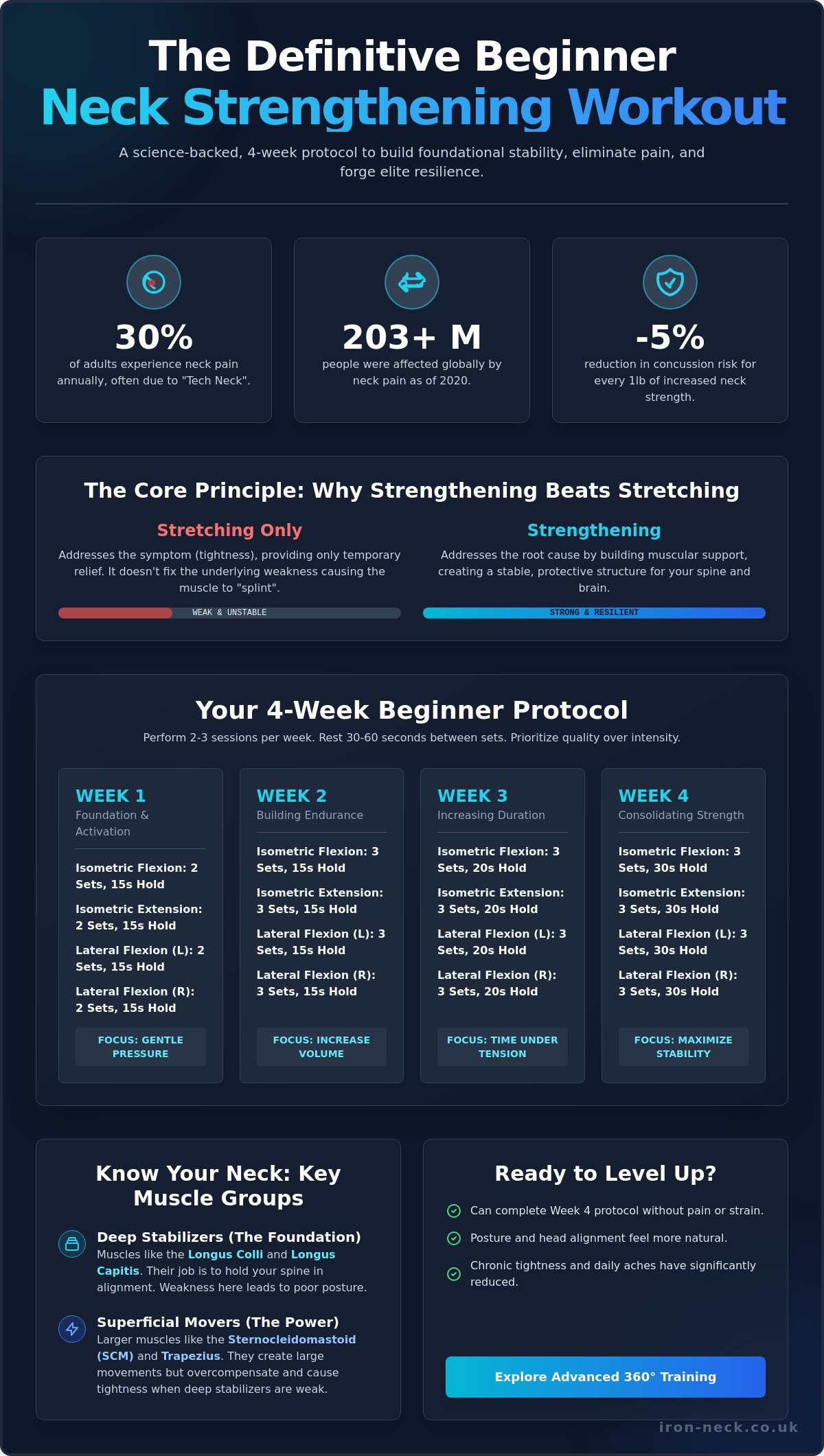
Did you know that 30% of adults experience neck pain every year, with over 203 million people affected globally as of 2020? If you're struggling with chronic "tech neck" from desk work or worrying about your concussion risk on the field, you've likely felt that your neck is the "missing link" in your physical health. It's a common frustration to feel like your posture is failing you. You deserve a clear, methodical path toward resilience.
This guide provides the definitive solution to these concerns. You'll master a science-backed beginner neck strengthening workout designed to build foundational stability and eliminate pain through a structured 4-week program. We'll break down the essential principles of cervical training. We'll also provide a routine that transforms your neck from a liability into an elite protective shield for your brain and spine. By the end of this article, you'll have the exact protocol needed to move with total confidence.
Key Takeaways
- Understand the cervical spine's multi-directional capabilities and why targeting deep stabilizer muscles is the foundation for all movement.
- Master a structured beginner neck strengthening workout that uses isometric holds and a 4-week protocol to build resilience safely.
- Learn why strengthening is superior to stretching for chronic tightness; address the body's natural "splinting" response to underlying weakness.
- Implement a sustainable routine of two to three sessions per week that prioritizes movement quality over intensity for long-term cervical health.
- Identify the specific performance markers that indicate you're ready to level up your training with 360-degree rotational resistance.
Why Neck Strength is the Foundational Missing Link
Neck training is frequently relegated to the sidelines of fitness, often viewed as a niche rehabilitation task rather than a performance pillar. This is a mistake. True neck strengthening is the systematic loading of the cervical stabilizer muscles to improve structural integrity. It's the foundation for all movement. Your head weighs approximately 10 to 12 pounds; any deviation from neutral alignment places exponential stress on the spine. A dedicated beginner neck strengthening workout isn't just about aesthetics or comfort. It's about securing the most critical junction of the human body.
Modern life has accelerated the need for this training. "Tech neck" is now a global epidemic. With 30% of adults experiencing neck pain annually, the traditional approach of simple stretching is failing. Stretching often addresses the symptom, but strength addresses the cause. Weak muscles often feel "tight" because they're struggling to hold your head up. By understanding the Anatomy of the neck muscles, we can see how these tissues support the skull and protect the spinal cord. Systematic loading transforms these stabilizers into a rigid, protective sleeve.
The Science of Injury Prevention
A strong neck serves as the primary shock absorber for the brain. Clinical data suggests that for every one pound of increased neck strength, concussion risk decreases by 5%. This is because a robust cervical spine dissipates impact forces before they reach the cranium. Cervical stiffness is a protective mechanism where the muscles contract to prevent excessive head acceleration during whiplash or contact. This prevents the "bobblehead" effect during athletic collisions. It's a critical component of safety for both youth athletes and professionals who want to stay in the game longer.
Performance Benefits Beyond the Spine
Elite resilience starts with stability. When your neck is weak, your brain receives "noisy" signals regarding your position in space. This can degrade peripheral vision and vestibular health, affecting your balance and reaction time. A stable cervical spine also allows for better force transfer during compound lifts like squats and deadlifts. If the "missing link" is weak, the entire kinetic chain suffers. Integrating a beginner neck strengthening workout into your routine ensures that power is never lost through a shaky foundation. You're building a body that's as hard to break as it is to beat.
Essential Anatomy: Identifying the Muscles You Are Training
Most people treat the neck as a simple hinge that only moves up and down. This is a scientific oversight. The cervical spine is the most mobile segment of your vertebral column, designed for 360-degree rotation, lateral flexion, and complex gliding movements. If you only train in one plane of motion, you're leaving significant gaps in your structural integrity. A comprehensive beginner neck strengthening workout must address this multi-directional reality to build true stability and protect the spinal cord. Because the neck houses such critical neural pathways, your approach must be methodical and precise.
Effective training requires a balance between deep stabilizers and superficial movers. Beginners often make the mistake of over-relying on the larger muscles they can see in the mirror while neglecting the foundational tissues beneath. True cervical health isn't just about the size of the muscles; it's about the coordination and endurance of the entire system. This internal support network acts as a hydraulic cylinder for your skull, maintaining alignment under gravity and during high-impact activities.
Deep Cervical Flexors vs. Superficial Movers
You must distinguish between the muscles that move the head and those that stabilize the spine. The Longus Colli and Longus Capitis are deep cervical flexors that sit directly against the vertebrae. Their primary role is maintaining the natural cervical curve and providing segmental stability. In contrast, the Sternocleidomastoid (SCM) is a powerful superficial mover used for large rotations and flexions. If the deep stabilizers are weak, the SCM overcompensates. This creates the forward head posture typical of "tech neck." You must master the activation of these deep stabilizers before adding heavy resistance to avoid joint shear and strain.
The Role of the Trapezius and Posterior Chain
Your neck doesn't function in isolation. The Upper Trapezius and Levator Scapulae serve as secondary stabilizers that anchor the cervical spine to the shoulder girdle. Shoulder blade stability directly influences neck health; if your scapulae are weak, your neck muscles must work twice as hard to maintain posture. Integrating these muscles improves proprioception, which is your brain's ability to sense the position and movement of your head in space. High-level proprioception is the "missing link" that allows athletes to anticipate impacts and desk workers to maintain elite posture. If you're ready to start building this foundation, using specialized neck training equipment can help you target these muscles with the precision required for long-term results.
The 4-Week Beginner Neck Strengthening Protocol
Building an elite cervical foundation requires a methodical approach. Don't rush the process. Most beginners fail because they prioritize intensity over quality, leading to strain rather than strength. For this beginner neck strengthening workout, you should aim for two to three sessions per week. This frequency provides the ideal balance between neural adaptation and tissue recovery. Each session should take approximately 10 to 15 minutes. Consistency is the variable that drives long-term results, not the amount of weight you move in a single day.
Your goal during these four weeks is to develop "cervical stiffness," which is the ability of your muscles to brace and protect the spine. We start with static holds to wake up the deep stabilizers before moving into dynamic patterns. By following this structured path, you eliminate the guesswork and ensure every rep contributes to your resilience.
Week 1-2: Establishing the Baseline
The first two weeks focus on isometric training. Isometrics are the safest way to introduce load to the cervical spine because they involve no joint movement. This phase is about neurological "re-education" for your muscles.
- Step 1: The Chin Tuck. This is the cornerstone of deep stabilizer activation. Sit tall and pull your chin straight back as if making a "double chin." You should feel the muscles in the front of your neck engage. Hold for 5 seconds and repeat for 10 repetitions.
- Step 2: 4-Way Isometric Holds. Use your own hand as a resistance tool. Press your head forward, backward, and to each side against your palm. The key is to keep your head in a neutral spine position; don't let your hand move your head. Hold each direction for 10 seconds. Complete 3 rounds.
Focus on your breathing during these holds. Avoid the temptation to hold your breath, as this increases internal pressure unnecessarily. Keep your shoulders packed down and back to ensure the neck muscles are doing the work.
Week 3-4: Controlled Movement and Rotation
Once you've mastered the baseline isometrics, you're ready to introduce a controlled range of motion. This phase transitions from static stability to functional mobility.
- Step 3: Slow-Tempo Rotations. Move your head slowly from left to right and ear to shoulder. Use a 3-second concentric and 3-second eccentric tempo. This slow pace builds proprioception and ensures you aren't using momentum to bypass weak spots.
- Step 4: Linear Loading with the Alpha Head Harness. This is the point where you introduce external resistance. Using a harness with a light resistance band allows you to apply a predictable, linear load. Focus on maintaining a perfect beginner neck strengthening workout form during light flexion and extension exercises.
Track your progress using "time under tension" rather than heavy weight. If a 10-second hold or a specific set of rotations feels easy, increase the duration of the set by 5 seconds. This methodical progression builds the endurance necessary for elite performance and pain-free living.
Common Pitfalls: Why Strengthening Beats Stretching
The most common reaction to neck stiffness is to reach for a stretch. While it feels productive, it often ignores the physiological reality of the cervical spine. Chronic "tightness" is frequently a protective "splinting" response. When your stabilizer muscles are too weak to support the weight of your head, your brain forces the larger muscles to lock down to prevent injury. If you keep stretching these locked muscles without building strength, you're essentially removing your body's only defense mechanism. A beginner neck strengthening workout is "the missing link" because it addresses the instability that causes the tension in the first place.
Hypermobility without strength is a recipe for chronic pain. If you have a high range of motion but low structural integrity, your joints are subject to micro-trauma during everyday movements. Strength provides the "stiffness" required to keep the vertebrae aligned. By shifting your focus from flexibility to resistance, you create a foundation that can actually withstand the demands of "tech neck" and high-impact sports. You don't need a longer muscle; you need a more resilient one.
The Myth of the "Permanent Stretch"
Stretching provides a temporary neurological "reset" that usually lasts for approximately 15 to 30 minutes. It doesn't change the physical length of the muscle or improve your posture long-term. The "Strengthen, Don’t Stretch" philosophy is backed by clinical observations showing that resistance training is more effective at reducing chronic neck pain than stretching alone. In cases of hypermobility, aggressive stretching is actually contraindicated as it can increase joint laxity. To begin building that resilience correctly, you can explore professional neck training tools designed to apply safe, controlled resistance.
Avoiding the "No Pain, No Gain" Mentality
The cervical spine requires a methodical and scientific approach to loading. Because the neck houses the spinal cord and major arterial pathways, explosive movements or ego-lifting have no place in a beginner neck strengthening workout. Progress should be measured in small, incremental steps. Watch for these specific signs of overtraining or improper form:
- Dizziness or lightheadedness during or after a set.
- Sharp, radiating pain that travels into the shoulders or arms.
- Persistent tension headaches that occur shortly after training.
If you experience these, reduce the resistance immediately. Your goal is elite resilience, not a quick fix. By prioritizing the quality of your isometric holds and rotations, you ensure that your training remains both safe and effective for the long haul. A scientific approach to load management is what separates an elite athlete from one sidelined by avoidable injury.
Leveling Up: Transitioning to Iron Neck Training
Bodyweight exercises and manual resistance are the starting points for any recovery or performance journey. However, bodyweight training eventually reaches a ceiling for elite neurological adaptation. You'll know you're ready to transition when your beginner neck strengthening workout no longer challenges your stability or when your isometric holds feel effortless. To achieve elite resilience, you must apply progressive overload. This is a scientific requirement for building the "cervical stiffness" necessary to protect the brain and spine.
Traditional training methods often rely on linear loading, which only strengthens the neck in simple forward, backward, or side-to-side planes. This is "The Missing Link" in most routines. Real-world impacts and athletic movements occur in 360 degrees. The Iron Neck 3.0 provides the definitive solution by introducing rotational resistance. This ensures that your stabilizer muscles are strong through every possible degree of movement, reducing the risk of injury during unpredictable collisions.
Iron Neck vs. Traditional Methods
Linear loading tools like the Alpha Head Harness are excellent for building foundational, straight-line strength. But the Iron Neck 3.0, priced at $349.00, offers a more holistic approach to cervical health. For those seeking the highest level of performance, the Iron Neck 3.0 Pro, at $599.00, includes an adjustable friction dial to customize rotational resistance. Both models are smaller and lighter than the previous 2.0 version, making them easy to integrate into any gym routine. If you're looking for a versatile entry point, Iron Neck Resistance Bands allow you to add controlled tension to your movements. These tools are backed by clinical research and endorsed by elite athletes who recognize that a strong neck is the foundation for all movement.
Setting Your Future Training Goals
Once you've mastered the beginner neck strengthening workout and transitioned to specialized equipment, your goals will shift toward advanced protocols. You'll begin to master complex movements like "The Figure 8" and "Protraction/Retraction" under load. These exercises challenge your proprioception and force your neck to maintain perfect alignment while your body moves through space. This level of training is critical for long-term health, especially considering that 203 million people were affected by neck pain globally in 2020.
Integrate these sessions into your full-body routine two to three times per week. By doing so, you ensure your cervical spine is never the weak link in your kinetic chain. Join the thousands of athletes and professionals who have moved beyond simple stretching to embrace a methodical, strength-based approach. Unlock your full potential and build the elite resilience your body deserves.
Build Your Elite Foundation Today
You now have the definitive blueprint to transform your cervical health. By moving past the temporary relief of stretching and embracing a structured beginner neck strengthening workout, you've addressed the root cause of instability. You understand that true resilience requires a methodical progression from static isometrics to dynamic, multi-directional loading. This isn't just about avoiding "tech neck" or daily discomfort; it's about achieving peak physical performance and protecting your most vital asset.
The Iron Neck Home Starter Kit provides the same 360-degree multi-directional training technology used by every NFL and UFC team to reduce injury risk. It's endorsed by leading physiotherapists and strength coaches who recognize that neck strength is the foundational missing link for elite movement. Don't let weakness limit your potential or leave you vulnerable to avoidable injury. Unlock your full potential with the Iron Neck Home Starter Kit and start building a body that's as resilient as it is powerful. You've got the science; now it's time for the work. Your journey to a stronger, pain-free life starts with the first rep.
Frequently Asked Questions
Is neck training safe for beginners?
Neck training is exceptionally safe for beginners when you prioritize isometric holds over dynamic movement. Starting with static resistance allows you to build foundational stability without placing excessive shear force on the cervical vertebrae. Most injuries occur from ego-lifting or explosive movements. By following a methodical beginner neck strengthening workout, you ensure that your stabilizer muscles adapt at a safe, sustainable pace.
How often should I do a neck strengthening workout?
You should perform a beginner neck strengthening workout two to three times per week. This frequency allows for optimal protein synthesis and neurological recovery between sessions. Training your neck every day is unnecessary and can lead to overtraining of the delicate cervical muscles. Consistency over a 4-week period is more important than high daily volume for achieving long-term structural resilience.
Will neck exercises help with my posture and tech neck?
Strengthening exercises are the definitive solution for "tech neck" and poor posture. While stretching provides temporary relief, building strength in the deep cervical flexors pulls the head back into neutral alignment. This reduces the 50 to 60 pounds of pressure placed on your spine when leaning forward. Strengthening these stabilizers eliminates the need for your body to "lock down" superficial muscles in a painful protective response.
Can neck strengthening prevent concussions?
While no equipment can completely eliminate concussions, a strong neck is your primary defense against traumatic brain injury. Strength improves your ability to brace for impact, which reduces the peak acceleration of the brain within the skull. Athletes with higher neck-to-head mass ratios and greater isometric strength consistently show lower incidences of head injuries in high-impact sports like football and rugby.
Do I need a neck harness or Iron Neck to see results?
You can begin with manual resistance, but a harness or Iron Neck is essential for achieving elite performance. Bodyweight exercises lack the ability to provide measurable progressive overload or consistent rotational resistance. To fix the "missing link" of rotational stability, you need a device that allows for 360-degree loading. This ensures your neck is protected from every angle, not just in linear planes.
What should I do if I feel pain during a neck exercise?
Stop the exercise immediately if you feel sharp, radiating, or electrical pain. Muscle fatigue or a mild "burn" is a normal part of training, but any sensation that travels into your arms or causes dizziness is a red flag. These symptoms often indicate nerve compression or joint irritation. Re-evaluate your form and ensure you are maintaining a neutral spine before attempting the movement again at a lower intensity.
How long does it take to see results from neck training?
Most individuals notice improved posture and reduced tension within the first 14 to 21 days of consistent training. These initial gains are largely neurological, as your brain becomes more efficient at activating the stabilizer muscles. Significant muscle hypertrophy and long-term structural changes typically require 8 to 12 weeks of progressive resistance. Tracking your time under tension will help you visualize these incremental improvements.
Can I train my neck if I already have a stiff neck?
Gentle training can often alleviate stiffness, but you should avoid training during acute inflammatory episodes. If your stiffness is caused by muscle weakness, isometric holds can help "re-set" the resting tension of the tissue. However, if you have a limited range of motion accompanied by fever or severe sharp pain, you should seek a professional evaluation before starting any new routine. Always prioritize safety over intensity.