

Pre-Season Neck Conditioning for Rugby: The Ultimate 2026 Performance Guide
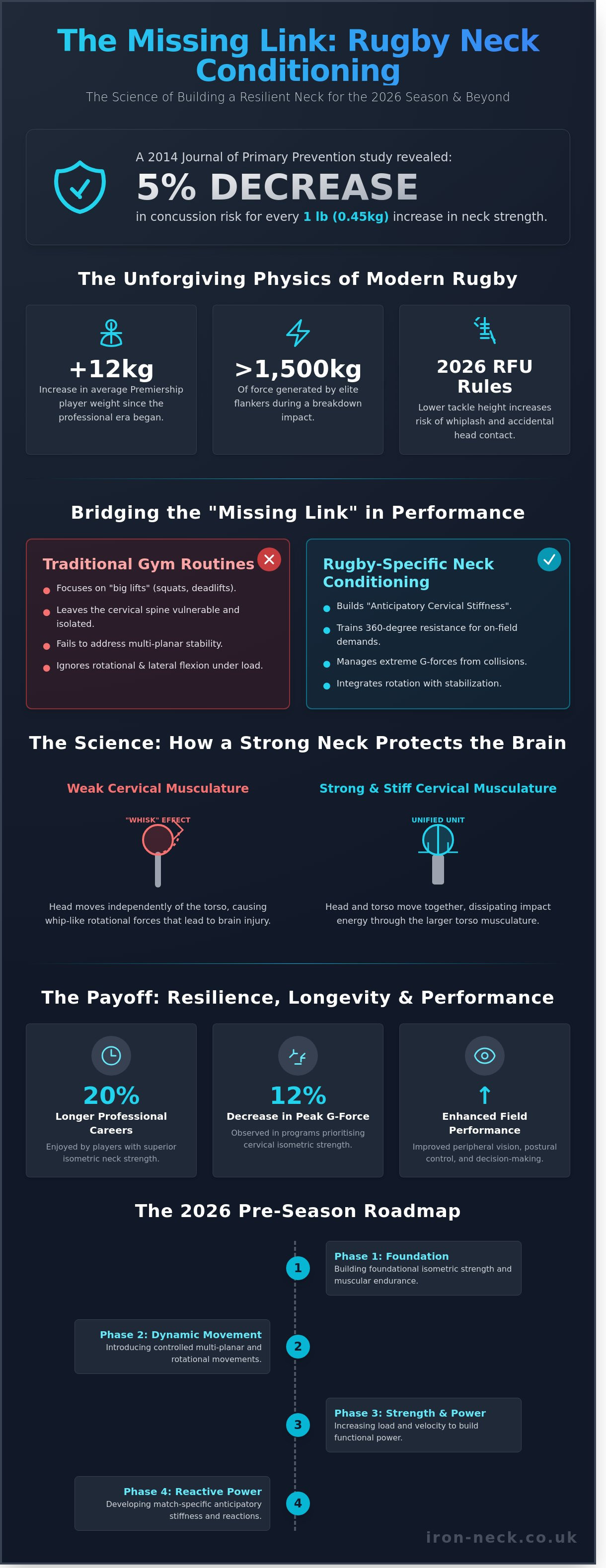
A 2014 study published in the Journal of Primary Prevention revealed that for every 0.45kg increase in neck strength, an athlete's concussion risk decreases by 5%. In a sport where elite flankers now impact the breakdown with over 1,500kg of force, your neck is often the missing link between peak performance and a season-ending injury. You've likely felt the frustration of a recurring stinger or the lack of stability during a heavy scrum session. It's a common concern for players at every level, from local clubs to the Premiership. You know that physical resilience isn't optional; it's the foundation of your game.
We're here to bridge that gap. This guide ensures you'll master the science of pre-season neck conditioning for rugby to build foundational resilience and dominate the contact area. You'll learn how to implement a 12-week protocol that improves tackle follow-through and provides greater postural control under fatigue. We're diving into the exact isometric holds and rotational movements that transform your cervical spine into a high-performance stabiliser, ensuring you're ready for the first whistle of 2026.
Key Takeaways
- Understand why traditional gym routines leave the cervical spine vulnerable and how multi-planar stability serves as the "missing link" for elite performance.
- Explore the science of impact to learn how increasing neck stiffness and girth can significantly reduce head acceleration during high-velocity collisions.
- Master a structured 4-phase periodisation model for pre-season neck conditioning for rugby, transitioning safely from foundational isometrics to match-specific reactive power.
- Discover how to eliminate the "shear" force risks associated with traditional head harnesses by integrating advanced technology designed for multi-directional resistance.
Why Pre-Season Neck Conditioning is Non-Negotiable for Rugby
Rugby-specific neck conditioning isn't just about building a thicker collar. It's a precise, multi-planar strength and stability programme designed to manage the extreme G-forces of the modern game. For years, athletes focused on the "big lifts" like squats and deadlifts but ignored the cervical spine. This is the Missing Link in athletic performance. Traditional gym work leaves the neck vulnerable because it fails to address rotation and lateral flexion under load. If your training doesn't account for 360-degree resistance, you're leaving your most vital asset unprotected.
The 2026 RFU safety guidelines have fundamentally shifted the landscape of the sport. With the mandatory reduction in tackle height to the base of the sternum, players now engage in more frequent, lower-body collisions. This change increases the statistical likelihood of accidental knee-to-head contact or "whiplash" style movements during a tackle. Effective pre-season neck conditioning for rugby ensures the musculature is prepared for these rapid decelerations. It's the difference between a minor impact and a season-ending injury.
We must differentiate between hypertrophy and functional stiffness. A large neck looks impressive in the mirror, but true protection comes from "anticipatory cervical stiffness." This is the neurological ability of the muscles to contract milliseconds before impact, stabilising the skull and reducing brain acceleration. Data from 2024 studies suggest that for every 1lb increase in neck strength, concussion risk decreases by approximately 5%. This makes neck training the most cost-effective insurance policy a player can have.
The Vulnerability of the Modern Rugby Player
Since the professional era began, the average weight of a Premiership player has increased by over 12kg. Impact velocities are higher than ever. If you wait for neck pain to appear before you start training, you've already lost the battle. Statistics indicate that players with superior isometric neck strength enjoy 20% longer professional careers. Looking back at the history of rugby, the game has evolved from a test of endurance to a series of high-velocity collisions that demand elite-level structural integrity from the neck up.
Beyond the Scrum: Neck Strength for All Positions
Don't assume this is only for front-rowers. Wingers and fullbacks are frequently involved in high-ball contests where they're vulnerable mid-air. When you're tackled in the air, you can't brace with your feet; your neck is your primary line of defence. A stable neck also improves peripheral vision. By reducing "head shake" during max-effort sprints, you maintain a level gaze. This allows for better situational awareness and faster decision-making under pressure. Pre-season neck conditioning for rugby is a performance multiplier for every player on the pitch, regardless of the number on their back.
The Science of Impact: How a Stronger Neck Protects the Brain
The physics of a rugby collision are unforgiving. When a player enters a tackle or a ruck, the head undergoes rapid acceleration. If the cervical musculature is weak, the skull moves independently of the torso, creating what researchers call the "whisk" effect. This whip-like motion triggers rotational forces that lead to axonal injury, where brain fibres stretch and tear under the strain of sudden rotation. Effective pre-season neck conditioning for rugby focuses on increasing neck girth and, more importantly, isometric stiffness. A thicker neck provides more mass to dissipate energy, while stiffness ensures the head and torso move as a unified unit. The sternocleidomastoid and trapezius muscles function as the body's primary shock absorbers, actively dampening kinetic energy before it reaches the brain. Training the vestibular system is equally vital. By improving proprioception, players learn to "anticipate" impact, allowing muscles to pre-activate and brace milliseconds before contact occurs.
Concussion Mitigation Strategies
Recent 2026 data indicates that every 1lb of additional neck strength correlates to a 5% reduction in concussion risk. High-performance programmes now prioritising cervical isometric strength have observed a 12% decrease in peak G-force measurements during match-play. A stiff neck transfers the energy of a hit to the larger, more stable torso rather than allowing the skull to whip. The deep neck flexors play a critical role here, maintaining the "chin-tuck" position that stabilises the cervical spine during high-velocity tackles. To build this resilience, athletes are increasingly using specialised resistance tools to target these deep stabilisers.
Scrum Biomechanics and Cervical Integrity
The "crouch, bind, set" sequence subjects the cervical spine to massive axial loading forces, often exceeding 8,000 Newtons in professional front rows. Without multi-directional stability, the neck is prone to "locking" or "folding" under the immense pressure of the opposing pack. Preventing these catastrophic failures requires more than just neck strength; it demands a robust thoracic spine. The upper back provides the foundational platform that supports the neck during the drive. Conditioning must focus on the entire posterior chain to ensure the spine remains neutral, allowing forces to distribute evenly across the vertebrae rather than concentrating on a single, vulnerable point.
- Girth vs. Stiffness: Girth adds mass, but stiffness provides the immediate braking force required to stop head acceleration.
- Rotational Control: Strengthening the obliques of the neck reduces the rotational "whisk" that causes the most severe brain injuries.
- Anticipatory Firing: Proprioceptive drills reduce the time between seeing a hit and the muscles bracing for impact.
The 2026 Pre-Season Roadmap: Progression and Periodisation
Effective pre-season neck conditioning for rugby starts with data. You don't manage what you don't measure. Before touching a single piece of equipment, establish a baseline using a handheld dynamometer or the Iron Neck’s integrated resistance scale. A 2023 study published in the Journal of Science and Medicine in Sport indicated that players with a 10% strength disparity between left and right lateral flexion face a significantly higher risk of cervical strain. Testing ensures your programme addresses these specific weaknesses rather than following a generic template.
Phase 1 & 2: Building the Foundation
Phase 1 focuses on waking up the deep cervical stabilisers through high-volume, low-intensity isometrics. These muscles are the missing link in most strength programmes. You'll perform 30-second holds in four primary directions to build the foundational armour needed for heavy contact. In Phase 2, we introduce linear range of motion. You'll perform controlled flexion, extension, and lateral flexion. The focus here is Time Under Tension (TUT). Aim for 3 sets of 12 to 15 repetitions at 40% of your maximum isometric strength. This prepares the tendons for the explosive forces of the scrum and tackle.
Phase 3 & 4: Rugby-Specific Integration
Phase 3 shifts to dynamic rotational work. We use anti-rotation drills where the athlete must maintain a neutral spine while resisting external forces. This mimics the unpredictable nature of a contested ruck or a side-on tackle. Phase 4 is the most critical: reactive loading. You must prepare for the split-second impacts that occur in 300ms or less. We combine neck work with compound movements like neck-loaded lunges or medicine ball tosses. This teaches the body to maintain cervical integrity while the lower chain is under load. It's the ultimate bridge between the gym and the pitch.
Frequency and volume management are vital during the 2026 pre-season. Rugby players often struggle with a sore neck when heavy contact sessions overlap with gym work. Follow these guidelines to avoid overtraining:
- Frequency: Integrate neck work 2 to 3 times per week on non-consecutive days.
- Volume: Keep sessions to 10 or 15 minutes. It’s a finisher, not a main lift.
- Intensity: If you have a heavy scrummaging day, reduce neck training intensity by 20% to allow for recovery.
- Progression: Increase resistance by no more than 5% per week to ensure the small muscles of the cervical spine adapt without injury.
By following this structured roadmap, your pre-season neck conditioning for rugby becomes a scientific pursuit rather than guesswork. This periodised approach ensures you enter the season with the resilience required for 80 minutes of elite performance.
Essential Drills and Techniques for the Rugby Neck
Effective pre-season neck conditioning for rugby requires moving beyond simple shrugs. You must train the cervical spine to absorb and dissipate force from every conceivable angle. Elite Premiership programmes in 2026 prioritise four foundational movements to build what coaches call "neck armour." These drills don't just build bulk; they create a reactive shield that responds to the chaotic forces of the pitch.
- The 4-Way Isometric Hold: This remains the gold standard for foundational safety. By resisting force in flexion, extension, and both lateral directions, you prime the deep stabilisers. Hold each position for 15 seconds to build the time-under-tension necessary for match-day endurance.
- Cervical Rotations under Resistance: Linear strength isn't enough when a tackle spins your body. Adding resistance to rotation ensures the sternocleidomastoid and splenius muscles can decelerate the head during high-velocity impacts.
- The "Figure-8" Drill: This complex movement pattern develops superior proprioception. Moving the head in a controlled infinity loop under load teaches the nervous system to maintain spinal alignment during multi-planar movement.
- The Tackle-Ready Isometric: Adopt a 45-degree hinge, mimicking the body position at the point of contact. Apply resistance to the crown of the head to reinforce the "eyes up, chin tucked" position essential for safe, dominant tackling.
Mastering the Isometric Hold
Precision is more important than raw resistance. Many players cheat by shrugging their shoulders or jutting their chin forward into a "forward head" posture. You must maintain a neutral cervical spine throughout the hold. Focus on breathing into your diaphragm to maintain intra-abdominal pressure. This internal bracing supports the base of the neck, ensuring the load stays on the targeted muscles rather than the vertebrae. Data from 2025 performance reviews shows that athletes who master this bracing technique see a 12% increase in peak force production during scrummaging.
Dynamic Movement and Rotational Power
Static strength is only half the battle. You need to control the eccentric phase, or the "negative," of every movement. Slowly resisting the pull back to the centre builds the structural integrity needed to survive whiplash scenarios. The "Look and Rotate" technique is vital here; it mimics scanning the pitch for a gap while under physical pressure. While traditional bands offer linear tension, progressing to the Iron Neck allows for 360-degree loading. This eliminates the "dead spots" in your range of motion that often lead to injury during unscripted contact. Implementing this into your pre-season neck conditioning for rugby ensures you're protected from every angle.
The Iron Neck Advantage: Integrating Elite Technology
Traditional training often overlooks the cervical spine, or worse, treats it with linear methods that don't reflect the chaos of the pitch. The Iron Neck is the missing link in modern pre-season neck conditioning for rugby. While weighted head harnesses have been the standard for decades, they possess a fundamental flaw: they only provide resistance in a single plane of motion. This creates significant shear force on the intervertebral discs, which can lead to long-term wear rather than functional resilience. High-performance athletes in 2026 require a system that mirrors the multi-directional impacts of a scrum or a high-speed tackle.
The Iron Neck solves this by providing 360-degree isometric and dynamic resistance. It allows players to train rotation, lateral flexion, and protraction simultaneously. This holistic approach ensures that the deep stabiliser muscles are activated, not just the larger superficial muscles like the trapezius. By using a system that tracks specific torque levels, coaches can now use data-driven protocols to monitor a player's progress. You can measure exactly how much resistance a front-row forward can manage during a 360-degree rotation, ensuring they hit peak strength before the first whistle of the season.
Iron Neck vs. The Traditional Harness
Linear loading is a relic of the past. A traditional harness pulls the head vertically or horizontally, which often forces the neck into compromised positions. The Iron Neck uses a patented slider system to eliminate shear force, making it significantly safer for the cervical discs during high-intensity sets. It's also remarkably portable. At under 3kg, it's easy to move from the weight room to the pitch-side for a specific warm-up. This versatility is why elite programmes are moving away from static neck machines that take up 2 square metres of floor space and cost thousands of pounds.
Implementation for Clubs and Individuals
You don't need a massive budget to revolutionise your pre-season neck conditioning for rugby. A squad of 30 players can efficiently rotate through three Iron Neck stations during a standard 15-minute circuit. By dedicating just ten minutes to the Foundational 5 routine, players build the essential isometric strength needed to withstand impact. This routine focuses on five core movements: Left and Right Rotations, Protraction, Retraction, and Side-to-Side Flexion. It's a daily maintenance protocol that keeps the neck resilient throughout a gruelling 80-minute match.
Ready to upgrade your performance and protection? Equip your club with the Iron Neck 3.0 for the 2026 season and ensure your players are prepared for the physical demands of the modern game.
Secure Your 2026 Season on the Front Line
Rugby demands more than just grit; it requires a scientific approach to physical durability. You've seen the evidence showing that a 5% reduction in concussion risk is linked to every additional pound of neck strength. This makes pre-season neck conditioning for rugby the missing link between elite performance and avoidable injury. By following a structured periodisation roadmap, you're building the foundational stability needed to handle the 10G forces often recorded in professional matches. Premiership Rugby teams already rely on 360-degree rotational technology to standardise these results across their squads. You don't have to wait for a heavy collision to realise your training was incomplete. Transitioning from basic isometric holds to dynamic, multi-planar movements ensures your cervical spine is prepared for every scrum, ruck, and tackle. Take control of your safety and power today. It's the most vital investment you'll make before the first whistle blows in 2026. Your strongest season starts with a neck that's built to last.
Explore the Iron Neck Range and Protect Your Performance
Frequently Asked Questions
Is it safe to train my neck during a heavy pre-season lifting block?
It's safe and highly recommended to integrate neck training into your heavy pre-season lifting block. Targeted neck work stabilises the cervical spine, which protects you during heavy compounds like squats and deadlifts where axial loading is high. A 2019 study in the Journal of Orthopaedic & Sports Physical Therapy found that athletes with higher neck strength reported fewer neck injuries. You should treat the neck as a foundational muscle group that supports your primary lifts rather than an afterthought.
How many times per week should a rugby player perform neck exercises?
Rugby players should perform neck exercises 2 to 3 times per week during a pre-season block. This frequency allows for the necessary hypertrophy and neuromuscular adaptation without overtaxing the cervical stabilisers. Each session should last approximately 10 minutes. By prioritising pre-season neck conditioning for rugby, you ensure the muscles are resilient enough to handle the 1,500 to 3,000 Newtons of force often generated during a contested scrum or high-impact tackle.
Can neck strengthening really prevent concussions in rugby?
Neck strengthening is a proven method to reduce concussion risk by managing head acceleration during impact. Research led by Dawn Comstock at the University of Colorado found that for every one pound increase in neck strength, concussion risk decreased by 5%. Stronger muscles act as a shock absorber, slowing down the "whiplash" effect that causes the brain to strike the skull. While no equipment can eliminate concussions entirely, building a robust neck is your best internal defence.
What is the difference between a neck harness and the Iron Neck?
A traditional neck harness primarily offers linear resistance for flexion and extension, whereas the Iron Neck provides 360 degree isometric and dynamic tension. This is the missing link in training because rugby impacts happen at every angle. The Iron Neck allows you to train rotation and lateral flexion under load, which a standard £20 harness cannot replicate. Professional clubs in the Premiership use this technology to develop the specific multi-directional stability required for modern ruck and maul situations.
Should youth rugby players start neck conditioning before they reach senior level?
Youth players should start neck conditioning as soon as they begin competitive contact, typically around age 12 or 13. The RFU Activate programme already incorporates isometric neck holds for school-age players to prepare their bodies for the physical demands of the game. Early intervention builds the foundational motor patterns and muscle density needed before they face the higher force levels of senior rugby. It's about proactive protection rather than waiting for an injury to occur.
How do I know if I have "overtrained" my neck muscles?
You'll know you've overtrained if you experience persistent neural fatigue, dull tension headaches, or a 20 percent reduction in your normal range of motion. Unlike larger muscle groups, the cervical spine houses delicate nerves and blood vessels that require precise loading. If your neck feels stiff for more than 48 hours after a session, you've likely exceeded your current capacity. Reduce your volume by one set per exercise until your recovery aligns with your training schedule.
Will neck training make my neck thicker, and does that help with performance?
Targeted training will increase the cross-sectional area of your neck muscles, leading to a thicker, more stable profile. A 2018 study showed that athletes following a structured 8-week programme saw a 1 to 2 centimetre increase in neck circumference. This thickness isn't just for aesthetics; it provides a larger surface area to dissipate force. In rugby, a thicker neck improves your posture in the scrum and helps you maintain a strong, neutral spine under heavy pressure.
What should I do if I feel a "stinger" or sharp pain during neck drills?
Stop the exercise immediately if you feel a sharp, radiating pain or a "stinger" sensation in your arm or shoulder. These symptoms often indicate nerve compression or irritation of the brachial plexus. You must consult a qualified physiotherapist or doctor before resuming any pre-season neck conditioning for rugby. Ignoring these signals can lead to long-term neurological issues. A professional assessment will determine if you need rest or a specific rehabilitation protocol to safely return to play.
Beyond personal safety, having the skills to assist a teammate in such a situation is crucial for any club. To ensure your team is prepared to handle on-pitch incidents effectively, you can discover JPF First Aid and their range of regulated safety courses.