

Neck Training for Police Officers UK: The Missing Link in Operational Safety
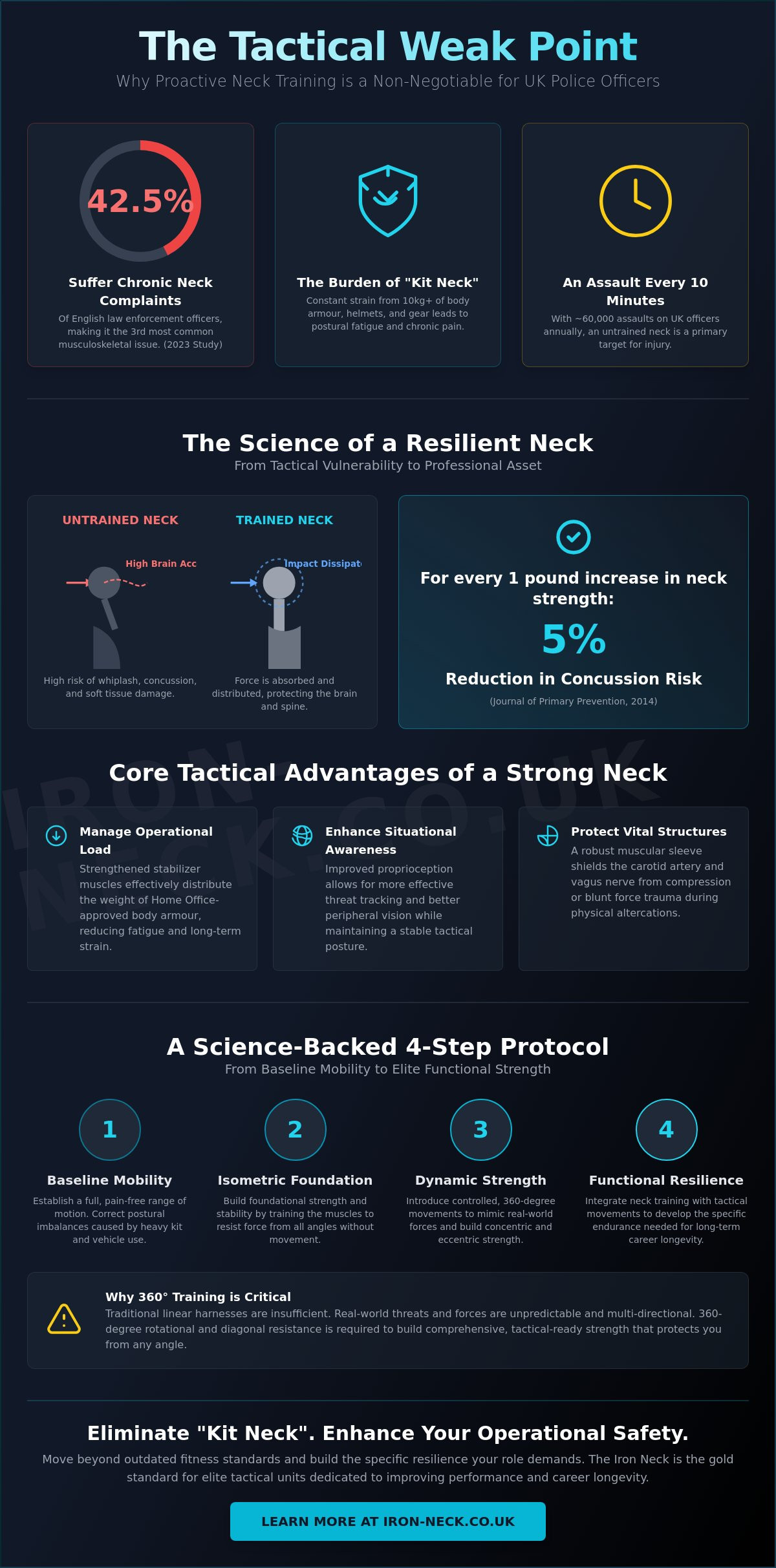
Did you know that 42.5% of English law enforcement officers suffer from chronic neck complaints? According to a 2023 study, neck pain is the third most common musculoskeletal issue in the force, following only back and shoulder problems. With nearly 60,000 assaults recorded in the year ending March 2025, your cervical spine is under constant threat from both heavy kit and physical altercations. You're likely all too familiar with "kit neck," that persistent stiffness after a 12 hour shift spent in heavy body armour or cramped patrol cars. It's often accepted as an inevitable part of the job, but it doesn't have to be.
This guide reveals why specific neck training for police officers UK is the missing link in operational safety. You'll discover how targeted strengthening protects you from PPE-related strain, tactical injuries, and long term career attrition. We'll examine the science of concussion resistance, the biomechanics of postural correction, and the foundational equipment required to transform a tactical vulnerability into a professional asset. It's time to move beyond general cardiovascular standards and build the specific resilience your role demands.
Key Takeaways
- Learn how targeted conditioning of the cervical spine helps you manage the daily operational load of heavy, Home Office-approved body armour.
- Discover the biomechanics of neck "stiffening" and how increasing neck strength can significantly reduce brain acceleration during physical altercations.
- Understand why traditional linear harnesses are insufficient and why 360-degree resistance is required to mimic real-world tactical movements.
- Follow a science-backed 4-step protocol for neck training for police officers UK that builds from baseline mobility to elite-level functional strength.
- See why the Iron Neck is the gold standard for elite tactical units looking to eliminate "kit neck" and improve long-term career longevity.
What is Tactical Neck Training for UK Police Officers?
Tactical neck training is the methodical conditioning of the cervical spine and its surrounding stabilizer muscles to manage the extreme operational loads of modern policing. While official fitness standards in the UK focus heavily on cardiovascular endurance through the multi-stage fitness test, they often ignore the structural integrity of the neck. This is the missing link in officer safety. Traditional strength training like bench presses and squats builds a powerful chassis, but these movements fail to protect the bridge between your head and your torso. For a UK officer, a weak neck isn't just a fitness deficiency; it's a tactical vulnerability.
Effective neck training for police officers UK shifts the focus from reactive rehabilitation to proactive prehab. Instead of waiting for a chronic injury to develop, you build a foundational shield that preserves your career longevity. This approach ensures that your body is prepared for the physical reality of the job before the pain starts. By treating the neck as a critical component of your operational kit, you increase your resilience against the daily wear and tear of life on the thin blue line.
Understanding "Kit Neck" and PPE Strain
UK policing presents a unique biomechanical challenge due to the specific requirements of Home Office-approved body armour. This equipment often forces officers into a chronic forward-leaning posture, shifting the centre of gravity and placing constant isometric strain on the posterior neck muscles. When you add the weight of a tactical helmet or a heavy radio clipped to your vest, the burden on your cervical spine increases exponentially. Kit Neck is the cumulative biomechanical strain of police equipment on the cervical spine. This persistent tension leads to the 42.5% rate of neck complaints reported by English officers in 2023. Strengthening the stabilizer muscles allows your body to distribute this load more effectively, reducing fatigue during long deployments.
The Role of the Neck in Use of Force
A resilient neck is your first line of defence during physical altercations. With an assault on a UK officer occurring every 10 minutes, the ability to stabilize the head during a struggle is vital for survival. A strong neck acts as a shock absorber, dissipating kinetic energy and reducing the risk of whiplash during emergency response driving or sudden impacts. This is particularly important for preventing the long-term cognitive effects of Post-concussion syndrome, which can arise from even minor head trauma. Furthermore, neck training for police officers UK improves your proprioception. This enhanced body awareness directly translates to better peripheral vision and situational awareness, allowing you to track threats more effectively while maintaining a stable tactical posture.
The Science of Concussion Resistance and Injury Prevention
The primary mechanism behind concussion prevention is the ability to reduce brain acceleration. When an officer sustains an impact to the head or torso, the brain moves within the skull, potentially causing trauma. By "stiffening" the neck through coordinated muscle activation, you create a rigid link between the head and the body. This effectively increases the mass that an external force must move, significantly slowing down the acceleration of the skull. Research indicates a direct correlation between neck strength and injury risk. For instance, a 2014 study published in the Journal of Primary Prevention showed that for every one pound increase in neck strength, the risk of concussion is reduced by 5%. For UK officers facing unpredictable physical encounters, this marginal gain is a critical safety factor.
Beyond impact resistance, a robust muscular structure protects the vital "soft" infrastructure of the neck. This includes the vagus nerve and the carotid artery, both of which are vulnerable during tactical struggles or "scuffles" on the street. A well-developed neck provides a protective sleeve of muscle that shields these structures from compression or blunt force trauma. In the long term, consistent neck training for police officers UK serves as a preventative measure against degenerative disc disease. Veteran officers frequently experience premature wear in the cervical spine due to years of carrying 10kg or more of tactical gear. Strengthening the stabilizer muscles ensures the spinal discs aren't bearing the brunt of that load alone.
Cervical Spine Stabilisation in Tactical Environments
Your deep neck flexors are the "core" of your upper body. They provide the foundational stability required to maintain a neutral head position when wearing heavy headgear or CBRN gas masks. Without this stability, your proprioception, the body's ability to sense its position in space, becomes compromised, leading to slower reaction times and poor situational awareness. Neck strength acts as a shock absorber for the skull, ensuring that tactical movements remain fluid and precise even under the weight of ballistic protection. To build this foundational resilience, many officers are now looking at advanced cervical conditioning tools to bridge the gap in their training.
Mitigating Whiplash in Emergency Response
Emergency response driving involves high-speed manoeuvres and the constant risk of sudden, violent decelerations. When a patrol vehicle stops abruptly, the physics of inertia forces the head to whip forward and back, straining the cervical ligaments. Isometric strength is your first line of defence in these collisions. By training the neck to resist movement under tension, you prepare your muscles to engage instantly during a crash. This is vital for ARV and traffic officers who spend up to 10 hours a shift in vehicles with ergonomic setups that aren't always optimized for safety. Building this specific tissue tolerance ensures you remain operational even after a high-G event.
Static vs. Dynamic Training: Choosing the Right Equipment
Selecting the right equipment for neck training for police officers UK is often the difference between a superficial change and genuine operational resilience. Most officers are familiar with the standard gym setup, but when it comes to the cervical spine, the "more weight is better" approach is flawed. You must choose tools that mimic the chaotic, multi-directional forces encountered on duty. While traditional weightlifting builds the foundation, tactical success requires a transition from static, linear movements to dynamic, rotational resistance. The goal isn't just a larger neck; it's a neck that can stabilize the head under duress.
The Limitations of Traditional Neck Harnesses
Traditional neck harnesses are designed for one thing: linear flexion and extension. While these tools are excellent for building muscle mass in the sagittal plane, they fail to prepare the cervical spine for the rotational impacts common in physical altercations. In a real-world struggle, force rarely comes from a perfectly straight line. Basic harnesses also invite "cheating" through torso compensation. Many users inadvertently use their hips or lower back to move the weight, which bypasses the very stabilizer muscles you need to protect. For an officer, a harness might build size, but the Iron Neck builds functional stability by isolating the neck muscles throughout a full range of motion.
Rotational Strength: The Tactical Advantage
Operational safety depends on your ability to resist force from any angle. This 360-degree challenge is where rotational strength becomes your primary tactical advantage. Training with the Iron Neck allows you to apply consistent tension while moving your head through natural patterns, such as scanning your environment or checking mirrors during emergency response. This dynamic resistance improves your "scanned" environment speed by conditioning the muscles to move the head quickly and stop it instantly. It's the only device that provides this level of consistent, 360-degree tension, ensuring no weak points remain in your cervical armour.
Matching the tool to your operational requirement is essential. The Iron Neck Device is the gold standard for those seeking elite-level rotational resistance and concussion prevention. However, the Alpha Head Harness remains a robust option for building foundational tissue tolerance and linear strength. Both tools are highly portable, making them ideal for the home gym or for use at the station between shifts. Whether you're an ARV officer or on the frontline, neck training for police officers UK should be accessible and integrated into your daily routine to ensure you're always "kit-ready". By moving beyond static exercises, you ensure your training translates directly to the street.
A 4-Step Neck Training Protocol for UK Officers
Building operational resilience requires a methodical approach. You wouldn't enter a high-risk situation without a plan; your physical preparation should be no different. This 4-step protocol for neck training for police officers UK is designed to move you from baseline stability to elite-level functional strength. By following this systematic progression, you ensure every session translates directly to your safety on the street. It's about transforming the cervical spine into a foundational shield that supports your entire tactical posture.
- Step 1: Baseline Assessment. Begin by evaluating your current cervical mobility and isometric hold times. Can you maintain a neutral head position against light resistance for 30 seconds without pain? If you identify restrictions in your range of motion, address these through mobility drills before adding significant load.
- Step 2: Linear Foundations. Introduce controlled linear movements, including flexion, extension, and lateral flexion. This stage builds foundational tissue tolerance and prepares the stabilizer muscles for more complex, multi-planar stresses.
- Step 3: Rotational Resistance. Integrate 360-degree movements to mimic tactical head scanning. This is where you bridge the gap between "gym strength" and operational performance by resisting force from any angle.
- Step 4: Kit Integration. Apply progressive overload while wearing your full operational kit. Training in your vest and helmet ensures your neck is conditioned for the specific biomechanical demands of your role.
Phase 1: Foundational Stabilisation
Before you push for power, you must master stability. Phase 1 focuses on correcting "Forward Head Posture," often called Tech Neck, which is exacerbated by the weight of heavy body armour pulling your shoulders forward. Use the "33% rule" for your initial resistance: start with roughly one-third of your perceived maximum effort. This allows the deep neck flexors to engage without being overwhelmed by larger, superficial muscles. Consistency is more important than intensity at this stage. A dedicated 10-minute session, performed 3 times a week, is the sweet spot for busy officers. It's enough to stimulate adaptation without causing excessive fatigue that could hinder your performance on shift.
Phase 2: Operational Integration
Once you've built a stable base, you must train for the chaos of the job. Phase 2 involves "Look Left, Look Right" drills under constant rotational load, simulating the high-speed scanning required during emergency response or foot pursuits. Practice your "Interview Stance" while maintaining neck tension to ensure your head remains stable if a verbal encounter suddenly turns physical. Training specifically while wearing your body armour is essential because it changes your centre of gravity and forces your neck muscles to work harder to maintain alignment. To begin your journey toward elite structural resilience, order the Iron Neck training system today and start building your foundational shield.
The Iron Neck: The Gold Standard for Police Performance
The Iron Neck is the definitive platform for those who refuse to settle for subpar resilience. While previous sections outlined the 4-step protocol, the hardware you choose determines the quality of your results. Elite tactical units and professional athletes worldwide utilize this technology because it addresses the cervical spine's complex requirements with unmatched precision. In the high-stakes environment of policing, where physical readiness is a professional requirement, the Iron Neck provides the scientific edge needed to maintain peak performance. Iron Neck UK & Europe supports the thin blue line by delivering the same high-performance standards used by elite military units and tier-one athletes.
Durability is a core feature of every device in our inventory. These tools are engineered to withstand the rigours of high-intensity training environments, whether that is a busy station gym or a dedicated home setup used between demanding shifts. The professional-grade materials ensure your investment in safety remains a permanent part of your tactical kit. This equipment represents the "Missing Link" in current health and safety initiatives, moving beyond general cardiovascular standards to address the specific structural demands of neck training for police officers UK. By integrating this technology, you transform the neck from a tactical vulnerability into a foundational shield.
Iron Neck 3.0 vs. Alpha Harness for Officers
Selecting the right tool is a strategic decision for your career longevity. The Iron Neck 3.0 is the ultimate tool for developing rotational power and proactive injury prehab. Its unique ability to provide consistent 360-degree resistance ensures you are prepared for the multi-directional forces of a physical struggle. In contrast, the Alpha Harness offers a robust, budget-friendly entry point for building foundational posterior chain strength and linear tissue tolerance. While the harness is an excellent starting point for basic conditioning, the Iron Neck 3.0 remains the superior investment for those seeking the highest level of concussion resistance and postural correction.
Getting Started with Iron Neck UK & Europe
Protecting your health is an essential part of operational readiness. You can browse our full range of specialized Iron Neck devices to find the model that best fits your specific training environment. We also provide access to specialized training resources designed to help you integrate cervical conditioning into your existing routine without overtraining. Don't wait for chronic pain to dictate the end of your career. Invest in your operational safety with Iron Neck UK & Europe today.
Secure Your Tactical Future
Professional policing requires a shift in how we view physical preparation. Operational success is no longer just about cardiovascular endurance; it's about the structural integrity that allows you to carry your kit without pain and resist injury during a high-stakes arrest. By prioritizing neck training for police officers UK, you're making a strategic investment in your most valuable asset: your health. We've explored the science of concussion resistance and the necessity of 360-degree rotational strength, moving beyond the limitations of traditional linear training.
The 4-step protocol and elite-grade equipment discussed here provide the roadmap to a more resilient career. Whether you're a frontline responder or part of a specialist unit, the goal remains the same: transforming a tactical vulnerability into a foundational shield. You have the tools and the methodology; now you need the commitment to execute. Upgrade your operational resilience with Iron Neck UK & Europe and ensure your physical capacity matches your professional dedication. Build the strength that lasts long after your final shift ends. Stay safe, stay strong, and stay operational.
Beyond physical preparation, acknowledging the hard work and dedication of fellow officers is a vital part of police culture; for those looking to mark a promotion or retirement with a high-quality commemorative item, Engraveitnow Ltd offers a range of premium personalised gifts.
Frequently Asked Questions
Is neck training safe for police officers with existing stiffness?
Neck training is safe if you begin with low-intensity isometric holds rather than dynamic movements. Stiffness is often a protective response from the body due to underlying weakness in the stabilizer muscles. By gradually restoring strength to the cervical spine, you can reduce chronic tension and improve your functional range of motion during long shifts on the frontline.
How much time per week do I need to spend on neck training?
You only need approximately 30 minutes per week to build a foundational shield. The most effective protocol for neck training for police officers UK is a 10-minute session performed three times per week. This frequency allows for muscle adaptation without causing the type of central nervous system fatigue that might hinder your operational performance during high-pressure situations.
Can neck training help with headaches caused by my police helmet?
Yes, strengthening your neck can significantly reduce cervicogenic headaches triggered by heavy headgear. When your neck muscles fatigue under the weight of a helmet, they often develop trigger points that radiate pain to the head. Building endurance in these muscles ensures they can support the load throughout a 12-hour deployment without seizing up or causing debilitating discomfort.
What is the difference between a neck harness and the Iron Neck?
A standard harness is limited to linear movements, whereas the Iron Neck provides 360-degree rotational resistance. In a tactical environment, you rarely face force from a single direction. The Iron Neck allows you to train for the unpredictable, multi-planar forces encountered during arrests, making it a more comprehensive tool for concussion resistance and operational safety.
Should I train my neck before or after my main shift?
It's best to train after your shift or on rest days to ensure your stabilizer muscles are fresh while you're on duty. Training immediately before a shift might lead to temporary fatigue, which could slightly compromise your situational awareness or postural control. Post-shift training also serves as an excellent way to "reset" your posture after hours spent in body armour.
Will a stronger neck help me pass the police fitness test (bleep test)?
While the bleep test is primarily a cardiovascular assessment, neck strength improves your overall running economy. By stabilizing your head, you prevent unnecessary energy leakage and maintain a more efficient upright posture as you fatigue. This structural stability allows you to focus on your breathing and pacing during the final levels of the 15-metre shuttle run.
Can I use the Iron Neck while wearing my body armour?
Yes, training in your actual operational kit is a highly effective way to build task-specific strength. Because body armour shifts your centre of gravity, performing your neck training for police officers UK while wearing your vest forces your muscles to adapt to real-world conditions. This ensures the strength you build in the gym translates directly to your resilience on the street.
Is neck training recognized by the College of Policing?
The College of Policing currently focuses on general aerobic standards, but individual officers are increasingly adopting neck training to manage the 86% musculoskeletal complaint rate within the force. While not yet a mandated requirement, many frontline responders view it as an essential part of their personal health and safety. Iron Neck UK & Europe provides the protocols and equipment necessary to take ownership of your structural safety and career longevity.
Disclaimer
All information shared is based on personal experience, researching and from other coaches. The information is by no means a cure for injuries and simply a guide as to how neck training can be applied to your everyday life.
If you have a neck injury, always seek advice from a medical professional or physiotherapist.