

Neck Strengthening for Judo: The Ultimate 2026 Performance Guide
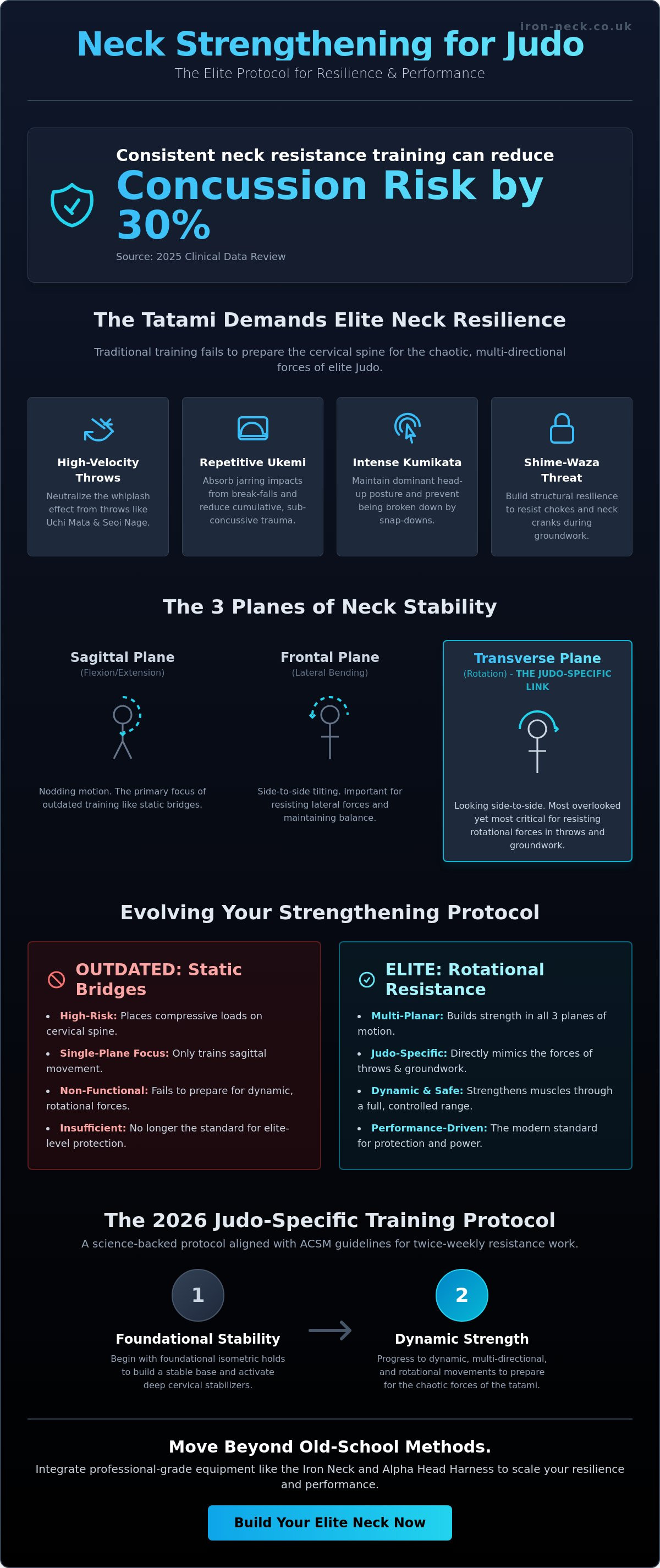
A 2025 clinical data review revealed that consistent neck resistance training can reduce concussion risk by 30% in high-impact contact situations. You've likely felt the jarring impact of a heavy Uchi Mata or the nagging stiffness that follows a session of repetitive Ukemi. These aren't just minor inconveniences; they're signs that your cervical stabilizers are under-prepared for the chaotic forces of the tatami. Traditional static bridges are no longer enough to protect you from elite level competition. Master the science of neck strengthening for judo to build a resilient, high-performance neck that withstands high-velocity throws and neutralizes the threat of Shime-waza.
In this guide, you'll learn how to implement a science-backed training protocol that aligns with the March 2026 ACSM guidelines of twice-weekly resistance work. We'll explore how multi-planar, rotational resistance creates the missing link in your athletic foundation. You will discover the exact methods to increase your resistance to stingers while improving your head control during intense grip fighting. It's time to move beyond old-school methods and adopt a methodical approach to protection and power.
Key Takeaways
- Understand how elite neck strength acts as the foundation for maintaining dominant head-up posture during intense Kumikata grip fighting.
- Analyze the biomechanics of the sagittal, frontal, and transverse planes to neutralize the whiplash effects of high-amplitude throws.
- Evaluate the risks of traditional training methods and why modern neck strengthening for judo must prioritize rotational resistance over high-risk static bridges.
- Learn a methodical training protocol that transitions from foundational isometric stability to dynamic, multi-directional strength.
- Discover how to integrate professional-grade equipment like the Iron Neck and Alpha Head Harness to scale your resilience and performance on the mats.
Beyond the Bridge: Why Judo Demands Elite Neck Strength
The physical demands of Judo are unique in the world of combat sports. While many athletes focus exclusively on grip strength or explosive hips, the neck is often the missing link between a successful throw and a season-ending injury. Effective neck strengthening for judo goes beyond building muscle for appearance. It's about creating a structural stabilizer that can manage the chaotic, high-velocity forces encountered during elite competition. When you're thrown, your neck acts as the final line of defense, absorbing energy during forced Ukemi and ensuring your head doesn't whip into the mat. It also serves as the foundational anchor for your upper kinetic chain, allowing you to maintain a dominant posture during heavy exchanges.
The Role of the Neck in Concussion Prevention
Science has evolved significantly in its understanding of head trauma. A 2025 clinical data review confirmed that consistent neck resistance training can reduce concussion risk by 30% in contact situations. This protection comes from increasing "effective mass." By strengthening the cervical muscles, you essentially couple the head to the torso more rigidly. This connection allows the mass of the body to help slow down head acceleration during an impact. In 2026, we understand that even sub-concussive impacts, the repetitive jarring from minor falls, can accumulate if the neck isn't properly conditioned. Concussion resistance is the neck’s ability to dissipate force and minimize the brain's movement within the skull.
Posture and Power: The Kumikata Connection
Dominating the grip fighting phase, or Kumikata, requires more than just strong hands. If your neck is weak, a simple snap-down can break your posture and leave you vulnerable to a foot sweep or a drop seoi nage. Cervical stability is directly linked to shoulder girdle power. When your neck muscles are engaged and strong, they provide a stable base for the trapezius and deltoids to generate force. Modern neck strengthening for judo must also account for rotational demands. "Looking where you throw" isn't just a coaching cue; it's a high-velocity movement that requires active, resisted rotation to prevent strain. A resilient neck ensures that your head stays up, your spine stays aligned, and your power remains unbroken throughout the match.
The Biomechanics of Grappling: How the Neck Protects the Judoka
Understanding neck strengthening for judo requires a deep dive into the three planes of human movement: sagittal, frontal, and transverse. While most gym exercises focus on the sagittal plane, which involves nodding forward and back, Judo is a chaotic environment defined by multi-directional forces. When you execute or receive a high-amplitude throw like Seoi Nage or Harai Goshi, your body accelerates rapidly while your head experiences a severe whiplash effect. To prevent injury, your cervical stabilizers must decelerate the skull instantly. This requires a balanced combination of neck exercises that target the Sternocleidomastoid for flexion and the Splenius Capitis and Trapezius for extension and lateral stability.
Transverse Plane Stability: Resisting the Twist
Rotational strength is the most overlooked aspect of grappling preparation. In the transverse plane, the neck must resist "cranking" forces during transitions to groundwork. If an opponent attempts to turn you over, they often use your head as a lever. Without elite rotational stability, this force is transferred directly to your intervertebral discs. Strengthening the deep neck flexors is essential for long-term spinal health because they provide the fine-tuned motor control needed to keep the cervical spine neutral under duress. Developing this specific resistance is why many elite athletes now use an Iron Neck for rotational training to bridge the gap between static strength and dynamic performance.
Isometric Resilience in Ne-waza
Groundwork demands a different type of strength. In Ne-waza, your neck often acts as a "fifth limb" to provide stability and leverage when your arms and legs are occupied. Whether you're maintaining a pin (Osaekomi-waza) or struggling to escape one, your neck muscles must maintain high levels of isometric tension for extended periods. This resilience is also your primary defense against chokes (Shime-waza). Strong stabilizer muscles help maintain the integrity of your airway and protect the carotid arteries, buying you precious seconds to work an escape. Effective neck strengthening for judo ensures that your neck is as comfortable holding a static contraction as it is absorbing a dynamic, high-velocity impact.
Comparing Strengthening Modalities: Harnesses, Bridges, and Rotational Resistance
For decades, the "Wrestler’s Bridge" stood as the undisputed gold standard for grapplers. It's an exercise that builds undeniable raw power, yet modern sports science has exposed its limitations in a high-velocity combat environment. While bridges provide a high reward in terms of sheer muscle mass, they carry a high risk for the cervical discs due to extreme axial loading. Clinical research into the mechanisms of serious neck injuries in Judo highlights how many traumas occur when the spine is in a compromised, non-neutral position. Traditional head harnesses offer a safer alternative for linear strength, but they fail to address the rotational forces that define a real match. Effective neck strengthening for judo requires a tool that can replicate the 360-degree chaos of the tatami.
Why Traditional Bridges May Be Outdated
The primary danger of the wrestler's bridge is the compression of the cervical vertebrae while the neck is in extension. This creates a "hinge" point that can lead to long-term disc degeneration or acute herniation. Modern elite training has shifted toward neutral-spine resistance to maximize safety without sacrificing performance. Equipment-based training is also far more time-efficient than traditional floor drills. Instead of spending twenty minutes on a mat doing static holds, a judoka can achieve superior results in half the time by using targeted resistance. This shift ensures you're building a neck that is functional and resilient, rather than just thick and stiff.
The Iron Neck Advantage for Judokas
The Iron Neck represents the ultimate evolution in neck strengthening for judo. Its unique "friction" dial allows you to apply controlled rotational resistance, a feature that neither a bridge nor a harness can provide. This halo design enables you to move through sport-specific patterns, such as "looking for the throw" or resisting a snap-down, while under constant tension. Because it uses portable, band-based resistance, it's easy to integrate directly into a dojo warm-up or a specialized strength session. You aren't just training your neck to be strong in one direction; you're developing the multi-directional stability needed to survive a high-amplitude throw and win the grip fight.
Linear strength is foundational, but rotational resistance is the missing link. By combining the Alpha Head Harness for heavy linear work with the Iron Neck for 360-degree stability, you create a holistic protection system. This methodical approach ensures your cervical spine remains a fortress, protecting your career and your long-term health.
The 2026 Judo-Specific Neck Training Protocol (How-To)
A methodical approach to neck strengthening for judo begins with the foundational "neutral spine" position. Before applying any resistance, you must ensure your chin is tucked and your ears are aligned with your shoulders. This alignment minimizes shear force on the intervertebral discs and maximizes the engagement of deep stabilizer muscles. Training follows a three-phase progression designed to transition from raw stability to explosive, sport-specific power.
- Phase 1: Isometric Stability. Focus on resisting movement. Hold neutral positions against multi-directional tension for 30 to 45 seconds to build the "brakes" needed for heavy impact.
- Phase 2: Hypertrophy. Utilize controlled concentric and eccentric movements. A 2-0-2 tempo encourages muscle growth in the sternocleidomastoid and trapezius, providing the effective mass required for concussion resistance.
- Phase 3: Dynamic Rotation. This phase uses Iron Neck 360s to bridge the gap between the gym and the mat. It trains the neck to maintain stability while the head and body move through different planes.
The "Judo 360" Protocol
This protocol mimics the chaotic demands of a live match. The "Look-Off" drill builds the rotational strength necessary for explosive Uchi Mata entries, where the head must lead the body's rotation under resistance. The "Figure 8" drill enhances proprioception by forcing the stabilizer muscles to coordinate through complex patterns. Finally, Resisted Ukemi drills involve practicing head control during simulated falls. By maintaining a strong, tucked position against band tension, you program the neurological response needed to prevent your head from hitting the mat during high-velocity throws.
Frequency and Integration
Consistency is the key to elite performance. Following the March 2026 ACSM update, you should target major muscle groups at least twice a week. Aim for a total of 10 sets per week for maximum hypertrophy. Integrate these drills into your existing strength and conditioning sessions or as a dedicated 15-minute block before dojo practice. Watch for warning signs of overtraining, such as persistent stiffness, radiating pain, or a reduced range of motion. If you experience these, reduce the resistance immediately and focus on recovery.
Ready to upgrade your training kit? Explore the full range of Iron Neck devices to start your progression today.
Scaling Your Strength: Integrating Iron Neck into Your Dojo Routine
Building a high-performance neck is a long-term investment in your athletic career. While traditional strength training often neglects the cervical spine, elite judokas recognize that neck strengthening for judo is the foundation for both safety and technical dominance. The equipment provided by Iron Neck UK & Europe serves as the missing link in a modern training kit. It provides the multi-directional resistance necessary to match the chaotic forces of the tatami. For those just beginning their journey into cervical conditioning, the Alpha Head Harness offers a cost-effective entry point for building foundational linear strength before progressing to complex rotational drills.
Systematic progress requires objective measurement. You shouldn't guess your neck strength any more than you'd guess your max squat. Following the 2026 trend toward objective monitoring, using tools like dynamometers or motion sensors ensures your stabilizers are adapting to the demands of high-impact throws. This methodical approach allows you to identify weaknesses in specific planes of motion and address them before they lead to injury. By using resistance bands with known tension levels, you can apply progressive overload just as you would with any other major muscle group. This data-driven strategy transforms your training from a casual routine into a professional-grade performance protocol.
From Rehab to Performance
Many athletes only consider neck training after experiencing lingering stiffness from repetitive breakfalls or a minor cervical strain. However, the goal is to transition from simple rehabilitation to building elite, explosive strength. A dedicated neck training programme is the most cost-effective insurance policy a Judoka can buy. Resistance bands allow for fine-tuned adjustments in tension, making it easy to scale exercises as your capacity increases. This progression doesn't just eliminate pain; it unlocks your full potential by improving head control and posture during the most grueling segments of a match.
Next Steps: Get Your Iron Neck UK & Europe Equipment
Longevity in combat sports is a choice. If you want to continue training Judo into your 40s and 50s, you must protect the structural integrity of your spine today. Neck strength is the primary factor in reducing the cumulative wear and tear of a grappling career. By integrating professional-grade equipment from Iron Neck UK & Europe into your dojo routine, you ensure that your body remains resilient enough to handle the pressures of elite competition for decades to come. Don't wait for a stinger or a concussion to realize the importance of neck strengthening for judo. Take a proactive step toward peak physical condition and injury prevention.
Secure Your Future on the Tatami
The evolution of combat sports science has made one thing clear; traditional training is no longer sufficient for the modern judoka. You've seen how 360-degree rotational resistance provides the protection that static bridges simply cannot match. By implementing a methodical neck strengthening for judo protocol, you effectively couple the head to the torso. This slows head acceleration and supports the verified reduction in concussion risk found in recent clinical data reviews. This isn't just about injury prevention. It's about maintaining dominant head position and posture during every high-velocity exchange.
Elite MMA and grappling athletes worldwide already utilize this technology to unlock their full potential. Our equipment is scientifically designed to provide the specific rotational resistance required for high-amplitude throws. With dedicated support and fast shipping from Iron Neck UK & Europe, British and European judokas can now access the same foundational tools used by world-class competitors. Upgrade your resilience with the Iron Neck UK & Europe Collection and ensure your body is ready for the chaotic forces of the mat. Stay strong and dominate your next match with absolute confidence.
Frequently Asked Questions
Is neck bridging safe for Judo practitioners?
Traditional neck bridging is generally considered high-risk due to the extreme axial loading it places on the cervical discs. While it was a staple of old-school training, modern sports science favors neutral-spine resistance to avoid the compression associated with extension-based floor drills. Professional equipment allows you to build the same raw power without compromising long-term spinal health.
How often should I train my neck for Judo?
Consistency is vital for structural adaptation. You should aim for a minimum of two sessions per week to meet the March 2026 ACSM guidelines for strength maintenance. This frequency allows for adequate recovery between high-intensity dojo sessions while ensuring your stabilizer muscles remain primed for the forces of Randori.
Can neck strengthening really prevent concussions on the mat?
Consistent neck strengthening for judo creates a structural shield by increasing your effective mass. By coupling the head more rigidly to the torso, you significantly reduce the peak acceleration of the brain during an impact. Clinical data from 2025 confirms that this added stability is a primary factor in reducing the severity of head trauma in contact sports.
Do I need an Iron Neck, or is a head harness enough?
A head harness is excellent for building linear strength in the sagittal plane, but it lacks the ability to train rotation. Iron Neck UK & Europe recommends the 360-degree resistance of our flagship device to address the rotational "cranking" forces unique to grappling. A harness is a great starting point, but the Iron Neck is the definitive tool for total cervical resilience.
How long does it take to see results in neck strength?
Initial neurological improvements in coordination and proprioception typically appear within 14 to 28 days. For measurable muscle hypertrophy and a noticeable increase in "stiffening" capacity during throws, you'll need approximately 8 to 12 weeks of progressive resistance. Tracking your band tension levels is the best way to objectively verify these gains.
Should I train my neck before or after Judo practice?
Use light activation drills as part of your pre-class warm-up and save heavy resistance work for after training. Priming the stabilizers before practice improves your awareness and head control during Kumikata. Performing your main strength sets after practice ensures that your neck isn't fatigued when you're required to take high-amplitude falls during the session.
What are the best exercises for a stiff neck after training?
Low-intensity isometric holds and controlled range-of-motion drills are superior to aggressive stretching for post-training stiffness. These movements encourage blood flow and help the nervous system "reset" the resting tension of the cervical muscles. If stiffness persists for more than 48 hours or is accompanied by radiating pain, reduce your training intensity immediately.
Is neck training suitable for junior Judokas?
Safe, age-appropriate neck strengthening for judo is critical for juniors because their neck musculature hasn't yet caught up to their head mass. Developing foundational stability early helps protect younger athletes from the whiplash effects of learning new throws. Focus on light, band-based isometric holds to build a baseline of protection without overtaxing their developing spines.