

Neck Strengthening Exercises to Prevent Muscle Knots: The 2026 UK Guide
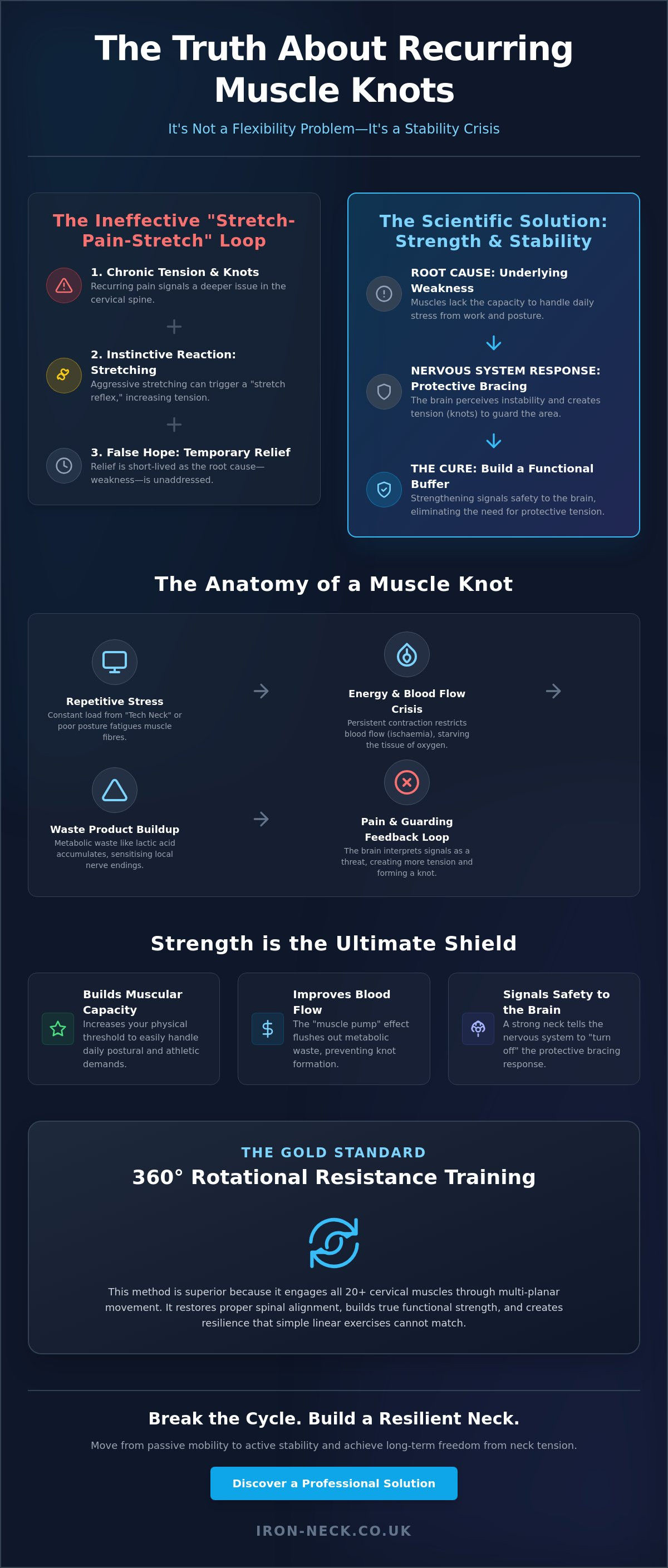
Your recurring muscle knots aren't a flexibility problem; they're a stability crisis. While most people reach for a massage therapist when tension strikes, these are often temporary fixes for a deeper physiological issue. When your muscles feel "tight," your nervous system is likely using that tension as a protective bracing mechanism to compensate for underlying weakness. By implementing specific neck strengthening exercises to prevent muscle knots UK athletes and high-level professionals now prioritise, you can signal safety to your brain and stop the cycle of chronic guarding.
It's exhausting to be stuck in a "stretch-pain-stretch" loop that limits your range of motion and triggers frequent tension headaches. You need a solution that moves beyond surface-level relief. This guide provides a scientific framework to eliminate recurring knots by building functional strength and resilience using evidence-based protocols. You'll learn how to increase your physical threshold for daily stress, improve your spinal alignment, and finally achieve long-term freedom from the upper trap tension that hinders your performance.
Key Takeaways
- Understand why myofascial trigger points are often a "protective bracing" response to underlying cervical weakness rather than simple muscle tightness.
- Learn how to break the ineffective "stretch-pain-stretch" cycle by building a physical threshold that exceeds your daily postural and athletic demands.
- Discover the specific neck strengthening exercises to prevent muscle knots UK professionals use to engage all 20+ cervical muscles through multi-planar movement.
- Master a methodical training protocol that leverages progressive overload to safely increase resistance without triggering inflammatory flare-ups.
- Explore why 360-degree rotational resistance is the gold standard for restoring spinal alignment and flushing metabolic waste from taut muscle fibres.
Understanding Muscle Knots (Trigger Points) in the Cervical Spine
Muscle knots aren't just a nuisance; they're a physiological signal that your cervical system is overwhelmed. Clinically referred to as Myofascial trigger points, these hyper-irritable spots develop within taut bands of muscle fibre when the tissue is subjected to repetitive stress without sufficient recovery. In the UK, the rise of "Tech Neck" has turned this into a widespread health challenge. When you spend hours leaning toward a screen, your upper trapezius and levator scapulae muscles work overtime to keep your head upright. This constant demand leads to fatigue, and eventually, the brain initiates a "protective bracing" response. It perceives the neck as unstable and creates tension to prevent injury. Without implementing neck strengthening exercises to prevent muscle knots UK athletes and desk workers alike will remain trapped in a cycle of recurring pain.
The Anatomy of a Neck Knot
A knot is essentially a local energy crisis. This state, known as ischaemia, occurs when persistent contraction restricts blood flow to the area. Without fresh oxygen, metabolic waste products like lactic acid accumulate. This sensitises local nerve endings and creates a feedback loop of pain and guarding. We categorise these into two distinct types:
- Active Trigger Points: These produce constant, radiating pain even at rest and are often the culprit behind referred pain in the jaw or temples.
- Latent Trigger Points: These remain quiet until the muscle is loaded or palpated, often masquerading as general stiffness until they "flare up" during sports or sudden movements.
Often, the suboccipital muscles at the base of the skull become the primary source of the tension headaches that plague the UK workforce. When these small muscles become chronically knotted, they compress local nerves, leading to that familiar "vice-like" grip around the forehead.
Why Traditional Stretching Often Fails
Most people attempt to "stretch out" a knot, but this often backfires. When you aggressively pull a muscle that the brain already perceives as weak or vulnerable, you trigger the "stretch reflex." This is a survival mechanism where the nervous system sends a signal to contract the muscle even harder to protect the joint. While passive stretching might provide ten minutes of relief, it doesn't change the tissue's capacity. To stop the cycle, you must move from passive mobility to active stability. Using neck strengthening exercises to prevent muscle knots UK protocols ensures the muscle is strong enough to handle its workload. You don't need longer muscles; you need more resilient ones that don't feel the need to "lock up" under pressure.
Why Strength is the Ultimate Shield Against Neck Tension
Resilience is the only permanent cure for chronic tension. While common advice often suggests taking posture breaks or light stretching, these methods fail to address the root cause: a lack of muscular capacity. If your neck muscles aren't strong enough to support your head during an eight hour workday, they will eventually fatigue and "lock up" as a survival mechanism. This is where neck strengthening exercises to prevent muscle knots UK professionals recommend become essential. By building a functional buffer, you ensure your tissues can handle the mechanical load of modern life without reaching the point of failure.
Strength training does more than just build stability; it fundamentally changes the environment within the muscle tissue. A Harvard study on strength training for neck pain found that specific resistance exercises provided significant relief by improving local blood flow. When you perform loaded movements, you create a "muscle pump" effect that flushes out metabolic waste products like lactic acid. This process prevents the chemical stagnation that allows trigger points to form in the first place. High-performance training also triggers hypertrophy, increasing capillary density and ensuring your muscles receive a constant supply of oxygenated blood.
The Weakness-Tension Cycle Explained
When a muscle is weak, it reaches its fatigue threshold rapidly. To prevent what the brain perceives as potential structural damage, the nervous system initiates a "knotting" response. This is a fail-safe bracing strategy. By replacing this involuntary bracing with actual structural support from the deep neck flexors and extensors, you break the cycle. You stop relying on tension for stability and start relying on strength. This shift is critical for anyone looking to move beyond temporary relief and toward long-term cervical health.
Evidence-Based Benefits of Resistance Training
Modern sports science has shifted away from passive treatments toward active "Load Management" protocols. UK physiotherapists increasingly recognise that a stronger neck is a safer neck. The benefits extend beyond pain relief:
- Concussion Mitigation: Increased neck stiffness can reduce the acceleration of the head during impacts, a vital factor for contact sports athletes.
- Postural Alignment: Strength in the posterior chain naturally pulls the cervical spine back into a neutral position, reducing the strain of "Tech Neck."
- Micro-trauma Prevention: Progressive resistance training thickens connective tissues, making them less susceptible to the tiny tears that lead to chronic inflammation.
If you want to stop managing pain and start building performance, you need the right tools for the job. Utilising a professional-grade neck training system allows you to apply precise, measurable resistance to these often-neglected muscle groups, ensuring you build the shield your body requires.
Top 5 Neck Strengthening Exercises to Prevent Muscle Knots
Static stretches are insufficient for building long-term cervical resilience. To truly address the 20+ muscles in the cervical spine, you must adopt a multi-planar training approach that challenges the tissue under load. While the NHS guide to neck exercises provides a solid baseline for basic mobility, preventing chronic trigger points requires progressive resistance. By moving beyond simple tilts and turns, you can develop the structural integrity needed to withstand the repetitive strain of modern life.
The "Chin Tuck" serves as the essential foundation for all cervical health. This movement specifically targets the deep neck flexors, which are often inhibited by the forward-head posture common in the UK workforce. To perform this correctly, pull your chin straight back as if making a double chin, ensuring your eyes remain level with the horizon. This action decompresses the suboccipital region and creates a neutral spinal alignment. Mastering this is a prerequisite for more advanced neck strengthening exercises to prevent muscle knots UK professionals utilise to build a stable, pain-free platform.
Foundational Isometric Holds
Isometrics are the safest entry point for anyone currently battling active muscle knots. They allow you to generate significant muscular tension without moving through a potentially painful range of motion. This "static loading" signals the nervous system to stop the protective bracing response. Follow this methodical protocol:
- Front and Back Press: Place your palm on your forehead and push forward, resisting all movement with your neck muscles. Repeat with your hands interlaced behind your head, pushing backward.
- Lateral Isometric Press: Place your hand on the side of your head above the ear. Apply steady pressure while maintaining a perfectly neutral spine.
- The Protocol: Perform 10-second holds at approximately 70% of your maximum effort. Complete 5 repetitions per side, twice daily, to build a baseline of stability.
Advanced Rotational Resistance
Rotation is the most overlooked dimension of neck fitness. Most cervical "tweaks" occur during sudden rotational movements when the stabilising muscles are caught off guard. Using Iron Neck Resistance Bands, you can introduce controlled, horizontal load to these movements. Start with "Look Left, Look Right" drills, maintaining a slow and deliberate tempo to ensure the muscles are under constant tension throughout the entire arc.
For elite-level coordination, implement "Figure 8" movements. Trace a small, horizontal number eight with your nose while under light resistance from a band or harness. This complex movement pattern forces the small intrinsic muscles of the neck to fire in a coordinated sequence. It builds the multi-directional resilience necessary to prevent micro-trauma during sports or sudden daily reaches. To maintain joint longevity, always finish your session with Controlled Articular Rotations (CARs), moving the head through its full, pain-free range of motion to ensure the joint surfaces remain lubricated and healthy.
Designing Your UK Home Training Programme for 2026
Structure is the antidote to inconsistency. To achieve permanent results, you must move away from the "do it when it hurts" mentality toward a methodical training schedule. Research suggests that short, high-frequency bouts of neck strengthening exercises to prevent muscle knots UK residents can perform at home are far more effective than infrequent, long sessions. A target of 10 minutes, three times per week, allows for optimal neurological adaptation while providing the tissue sufficient time to recover and rebuild. With the median cost of a private physiotherapy assessment in the UK currently at £74, a proactive home programme is a methodical way to safeguard your health and reduce the need for reactive clinical visits.
Success hinges on progressive overload. You cannot expect a muscle to grow more resilient if the stimulus never changes. Once a specific movement feels manageable, you must increase the resistance. This might involve moving further away from an anchor point with your resistance bands or increasing the tension on your Iron Neck device. By systematically increasing the load, you force the cervical spine to adapt, effectively raising your threshold for pain and fatigue. Tracking your progress is vital. Over a 12 week period, monitor your range of motion and the frequency of "knot" flare ups to validate the efficacy of your training.
The 10-Minute Daily Resilience Routine
Consistency is easier when training is integrated into your existing habits. Use "micro-dosing" to maintain cervical health throughout the day:
- Morning: Perform mobility CARs (Controlled Articular Rotations) to "wake up" the cervical joints and lubricate the spinal discs after sleep.
- Mid-day: Execute three sets of isometric resets. This combats the desk-induced slouching that often leads to the "protective bracing" response in the upper traps.
- Evening: Focus on deep neck flexor activation. This ensures your postural muscles remain engaged, providing long-term correction for spinal alignment.
Safety First: When to Back Off
Training for resilience requires pushing boundaries, but you must distinguish between "good" muscle soreness and "bad" pain. Delayed Onset Muscle Soreness (DOMS) is a natural part of the strengthening process. However, you should immediately stop if you experience "Red Flags" such as dizziness, numbness, or sharp, radiating pain that travels down the arm. These symptoms may indicate nerve involvement or pre-existing cervical disc issues. In such cases, consult a UK-based medical professional for a formal assessment before continuing with loaded resistance work. Safety and efficacy are the foundations of any elite-level training protocol.
Ready to implement a professional-grade protocol? Explore our full range of neck training equipment to start building your resilience today.
The Iron Neck Advantage: Professional-Grade Knot Prevention
Traditional training often fails because it ignores the three-dimensional complexity of the cervical spine. Bodyweight movements and basic resistance bands are limited to linear planes, which leaves significant "blind spots" in your muscular armour. The Iron Neck is the definitive solution for neck strengthening exercises to prevent muscle knots UK because it facilitates 360-degree stability. By combining linear tension with rotational resistance, it forces the neck's 20+ muscles to work in unison. This creates a "Halo" effect where you must maintain perfect postural alignment while navigating a variable, rotating load. It's the most methodical way to transition from reactive rehabilitation to proactive peak performance.
Elite UK athletes and health professionals trust this technology because it provides a level of specificity that standard gym equipment cannot match. When you train with rotational resistance, you are training the neck to handle the unpredictable forces of both contact sports and the repetitive strain of office work. This high-performance approach ensures that your muscles are never caught off guard, effectively eliminating the "protective bracing" response that leads to chronic tension and headaches.
Unlocking 360-Degree Stability
The core of the Iron Neck's efficacy lies in its ability to strengthen the muscles that standard exercises miss. Most injuries and chronic knots occur during sudden, rotational movements where the stabilising muscles are caught off guard. Using the built-in "Friction Dial," you can apply precise, measurable resistance to every degree of head movement. This allows for clinical-grade load management, ensuring you can progress safely without overloading sensitive tissues. The Iron Neck is the only device that allows for rotational resistance through a full range of motion.
- Multi-Planar Loading: Engages the intrinsic stabilisers that bodyweight exercises miss.
- Postural Correction: The constant rearward pull naturally corrects forward head posture and spinal alignment.
- Metabolic Flushing: The high-intensity "muscle pump" effectively clears the chemical stagnation associated with myofascial trigger points.
Investing in Long-Term Spinal Health
When you consider the rising costs of private healthcare in the UK, a professional-grade training device is a strategic investment. With the median cost of a single private physiotherapy session now at £74, and most musculoskeletal conditions requiring five to six sessions, the cumulative expense of reactive treatment adds up quickly. Choosing a permanent home solution allows you to maintain your resilience daily. Whether you opt for the Iron Neck for maximum versatility or the Alpha Head Harness as a dedicated entry point for heavy loading, you're choosing a path of self-reliance. Is the Iron Neck right for you? Explore our range today.
Take Command of Your Cervical Resilience
You now understand that chronic tension isn't a permanent condition; it's a physiological signal that your cervical capacity needs an upgrade. By moving away from passive stretching and adopting a methodical routine of neck strengthening exercises to prevent muscle knots UK high-performers rely on, you can finally break the cycle of protective guarding. Building functional strength ensures your tissues can handle the mechanical loads of modern life without locking up or triggering tension headaches.
Don't settle for temporary relief when you can build a lasting shield. Join the elite UK rugby clubs and 90% of NFL teams that utilise our clinically backed, multi-directional resistance to protect their athletes. With over 1,000 5-star reviews from chronic pain sufferers, this technology is the proven standard for spinal health and alignment. It's time to invest in your performance and safety. Build a resilient, knot-free neck with the Iron Neck 2026 range and unlock your full physical potential today.
Frequently Asked Questions
Can I do neck exercises if I currently have a painful muscle knot?
Yes, but you must prioritise isometric holds over dynamic movements. Static loading at a low intensity helps signal safety to the nervous system, which can actually reduce the protective guarding response. Avoid pushing into sharp pain; instead, stay within a comfortable range of motion to maintain blood flow and prevent further stagnation in the tissue.
How long does it take to see results from neck strengthening?
Initial neurological adaptations, such as improved stability and reduced tension, typically occur within two to four weeks. However, building structural resilience and significant tissue capacity requires a consistent 12 week commitment. During this period, the muscles undergo hypertrophy and connective tissues thicken, providing a permanent shield against the fatigue that causes knots.
Are neck strengthening exercises safe for people with "Tech Neck"?
Specific neck strengthening exercises to prevent muscle knots UK residents experience from desk work are not just safe; they're essential. Strengthening the deep neck flexors directly counters the forward head posture associated with "Tech Neck." By building the capacity of these stabilisers, you reduce the workload on your upper traps and levator scapulae, preventing chronic fatigue.
Will strengthening my neck make my traps look too bulky?
No, functional neck training focuses on the deep stabilisers and intrinsic muscles rather than the superficial trapezius. While you'll gain lean muscle and improved tone, significant "bulk" only occurs with specific, high volume hypertrophy protocols. Most users find that strengthening actually improves their aesthetic profile by correcting slouching and enhancing spinal alignment.
How often should I perform these exercises to prevent knots from returning?
Consistency is more important than duration. A protocol of 10 minutes, three times per week, is the gold standard for maintaining cervical resilience. This frequency provides enough stimulus to keep the nervous system engaged while allowing for the tissue recovery necessary to prevent inflammatory flare ups. Short, focused sessions fit easily into a professional schedule.
Do I need special equipment to start a neck strengthening programme?
You can begin with foundational isometrics using hand resistance, but you'll eventually hit a performance plateau. To achieve progressive overload, you need measurable resistance. Utilising Iron Neck Resistance Bands or a professional device allows you to apply precise load through a full 360 degree range of motion, which is impossible to replicate with manual pressure alone.
What is the difference between a neck stretch and a neck strengthening exercise?
Stretching focuses on temporary tissue elongation and mobility, while strengthening focuses on capacity and stability. While stretching might provide five minutes of relief, it doesn't change the muscle's ability to handle load. Strengthening ensures your muscles are powerful enough to support your head's weight without needing to "brace" or knot up under stress.
Can neck strengthening help with tension-related headaches?
Yes, by addressing the root cause of suboccipital tension. Many headaches are triggered when weak neck muscles fatigue and tighten, compressing the nerves at the base of the skull. By implementing neck strengthening exercises to prevent muscle knots UK protocols, you build a stable platform that prevents these muscles from overworking, effectively reducing the frequency and intensity of tension headaches.