

Military Neck Strengthening Standards: Elite Benchmarks for 2026
During an emergency ejection, a fighter pilot's cervical spine must withstand forces exceeding 20G, instantly turning a standard flight helmet into a crushing weight. You probably already know that while your compound lifts are solid, your neck remains the missing link in your overall tactical readiness. It's the most common area for fatigue during long rucking sessions or when wearing helmet-mounted displays, yet it's often the most neglected part of a strength program.
We've developed this guide so you can master the specific military neck strengthening standards and training protocols used by elite units to build a resilient, high performance body. If you've wondered what the actual strength benchmarks are for roles like fighter pilots or infantry, we're providing the answers. You'll gain objective metrics to track your progress and learn how to implement 360 degree rotational stability to combat modern tactical loads. We're breaking down the benchmarks for 2026 to ensure you have the G-tolerance and impact resistance required for the most demanding environments on earth.
Key Takeaways
- Learn why modern elite units have shifted their focus from neck thickness to functional torque production and maintaining cervical neutrality under load.
- Discover the critical differences between the 9G+ cervical demands of fighter pilots and the high-impact shock absorption required for ground forces.
- Establish your baseline using the 2026 military neck strengthening standards to determine if your strength-to-bodyweight ratio is functional or elite.
- Master a 4-phase training protocol that prioritizes mobility and 360-degree stability to outperform traditional head harness limitations.
- Understand how utilizing measurable, variable rotational resistance allows tactical athletes to meet and exceed rigorous military benchmarks.
Understanding Military Neck Strengthening Standards and Protocols
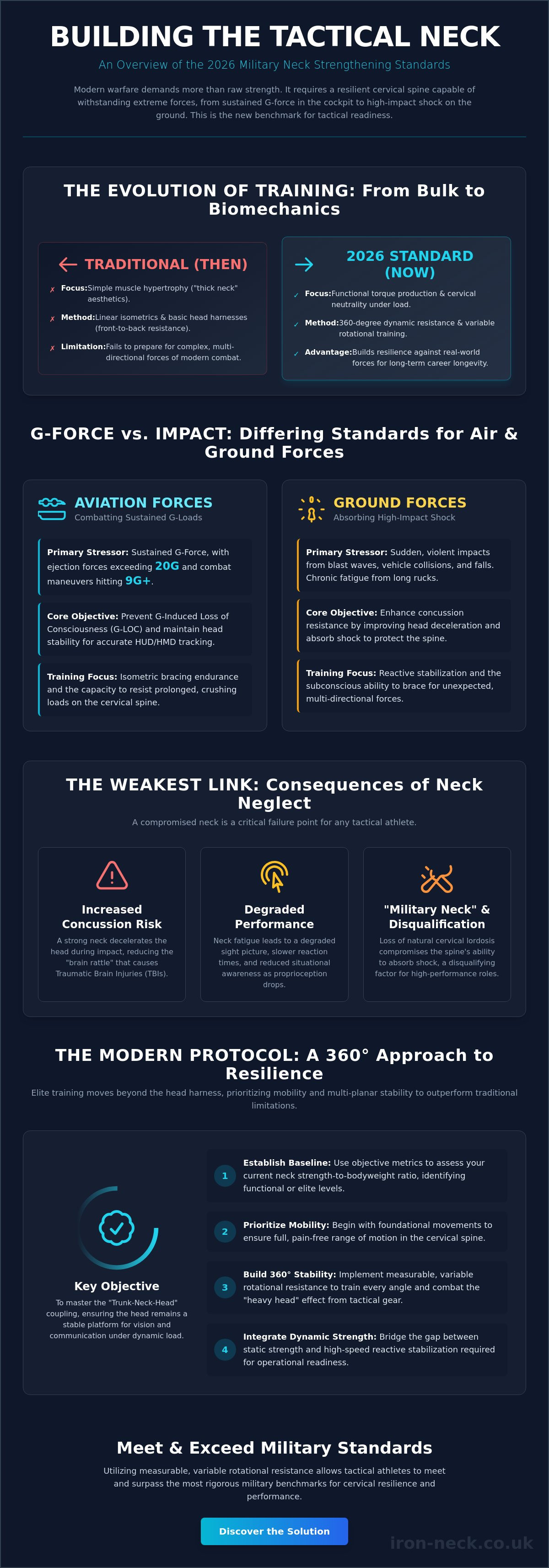
The definition of modern military neck strengthening standards has evolved far beyond simple muscle hypertrophy. It's no longer about the "thick neck" aesthetics of the 1980s; it's about the functional capacity to maintain cervical neutrality under extreme axial and rotational loads. Elite units now prioritize the ability to resist torque, ensuring the head remains a stable platform for vision and communication regardless of the external forces applied. This shift reflects a deeper understanding of human performance, where the neck acts as the critical bridge between the torso and the skull.
In 2026, the British Army and the RAF have intensified their focus on cervical health protocols to ensure long-term career longevity. While the Army Combat Fitness Test provides a baseline for general tactical readiness, specialized units require a more targeted approach to the "Trunk-Neck-Head" coupling. This coupling is essential for weapon stabilization; if your neck stabilizer muscles fatigue, your sight picture degrades, and your reaction time slows. A resilient cervical spine ensures that the head doesn't bob or whip during rapid tactical maneuvers, keeping the operator's eyes on the target.
The Evolution of Tactical Neck Training
We've moved past the era of linear isometrics. Traditional training often relied on simple front-to-back resistance, which fails to prepare the body for the complex, multi-directional forces of modern combat. Today's tactical athletes face increased cervical strain due to helmet-mounted technology, including Night Vision Goggles (NVGs) and Heads-Up Displays (HUDs), which shift the head's center of gravity forward. The modern standard for cervical stability in tactical athletes is the capacity to maintain a neutral spine while resisting 360-degree dynamic resistance during high-velocity movement.
Neck Strength as a Survival Metric
Data consistently shows a direct correlation between neck strength and concussion resistance. A stronger neck allows an operator to decelerate the head more effectively during an impact, reducing the "brain rattle" that leads to traumatic brain injuries. Beyond impact, neck fatigue is a silent killer of situational awareness. When the muscles supporting the head tire during high-stress operations, proprioception drops, and the operator becomes less aware of their periphery. Furthermore, "military neck," or the loss of natural cervical lordosis, is now a major concern. This condition isn't just painful; it's often a disqualifying factor for certain high-performance roles because it compromises the spine's ability to absorb shock, making the individual a liability in high-G or high-impact environments.
G-Force vs. Impact: Differing Standards for Air and Ground Forces
The physical demands placed on the cervical spine vary wildly depending on the operational environment. While ground troops face sudden, violent impacts, aircrew must endure sustained, crushing loads. Modern military neck strengthening standards must account for these distinct stressors to ensure mission success. The introduction of helmet-mounted displays (HMDs) and Night Vision Goggles (NVGs) has complicated this, creating a "heavy head" effect that shifts the center of gravity forward. This shift increases the torque requirements on the stabilizer muscles, turning a standard movement into a high-risk maneuver. When you add several pounds of glass and electronics to a helmet, the leverage exerted on the cervical vertebrae increases exponentially during rapid head turns. Without specific training, this extra weight leads to rapid fatigue and potential long-term degenerative changes.
There's a fundamental physiological difference between isometric bracing and reactive stabilization. Bracing is a conscious, pre-planned engagement of the musculature, often seen when a pilot prepares for a high-G turn. Reactive stabilization is the body's subconscious response to an unexpected force, such as a blast wave or a sudden change in flight vector. Training for one without the other leaves a dangerous gap in protection. Building this level of resilience requires more than just traditional shrugs; it requires a comprehensive neck training solution that addresses every angle of resistance. Effective protocols must bridge the gap between static strength and dynamic, high-speed stability.
Aviation Standards: Combatting G-Induced Loss of Consciousness (G-LOC)
Fighter pilots routinely operate in 9G+ environments, where the weight of the head and helmet can exceed 50 pounds. According to the Air Force G-Force Neck Conditioning Guide, specific torque benchmarks are required to maintain structural integrity. Beyond structural support, the deep neck flexors play a vital role in maintaining airway patency. If these muscles fail, the pilot's ability to perform the anti-G straining maneuver is compromised, increasing G-LOC risk.
Infantry Standards: Resilience Against Blunt Force Trauma
Ground forces prioritize resilience against blunt force trauma. Whether it's the whiplash of an IED blast or a parachute landing, the neck must act as a shock absorber. This requires synergy between neck and trap strength. Standardized testing often involves handheld dynamometers to establish baseline safety. Operators who fall below these benchmarks face significantly higher risks for chronic pain and debilitating injury during high-impact operations.
Benchmarking Your Progress: Neck Strength-to-Bodyweight Ratios
Establishing elite benchmarks requires moving away from subjective feel toward quantifiable data. To meet 2026 military neck strengthening standards, you must understand your current capacity relative to your total mass. We use strength-to-bodyweight ratios because they provide a scalable metric for everyone from light-weight pilots to heavy-set infantry. A critical component of this is the 1:1.5 rule. Your neck extension should be approximately 50% stronger than your flexion. This ratio ensures the posterior stabilizer muscles can counteract the forward pull of heavy tactical gear and gravity, preventing the "power leaks" that lead to cervical fatigue.
Unilateral imbalances are perhaps the most significant predictor of injury. If your left lateral flexion is 20% weaker than your right, you've created a structural vulnerability that will fail under high-G loads or sudden impact. Identifying these gaps early allows for targeted correction before they manifest as chronic pain or performance failure. The U.S. Army Neck Strength Baseline Study provides the scientific foundation for these benchmarks, highlighting how ground soldiers carrying modern equipment must maintain specific strength profiles to avoid career-ending cervical strain.
The 2026 Strength Standard Table
| Tier | Flexion (% of BW) | Extension (% of BW) |
|---|---|---|
| Novice | 3% - 5% | 5% - 7.5% |
| Tactical | 6% - 9% | 10% - 13% |
| Elite | 10% + | 15% + |
Elite tactical athletes target a 10-15% neck-to-bodyweight strength ratio to ensure maximum protection during high-velocity operations. When testing these ratios at home, use simple resistance tools or a handheld dynamometer to measure the force required to break your isometric hold. Watch for compensations like shrugging the shoulders or tucking the chin, as these indicate your primary stabilizers have already reached failure.
Measuring Rotational Torque: The New Frontier
Linear strength is only 50% of the military standard. Combat isn't linear; it's a series of unpredictable, multi-planar forces. Modern benchmarks now include rotational resistance, which measures your ability to maintain head alignment against a twisting force. You can quantify this progress using a variable friction dial on advanced training devices. By increasing the friction over time, you build the specific torque capacity needed to stabilize a flight helmet or NVGs during rapid head scans. If you can't maintain a neutral gaze while resisting rotational tension, your neck remains the missing link in your tactical readiness.
Elite Training Protocols: Beyond the Traditional Head Harness
Traditional head harnesses are a relic of a linear era. While they provide basic resistance for flexion and extension, they fail to address the complex, multi-planar forces encountered in modern tactical environments. To meet current military neck strengthening standards, your training must evolve beyond simple up-and-down movements. Elite units have moved toward a 4-phase progression that prioritizes long-term health and explosive performance. This methodical approach ensures that the cervical spine isn't just "thick," but functionally capable of resisting torque from every conceivable angle.
We often refer to neck training as "The Missing Link" in tactical strength programs. You can have a world-class squat and a massive deadlift, but if your neck can't stabilize your head under load, your kinetic chain has a critical failure point. Integrating neck work into compound movements is essential. Tactical athletes now practice "neck packing" during heavy lifts to ensure the cervical spine remains a rigid extension of the thoracic spine. Elite units typically incorporate this work 3-4 times per week, focusing on high-quality repetitions that build resilience without inducing the type of central nervous system fatigue that ruins a primary training session.
To bridge the gap between basic fitness and combat readiness, you must invest in professional-grade neck training equipment that allows for 360-degree resistance. Static weights simply cannot mimic the unpredictable nature of a high-G turn or a blast wave.
Phase 1 & 2: Foundational Bracing and Isometrics
- Step 1: Establish a neutral "packed" neck position. You must learn to maintain this alignment under light, consistent tension before adding complexity.
- Step 2: Implement 4-way isometrics. By resisting force from the front, back, and sides, you wake up the deep stabilizer muscles that protect the vertebrae.
- Step 3: Introduce slow-tempo eccentric movements. Lowering a load under control for 3-5 seconds builds the tissue resilience necessary to handle sudden decelerations.
Phase 3 & 4: Dynamic Rotational and Reactive Training
Once you've built a stable foundation, you must move into dynamic work. The "Figure 8" protocol is a staple for elite aircrew and ground forces alike. By tracing a small, controlled infinity pattern with your nose while under constant rotational resistance, you build 360-degree awareness and proprioceptive control. Reactive training takes this a step further. In this phase, you respond to external perturbations or "snags" in resistance to mimic the unpredictability of combat. This training is vital because rotational resistance prevents the "hinge" effect during impact.
The Iron Neck: Meeting and Exceeding Military Standards
The Iron Neck 3.0 Pro represents a fundamental shift in tactical human performance. It wasn't built as a casual fitness accessory; it was engineered to meet the high-stakes military neck strengthening standards required for 2026 and beyond. While traditional tools rely on linear tension, the Iron Neck Pro utilizes a variable friction dial to provide measurable, rotational resistance. This is the missing link for tactical athletes who must quantify their progress to reach elite benchmarks. By adjusting the friction, you can dial in the exact amount of torque needed to challenge your stabilizer muscles without compromising form. This precision allows special forces units to reduce injury downtime and ensure every operator is mission-ready.
Choosing the right tool depends on your specific mission requirements. The Alpha Head Harness is an excellent foundational piece for building raw isometric strength and posterior chain integration. However, when you need to simulate the complex forces of a high-G turn or the weight of a flight helmet, the Iron Neck 3.0 Pro is the definitive solution. It bridges the gap between basic conditioning and the advanced 360-degree stability required in modern combat environments. Special forces case studies consistently show that incorporating rotational resistance leads to better impact absorption and reduced chronic strain during long deployments.
Unlocking 360-Degree Tactical Stability
The halo-style design is what sets this technology apart. It allows you to move through all planes of motion, including rotation, lateral flexion, and protraction, while under constant tension. This is vital for "ruck-ready" training programmes where the head must remain stable while the body moves over uneven terrain. By training in every degree of movement, you eliminate the structural gaps that lead to cervical failure. If you're deciding between different training modalities, check out our guide on Iron Neck vs. Neck Harness: Which Is Right For You? to find your optimal setup.
Scientific Validation for the Tactical Athlete
The data supporting neck training is undeniable. Research indicates that for every one pound of neck strength gained, there's a corresponding 5% decrease in concussion risk. Reaching the elite standards discussed in this guide can result in a 30% reduction in concussion risk, a statistic that has led professional rehab specialists across the UK to adopt the Iron Neck for cervical recovery. It's about building a foundation of resilience that protects your most vital asset: your brain. Don't leave your safety to chance. View the Iron Neck collection and start your elite training today.
Master Your Tactical Foundation for 2026 and Beyond
The evolution of modern combat and aviation demands a proactive approach to cervical health. You've seen how elite units have moved away from traditional methods to embrace 360-degree stability and measurable torque. By mastering these military neck strengthening standards, you're doing more than preventing pain; you're building a resilient platform for high-performance operations. Whether you're enduring 9G maneuvers or carrying heavy tactical loads, your neck remains the foundational bridge for all movement and protection.
It's time to stop guessing and start quantifying your progress with tools designed for the most demanding environments on earth. Iron Neck is used by elite military units and professional sports teams worldwide to ensure maximum readiness. Our system is backed by peer-reviewed research on concussion reduction and provides the 360-degree rotational resistance that traditional harnesses can’t match.
Upgrade your training with the world’s #1 neck strengthening system.
Take the first step toward unlocking your true physical potential and protecting your long-term health today. You have the benchmarks. Now, you need the equipment to meet them.
Frequently Asked Questions
What is the minimum neck strength required for military service?
There's currently no universal mandated "minimum" strength-to-bodyweight ratio across all military branches, but elite roles have established functional benchmarks for readiness. For general service, the focus remains on maintaining a neutral spine under the weight of standard issue gear. Meeting military neck strengthening standards usually involves reaching a tactical tier, where your flexion strength is at least 6% to 9% of your total bodyweight.
Can neck strengthening really prevent concussions in combat?
Yes, scientific research indicates that increased neck strength is a modifiable risk factor that reduces head acceleration during impact. By strengthening the stabilizer muscles, you improve your body's ability to decelerate the skull, which directly lowers the risk of traumatic brain injury. Every pound of increased strength provides a measurable layer of protection against the whiplash effect caused by blasts or blunt force trauma during operations.
How often should tactical athletes train their neck?
Tactical athletes should train the neck 3 to 4 times per week to ensure optimal recovery and adaptation. This frequency allows for consistent stimulus without overtraining the delicate stabilizer muscles of the cervical spine. It's best to integrate these sessions into your existing strength program, focusing on high quality repetitions and 360 degree stability rather than sheer volume or daily max effort sets.
Is a thick neck a reliable indicator of neck strength?
No, neck girth isn't a reliable correlate for functional torque production or rotational stability. A thick neck might look impressive, but without specific training for the deep stabilizer muscles, it may still fail under high G-loads or unpredictable impacts. True strength is measured by your ability to maintain cervical neutrality against resistance, not just the circumference of your collar or the size of your traps.
What are the best exercises to prepare for fighter pilot G-loads?
The most effective exercises for G-load preparation involve 360 degree rotational isometrics and dynamic resistance. Pilots must focus on the deep neck flexors to maintain airway patency and structural integrity during high G maneuvers. Using a variable friction device allows you to simulate the crushing loads of combat flight while training the neck to resist torque from multiple angles simultaneously, addressing the missing link in aviation fitness.
How do I measure my neck strength without professional equipment?
You can estimate your baseline using a simple resistance band and a luggage scale to measure isometric break force. Attach the scale to a fixed point and the band to your head, then record the force required to pull you out of a neutral packed position. While less precise than clinical tools, this provides a functional metric to track your progress against military neck strengthening standards over time.
Will neck training help with heavy rucking and helmet fatigue?
Yes, strengthening the neck and upper traps significantly reduces fatigue during long rucking sessions and extended use of helmet mounted displays. By improving the endurance of your stabilizer muscles, you prevent the head drop that occurs when the cervical spine can no longer support the weight of your gear. This leads to better situational awareness and reduced chronic pain during the most demanding phases of a deployment.
Is it safe to train the neck every day?
Daily neck training is generally not recommended because the muscles of the cervical spine require time to repair and adapt just like any other muscle group. The neck can suffer from overuse injuries or chronic stiffness if it isn't given adequate rest between sessions. Stick to a structured protocol of 3 to 4 sessions per week to maximize tissue resilience and ensure long term performance without risking unnecessary strain.