

Justifying the Cost of Specialist Fitness Equipment: An ROI Approach to Performance
What if the £600 you're hesitant to spend on a professional training tool is actually saving you £2,400 in private physiotherapy fees over the next two years? Many serious athletes view high-end gear as a luxury, but justifying the cost of specialist fitness equipment requires looking at the hard data rather than the initial price tag. You've likely felt the frustration of a performance plateau or a recurring injury that keeps you sidelined for weeks at a time. It's natural to be skeptical of premium tools that demand a significant upfront investment, especially when the market is flooded with gear that doesn't deliver.
We agree that every pound in your training budget must deliver a measurable result. This article will show you how to evaluate the true value of high-end tools and why specialist equipment is often the most cost-effective path to your long-term health. We'll explore the scientific proof of efficacy, the financial logic of injury prevention, and the specific markers that validate a premium purchase for the dedicated athlete. By the end, you'll understand how to calculate the real ROI of your performance setup.
Key Takeaways
- Shift your perspective from a "commodity mindset" to an outcome-focused approach, prioritizing tools designed for specific biomechanical results over simple weight.
- Learn why the engineering behind precision tools, such as 360-degree rotational resistance, provides the proprioceptive feedback necessary for elite performance.
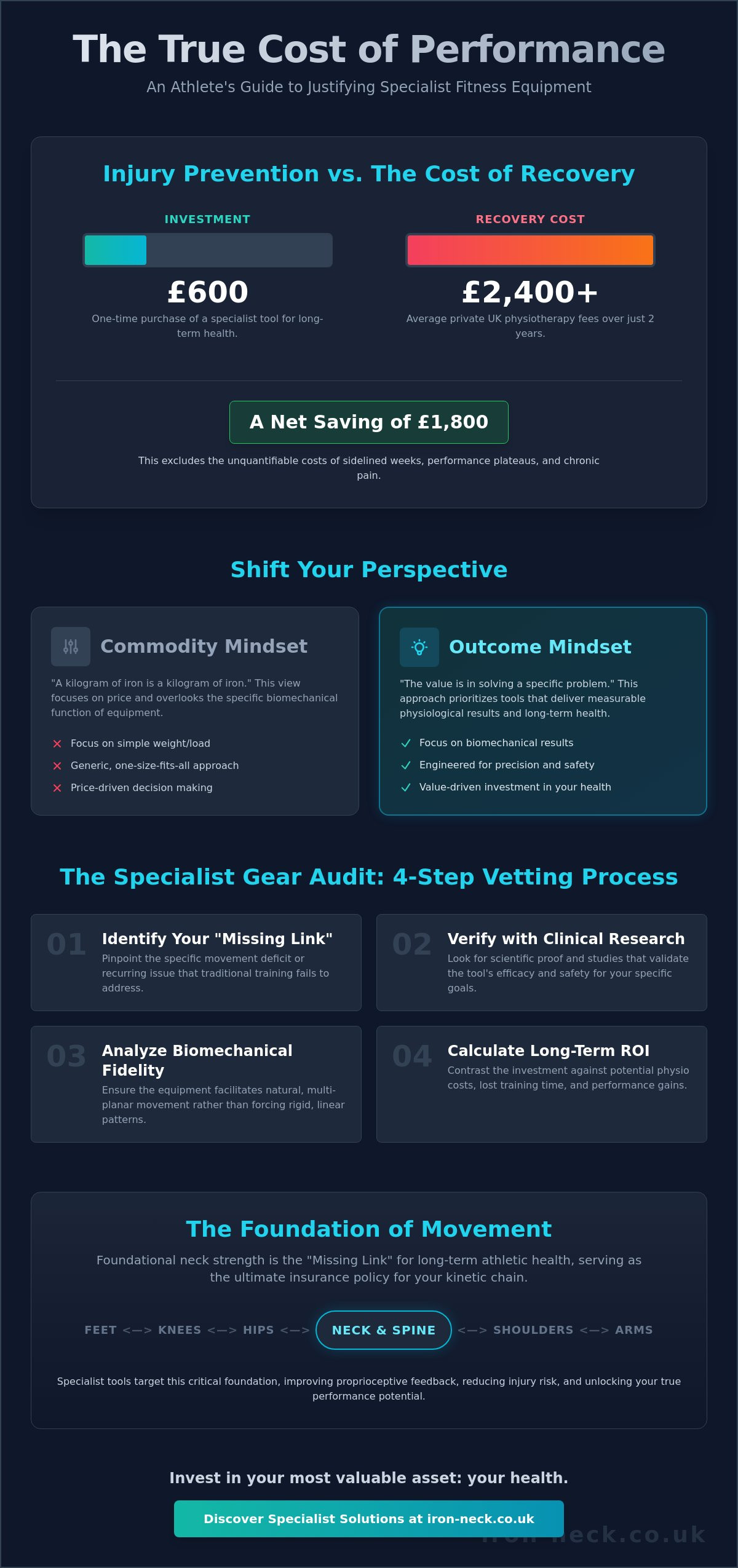
- Calculate your true ROI by contrasting the initial investment of high-end gear against the recurring expenses of private UK physiotherapy and injury recovery.
- Master a 4-step vetting process for justifying the cost of specialist fitness equipment, ensuring every purchase is backed by clinical research and solves a specific movement deficit.
- Identify the "missing link" in your training and discover how foundational neck strength serves as the ultimate insurance policy for long-term athletic health.
Beyond the Price Tag: Redefining Value in Specialist Fitness Equipment
Specialist fitness equipment represents a fundamental shift from general physical exertion toward targeted biomechanical outcomes. While standard gym kit focuses on moving external loads, specialist tools prioritise how the body moves through space. You aren't just buying weight; you're investing in specific physiological results. For the 2026 athlete, the goal has evolved. The focus is no longer solely on muscle hypertrophy. Instead, elite performers prioritise longevity, injury resilience, and functional integrity.
This shift represents a move from a commodity mindset to an outcome mindset. In a commodity mindset, a kilogram of iron is just a kilogram of iron. In an outcome mindset, the value lies in the equipment's ability to solve a specific problem, such as chronic neck pain or poor rotational power. This is the foundation of justifying the cost of specialist fitness equipment. We often refer to these tools as "The Missing Link" because they address the critical gaps left by traditional, linear training programmes.
Commodity vs. Specialist Gear
A standard £50 neck harness provides basic linear resistance, but it cannot replicate the 360-degree rotational resistance offered by precision-engineered devices. Specialist gear uses sophisticated mechanics to target stabilizer muscles that larger, prime-mover muscles often overshadow. By integrating the principles of strength training with clinical precision, these tools bridge the gap between physiotherapy and high-performance sport. You're paying for the engineering that allows for isometric, concentric, and eccentric loading across every plane of motion; something a simple strap and chain can't achieve.
The Psychology of the Investment
Investing in high-tier equipment changes your relationship with your training. When you allocate significant capital toward a tool, you're creating "skin in the game." This financial commitment often correlates with higher user compliance and a more disciplined approach to recovery. You're no longer just spending money on a hobby; you're allocating capital toward your most valuable asset: your health. Just as you might use IronClad Family to protect and organise your critical digital assets, investing in specialist equipment is a strategic move to safeguard your physical well-being. This transition from consumerism to capital allocation is what separates the dedicated athlete from the casual gym-goer. Specialist fitness equipment is a precision instrument designed to calibrate the human body for peak performance and long-term durability.
The Engineering of Performance: Why Precision Tools Outperform Generic Alternatives
Developing high-performance gear requires more than basic manufacturing; it involves rigorous R&D to master multi-directional resistance. When you're justifying the cost of specialist fitness equipment, you're paying for the engineering that manages complex forces. Generic machines often rely on linear resistance. This is problematic because the human body, particularly the cervical spine, operates through rotation and multi-planar movement. Precision tools provide essential proprioceptive feedback, which is the brain's ability to sense the body's position in space. Without this feedback, you risk training muscles in isolation, which fails to translate to real-world performance or injury prevention.
Specialist equipment employs variable resistance to ensure the load is lightest where the joint is most vulnerable. This is critical for delicate structures like the neck. High-end tools ensure that the resistance curve matches the natural strength profile of the user. This level of safety and scientific alignment is a primary factor in justifying the cost of specialist fitness equipment for elite athletes and rehabilitation clinics across the UK. You aren't just buying a weight; you're buying a system designed to protect the integrity of your kinetic chain.
Biomechanical Fidelity
Generic gym equipment frequently forces users into rigid, unnatural patterns. These fixed paths can lead to compensatory movements and chronic pain over time. In contrast, tools designed for rotational resistance address the root causes of "Tech Neck" by strengthening the deep stabilisers of the cervical spine. A 2018 study on multi-planar resistance demonstrated that training across all planes of motion significantly improves neck strength and reduces injury risk compared to traditional, linear methods. Following the Physical Activity Guidelines for Americans ensures that muscle-strengthening activities are performed effectively. Specialist tools make adhering to these global standards easier by maintaining biomechanical accuracy during every rep.
Durability and Safety Standards
Cheap equipment carries a hidden price: the risk of mechanical failure. When a component snaps under tension, the result can be a catastrophic injury that costs thousands in medical bills and lost training time. High-end tools use medical-grade components and aerospace-quality materials. These materials withstand thousands of cycles of high-stress use without degrading or losing calibration. Professional endorsements from UK sports scientists and chiropractors aren't just marketing; they're a testament to the equipment's ability to perform under pressure. Investing in quality means you're buying a tool that protects your health while you push your physical limits. If you're ready to upgrade your training environment, consider how integrated neck training systems can redefine your performance standards.
Calculating Your ROI: Injury Prevention vs. The Cost of Recovery
The most frequent objection to high-end training tools is that they're "too expensive." This perspective treats health as a discretionary expense rather than a strategic investment. When justifying the cost of specialist fitness equipment, you must shift your focus from the initial price tag to the long-term "Cost of Inaction" (COI). If you choose not to invest in foundational strength, you're essentially budgeting for future failure. A three-month training hiatus due to a preventable neck injury doesn't just stall your progress; it resets your baseline and costs you months of peak performance that you can never recover.
The Financials of Rehabilitation
Compare the one-time acquisition of a professional-grade tool to the recurring drain of reactive healthcare. In London, a private physiotherapy session typically costs between £75 and £115. A standard rehabilitation program for a cervical strain or repetitive stress injury often spans eight to ten sessions, quickly exceeding £900. By owning a clinical-grade device at home, you're effectively pre-paying for years of injury resilience. Scientific literature regarding the cost-benefit analysis of physical fitness confirms that proactive intervention is significantly more economical than post-injury care. Saving just five physio sessions pays for the equipment entirely. Furthermore, the ROI of preventing a single concussion or whiplash event in contact sports is measured in years of career longevity.
Performance Dividends
The neck is the "Missing Link" in human performance. It serves as the bridge between the brain and the body, yet it's often the most neglected area in a standard gym. Strengthening the cervical spine improves proprioception and stability, which translates directly into more explosive power in your primary lifts and athletic movements. A stable neck allows for better force transfer throughout the kinetic chain. This isn't just about the gym. Improved posture reduces the frequency of tension headaches, directly boosting your professional productivity and cognitive focus. Consider this: the price of a specialist neck training tool is lower than a mid-range smartphone, yet while the phone depreciates, the equipment compounds your physical capability every year you use it.
- Reactive Cost: £800 to £1,200 for a single injury rehabilitation cycle in the UK.
- Proactive Investment: One-time cost for a tool that provides a decade of utility.
- Productivity Gain: Eliminating "tech neck" and headaches leads to higher output and fewer sick days.
- Performance Edge: Justifying the cost of specialist fitness equipment is easy when it unlocks the explosive power previously lost to a weak cervical foundation.
The Specialist Gear Audit: 4 Criteria for Vetting High-End Training Tools
Investing in elite performance requires more than just a credit card; it requires a framework for decision-making. You shouldn't buy a piece of kit because it looks impressive in a social media clip. You buy it because it yields a measurable return on your physical health. When justifying the cost of specialist fitness equipment, you need to filter every purchase through a rigorous four-step audit.
First, identify if the tool solves a specific biomechanical deficit. Most commercial gyms are filled with machines that prioritize linear resistance. These are great for general hypertrophy but often ignore the foundational stabilizer muscles. If a tool doesn't offer a solution to a specific weakness, like cervical spine instability or poor proprioception, it's just clutter. It must do what a standard dumbbell cannot.
Second, verify the scientific backing. Is the technology supported by clinical research or is it simply marketing science? Look for tools used by medical professionals and elite athletes. For example, Iron Neck is currently utilized by over 500 professional and collegiate athletic programs to mitigate injury risk. When the stakes are high, professionals don't gamble on unproven gear.
Third, calculate the cost-per-use. A £400 investment might seem steep initially. However, when spread across 500 training sessions over a five-year lifecycle, the cost drops to just 80p per session. This is significantly cheaper than a single session with a specialist physiotherapist. High-quality gear is an insurance policy against future injury.
Fourth, demand multi-planar movement. Performance doesn't happen in a vacuum or a straight line. If your gear only allows for up-and-down resistance, it isn't preparing you for the chaotic demands of sport or real-world movement. Real-world strength is built in 360 degrees.
Evaluating Scientific Credibility
Distinguishing between real data and clever advertising is vital. Real credibility comes from peer-reviewed studies and adoption by high-stakes professionals. When you see a tool in an elite training facility or a clinical rehabilitation setting, it's a signal of efficacy. You can learn more about these principles in our Science of Neck Resistance Training pillar. Avoid products that rely solely on "influencer" hype without anatomical justification.
The Cost-Per-Use Calculation
Elite athletes live by the mantra "Buy Once, Cry Once." It's better to invest in high-quality gear that lasts five years than to replace cheap, ineffective alternatives every six months. Justifying the cost of specialist fitness equipment becomes easy when you compare it to a standard gym membership. A gym provides general access; specialist gear provides a specific, high-intensity solution to the missing link in your training. Over time, the results in posture and performance far outweigh the initial price tag.
The Iron Neck Advantage: Investing in the Foundation of Movement
The Iron Neck represents the pinnacle of justifying the cost of specialist fitness equipment. While a standard neck harness offers basic linear resistance, it fails to address the complex, multi-planar nature of the human neck. The Iron Neck’s patented 360-degree rotational system provides a level of concentric and eccentric loading that no other device can replicate. It transforms the cervical spine from a vulnerable point into a pillar of stability. This isn't just an accessory; it is a precision-engineered tool designed for those who refuse to settle for mediocre physical standards.
Choosing this equipment means prioritising a dual-benefit approach: Protection and Performance. By providing consistent tension throughout a full range of motion, the device forces the stabilizer muscles to engage in ways that traditional weightlifting cannot trigger. This creates a robust "internal armour" that protects the athlete during high-impact scenarios while simultaneously improving the body's kinetic chain. When you look at the long-term health of your spine, the initial investment becomes a fractional cost compared to the price of chronic pain or lost training time.
Unlock Your Full Potential
Modern fitness protocols for 2026 identify neck strength as "The Missing Link" in total body performance. Long hours at desks and constant mobile phone use lead to "tech neck," a condition that compromises the cervical spine and degrades posture. The Iron Neck corrects these imbalances by engaging deep stabilizer muscles. It doesn't just build muscle; it restores proper alignment and improves proprioception. Explore the Iron Neck Device Range to see how this technology integrates into a modern performance routine.
Strength in the neck is the foundation for all movement. If the head is not stable, the rest of the body cannot move with maximum efficiency. By fixing posture and reducing injury risk, you unlock power in your primary lifts and improve your overall athletic ceiling. This is the logic of justifying the cost of specialist fitness equipment; you are buying the ability to train harder, for longer, without the setback of preventable injuries.
A Scientific Approach to Longevity
Elite UK rugby clubs, MMA fighters, and F1 teams don't buy equipment based on trends; they invest based on rigorous data and proven outcomes. These professionals use the Iron Neck to shift the focus from "rehab" to "pre-hab." Scientific studies have shown that every one-pound increase in neck strength can reduce concussion risk by up to 5%. For a professional athlete in the UK, this is a calculated decision to extend a career and protect cognitive health.
The transition from reactive treatment to proactive strengthening is the hallmark of a high-performance mindset. Whether you are navigating the physical demands of the pitch or the rigours of a high-stress professional life, your neck is the bridge between your brain and your body. Treat your body like the high-performance machine it is. Invest in your foundation today.
Secure Your Performance Future Today
Serious training requires more than just effort; it demands tools built with precision engineering. When you're justifying the cost of specialist fitness equipment, look beyond the initial price. Consider that the average cost of private physiotherapy for a sports injury in the UK often exceeds £50 per session. Investing in gear that prioritises injury prevention and biomechanical efficiency isn't an expense. It's a calculated strategy to keep you on the field and out of the clinic.
The Iron Neck stands as the definitive solution for those ready to address the missing link in their kinetic chain. It's the only tool featuring 360-degree rotational resistance technology to build true cervical stability. This isn't experimental tech; it's a foundation of movement trusted by 100+ Pro Teams and over 1,000 clinics worldwide. Every claim is backed by peer-reviewed sports science to ensure you get measurable results from every rep. Don't wait for a setback to start taking your health seriously. Upgrade your training with the world’s #1 neck strengthening tool and build the resilience your body deserves. Your peak performance starts with a stronger foundation.
Frequently Asked Questions
Is specialist fitness equipment really better than standard gym gear?
Specialist equipment provides targeted biomechanical advantages that standard gear cannot replicate. While a basic cable machine offers linear resistance, specialist devices like the Iron Neck enable 360 degree isometric and dynamic training. This precision addresses the cervical spine's specific needs. You aren't just buying a tool; you're investing in a scientific approach to performance that eliminates the guesswork found in general gym routines.
How do I know if an Iron Neck is worth the investment for my specific needs?
You can determine the value by calculating the long term ROI regarding your health and performance goals. If you're a combat athlete or a desk worker suffering from chronic stiffness, justifying the cost of specialist fitness equipment becomes clear when you factor in reduced pain and increased resilience. One study published in the Journal of Primary Prevention found that stronger neck muscles can reduce concussion risk by up to 50%.
Can I achieve neck strength results without expensive equipment?
You can start with basic isometric exercises, but they lack the progressive overload required for elite results. Manual resistance or towel drills don't provide measurable data or consistent tension through a full range of motion. Specialist gear provides a controlled environment to track 100% of your progress. This ensures you're actually getting stronger rather than just guessing with bodyweight movements.
What is the average lifespan of specialist devices like the Iron Neck?
High quality specialist devices are engineered for professional environments and typically last 5 to 10 years with regular use. The Iron Neck uses durable materials like glass reinforced nylon and high strength bungees designed to withstand thousands of repetitions. This longevity ensures your initial outlay is spread over thousands of training sessions. It makes the cost per use significantly lower than a monthly gym membership over the same period.
How does the cost of specialist gear compare to physiotherapy sessions?
A single private physiotherapy session in the UK averages between £45 and £80. If you require a standard six week recovery block, you'll likely spend over £300. Investing in specialist equipment allows for daily preventative maintenance at home. By proactively strengthening the cervical spine, you can potentially avoid these recurring clinical costs. It's a one time investment that replaces a lifetime of reactive spending.
Does specialist equipment hold its resale value?
Specialist fitness gear retains a high percentage of its original price due to low market saturation and high demand. On UK platforms like eBay, well maintained specialist trainers often sell for 60% to 70% of their retail value. Generic dumbbells or benches often struggle to clear 30% on the secondary market. This high resale floor reduces your total cost of ownership and provides a clear exit strategy.
Is there scientific proof that specialist neck trainers prevent injury?
Peer reviewed research confirms that neck strength is a primary factor in reducing head acceleration during impacts. A 2014 study by researchers including Dawn Comstock found that for every one pound of increased neck strength, concussion risk decreases by 10%. Specialist trainers are the only tools that allow for the specific, multi planar strengthening required to achieve these clinical benchmarks. This data driven approach moves neck training from optional to essential.
Can I use specialist equipment if I am not a professional athlete?
Specialist equipment is designed for anyone who wants to improve their quality of life. Desk bound professionals in the UK spend an average of 9 hours a day sitting, which leads to significant postural decline. Using specialist gear for just 10 minutes, three times a week, can reverse the effects of postural strain. It provides a foundational solution for anyone seeking a pain free and functional body.