

Improve Neck Stability for Better Lifts: The Missing Link in Your Strength Training (2026)
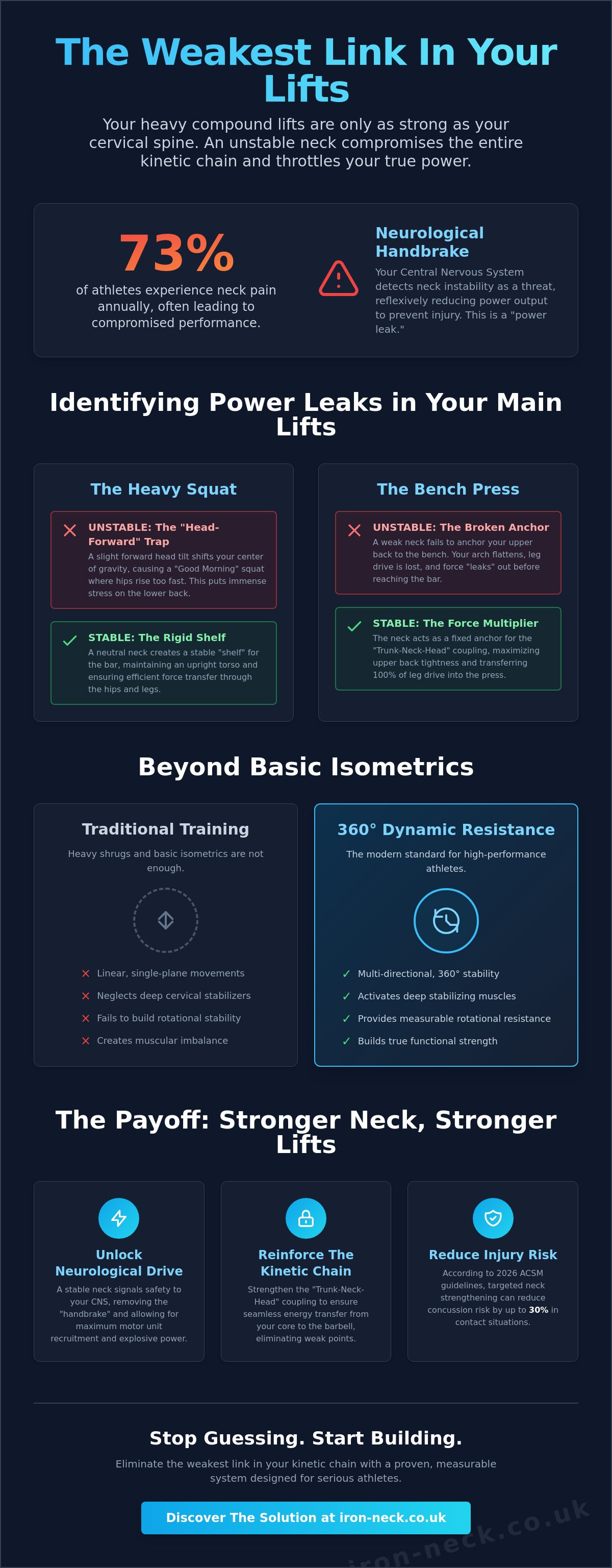
Your heavy compound lifts are only as strong as your weakest link. For most athletes, that link isn't the grip or the core; it's the cervical spine. You've likely hit a plateau where the weight feels manageable, but you feel "disconnected" or unstable at the top of a squat or bench press. You aren't alone. With neck pain affecting up to 73% of athletes annually, many lifters unknowingly sacrifice force production because their "trunk-neck-head" coupling is compromised.
To improve neck stability for better lifts, you must treat the neck as the primary gateway of your Central Nervous System. We're moving beyond traditional manual resistance toward modern, measurable systems that offer 360-degree stability. This guide will show you how cervical stability acts as a force multiplier and provide the exact protocols needed to eliminate this gap in your kinetic chain. We'll explore the science of neurological drive, the impact of the Iron Neck 3.0 Pro's variable friction dial on rotational resistance, and the specific 2026 ACSM guidelines for maximizing your structural integrity while reducing concussion risk by 30% in contact situations.
Key Takeaways
- Understand the "Trunk-Neck-Head" coupling mechanism and how maintaining neutral alignment under axial loads acts as a force multiplier.
- Learn how to improve neck stability for better lifts by identifying "power leaks" that compromise your bench press arch and squat center of gravity.
- Discover why 360-degree dynamic rotational resistance is essential for high-performance athletes compared to traditional linear isometrics.
- Follow a structured 4-week blueprint that transitions from foundational bracing to advanced movement under tension for maximum neurological drive.
- Explore how the Iron Neck’s Variable Friction Dial provides the precise, measurable resistance needed to eliminate the weakest link in your kinetic chain.
The Science of Cervical Stability: Why the Neck is a Force Multiplier
Cervical stability is the ability of your spine to maintain neutral alignment while under high axial loads. It isn't just about resisting a tackle or looking strong; it's about structural integrity. When you're under a heavy barbell, your neck acts as the primary anchor for the "Trunk-Neck-Head" coupling mechanism. This coupling ensures that tension generated in your core and upper back is transferred efficiently through the entire kinetic chain. If the neck is weak, the chain breaks. You don't just lose neck position; you lose the ability to generate maximal force in your extremities. By working to improve neck stability for better lifts, you're reinforcing the literal gateway of your Central Nervous System (CNS).
Stability also dictates your sense of balance and spatial awareness, known as proprioception. During compound movements like the clean and jerk or a heavy back squat, your brain relies on the vestibular system and mechanoreceptors in the neck to determine where your body is in space. A stable neck provides a clear, vibration-free signal to the brain. This allows for precise bar path control and immediate corrections in center of gravity. When the cervical spine is locked in, your body moves as a single, cohesive unit rather than a collection of disconnected parts.
The Neurological Connection to Force Production
Your brain is a safety governor. If it detects instability near the spinal cord, it will reflexively throttle your power output to prevent a catastrophic injury. This phenomenon is often called "neural leakage." When your neck wobbles during a heavy bench press, your CNS perceives a threat and reduces the drive to your chest and triceps. You aren't actually weak; your brain is simply pulling the handbrake. A stable cervical spine signals safety to the vestibular system, which in turn unlocks higher recruitment of motor units. This is why a stable neck acts as a force multiplier. It doesn't just hold your head up; it allows your CNS to send the "all clear" signal for maximum explosive power.
Anatomy of a Stable Lift
True stability comes from the deep cervical flexors, not just the large muscles you see in the mirror. While the Sternocleidomastoid muscle anatomy shows it's a powerful mover for rotation and flexion, it shouldn't be the primary stabilizer during a heavy lift. Over-reliance on superficial muscles like the SCM or the upper trapezius leads to "head-forward" compensation patterns that shift the bar's center of gravity.
To improve neck stability for better lifts, you must train the deep stabilizers to work in synergy with the levator scapulae and trapezius. This creates a rigid "shelf" for the bar. There's a critical difference between muscle hypertrophy and functional stability. You can have a thick neck but still suffer from power leaks if those muscles don't fire correctly under tension. Training for stability ensures that your structural "brace" is as strong as your prime movers.
Identifying the "Weak Link": How Poor Stability Sabotages Your Lifts
Many lifters view the neck as a passive observer during heavy sessions. This is a critical error. When you attempt to move maximal loads, your body seeks total systemic rigidity. If your cervical spine lacks stability, you'll experience "power leaks" that diminish your total output. In the bench press, your neck must serve as a fixed anchor to maintain your upper back arch and effectively transfer leg drive into the bar. Without this anchor, your arch flattens and your force production drops. To improve neck stability for better lifts, you must address these biomechanical failures before they become ingrained habits.
The "Head-Forward" trap is another common sabotuer. In a heavy squat, even a slight forward tilt of the head shifts your entire center of gravity. This forces your lower back to compensate, often leading to a "good morning" squat where your hips rise faster than the bar. This instability isn't just a technique flaw; it's a structural deficit. A study on neck strength training highlights how targeted resistance training improves the structural integrity of the cervical spine, which is vital for maintaining a rigid "shelf" for the bar during high-load movements.
We must also debunk the #1 lifter misconception: that heavy shrugs are sufficient neck training. Shrugs primarily target the upper trapezius, which are superficial movers. They do very little for the deep stabilizer muscles that protect your cervical nerves and support scapular health. Because the levator scapulae and trapezius attach to the shoulder blade, a weak neck often manifests as poor scapular control. To truly optimize performance and protect your shoulders, you need to integrate foundational neck training that goes beyond simple hypertrophy.
The Impact on the Big Three: Squat, Bench, and Deadlift
- Squat: Neck rigidity prevents the chest from caving. By maintaining a neutral cervical position, you keep the bar's weight distributed over your mid-foot, ensuring maximum drive out of the hole.
- Bench Press: A stable neck creates a robust base against the bench. This protects the delicate cervical nerves from compression while allowing you to maintain the high-thoracic arch necessary for elite-level pressing.
- Deadlift: Proper stability prevents "cervical whip" during the lockout. It ensures your spine remains a single, unyielding unit from the crown of your head to your coccyx, reducing the risk of shear force.
Warning Signs of Neck Instability
Identifying instability early can prevent long-term injury. If you experience recurring "stingers" or sharp nerve pinches during heavy overhead pressing, your cervical stabilizers are likely failing to protect the nerve roots. Another red flag is involuntary head shaking or "bobbing" during the eccentric phase of a lift; this indicates that your CNS is struggling to maintain control under load. Finally, chronic tension in the upper traps that doesn't respond to stretching is often a sign that those muscles are overworking to compensate for weak deep stabilizers. If you want to improve neck stability for better lifts, these signs are your body's way of asking for a dedicated training protocol.
Beyond Basic Isometrics: Advanced Protocols for Multi-Directional Stability
Linear isometrics are the starting point for rehabilitation, but they aren't the finish line for elite performance. Many traditional programs rely on hand-resisted isometrics, where you simply press your palm against your forehead. These methods lack measurable progression and fail to account for rotational torque. To improve neck stability for better lifts, you must move beyond static holds in a single plane. Real-world strength requires 360-degree stability that can withstand forces from every angle. This is where dynamic rotational resistance becomes the "Missing Link" in your training. If your cervical stabilizers can't manage rotational forces, they'll struggle to maintain a rigid, linear brace under a heavy barbell.
Eccentric control is equally vital. Most whiplash-style injuries occur because the muscles can't decelerate the head's movement fast enough. By training the neck to resist and slow down rotational forces, you build a protective buffer that extends beyond the gym. This multi-directional approach ensures that your "Trunk-Neck-Head" coupling remains unyielding, even when a lift doesn't go perfectly according to plan. Rotational strength is the actual foundation that allows for superior linear stability.
The Limitations of Traditional Neck Harnesses
Standard weighted harnesses are often limited to basic flexion and extension. These "up and down" movements only cover approximately 20% of the neck's total functional capability. Relying solely on these tools can create a false sense of security while leaving you vulnerable to shear forces during complex movements. The Iron Neck 3.0 Pro resolves this "rotational gap" by allowing for controlled, measurable resistance through a full range of motion. It transforms neck training from a primitive exercise into a sophisticated protocol that mimics the multi-planar demands of heavy compound lifting.
The Role of Reactive Training
Elite performance requires more than just strength; it requires reactive stability. Perturbation training involves resisting unpredictable forces to sharpen your neurological response. You can achieve this by using Iron Neck Resistance Bands to add a dynamic, oscillating element to your holds. This forces the deep stabilizer muscles to fire rapidly and adjust to micro-changes in tension. Building this "anticipatory" strength is critical for contact sports and maximal lifting efforts. When you improve neck stability for better lifts using reactive protocols, you're training your brain to keep your spine safe before the load even begins to shift. This neurological readiness is what separates a plateaued lifter from one who consistently hits new personal bests.
The 4-Week Neck Stability Blueprint for Lifters
Elite strength isn't built on a foundation of guesswork. To improve neck stability for better lifts, you need a methodical approach that mirrors your main training blocks. This 4-week blueprint integrates seamlessly into your current split, focusing on high-frequency, low-intensity work that primes the Central Nervous System (CNS) without causing local fatigue. Because the muscles of the cervical spine are primarily postural, they respond best to consistent stimulus rather than occasional high-intensity bouts.
Phase 1 (Weeks 1-2) establishes your foundational isometrics. During this period, your goal is to build the baseline "brace" necessary to protect the spine under load. You'll focus on static holds to ensure the deep stabilizers are firing correctly. Phase 2 (Weeks 3-4) introduces rotational integration. This is the stage where you incorporate controlled movement under tension, utilizing rotational resistance to eliminate the "Missing Link" in your kinetic chain. Before any heavy session, spend 180 seconds performing light pivots to prime your vestibular system; this "primes" the CNS for the axial loading to come. To get started with the right equipment, you can view the full range of Iron Neck training bundles.
Weekly Routine Integration
- Day A: Linear Focus (Post-Squat/Deadlift) – Perform 3 sets of 10-15 repetitions. Focus on slow, controlled flexion and extension to reinforce the "shelf" required for heavy back squats.
- Day B: Rotational Focus (Post-Upper Body) – Perform 3 sets of 360-degree pivots. This day targets the rotational torque resistance needed to maintain a stable base during the bench press.
- Day C: Isometric Stability (Active Recovery) – Focus on long-duration holds of 30-60 seconds in neutral positions. This builds the endurance necessary for long training sessions and high-volume sets.
Measuring Progress Without Maxing Out
You shouldn't test a "one-rep max" for your neck. Instead, track "Time Under Tension" (TUT). If you can maintain a perfect brace for 45 seconds with a specific resistance band today when you could only manage 30 seconds last week, you've improved. Use the "Mirror Test" during your sets; if you see your shoulders shrugging toward your ears, your upper traps are compensating for weak stabilizers. Finally, evaluate your "Lift Feel." You'll know the program is working when the bar feels lighter on your back and your "trunk-neck-head" coupling feels like a single, unyielding unit. When you improve neck stability for better lifts, the primary metric is the newfound rigidity you feel during your heaviest compound movements.
For lifters who want to take their performance even further by combining structural stability with optimized nutrition and recovery, you can explore Private Personal Training to see how a professional can help you bridge the gap between strength and science.
Iron Neck: The Ultimate Tool for Foundational Strength
The Iron Neck isn't a casual fitness accessory; it's a critical piece of equipment for serious athletes. Traditional training methods often fail because they can't replicate the multi-planar forces encountered under a heavy barbell. By providing 360-degree resistance, the Iron Neck allows you to improve neck stability for better lifts by training the cervical spine to resist tension from every possible vector. This holistic approach ensures that your structural integrity never becomes the limiting factor in your performance. It bridges the gap between general strength and the specific rigidity required for elite compound movements.
Precision is the hallmark of professional strength and conditioning. The Variable Friction Dial on the Iron Neck 3.0 Pro model allows for measurable, incremental progression. You don't have to guess if you're getting stronger. By adjusting the rotational resistance, you can systematically apply progressive overload to the stabilizer muscles. Elite S&C coaches recognize this as the definitive solution for "The Missing Link" in athletic development. It turns neck training into a data-driven science, providing a safety insurance policy for heavy lifters. This protection is vital for anyone aiming to reach peak physical condition without the setback of cervical strain or neural leakage.
Why a Halo-Style Device Beats a Head Harness
Standard head harnesses are primitive tools that often rely on pulling against the jaw. This creates uneven pressure and limits your training to basic linear planes like flexion and extension. A halo-style device enables true multi-directional movement. This includes rotation, lateral flexion, and the critical protraction and retraction movements that fix poor posture and reinforce the Trunk-Neck-Head coupling. The device distributes pressure evenly around the skull, ensuring safety during high-tension sets. It's also highly portable. You can easily include it in your gym bag essentials, ensuring you never miss a priming session before you hit the squat rack.
Getting Started with Iron Neck UK & Europe
Choosing the right model is the first step toward overcoming your limitations. The Iron Neck 3.0 is the foundational model, perfect for improving posture and mobility. For athletes who want to improve neck stability for better lifts, the Iron Neck 3.0 Pro is the gold standard. Its variable friction dial provides the exact rotational resistance needed to challenge the deep stabilizers. Every purchase from Iron Neck UK & Europe provides access to the Iron Neck training app, featuring expert-led protocols that guide you from foundational bracing to explosive performance. Unlock your full potential and shop the Iron Neck range today.
Master the Missing Link in Your Performance
Your journey to a stronger total doesn't end at the squat rack or the bench press. It starts with the structural integrity of your cervical spine. By integrating the protocols discussed, you've learned that a stable neck is the foundation for maximal Central Nervous System drive and explosive force production. You now understand why 360-degree resistance is the definitive way to improve neck stability for better lifts, ensuring your kinetic chain remains unyielding under the heaviest axial loads.
Elite strength and conditioning coaches, along with athletes in the NFL and UFC, already recognize that neck training is a mandatory safety insurance policy. This clinically backed approach is trusted by doctors and physiotherapists worldwide to reduce injury risk and unlock untapped power. Don't let a weak link at the top of your spine dictate your limits. With UK-based support and fast shipping, you can start reinforcing your foundation immediately. Shop the Iron Neck Collection: The #1 Tool for Elite Neck Strength and take command of your structural health. It's time to lift without limitations.
Frequently Asked Questions
How often should I train my neck for better stability?
Dedicate 2 to 3 sessions per week to neck training for optimal results. This frequency aligns with the 2026 ACSM guidelines for muscle group volume and recovery. High-frequency, low-intensity work allows the postural muscles of the cervical spine to adapt without overtraining. Consistency is the primary driver for building the structural brace required for heavy compound movements.
Can neck training actually increase my squat or deadlift total?
Strengthening the neck acts as a force multiplier for your major lifts by reducing neural leakage. A stable cervical spine signals safety to the brain, which allows your CNS to unlock higher motor unit recruitment in your legs and back. You'll find that you can improve neck stability for better lifts, leading to a more rigid shelf during squats and a stronger lockout in deadlifts.
Is it safe to train the neck if I have existing stiffness or posture issues?
Targeted resistance training is often the most effective way to resolve chronic stiffness and poor posture. Most tension results from weak deep stabilizers overworking the superficial muscles to maintain head position. Training corrects these imbalances and addresses tech neck by reinforcing neutral alignment. If you have a diagnosed medical condition, consult a professional before starting a new protocol to ensure safety.
What is the difference between an Iron Neck and a traditional neck harness?
The primary difference lies in the plane of resistance and measurable progression. A traditional harness only provides linear resistance, covering approximately 20% of neck function. The Iron Neck offers 360-degree dynamic resistance and features a Variable Friction Dial for precise overload. This allows you to train rotation and lateral flexion, which are essential for real-world athletic performance and holistic spinal integrity.
How long does it take to see results in neck stability?
You can expect to feel neurological improvements within the first 2 to 4 weeks of consistent training. During this initial phase, your trunk-neck-head coupling becomes more efficient and your lifts feel more locked in. Significant structural changes and muscle hypertrophy typically occur after 8 to 12 weeks of progressive overload. Measuring your progress through Time Under Tension is the most effective way to track these foundational gains.
Should I train my neck before or after my main lifting session?
Perform 2 to 3 minutes of light rotational work before your session to prime your vestibular system. This priming signals your brain that the cervical spine is stable, which can improve your total force production during heavy sets. Save higher-volume, hypertrophy-focused work for the end of your training session to avoid local fatigue in your stabilizers while you are under a heavy barbell.
Does neck training help prevent headaches from heavy lifting?
Targeted neck training can significantly reduce the frequency of exertion-related headaches. These often stem from the upper traps and suboccipital muscles overcompensating for weak deep flexors during a heavy bench or squat. By strengthening the foundational stabilizers, you eliminate this excessive tension. This creates a resilient system that handles the high intra-abdominal pressure of heavy lifting without triggering pain.
Can I improve neck stability without any specialised equipment?
You can use manual isometrics to start, but they lack the measurable progression needed for elite performance. Hand-resisted exercises don't account for rotational torque and are difficult to track over time. To truly improve neck stability for better lifts, you need a system that provides consistent, 360-degree resistance. Modern equipment ensures you are applying progressive overload safely and effectively across all planes of motion.