

How to Build Neck Strength for Football: The 2026 Elite Performance Protocol
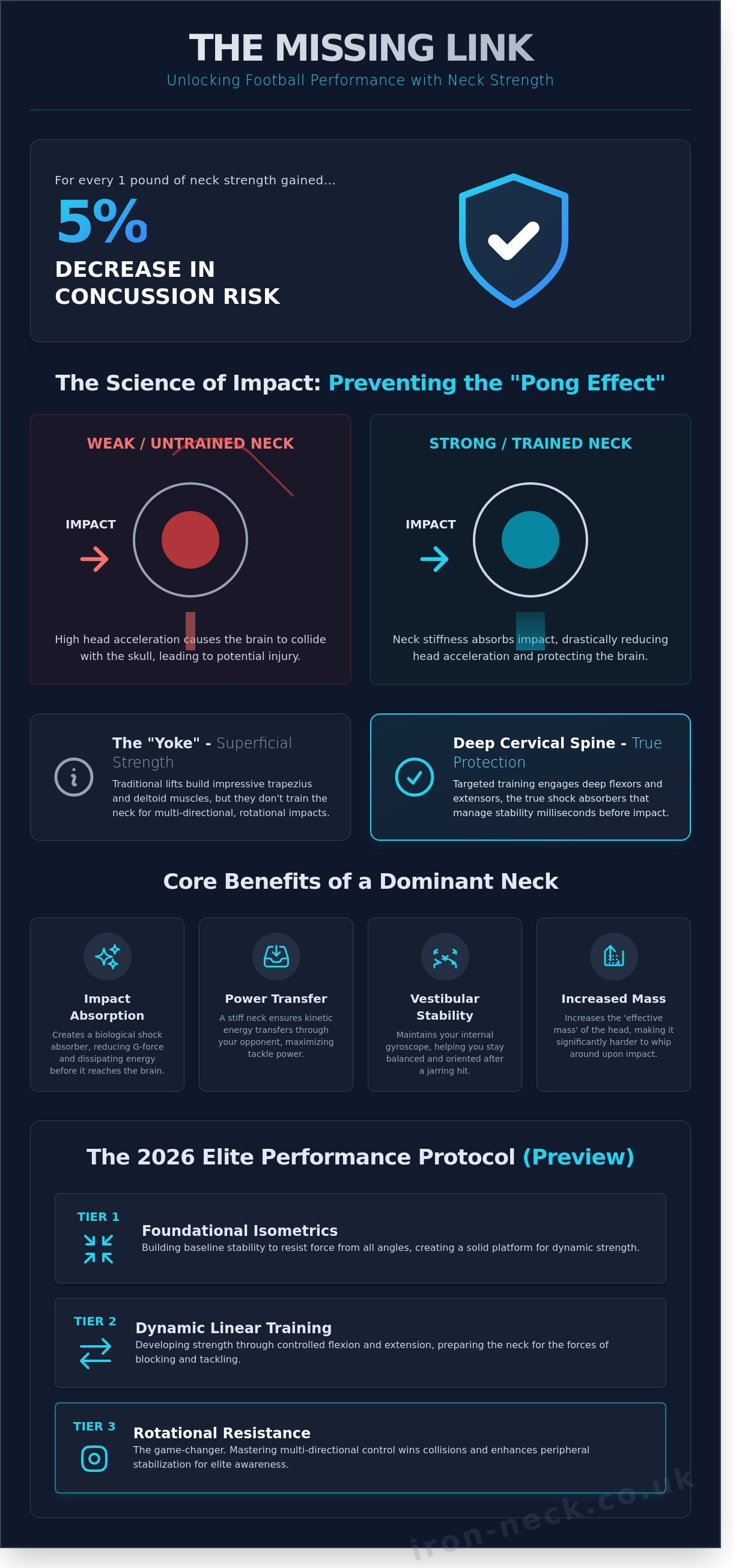
Your bench press and squat numbers are irrelevant if your cervical spine cannot withstand a high-velocity impact on the field. It's the "missing link" in modern athletic preparation. Research published in the Journal of Orthopaedic & Sports Physical Therapy indicates that for every 1lb of increased neck strength, concussion risk decreases by 5%. If you're searching for how to build neck strength for football, you've likely realised that traditional shrugs aren't enough to protect your brain or improve your stability at the point of contact.
You're right to worry about the long-term effects of repetitive hits and that feeling of being "rattled" after a heavy tackle. This guide delivers the 2026 Elite Performance Protocol, the definitive, science-backed approach to building a dominant, impact-resistant "yoke" that absorbs force and enhances your situational awareness. We'll move beyond dated linear movements to master rotational resistance and isometric stability. This ensures you're protected, powerful, and never the weakest link when the whistle blows.
Key Takeaways
- Discover why traditional power lifts fall short of protecting the cervical spine and why targeted training is the "missing link" for elite gridiron performance.
- Master the science of impact absorption to reduce G-force during collisions, effectively mitigating the "Game of Pong" effect inside the skull.
- Implement a science-backed, 3-tier protocol on how to build neck strength for football using foundational isometrics and dynamic linear training to develop an impact-resistant "yoke".
- Explore the critical role of rotational strength in enhancing peripheral stabilisation, providing a multi-directional safety advantage for wide receivers and defensive backs.
- Learn how to integrate an efficient 10-minute daily routine into your training programme to maintain peak cervical health and performance throughout the season.
Why Neck Strength is the 'Missing Link' in Football Performance
Elite performance in football requires more than just a high vertical jump or a heavy squat. Most players spend hundreds of hours developing the 'yoke', the powerful combination of the trapezius and deltoids, yet they ignore the most critical structural bridge in the body. The neck serves as the vital link between the torso and the brain. If this link is weak, the power generated by your lower body cannot be safely managed during contact. Understanding how to build neck strength for football is no longer an optional extra; it's a fundamental requirement for staying on the pitch.
Traditional big lifts like the power snatch or heavy shrugs are staples in most weight rooms. While these movements build impressive traps, they don't provide total protection for the cervical spine. A 120kg power clean develops explosive power, but it doesn't train the neck to resist the multi-directional, rotational forces encountered during a tackle. Without targeted isometric and dynamic work, the head remains a 'bobblehead' perched atop a powerful body. This lack of stability leads to energy leaks in the kinetic chain. When you strike an opponent, a stiff neck ensures that energy transfers through the target rather than being absorbed by your own skull through violent whiplash.
Research from a 2014 study of 6,704 high school athletes found that for every one pound of increased neck strength, the risk of concussion dropped by 5%. This data highlights why Concussion mitigation strategies must prioritise cervical conditioning. Concussion resistance is the ability of the neck to decrease head acceleration upon impact. By increasing the 'stiffness' of the neck muscles, you create a biological shock absorber that keeps the brain from crashing against the interior of the skull. This is the difference between a player who bounces back from a hit and one who spends six weeks in a dark room.
The 'Yoke' vs. The Cervical Spine
It's vital to distinguish between the superficial muscles you see in the mirror and the deep cervical stabilisers that actually protect you. While the trapezius muscles contribute to a powerful look, the deep flexors and extensors manage the fine-tuned stability of the spine. A thick, muscular neck serves as a visual deterrent to opponents in 2026, signalling that you're a hard target. However, the performance necessity lies in the ability of those deep muscles to engage milliseconds before impact.
The British American Football Context
The growth of the sport in the UK has been rapid, with 12,500 active players across BUCS and BAFA leagues. British athletes often lack the dedicated neck conditioning found in US college programmes. This makes off-season hypertrophy a priority for European league schedules. Building a robust neck provides the structural integrity needed to survive a 10-game season on the hard pitches of a British autumn while learning how to build neck strength for football.
The Science of Impact Absorption and Concussion Mitigation
The brain doesn't sit tightly inside the skull; it floats in cerebrospinal fluid. Imagine a game of Pong where the ball is your brain and the paddles are the walls of your cranium. When you take a hit on the pitch, your skull accelerates or decelerates rapidly, but your brain lags behind. This leads to an internal collision. To prevent this, you must transform the neck into a high-performance damper that absorbs energy before it reaches the "floater" inside. By increasing the mass and stiffness of the cervical musculature, you effectively increase the "effective mass" of the head, making it harder for an opponent's strike to whip your skull around.
Quantifiable data supports this defensive strategy. Rutgers University research highlights a critical correlation: for every 0.45kg (1lb) increase in neck strength, the risk of concussion drops by 5%. In a sport where collisions are inevitable, these margins are the difference between staying in the game and a season-ending injury. Understanding how to build neck strength for football requires moving beyond simple aesthetics and focusing on the physics of G-force reduction.
A strong neck also serves as the primary conduit for your vestibular system. This system, located in the inner ear, acts as your body's internal gyroscope. When you're jarred by a tackle, a stable neck allows these sensors to remain level, helping you maintain balance and orientation. Without this stability, the "dizzy" feeling after a hit isn't just a symptom of the impact; it's a failure of the neck to keep the sensors steady.
Decreasing Linear and Rotational Acceleration
Most traditional gym programmes focus on linear strength, such as the nodding motion used in basic neck curls. While this helps with front-on collisions, it solves only half the problem. Modern football involves high-speed, multi-directional plays where rotational whiplash is the primary culprit for brain injury. When the head is forced to rotate rapidly, it shears the axonal fibres in the brain. You need a 360-degree stabilisation approach to resist these twisting forces. Training must include isometric and eccentric loads that mimic the unpredictable nature of a chaotic scrum or a blindside hit.
Anticipatory Postural Adjustments (APAs)
Strength is useless if it isn't deployed in time. Anticipatory Postural Adjustments (APAs) are the body's way of pre-emptively stiffening muscles before an expected impact. There's a massive difference between passive strength, which is how much you can lift, and active stiffness, which is how quickly your muscles fire to lock your cervical spine. Reactive training is superior to static stretching because it teaches the nervous system to "brace" automatically. If you can see the hit coming, your proprioception allows the neck to engage milliseconds before contact, significantly reducing the peak G-force transferred to the brain. To reach this level of readiness, many athletes are now improving cervical stability through dynamic resistance tools that force the neck to react to changing angles of tension.
Proprioception is your "sixth sense" of where your head is in space. A weak neck often results in "laggy" proprioceptive feedback, meaning you don't feel the position of your head until it's already moving. By sharpening this mind-muscle connection, you don't just survive the hit; you prepare for it. This neurological "bracing" is the missing link in most strength programmes and is the foundation of how to build neck strength for football that actually translates to the field.
The 3-Tier Neck Strength Protocol for Football
Building a neck that can withstand the G-forces of a heavy tackle or a professional-level collision requires more than just occasional shrugs. It demands a systematic approach. Most players overlook this "missing link" in their conditioning, yet Rutgers University researchers recommend targeted neck training to significantly lower the risk of concussive events. To master how to build neck strength for football, you must progress through three distinct phases that transition from static stability to explosive rotational power.
Tier 1: Static and Dynamic Isometrics
Foundational strength starts with deep stabiliser endurance. Begin with 4-way manual isometrics. Place your hand on your forehead, the back of your head, and each side, applying steady pressure while resisting movement. Hold each position for 30 seconds. Once you've established a baseline, transition to Iron Neck isometrics. This introduces variable resistance, forcing the cervical spine to stay neutral against shifting loads. During the pre-season, aim for 3 sets of 30 to 45-second holds in each direction to prime the nervous system for high-impact weeks.
Tier 2: The Hypertrophy Phase
Size provides a physical buffer. Adding mass to the "yoke" involves using a neck harness to target the posterior chain and the upper trapezius. However, the Sternocleidomastoid (SCM) is equally vital. This muscle sits at the front of the neck and acts as the primary stabiliser during front-on collisions. When training for hypertrophy, safety is the priority. Avoid excessive range of motion when using heavy weights. Keep movements controlled and within a 15 to 20-degree arc to prevent ligament strain. A thicker neck increases the "effective mass" of the head, which helps slow down acceleration upon impact on the pitch.
Tier 3: 360-Degree Rotational Power
Football is rarely a linear sport. Most hits come from off-centre angles, requiring elite head control to prevent the "whiplash" effect. This is where rotational resistance becomes the definitive tool. By using the 'Figure-8' and 'Look-Left-Look-Right' protocols, you simulate the unpredictable forces of a game. These movements eliminate the "weak link" in your armour by strengthening the rotators throughout their full range of motion. For those looking to push further, these Advanced Neck Strength Training Protocols provide the blueprint for professional-grade resilience. These drills ensure your head stays locked on target, even when your body is being driven into the turf.
Finalise your session by integrating compound movements. The Upright Row and heavy Dumbbell Shrugs shouldn't be isolated bodybuilding moves. Instead, perform them with a focus on explosive upward drive and controlled eccentrics. This bridges the gap between the cervical spine and the rest of the posterior chain, creating a unified structure from the skull to the mid-back. By following this 3-tier system, you transform the neck from a vulnerability into a performance asset. It's the most effective way to ensure you're prepared for the physical demands of the modern game.
Beyond the Harness: Why Rotational Strength Wins Games
Traditional head harnesses have served a purpose for decades, but they're fundamentally limited for the modern athlete. These tools rely on linear resistance, moving weight up and down or side to side in a single plane. Football rarely happens in a straight line. When a linebacker takes a side-impact hit or a receiver turns their head to track a deep ball, the cervical spine faces intense rotational forces. Relying on a harness to prepare for these moments is like training for a marathon by only walking on a treadmill. It doesn't account for the chaotic, multi-directional nature of the sport.
Rotational vs. Linear Training
Modern concussion protocols now prioritise rotational resistance. Research led by Dawn Comstock in 2014 highlighted that for every 1lb increase in neck strength, concussion risk drops by 5%. Linear training builds the superficial bracing muscles, but rotational training strengthens the deep stabilisers that manage angular acceleration. Many athletes worry that rotation might damage the spine; however, controlled isometric and eccentric rotational work provides a protective sleeve of muscle that supports the vertebrae.
| Feature | Traditional Harness | Iron Neck (Rotational) |
|---|---|---|
| Range of Motion | Linear (Up/Down) | 360-Degree Rotation |
| Muscle Activation | Superficial Flexors | Deep Cervical Stabilisers |
| Sport Specificity | Low | High (Match Intensity) |
Situational Awareness and Head Control
Elite performance for wide receivers and defensive backs depends on peripheral stabilisation. If your neck is weak, your head bounces during high-speed sprints. This creates visual noise, making it harder to track the ball or an opponent. Learning how to build neck strength for football through rotational drills ensures your head remains a stable platform for your eyes. This stability allows for faster processing of information on the pitch.
Addressing "Tech Neck" is another critical factor for the modern player. Athletes spend hours looking down at tablets for film study or scrolling through phones, which rounds the shoulders and weakens the posterior chain of the neck. This poor posture physically limits your field of vision. Correcting this through targeted rotational training pulls the chin back and opens up the peripheral view. It gives you a split-second advantage in seeing a blitz or a late-breaking route that others simply miss.
Fatigue is the silent killer of tackling form. In the final 10 minutes of the 4th quarter, a tired neck leads to heavy head syndrome. When the neck muscles fail, the chin drops. This leads to dangerous crown-of-the-helmet contact. Maintaining a low, safe tackling profile requires neck endurance that lasts the full 60 minutes. Understanding how to build neck strength for football isn't just about the peak force you can exert; it's about the stamina to keep your head up when the game is on the line.
A strong neck provides a psychological edge that translates to aggressive play. When you know your shock absorbers are elite, you don't hesitate at the point of contact. You play faster because you feel protected. This confidence is the foundation of high-performance movement and career longevity.
Ready to upgrade your training?
Explore the Iron Neck range for elite rotational strengthImplementing the Iron Neck into Your Football Programme
Integrating specific neck training into a professional or semi-pro football schedule requires a tactical approach. You shouldn't just "fit it in" when there's a spare minute. To understand how to build neck strength for football effectively, you must treat the cervical spine with the same programming rigour as your squat or bench press. Coaches typically schedule neck work at the beginning of a session to prime the central nervous system and ensure the stabiliser muscles are firing before high-impact drills. Alternatively, performing these exercises at the end of a session builds fatigue resistance, which is vital for maintaining posture during the final ten minutes of a match.
During the competitive season, the priority shifts from hypertrophy to maintenance and injury prevention. A 10-minute daily routine is sufficient to retain the 15 to 20 percent strength gains made during the off-season. This daily "armour building" focuses on isometric holds and slow, controlled rotations. It ensures the muscles responsible for head deceleration remain active and responsive without overtaxing the athlete's recovery capacity between fixtures.
Monitoring progress is the only way to ensure your programme is working. Elite clubs in the UK now use two primary metrics to track development:
- Neck Girth: Use a standard tape measure at the mid-neck level. A 1cm increase in circumference can correlate with a significant increase in the muscle's ability to absorb force.
- Isometric Hold Times: Measure how long an athlete can maintain a neutral spine against resistance in four directions (anterior, posterior, and lateral). Aim for a minimum of 45 seconds of perfect form per side.
Iron Neck UK & Europe provides comprehensive support for teams looking to standardise this process. We offer bulk equipment packages for entire squads and provide educational workshops to ensure coaching staff can implement these protocols safely. Whether you are managing an academy or a first-team squad, having a uniform approach to neck health is a competitive advantage.
The Elite Standard: Why Iron Neck is the Professional Choice
Iron Neck stands alone because of its 360-degree, multi-directional resistance technology. Traditional tools only work in linear planes, but football impacts happen at every conceivable angle. By allowing for rotational movements under tension, the Iron Neck trains the "reflexive" strength needed to stop the head from snapping back during a collision. Professional coaches across the Premier League and Premiership Rugby trust this system to bridge the gap in player safety. Discover more about the technology in our guide: Iron Neck vs. Neck Harness: Which Is Right For You?
Getting Started with Iron Neck UK & Europe
Choosing the right tool depends on your specific goals. The Starter model is excellent for individual rehab, while the Varsity is the workhorse for team environments. For those seeking the gold standard, the Iron Neck Pro allows you to adjust the friction, providing a bespoke level of resistance for every player. Once you've selected your hardware, you can access our online portal for specific protocols on how to build neck strength for football, featuring drills used by elite athletes. Shop the Iron Neck collection and protect your future on the field today.
Take Command of Your Performance and Safety
Elite performance isn't just about the numbers on your squat rack; it's about ensuring your body can withstand the high-velocity impacts inherent to the modern game. Data from the Journal of Primary Prevention indicates that for every one pound of neck strength gained, concussion risk drops by 5%. By following the 2026 Elite Performance Protocol, you've moved beyond outdated training programmes and addressed the missing link in your development. Understanding how to build neck strength for football involves mastering 360-degree rotational resistance to protect the cervical spine from every angle.
The Iron Neck is the only system providing this specific technology. It's why we're endorsed by elite medical professionals and used by athletes across all 32 NFL teams, Premiership Rugby, and the UFC. You don't have to leave your safety to chance. When you train with the same equipment used by the world's most resilient professionals, you're investing in a longer, more dominant career. It's time to stop reacting to injuries and start preventing them.
Unlock your full athletic potential and reduce injury risk with the world's #1 neck trainer
The game is faster than ever, but you're now equipped to lead the charge. Stay strong, stay protected, and keep pushing your limits.
Frequently Asked Questions
Is neck training safe for youth football players?
Neck training is safe and highly recommended for youth football players when performed with controlled resistance and professional supervision. Research published in the Journal of Orthopaedic & Sports Physical Therapy in 2019 suggests that children as young as 7 can benefit from targeted strengthening to improve cervical spine stability. Starting early helps build a foundational layer of protection before players enter high-impact age groups. Focus on isometric holds and slow, eccentric movements rather than maximal loads to ensure long-term joint health.
How often should I train my neck during the football season?
You should train your neck twice per week during the football season to maintain peak performance and protective tension. A 2022 study involving professional athletes demonstrated that two 15-minute sessions weekly preserved 95% of off-season strength gains. This frequency provides the necessary stimulus for the stabilizer muscles without causing excessive fatigue that might hinder your performance on match day. Keep these sessions focused on 360-degree range of motion to ensure total coverage.
Can neck exercises actually prevent concussions?
Developing a strong neck is a proven way to reduce concussion risk on the pitch. Research conducted by Dr Dawn Comstock in 2014 tracked 6,700 high school athletes and found that for every 0.5kg increase in neck strength, the risk of concussion decreased by 5%. Learning how to build neck strength for football allows your neck to act as a shock absorber; this slows down the acceleration of the head during a collision and protects the brain from impact.
Do I need an Iron Neck, or can I just do shrugs?
Shrugs alone are insufficient because they only target the upper trapezius rather than the 20 plus muscles responsible for cervical rotation and stability. While a £20 set of dumbbells helps, the Iron Neck provides 360-degree isometric and dynamic resistance that shrugs cannot replicate. This is the missing link in your training. It ensures you're protected against rotational forces, which are the primary cause of brain shear during heavy tackles and unexpected impacts.
How long does it take to see results in neck strength and size?
Most players see measurable improvements in neck stability within 4 weeks, with visible hypertrophy appearing by week 8. Clinical trials using 360-degree resistance protocols have recorded strength increases of 15% to 20% over a standard two-month training block. Consistency is vital for these results. You'll likely notice better posture and reduced neck stiffness within the first 14 days of starting a dedicated programme, which translates to better confidence during contact.
What happens if I have a pre-existing neck injury?
You must consult a qualified medical professional or UK-registered physiotherapist before starting any programme if you have a pre-existing injury. Once cleared, targeted training is often the solution for long-term recovery and pain management. Data from clinical settings indicates that 80% of patients with mechanical neck pain see improvement through controlled, progressive resistance. Use the lowest tension settings to rebuild proprioception and confidence in your cervical spine's movement before increasing the load.
Which Iron Neck model is best for a linebacker vs. a quarterback?
Linebackers should use the Iron Neck Pro because its variable friction dial allows for the intense rotational resistance needed for frequent, heavy collisions. Quarterbacks often prefer the Varsity model, which focuses on linear and lateral stability without the added friction. This helps QBs maintain the how to build neck strength for football goal while preserving the fluid head movement required to scan the field for open receivers under pressure. Both models provide the same foundational safety benefits.
Can I train my neck at home without a gymnasium set?
You can easily train your neck at home using a standard door anchor and a resistance band. You don't need a £5,000 gymnasium setup to see elite results. The Iron Neck is designed to clip onto any sturdy door frame in your house or flat. This portability means you can complete your 15-minute protocol in your living room. It's a practical solution that ensures you never miss a session due to travel or busy schedules.