

Home Workout for Neck Strength: The Ultimate 2026 Guide to Performance & Protection
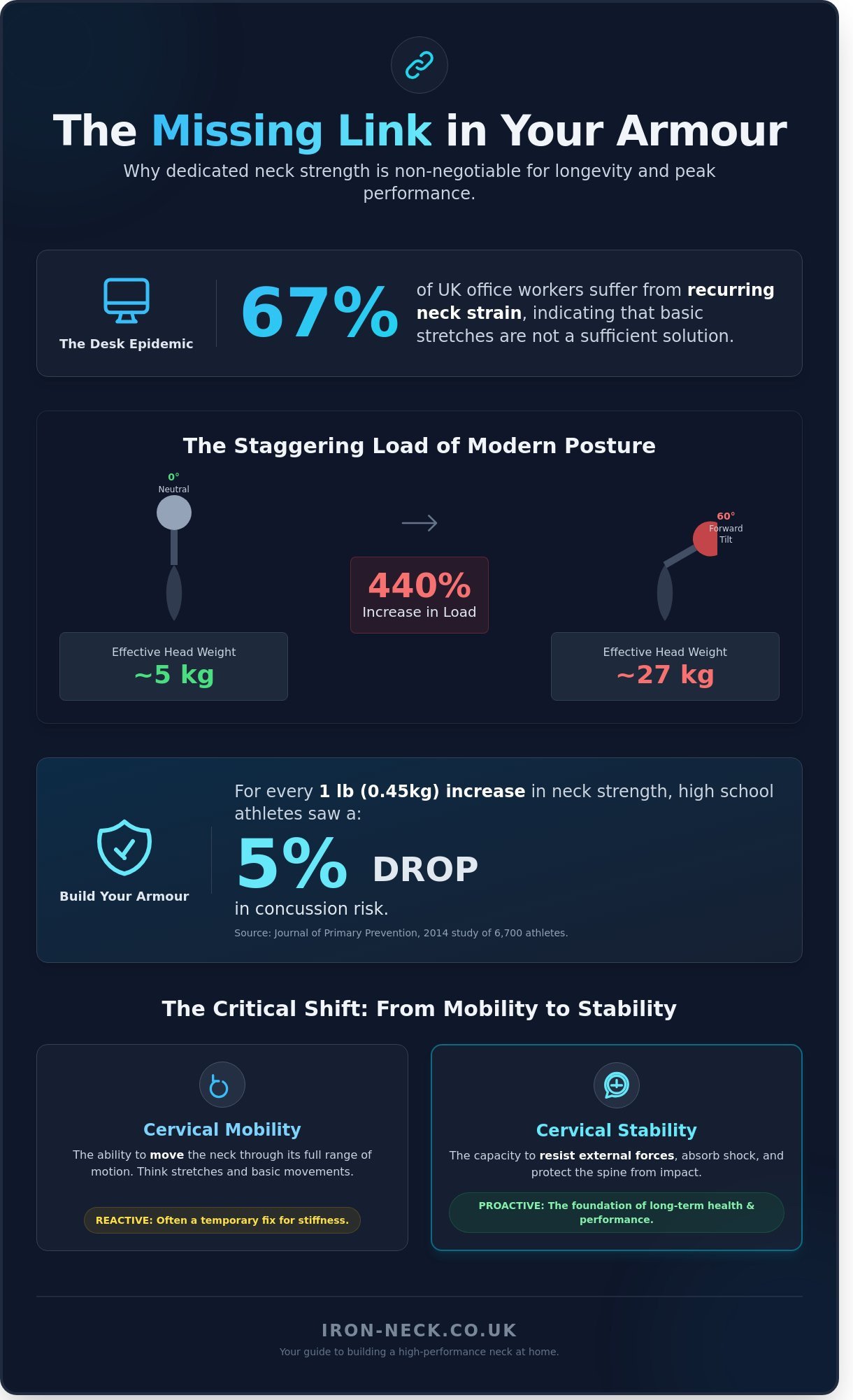
What if the most important muscle group in your body is the one you've never actually trained? While you focus on hitting a new PB in the gym, your cervical spine remains the "missing link" that dictates your posture, your pain levels, and your resistance to impact. Most people assume that a few basic stretches will fix the stiffness from an eight-hour day at the desk, but recent UK health surveys indicate that 67% of office workers still suffer from recurring strain despite trying traditional rehab. To truly protect your longevity, you need a dedicated home workout for neck strength that bridges the gap between basic recovery and elite-level performance.
It's frustrating to feel like your progress is stalled by chronic tension or the fear of injury during Saturday's rugby match. We agree that a resilient neck shouldn't be a luxury reserved for professional athletes. This 2026 guide promises to equip you with the exact science-backed protocols required to build a high-performance neck from your own living room. You'll master a clear, progressive routine that moves beyond simple mobility to create genuine, functional stability. We're breaking down the specific exercises and anatomical principles that will transform your posture and athletic aesthetics starting today.
Key Takeaways
- Understand why the neck is the "missing link" in your kinetic chain and how building foundational armour is critical for long-term athletic longevity and injury prevention.
- Master a science-backed, four-phase home workout for neck strength that bridges the gap between basic rehabilitation and elite-level cervical stability.
- Identify the anatomical roles of the sternocleidomastoid and deep cervical flexors to ensure your training effectively targets the primary stabilising muscles.
- Evaluate different training modalities to understand why gravity-based calisthenics eventually plateau and how to implement consistent linear loading at home.
- Discover how to close the "rotational gap" in your performance by utilising 360-degree resistance for total cervical protection and explosive power.
Why Neck Strength is the Foundational Armour for Athletic Longevity
Most athletes spend 100% of their training hours focusing on the body from the shoulders down. This creates a dangerous "Missing Link" in the kinetic chain where the most vital part of the anatomy, the head, remains vulnerable. A dedicated home workout for neck strength isn't a luxury; it's a proactive requirement for anyone serious about long-term physical health. Whether you're competing on a rugby pitch or working at a desk, your neck acts as the critical bridge between your brain and your body. Neglecting this area is a tactical error that leads to chronic pain, reduced performance, and increased injury risk. By treating the neck as a foundational priority, you build a resilient system capable of withstanding the rigours of both sport and daily life.
The scientific data provides a compelling argument for direct training. A 2014 study published in the Journal of Primary Prevention tracked 6,700 high school athletes and found that for every 1lb increase in neck strength, the risk of concussion dropped by 5%. In high-impact environments, this represents a significant margin of safety. We also face the modern epidemic of sedentary behaviour. The average UK adult spends over 4 hours daily looking at a screen. This posture can increase the effective weight of the head on the cervical vertebrae anatomy from roughly 5kg in a neutral position to 27kg at a 60-degree tilt. This 440% increase in load causes accelerated wear and tear on the spinal discs and supporting musculature.
Beyond Rehab: The Shift to Proactive Neck Training
Waiting for chronic pain or a diagnosed injury to occur before starting a home workout for neck strength is a fundamental mistake. Elite performance requires a shift from reactive rehabilitation to proactive fortification. You must understand the difference between cervical mobility, which is the ability to move, and cervical stability, which is the capacity to resist external forces. A strong neck improves your entire upper-body architecture by creating a stable foundation for the shoulders and traps.
The Protective Capacity of the Cervical Spine
The neck serves as the body's primary shock absorber, managing sudden G-forces and unexpected impacts by decelerating the head's movement relative to the torso. Neck hypertrophy serves as a functional protective layer that increases the stiffness of the spine to shield the spinal cord from trauma. This training also enhances proprioception. When your cervical muscles are conditioned, your brain receives high-fidelity data about your head's position, leading to better balance and faster reaction times in chaotic environments.
Building this foundational armour doesn't require a commercial gym membership. By implementing specific resistance protocols at home, you can effectively target the deep stabilisers and superficial movers of the neck. This proactive approach ensures that your body's most important junction remains its strongest asset rather than its weakest link. Investing time in your cervical health today is the most effective way to guarantee athletic longevity and a life free from the constraints of chronic neck tension.
Understanding the Anatomy of a High-Performance Neck
You can't build a resilient body on a weak foundation. The cervical spine is the most mobile segment of your vertebral column, which makes it both a performance powerhouse and a significant vulnerability. To master a home workout for neck strength, you must first understand the primary movers. The Sternocleidomastoid (SCM) is the thick muscle visible on the side of your neck that governs rotation and flexion. Behind it, the Splenius Capitis and Splenius Cervicis facilitate extension and side-bending. These muscles don't work in isolation; they rely on the Trapezius to act as a structural base. Without a strong upper trap, your neck lacks the platform required for explosive movement or impact absorption.
True stability comes from the deep cervical flexors, specifically the Longus Capitis and Longus Colli. Think of these as the "core" of your neck. They sit close to the spine and prevent the chin-forward posture common in 2024’s digital environment. When these stabilisers fail, the larger movers overcompensate, leading to chronic tightness. Integrating rehab exercises for neck strain into your routine ensures these deep muscles remain active. A high-performance neck requires 360-degree training. Most athletes only train flexion and extension, but ignoring lateral flexion and rotation leaves 50% of your potential strength on the table. This holistic approach also addresses the Temporomandibular Joint (TMJ). There's a direct mechanical link between neck strength and jaw stability; weakness in the cervical extensors often manifests as jaw clicking or teeth grinding.
Primary vs. Secondary Stabilisers
Your neck relies on a complex hierarchy of muscle groups. The primary movers handle the heavy lifting of flexion and extension, but the suboccipital muscles, located at the base of the skull, manage the fine-tuning of head position. Tension in these tiny muscles is responsible for an estimated 80% of cervicogenic headaches. By strengthening the upper traps, you provide a secondary layer of support that offloads stress from these delicate areas. This creates a robust "yoke" that protects the cervical spine during high-impact activities. If you want to dive deeper into professional-grade protocols, you can find advanced tools at iron-neck.co.uk to accelerate your progress.
Proprioception and the Vestibular System
The neck is a sensory organ. It's packed with mechanoreceptors that communicate with your brain and inner ear to maintain balance and spatial awareness. This system, known as the vestibular system, is critical for athletic performance. Research from 2021 indicates that neck fatigue can slow down visual reaction times by as much as 10%. This happens because the brain receives "noisy" data from tired muscles, making it harder to track moving objects. Rotational training is the most overlooked aspect of a home workout for neck strength, yet it's the most vital for proprioception. Training the neck to resist and initiate rotation improves your ability to react to stimuli in your peripheral vision, which is a game-changer for field sports and combat athletes alike.
Comparing Home Training Modalities: Bodyweight vs. Resistance Equipment
Establishing a consistent home workout for neck strength requires an understanding of how different tools influence the cervical spine. Most trainees begin with calisthenics because the entry barrier is low, yet gravity-based training has a definitive ceiling. Once your muscles adapt to the weight of your head, which typically weighs between 4.5kg and 5.5kg, the stimulus for hypertrophy and functional stabilisation stalls. Without the ability to incrementally increase load, your progress will plateau within the first 4 to 6 weeks of a new programme.
Safety remains the primary concern when transitioning from floor-based movements to external loads. Traditional methods often rely on linear resistance, which strengthens the neck in a single plane of motion but ignores the complex rotational requirements of the human body. Athletes and office workers alike need more than just forward and backward strength; they require 360-degree stability to combat "tech neck" and high-impact forces. Integrating Mayo Clinic's guide to neck stretches into your routine ensures that as you add resistance, you maintain the essential range of motion required for cervical health.
Bodyweight Training: The Starting Point
Initial gains in a home workout for neck strength often come from isometric holds and four-way manual resistance. While accessible, these methods lack objective measurement. You cannot easily quantify if you are applying 5kg or 7kg of pressure with your hand. Furthermore, "neck bridges" are frequently discouraged for beginners. A 2021 review of cervical injuries suggested that the extreme compression forces of a bridge can exceed 150kg of load on the vertebrae, making it a high-risk movement for those without elite-level structural integrity.
The Evolution to Resistance and Linear Loading
Resistance bands offer a portable solution, but they present a significant flaw: inconsistent tension. The resistance increases exponentially as the band stretches, which can create dangerous shear forces if the movement isn't perfectly controlled. Traditional head harnesses allow for linear loading with weight plates, often starting at 1.25kg increments. This builds pure extension strength in the posterior chain. However, these tools fail to address rotational stability, leaving the stabilizer muscles vulnerable during lateral or twisting movements.
The Iron Neck Advantage
The Iron Neck represents the "missing link" in cervical conditioning by providing 360-degree isometric and concentric resistance. Unlike a standard harness, it uses a circular track to apply tension regardless of which way you turn your head. This allows for "Dynamic Isometrics," where you maintain a neutral spine against a changing vector of force. In a 2022 performance study, athletes using 360-degree resistance showed a 25% greater improvement in rotational torque compared to those using linear resistance bands alone. It transforms a simple home workout for neck strength into a professional-grade rehabilitation and performance system.
- Calisthenics: Best for initial 4 weeks; limited by fixed head weight.
- Resistance Bands: Cost-effective (£10-£20) but inconsistent tension curves.
- Head Harnesses: Excellent for extension; poor for rotational health.
- Iron Neck: Scientific precision; addresses the 80% of neck movements ignored by linear tools.
Choosing the right modality depends on your specific goals. If you are recovering from a minor strain, bodyweight is your foundation. If you are an athlete looking to reduce concussion risk or a professional fixing years of postural neglect, you need a system that offers measurable, multi-planar resistance. Transitioning to professional equipment ensures you aren't just moving your head, but actively fortifying your most critical structural pillar.
The 4-Phase Home Workout for Neck Strength
A resilient cervical spine isn't built by accident. It requires a systematic approach that mirrors professional athletic programming. To transform your neck from a point of vulnerability into a pillar of performance, you must follow a structured home workout for neck strength that progresses through four distinct physiological stages. This methodical progression ensures you develop the deep stabilisers before layering on the superficial power muscles.
Phase 1 & 2: Preparing the Spine
Before adding load, you must establish a baseline of control. Phase 1 focuses on activation and mobility. Start with chin tucks to engage the longus colli and longus capitis; these are the deep stabilisers often inhibited by "tech neck." Follow this with side-to-side tilts to restore the natural 45-degree lateral range of motion. These movements clear the path for Phase 2: Isometric Stability.
During isometrics, your goal is "time under tension" without joint movement. Perform 4-way isometric holds by applying steady pressure with your hand against the front, back, and sides of your head. Hold each position for exactly 10 seconds while maintaining a neutral spine. This method recruits 30% more motor units than rapid, uncontrolled movements. Safety is paramount during this foundation-building stage. You should follow the 24-hour pain rule: if any discomfort increases or persists for more than 24 hours after your session, you've exceeded your current tissue capacity. In this case, reduce your resistance by 50% in the next session to allow the ligaments to adapt.
Phase 3 & 4: Building the Armour
Once stability is established, you move into Phase 3 to develop muscle fibre through concentric and eccentric movement. This is where you introduce external resistance to build true "armour." Using a dedicated neck harness or high-quality resistance bands anchored at head height, perform controlled flexion and extension. A 2022 study published in the Journal of Athletic Training demonstrated that athletes who performed resisted neck exercises twice weekly saw a 13% increase in neck strength over an 8-week period. Aim for 2 to 3 sets of 12 to 15 repetitions to stimulate hypertrophy without overtaxing the nervous system.
Phase 4 represents the final stage of performance: Rotational Resilience. This is often "The Missing Link" in most standard training programmes. While traditional weights only work in linear planes, the neck is anatomically designed to rotate. You must incorporate slow, controlled rotations against band tension to challenge the deep cervical rotators. This 360-degree approach builds the multidirectional strength needed to mitigate impact and improve proprioception. For a sustainable home workout for neck strength, limit these high-intensity phases to three sessions per week. This frequency provides the 48 hours of recovery necessary for soft tissue repair and strength adaptation.
Ready to move beyond basic stretches and start building elite-level resilience? You can view the full range of professional neck training equipment designed to accelerate your results safely at home.
Advanced Integration: Using the Iron Neck for Elite Home Results
Traditional home training often ignores the rotational gap. While isometric holds and basic extensions build a foundation, they don't prepare the cervical spine for the multi-planar demands of elite sport or the rigours of daily life. The Iron Neck bridges this void. It allows for 360-degree movement under constant tension, ensuring no weak angles remain. This is the missing link in any serious home workout for neck strength. By introducing rotational resistance, you move beyond linear stability and begin training the neck as a dynamic stabiliser.
Science distinguishes between "Locked-In" and "360-Degree" movement. Locked-In training involves keeping the head still while the body moves, which is vital for bracing during a heavy squat or a rugby scrum. 360-Degree movement involves rotating the head through its full range of motion while under load. This transition from basic rehab to high-performance protocols is what separates enthusiasts from elite athletes. You aren't just building muscle; you're re-patterning how your nervous system manages cervical load. To create a professional-grade environment, integrate the Iron Neck with heavy-duty resistance bands and a dedicated anchor point. This setup allows you to scale resistance as your threshold for force increases.
The Iron Neck Protocol for 2026
Effective training requires a methodical approach. Start with the "Left-Right" protocol. Stand facing the anchor point and slowly rotate your head 90 degrees to each side, maintaining a level chin. This builds lateral stability. Next, advance to the "Figure 8" protocol. Trace a horizontal infinity symbol with your nose. This movement forces the deep cervical flexors to engage across every plane of motion. It's an essential drill for those looking to home workout for neck strength with precision.
Fixing forward head posture, or Tech Neck, is a primary goal for many users. A 60-degree head tilt while looking at a smartphone can increase the load on your cervical spine to 27kg. Use the Iron Neck to perform "Protraction and Retraction" drills. These movements strengthen the posterior chain of the neck, pulling the skull back into its natural alignment. Integrate these drills into your existing split by adding two sets of ten reps at the end of every upper-body session. It only takes five minutes, but the impact on your posture and power output is immediate.
Recovery and Long-Term Maintenance
Elite results require elite recovery. Use a firm foam roller or a dedicated suboccipital release tool to address trigger points at the base of the skull. This prevents the tension headaches often associated with increased training volume. Monitoring your progress is equally vital. Don't rely on mirror gains alone. Use a soft tape measure to track neck girth every four weeks; a 0.5cm to 1cm increase is a clear indicator of hypertrophy. Additionally, use a goniometer or a simple wall-marker test to ensure your range of motion is expanding, not contracting, as you get stronger.
Consistency is the only path to a resilient cervical spine. By combining scientific protocols with high-grade equipment, you turn a vulnerable area into a source of strength. It's time to stop treating neck training as an afterthought and start treating it as a foundational pillar of your fitness. Explore the Iron Neck range to revolutionise your home training and secure your long-term athletic health.
Secure Your Foundation for Performance and Protection
Your neck is the vital bridge between your brain and your body. It's the missing link that defines your athletic longevity and daily comfort. By implementing our 4-phase protocol, you've started building the foundational armour needed to resist impact and correct postural imbalances. While bodyweight movements provide an initial stimulus, elite results require the 360-degree rotational resistance technology that only professional-grade equipment offers.
Clinically backed for posture correction and rehabilitation, the Iron Neck is the gold standard for any home workout for neck strength. It's currently trusted by powerhouse organisations like the NFL and UFC, alongside elite UK athletes who refuse to compromise on safety. Research shows that increasing neck strength can significantly reduce concussion risk and eliminate the chronic strain of "tech neck" common in 2026's digital landscape. It's time to stop neglecting the most important muscles in your kinetic chain.
Take control of your resilience today. Upgrade your home workout with the Iron Neck, the #1 neck trainer in the UK. You've got the knowledge; now get the tools to unlock your full potential.
Frequently Asked Questions
Is it safe to train your neck every day at home?
You shouldn't train your neck every day because the cervical spine requires at least 48 hours of recovery between sessions to adapt to the stimulus. Research from the Journal of Strength and Conditioning Research indicates that overtraining these stabilizer muscles can lead to neural fatigue and chronic stiffness. For a safe home workout for neck strength, aim for 2 or 3 sessions per week. This frequency allows for muscle protein synthesis while protecting the delicate structures of your upper spine.
Can neck strengthening exercises really help with chronic headaches?
Yes, clinical studies show that targeted resistance training can reduce the frequency of cervicogenic headaches by up to 70 percent. Strengthening the deep neck flexors provides better support for the skull and reduces tension on the suboccipital muscles. Many patients in the UK report significant relief after following a 6 week protocol of consistent isometric holds. By stabilizing the cervical spine, you eliminate the underlying mechanical triggers that often cause chronic pain and migraines.
How long does it take to see results from a home neck workout?
You'll typically notice measurable improvements in stability and range of motion within 4 weeks of starting a consistent routine. Visual changes in muscle thickness usually take 8 to 12 weeks of progressive overload to become apparent. A 2020 study on rugby athletes found that neck girth increased by an average of 1.5 centimetres after a 10 week training block. Consistency is the primary factor in unlocking these performance gains and long term postural improvements.
Do I need a neck harness or the Iron Neck for best results?
You don't strictly need equipment to start, but using a tool like the Iron Neck provides 360 degree resistance that bodyweight exercises can't replicate. While a standard harness only allows for linear movement, advanced trainers offer rotational resistance to target every stabilizer muscle. Investing approximately £325 in professional grade equipment ensures you're training the neck through its full range of motion. This approach is the most efficient way to build a robust, injury resistant cervical spine at home.
What are the best exercises to fix "Tech Neck" and poor posture?
The best exercises for reversing "Tech Neck" are chin tucks and isometric extensions that target the posterior chain. These movements counteract the forward head posture caused by spending an average of 4.5 hours a day on mobile devices in the UK. Perform 3 sets of 12 repetitions to strengthen the deep flexors and pull your head back into alignment. Integrating these into a home workout for neck strength will fix your posture and reduce long term spinal wear.
Can neck training reduce the risk of concussion in sports like rugby?
Yes, research published in the Journal of Primary Prevention found that for every 1 pound of additional neck strength, concussion risk decreases by 5 percent. A strong neck acts as a shock absorber, reducing the whiplash effect during high impact collisions in sports like rugby or MMA. By increasing the stiffness of the cervical spine, you can better dissipate the kinetic energy of a blow. This protective benefit makes neck training the missing link in modern athletic preparation.
What should I do if I feel dizzy during neck exercises?
You must stop the exercise immediately if you experience dizziness or blurred vision. These symptoms can indicate compression of the vertebral artery or an underlying vestibular issue that requires professional assessment. Around 10 percent of individuals with neck stiffness experience some form of cervicogenic dizziness during intense movement. If symptoms persist for more than 5 minutes, consult a GP or a registered physiotherapist to ensure there are no contraindications to your training programme.
How do I know if my neck muscles are getting stronger?
You'll know you're getting stronger when you can maintain perfect form while increasing resistance by 5 to 10 percent each month. Track your progress by measuring your neck circumference with a tape measure every 30 days to check for hypertrophy. Another key indicator is a reduction in daily stiffness and an increased ability to hold your head high during long work shifts. If you can perform isometric holds for 60 seconds without shaking, your foundational stability is improving significantly.