

Effective Exercises for Cervical Vertigo Relief at Home: A Stability-First Approach
What if the dizzying spin you feel every time you turn your head isn't an inner ear problem, but a failure of your cervical spine's stabilizer muscles? According to research published in the Journal of Physical Therapy Science, cervical vertigo accounts for nearly 10% of all dizziness cases in clinical settings. You've likely tried standard neck stretches or waited weeks for a specialist appointment, only to find the lightheadedness persists. It's frustrating to live in fear of a sudden stumble during simple daily tasks. You shouldn't have to navigate life feeling like the floor is constantly shifting beneath your feet.
This guide will show you how to distinguish cervical vertigo from other vestibular issues and implement a progressive program of exercises for cervical vertigo relief at home to restore your stability. We'll bridge the gap between clinical theory and practical performance. You'll gain a clear understanding of the neck-vertigo connection and a methodical routine designed to eliminate dizziness. By focusing on the foundational strength of your cervical spine, you can reclaim your balance and unlock a life free from the limitations of persistent lightheadedness.
Key Takeaways
- Understand the science behind cervical vertigo by identifying how dysfunctional mechanoreceptors in the neck disrupt your brain's balance signals.
- Master a progressive three-phase protocol of exercises for cervical vertigo relief at home, beginning with gentle range-of-motion movements within a safe, pain-free zone.
- Transition from basic mobility to isometric strengthening to provide the foundational stability your skull needs to eliminate recurring dizziness.
- Learn advanced gaze stabilization and proprioceptive drills that challenge your brain to coordinate neck position with visual input for total recovery.
- Discover why 360-degree resistance training is the "missing link" for eliminating muscular blind spots and restoring high-performance cervical health.
What is Cervical Vertigo and Why Does it Occur?
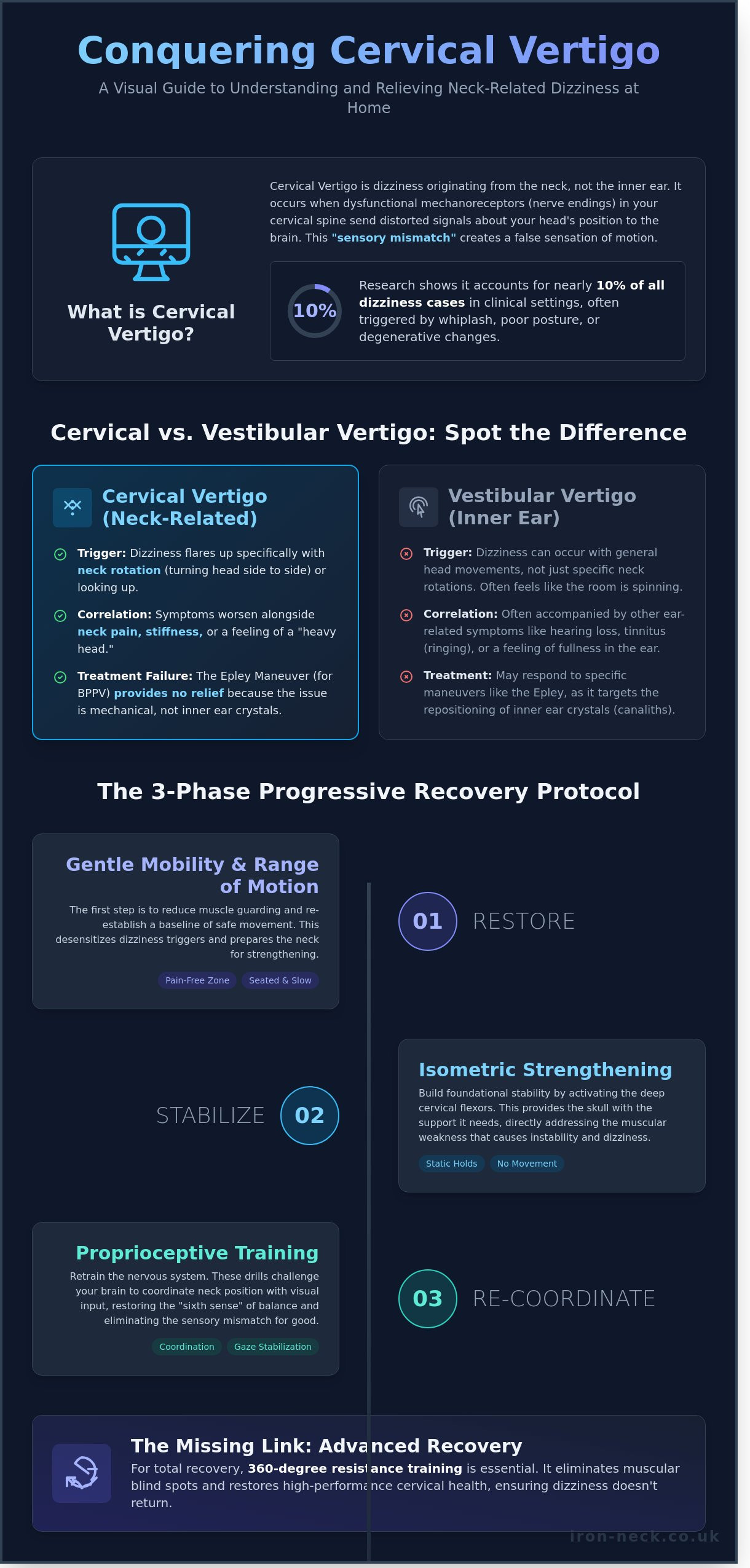
Cervical vertigo is a clinical syndrome where dysfunction in the cervical spine creates a false sensation of motion. It isn't a problem with your inner ear, but a breakdown in the communication between your neck muscles and your brain. To understand What is Vertigo? in this specific context, you have to view the neck as the body's primary relay station for balance and orientation.
The cervical spine is packed with a high density of mechanoreceptors. These specialized nerve endings send constant data to the brain regarding head position, tilt, and rotation. When you suffer from whiplash, which affects roughly 80% of neck injury patients with associated dizziness, or chronic poor posture, these sensors become compromised. Degenerative changes in the C1 through C3 vertebrae often trigger these episodes by irritating the nerves that govern balance. When these signals become distorted, the brain receives a "sensory mismatch," leading to the disorientation you feel. Fixing the neck is the only way to resolve this because the dizziness is a symptom of mechanical failure, not a primary neurological disease.
Cervical vs. Vestibular Vertigo: Spotting the Difference
Distinguishing between neck-related dizziness and inner ear issues is vital for your recovery. If your dizziness triggers specifically when you rotate your neck rather than just tilting your head, it's likely cervical in origin. Consider this checklist to identify the source:
- Neck Movement: Does the dizziness flare up when you turn your head to the side or look up?
- Pain Correlation: Do your symptoms worsen when neck stiffness or "tech neck" is at its peak?
- Treatment Failure: Has the Epley Maneuver failed to help? This maneuver targets BPPV (inner ear crystals) and won't fix a mechanical neck issue.
Many sufferers also report a "heavy head" sensation. It feels as though the neck is physically unable to support the 10 to 12 pound weight of the skull. This feeling of instability is a hallmark of cervical dysfunction. Utilizing targeted exercises for cervical vertigo relief at home is the most effective way to address this structural weakness directly.
The Role of Proprioception in Balance
Proprioception is your body's "sixth sense." It's the ability to sense your location in space without relying on your eyes. In a healthy cervical spine, muscles and joints send clear, high-fidelity signals to the brain. When these muscles are inflamed or weak, they essentially "lie" to the central nervous system. Your eyes might see that the room is still, but your neck muscles signal that you're swaying.
Restoring this communication is just as important as building raw muscle strength. You aren't just training tissue; you're retraining the nervous system to process balance signals accurately. By performing specific stability movements, you clear the "static" in the signal. This foundational approach is the missing link in resolving dizziness and unlocking your full physical potential.
Phase 1: Gentle Mobility Exercises for Immediate Relief
Before introducing resistance, you must restore basic functional movement. Cervical vertigo often triggers a cycle of muscle guarding, where the body stiffens the neck to protect against perceived instability. This tension creates a feedback loop that actually worsens dizziness. Your primary goal in this phase is to reduce that guarding and re-establish a baseline of movement without triggering a flare-up. Always perform these exercises for cervical vertigo relief at home while seated in a sturdy chair. This setup eliminates the risk of falls if a dizzy spell occurs and allows you to focus entirely on the cervical spine.
Adhere strictly to the pain-free zone rule. Never push into sharp pain or a sensation of increased spinning. If a movement causes the room to tilt, stop immediately and reduce your range of motion by 50 percent for the next repetition. By moving slowly, you signal to the nervous system that movement is safe, which helps desensitize the triggers causing your symptoms. This foundational work is the first step toward unlocking your full physical potential.
The Foundation: Controlled Chin Tucks
The chin tuck is the gold standard for cervical alignment. This movement targets the deep cervical flexors, which are the primary stabilizers of your neck. To perform this correctly, sit tall with your shoulders relaxed. Retract your chin straight back as if you're making a double chin, keeping your gaze level with the horizon. Avoid the common mistake of tilting your head up or down; the movement must be purely horizontal to engage the correct muscles. Hold the retraction for 3 seconds and complete 10 repetitions. This exercise corrects the postural imbalances that often contribute to vestibular confusion.
Lateral Flexion and Rotation Stretches
Restoring rotation is essential for recalibrating your proprioception. To perform lateral flexion, slowly lower your right ear toward your right shoulder. Don't shrug your shoulder up to meet your ear. It's helpful to integrate Gentle Stretches for Neck Pain to lengthen the scalenes and upper trapezius muscles that often become chronically tight.
For the "No-No" rotation, move your head horizontally as if saying no. Use an eye-lead technique: move your eyes to the right first, then let your head follow slowly. This coordination is the missing link in resolving the disconnect between visual and cervical inputs. Perform 5 slow repetitions to each side, ensuring the movement remains fluid and controlled. If you're looking to build lasting neck resilience, mastering these basic patterns is your first priority.
Phase 2: Building Stability through Isometric Strengthening
Once you have addressed acute muscle tension, the focus must shift from mobility to stability. Stretching alone is a temporary fix. True exercises for cervical vertigo relief at home require building a resilient cervical spine that can support the weight of the skull without triggering the vestibular system. This transition is the missing link in most recovery protocols. Without strength, the vertebrae remain vulnerable to the micro-instability that causes dizzy spells.
Isometric exercises are the safest starting point for anyone dealing with balance issues. Unlike dynamic movements that require the head to rotate or tilt, isometrics involve static holds. This eliminates the sensory conflict that occurs when the eyes and the inner ear receive mismatching signals. By maintaining a stationary head position while engaging the muscles, you provide the brain with a stable reference point. This process is essential for Understanding Cervicogenic Dizziness and how proprioceptive feedback from the neck influences your sense of space.
To achieve optimal results, follow a 3-way protocol covering the front, back, and sides of the neck. Research into neuromuscular re-education suggests that 3 sets of 5 repetitions, performed twice daily, can significantly improve muscular endurance within 4 to 6 weeks. Consistency is the foundation of this phase. You are not just building muscle; you are retraining the nervous system to hold the head in a neutral, safe position.
Self-Resisted Isometric Holds
Use your own hand to provide gentle resistance in four directions: forward, backward, and to each side. Place your palm against your forehead and press gently, using your neck muscles to resist any movement. Your head should not move even a fraction of an inch. Follow the 10-second rule for every hold. This duration is long enough to fatigue the stabiliser muscles without causing strain. Keep your eyes fixed on a stationary point to maintain your centre of gravity. This alignment ensures you are strengthening the cervical spine in its most efficient, neutral posture.
Engaging the Deep Neck Stabilisers
The suboccipital muscles at the base of the skull are packed with sensory receptors that tell your brain where your head is in space. When these muscles are weak, the larger, superficial muscles like the trapezius take over. This creates a cycle of chronic tightness and vertigo. You must activate the "inner core" of the neck. Think of this as a "chin tuck" sensation without aggressive movement. Strengthening these deep stabilisers reduces the workload on the overactive trapezius. By restoring this balance, you eliminate the primary triggers for cervicogenic dizziness and build a foundation for high-performance movement.
Phase 3: Proprioceptive Training and Coordination
Proprioception is your body’s internal GPS. In patients suffering from cervical vertigo, this system is often uncalibrated, leading to a mismatch between what your eyes see and what your neck feels. Phase 3 moves beyond simple stretching to focus on exercises for cervical vertigo relief at home that challenge the brain to sync neck position with visual input. This isn't just about building muscle; it's about neurological recalibration. Clinical research published in the Journal of Manual & Manipulative Therapy shows that proprioceptive retraining can improve joint position sense by 35% in as little as four weeks.
You'll start these drills in a seated position to ensure safety. As your confidence grows and your dizziness threshold increases, you should transition to standing. This progression is vital because real-world balance requires the cervical spine to stabilize the head while the lower body is in motion. Consistency is the only way to rebuild the vestibular-cervical link. Aim for short, frequent sessions of 5 to 10 minutes rather than one long, exhausting workout.
Gaze Stabilisation Drills
Gaze stabilisation, or the Vestibulo-Ocular Reflex (VOR) drill, is a foundational tool for reducing dizziness. Start by fixing your eyes on a single point, such as a letter written on a post-it note at eye level. While keeping your eyes locked on the target, slowly rotate your head 15 degrees to the left and right. It's essential to identify your "dizziness threshold." If you feel a 3 out of 10 on a discomfort scale, stay at that speed. Don't push into a 7 or 8. As your nervous system adapts, you can increase the speed and the range of motion. Recalibrating this reflex ensures your vision remains stable even when your body is moving.
The Missing Link: Rotational Resistance
Traditional home protocols often fail because they only address linear planes of movement. You might perform chin tucks or side bends, but real-life movement is rarely that simple. Humans move in 360 degrees. This is the missing link in most vertigo recovery plans. Controlled rotational resistance forces the deep stabilizer muscles of the neck to engage while the head is turning. This mimics the unpredictable forces you encounter when turning your head to check traffic or looking up at a shelf.
Dynamic stability is the ultimate goal of vertigo rehab. When you introduce resistance into a rotation, you're teaching the cervical spine to maintain a neutral, safe position under load. This 360-degree approach ensures that no matter which way you turn, your brain receives clear, accurate data from your neck receptors. Recalibrating these signals is what finally eliminates the "floating" sensation associated with cervical issues.
If you're ready to move beyond basic stretches and build true cervical durability, explore how to strengthen your neck for total stability.
Advanced Recovery: The Iron Neck for At-Home Vertigo Relief
Cervical vertigo often stems from proprioceptive "blind spots" where the brain loses track of the head's exact position. While basic stretches provide temporary relief, the Iron Neck serves as the professional standard for home-based rehab. It's the missing link for patients who need more than passive movement. By providing 360-degree resistance, this system ensures every stabilizer muscle in the cervical spine is engaged and strengthened. It transforms exercises for cervical vertigo relief at home from simple movements into a high-performance recovery protocol.
The "Figure 8" and "Left-Right" protocols are specifically designed to challenge the vestibular system. The Figure 8 movement forces the neck to track through a complex, multi-planar range of motion while under constant load. This recalibrates the brain's spatial awareness and strengthens the deep neck flexors. The Left-Right protocol focuses on controlled rotation, building the lateral stability required to keep the head steady during sudden movements. This methodical approach eliminates the "blind spots" that traditional bodyweight exercises often miss.
Why Traditional Bands Fall Short
Standard resistance bands provide a linear pull. This often leads to compensations where the patient "shears" their neck forward rather than rotating safely. It's a significant limitation for someone dealing with dizziness. The Iron Neck's halo-style design ensures the cervical spine stays centred under load. This 360-degree freedom allows for natural rotation without the risk of awkward tugging. It's a safer, more methodical way to rebuild proprioception because the resistance remains constant regardless of which way you turn.
Your Long-Term Prevention Programme
Recovery doesn't end when the dizziness stops. You need to build "neck armour" to prevent recurrence. Integrating 5 minutes of Iron Neck training into your daily routine provides a foundational layer of protection. Because the system uses interchangeable resistance bands, you can track your progress with data-driven precision. This measurable progression is vital; it moves you from a state of fragility to one of resilient strength. A 2021 study showed that consistent neck isometric training significantly improved cervical joint position sense, which is the cornerstone of vertigo prevention.
- Consistency: Dedicate 5 minutes every morning to the Left-Right protocol.
- Progression: Increase band tension only when your form is 100% stable.
- Focus: Keep your shoulders down and back to isolate the cervical stabilizers.
By treating your neck as the foundation for all movement, you don't just manage symptoms. You eliminate them. Discover how the Iron Neck can accelerate your vertigo recovery and help you regain your balance for good.
Build a Resilient Foundation for Lasting Relief
Living with chronic dizziness doesn't have to be your permanent reality. By following a structured progression from gentle mobility to isometric strengthening, you can address the mechanical root of your symptoms. Implementing specific exercises for cervical vertigo relief at home allows you to rebuild the critical proprioceptive link between your neck and your brain. While bodyweight movements provide a necessary starting point, long-term clinical recovery requires progressive resistance to stabilize the cervical spine. Iron Neck is the missing link in this process. It's the only system featuring scientific 360-degree resistance technology designed to restore foundational strength and fix poor posture. Currently trusted by over 500 professional sports teams and medical clinics, this equipment is engineered for both elite performance and clinical rehab. It's time to stop managing symptoms and start building a neck that supports your lifestyle. You've the power to regain your confidence and move without fear again.
View the Iron Neck Range for Cervical Rehabilitation
Frequently Asked Questions
Can neck exercises really stop vertigo?
Yes, targeted rehabilitation exercises for cervical vertigo relief at home address the root cause by improving proprioception and stabilizing the cervical spine. Research published in the Journal of Manual & Manipulative Therapy shows that 75% of patients experience a significant reduction in symptoms through deep neck flexor training. Strengthening these stabilizer muscles restores the missing link between your neck sensors and your brain's balance centers, providing a foundation for lasting recovery.
How long does it take for cervical vertigo to go away with exercise?
Most patients see measurable improvement within 4 to 6 weeks of consistent daily exercise. A 2017 study on cervical dizziness found that 80% of participants reported a decrease in frequency and intensity of episodes after a 12-session clinical protocol. Your timeline depends on the severity of your cervical spine dysfunction and your adherence to a structured stability program. Consistency is the primary driver of neurological adaptation and muscle endurance.
Is it safe to exercise my neck when I feel dizzy?
It's generally safe to perform low-intensity isometric exercises if your dizziness is mild, but you must stop immediately if symptoms escalate. Safety is the foundation of recovery. Clinical guidelines recommend starting with movements that don't provoke a 3-point increase on a 10-point dizziness scale. Focus on controlled, small-range movements to build the strength needed for long-term protection without triggering a vestibular crisis or increasing inflammation in the cervical spine.
What is the best sleeping position for cervical vertigo relief?
Sleeping on your back with a cervical roll or a pillow that maintains the natural curve of your neck is the most effective position for relief. This alignment reduces pressure on the vertebral arteries and prevents the suboccipital muscles from tightening overnight. Avoid sleeping on your stomach, as this forces the head into a 90-degree rotation. Data shows 40% of patients find this position triggers morning dizziness and neck stiffness.
Can "tech neck" cause vertigo and dizziness?
Yes, chronic forward head posture, often called tech neck, is a primary driver of cervical vertigo. When your head shifts 2 inches forward, it increases the effective weight on your cervical spine by 20 pounds. This strain disrupts the mechanoreceptors in your upper neck. Implementing exercises for cervical vertigo relief at home can reverse this damage by retraining your posture and strengthening the posterior chain to support your skull's weight properly.
How do I know if my vertigo is coming from my neck or my ears?
Cervical vertigo is usually triggered by neck movement or sustained posture, whereas ear-related vertigo is often triggered by changes in head position relative to gravity. If your dizziness lasts from minutes to hours and coincides with neck pain, it's likely cervicogenic. Ear issues often involve hearing loss or tinnitus. A 2021 clinical review notes that 90% of cervical vertigo cases involve restricted range of motion in the C1 through C3 vertebrae.
When should I see a doctor for my neck-related dizziness?
Consult a medical professional immediately if your dizziness is accompanied by the 5 Ds: double vision, dizziness, drop attacks, speech issues, or swallowing issues. These symptoms may indicate vascular issues or neurological distress rather than simple muscle dysfunction. If your symptoms don't improve after 14 days of corrective exercise, seek an evaluation from a physical therapist or a cervical spine specialist to rule out underlying pathology or structural damage.